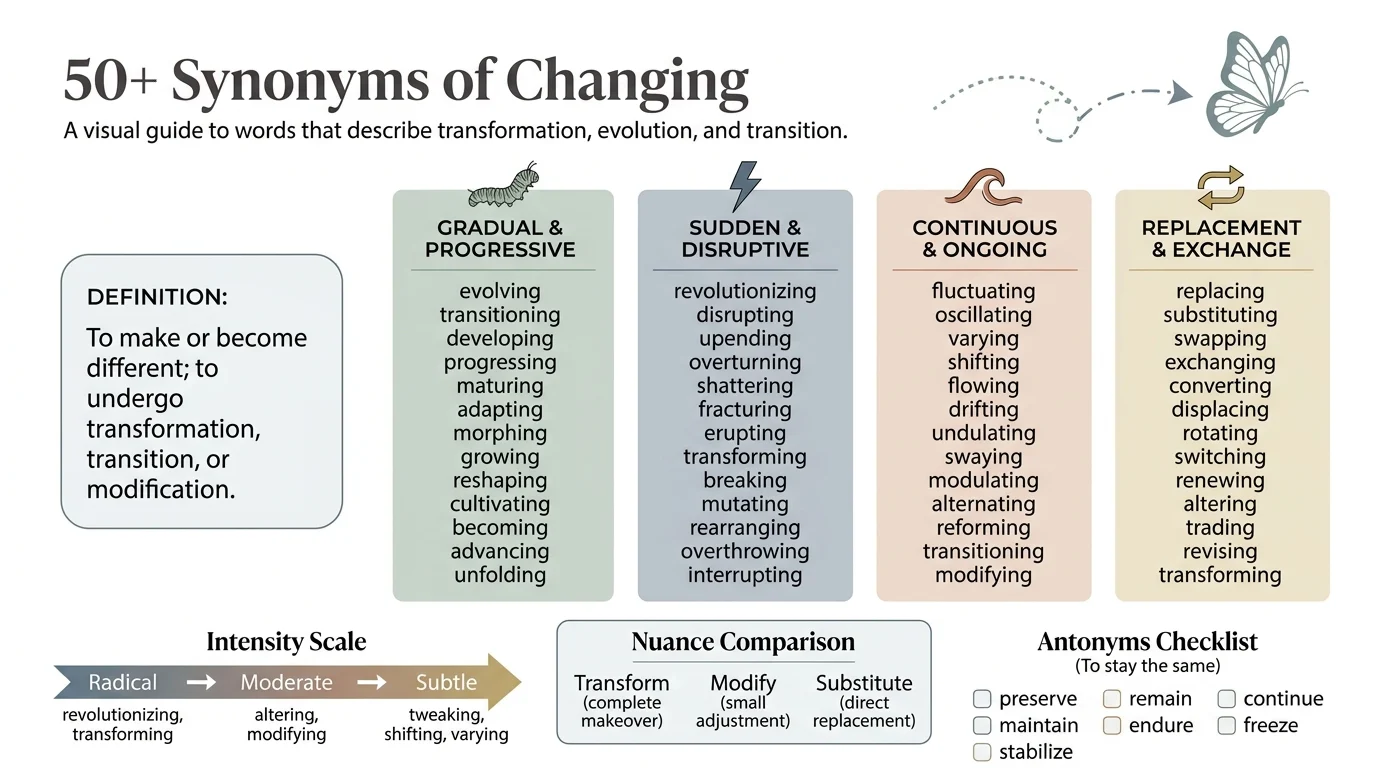
Have you ever needed to describe something that is becoming different, evolving, or shifting but felt that “changing” was too simple or repetitive? You want to capture the specific nature of transformation, whether it is gradual, sudden, or ongoing, and the word “changing” comes to mind. Choosing the right synonym for “changing” can transform a basic observation into a precise expression of transformation, evolution, or fluctuation. This guide explores the best synonyms of changing, explaining exactly which word to use and when.
Quick Ans: “Changing” means becoming different, being transformed, or varying over time. For gradual change, choose evolving or developing. For sudden change, use shifting or transforming. For ongoing change, use fluctuating or varying. For replacement, use switching or altering. For improvement, use improving or progressing.
Meaning, Tone, and Context
Understanding the core meaning of “changing” is the first step to using it effectively.
Simple Definition: Becoming different; being transformed or altered; varying over time.
Part of Speech: Adjective (present participle of “change”) and verb.
Overall Tone: Neutral. It can indicate improvement, decline, or simple difference.
Formality Level: Neutral. The word works in most contexts.
Common Uses: Native English speakers use it in business (“changing market”), science (“changing climate”), personal life (“changing priorities”), and general contexts (“changing times”).
Word Forms: Related words include the verb change, the noun change, the adjective changeable, and the adjective changed.
When and How to Use “Changing”
“Changing” is the perfect choice when you want to describe transformation, evolution, or variation. Here are seven realistic examples.
Business: “The changing market demands new strategies.”
Science: “The changing climate affects ecosystems worldwide.”
Personal: “Her changing priorities led her to switch careers.”
Professional: “We need to adapt to the changing needs of our customers.”
Academic: “The study examines the changing patterns of migration.”
Technology: “Rapidly changing technology requires continuous learning.”
Social Media: “Changing habits are reshaping how we consume media.”
Best Synonyms of “Changing”
No synonym is identical in every situation. Here is your guide to the best replacement for “changing” based on your writing context.
For Gradual and Developmental Change
Most Direct: Evolving means developing gradually. “The evolving situation required flexibility.”
Developing: Developing means growing or advancing. “The developing technology is exciting.”
Progressing: Progressing means moving forward. “The progressing project is on schedule.”
Growing: Growing means increasing. “The growing demand for electric cars.”
For Sudden and Dramatic Change
Shifting: Shifting means changing position or direction. “The shifting winds signaled a storm.”
Transforming: Transforming means changing completely. “The transforming power of education.”
Revolutionizing: Revolutionizing means changing radically. “The revolutionizing effect of the internet.”
Overturning: Overturning means reversing. “The overturning of the verdict shocked many.”
For Ongoing and Fluctuating Change
Fluctuating: Fluctuating means rising and falling. “The fluctuating prices concerned investors.”
Varying: Varying means changing between different states. “The varying weather made planning difficult.”
Unstable: Unstable means likely to change. “The unstable situation required caution.”
Dynamic: Dynamic means constantly changing. “The dynamic market rewards agility.”
For Replacement and Alteration
Switching: Switching means changing from one to another. “The switching of roles was seamless.”
Altering: Altering means changing in character. “The altering of the policy caused controversy.”
Modifying: Modifying means making partial changes. “The modifying of the design improved safety.”
Adjusting: Adjusting means making small changes. “The adjusting of the schedule was necessary.”
When Not to Use “Changing”
Using “changing” can sound wrong or awkward in certain situations.
When You Mean “Different”: “Changing” is a process. “Different” is a state.
Better Choice: Different or varied. “The options are different.”
When You Mean “New”: “Changing” is about process. “New” is about age.
Better Choice: New or recent. “The new policy is effective.”
When It Sounds Too General: In casual conversation, “changing” can be vague.
Better Choice: Switching or adjusting. “I am switching jobs.”
Words Commonly Confused With “Changing”
| Word | Difference | When to Use | Example |
|---|---|---|---|
| Evolving | Gradual development | Science and business | “The evolving situation.” |
| Shifting | Changing position | Trends and directions | “The shifting wind.” |
| Transforming | Complete change | Dramatic contexts | “The transforming power.” |
| Fluctuating | Rising and falling | Prices and numbers | “Fluctuating prices.” |
| Switching | Changing from one to another | Choices and roles | “Switching jobs.” |
| Altering | Making changes | Plans and policies | “Altering the plan.” |
Best Synonyms of “Changing” by Context
| Context | Best Synonym | Why It Works | Example |
|---|---|---|---|
| Formal writing | Evolving | Formal and precise | “The evolving situation.” |
| Academic writing | Dynamic | Standard in research | “The dynamic nature of the market.” |
| Professional | Shifting | Professional and clear | “The shifting priorities.” |
| Business | Transforming | Business and strategic | “The transforming industry.” |
| Science | Fluctuating | Scientific and precise | “The fluctuating climate.” |
| Casual | Switching | Simple and natural | “Switching jobs.” |
| Emotional | Overturning | Dramatic and emotional | “The overturning of traditions.” |
How to Choose the Best Synonym of “Changing”
Choosing the right word is a simple decision. Answer these questions.
What type of change am I describing? For gradual, use evolving or developing. And For sudden, use shifting or transforming. For ongoing, use fluctuating or varying. For replacement, use switching or altering.
What is my audience? For a formal report, use evolving or dynamic. For a friend, use switching or adjusting.
What is my purpose? Are you describing trends, technology, or personal life? The correct synonym depends entirely on this.
What is the emotional strength? Revolutionizing and overturning are stronger. Adjusting is milder. Pick the one that matches your message.
Real Life Examples of “Changing”
School: Basic: “The changing schedule confused students.” Improved: “The shifting schedule confused students.”
College: Basic: “The study examines changing trends.” Improved: “The study examines evolving trends.”
Workplace: Basic: “The changing workload is challenging.” Improved: “The fluctuating workload is challenging.”
Business: Basic: “The changing market demands innovation.” Improved: “The transforming market demands innovation.”
Email: Basic: “The changing deadline is noted.” Improved: “The adjusted deadline is noted.”
Conversation: Basic: “I am changing jobs.” Improved: “I am switching jobs.”
Storytelling: Basic: “The changing seasons were beautiful.” Improved: “The ever-changing seasons were beautiful.”
Top 10 Synonyms of “Changing”
| Synonym | Simple Meaning | Best Used For | Example Sentence |
|---|---|---|---|
| Evolving | Developing gradually | Science and business | “The evolving situation required flexibility.” |
| Shifting | Changing position or direction | Trends and directions | “The shifting winds signaled a storm.” |
| Transforming | Changing completely | Dramatic contexts | “The transforming power of education.” |
| Fluctuating | Rising and falling | Prices and numbers | “The fluctuating prices concerned investors.” |
| Varying | Changing between states | General and academic | “The varying weather made planning difficult.” |
| Switching | Changing from one to another | Choices and roles | “The switching of roles was seamless.” |
| Altering | Making changes | Plans and policies | “The altering of the policy caused controversy.” |
| Modifying | Making partial changes | Design and plans | “The modifying of the design improved safety.” |
| Dynamic | Constantly changing | Business and science | “The dynamic market rewards agility.” |
| Progressive | Moving forward | Reform and development | “The progressive policy was welcomed.” |
Synonyms of “Changing” by Usage
Professional vs. Personal Synonyms
In the workplace, choose evolving, dynamic, or shifting. With friends, use switching, adjusting, or changing.
Formal vs. Conversational Synonyms
For formal writing, use evolving, dynamic, or transforming. For casual conversations, use switching, adjusting, or altering.
Academic Synonyms
For research and essays, choose evolving for trends, fluctuating for data, and dynamic for systems.
Professional and Business Synonyms
For maximum impact, choose transforming for industries, shifting for priorities, and dynamic for markets.
Creative and Literary Synonyms
To add emotion and imagery, choose ever-changing, overturning, or revolutionizing. These words create atmosphere.
Slang or Modern Synonyms
In modern American slang, switching up, mixing up, or shaking up are common. For example, “He is switching up his style.” These are casual and should be avoided in formal writing.
Strongest to Mildest Synonyms
Mild: adjusting, modifying, varying
Moderate: changing, shifting, switching
Strong: evolving, transforming, fluctuating
Very Strong: revolutionizing, overturning, dynamic
Emotional vs. Neutral Synonyms
Emotional Synonyms: Transforming, overturning, revolutionizing. These words hint at dramatic change. Use them when you want to evoke feeling.
Neutral Synonyms: Changing, evolving, shifting. These words communicate factual information.
Antonyms of “Changing”
| Antonym | Meaning | Example Sentence |
|---|---|---|
| Stable | Not likely to change | “The stable economy grew.” |
| Static | Not moving or changing | “The static display was boring.” |
| Constant | Not changing | “The constant temperature was comfortable.” |
| Fixed | Firmly set | “The fixed price was fair.” |
| Permanent | Lasting | “The permanent solution was found.” |
| Unchanging | Not changing | “The unchanging routine was tedious.” |
| Steady | Firm and stable | “The steady progress was encouraging.” |
| Consistent | Not changing | “The consistent results were reassuring.” |
| Immutable | Unchanging | “The immutable laws of physics.” |
| Invariable | Never changing | “The invariable routine was predictable.” |
| Uniform | Not varying | “The uniform temperature was maintained.” |
| Rigid | Not flexible | “The rigid rules were frustrating.” |
| Frozen | Not moving | “The frozen assets were released.” |
| Stagnant | Not flowing | “The stagnant water was murky.” |
| Fixed | Firmly in place | “The fixed schedule was convenient.” |
Comparison: “Changing” vs Similar Words
Changing vs. Evolving
Main Difference: “Changing” is broader. “Evolving” is gradual.
Which Is Stronger? “Evolving” is more specific.
Which Is More Formal? Both are formal.
When to Use Each: Use “evolving” for gradual change. Use “changing” for general contexts.
Examples:
Changing: “The changing market.”
Evolving: “The evolving situation.”
Changing vs. Shifting
Main Difference: “Changing” is broader. “Shifting” is about direction.
Which Is Stronger? “Shifting” is more specific.
Which Is More Formal? Both are formal.
When to Use Each: Use “shifting” for trends. Use “changing” for general contexts.
Examples:
Changing: “The changing priorities.”
Shifting: “The shifting priorities.”
Changing vs. Transforming
Main Difference: “Changing” is broader. “Transforming” is complete change.
Which Is Stronger? “Transforming” is stronger.
Which Is More Formal? Both are formal.
When to Use Each: Use “transforming” for dramatic change. Use “changing” for general contexts.
Examples:
Changing: “The changing industry.”
Transforming: “The transforming industry.”
Changing vs. Fluctuating
Main Difference: “Changing” is broader. “Fluctuating” is rising and falling.
Which Is Stronger? “Fluctuating” is more specific.
Which Is More Formal? Both are formal.
When to Use Each: Use “fluctuating” for prices. Use “changing” for general contexts.
Examples:
Changing: “The changing prices.”
Fluctuating: “The fluctuating prices.”
Changing vs. Switching
Main Difference: “Changing” is broader. “Switching” is replacement.
Which Is Stronger? “Switching” is more specific.
Which Is More Formal? “Changing” is more formal.
When to Use Each: Use “switching” for jobs. Use “changing” for general contexts.
Examples:
Changing: “The changing roles.”
Switching: “The switching of roles.”
Changing vs. Dynamic
Main Difference: “Changing” is a process. “Dynamic” is a quality.
Which Is Stronger? “Dynamic” is more descriptive.
Which Is More Formal? Both are formal.
When to Use Each: Use “dynamic” for markets. Use “changing” for general contexts.
Examples:
Changing: “The changing market.”
Dynamic: “The dynamic market.”
Common Phrases and Expressions with “Changing”
Phrase: Changing times
Meaning: A period of transition.
Example Sentence: “These are changing times for the industry.”
Phrase: Changing landscape
Meaning: A shifting situation.
Example Sentence: “The changing landscape of technology.”
Phrase: Changing needs
Meaning: Evolving requirements.
Example Sentence: “We must adapt to changing needs.”
Phrase: Changing climate
Meaning: Shifting weather patterns.
Example Sentence: “The changing climate affects agriculture.”
Phrase: Changing priorities
Meaning: Different focus.
Example Sentence: “Her changing priorities led to a new career.”
Phrase: Ever-changing
Meaning: Constantly changing.
Example Sentence: “The ever-changing fashion industry.”
Common Mistakes to Avoid
Mistake 1: Using “changing” when you mean “different”.
Incorrect: “The changing options are available.”
Better: “The different options are available.”
Why: “Different” is a state.
Mistake 2: Using “changing” when you mean “new”.
Incorrect: “The changing policy is effective.”
Better: “The new policy is effective.”
Why: “New” is about age.
Mistake 3: Overusing “changing” in conversation.
Incorrect: “I am changing jobs.”
Better: “I am switching jobs.”
Why: “Switching” sounds more natural.
Mistake 4: Using “changing” when you mean “evolving”.
Incorrect: “The changing situation is complex.”
Better: “The evolving situation is complex.”
Why: “Evolving” is gradual.
Mistake 5: Using “changing” when you mean “transforming”.
Incorrect: “The changing industry is exciting.”
Better: “The transforming industry is exciting.”
Why: “Transforming” is complete change.
Frequently Asked Questions
1. What are the best synonyms of “changing”?
The best synonyms depend on your context. For gradual, choose evolving or developing. And For sudden, use shifting or transforming. For ongoing, use fluctuating or varying.
2. What are the best formal synonyms of “changing”?
The best formal synonyms are evolving, dynamic, and transforming. These words are suitable for academic papers, professional reports, and business communications.
3. What are common informal synonyms of “changing”?
For informal settings, use switching, adjusting, or mixing up. These alternatives sound more natural in everyday conversation.
4. What is another word for “changing” in professional writing?
In professional writing, evolving is an excellent choice. It conveys gradual development. Dynamic is also strong for markets.
5. What is the difference between “changing” and “evolving”?
“Changing” is broader. “Evolving” is gradual. Use “evolving” for development and “changing” for general contexts.
6. What is the opposite of “changing”?
The most direct opposites (antonyms) of changing are stable, static, and constant. These words describe things that are not changing.
Conclusion
“Changing” is a versatile and essential word for describing transformation, evolution, and variation. The term is neutral and widely accepted in most contexts, yet it can sound too general for specific descriptions or too simple for formal writing. The best choice among the synonyms of changing depends entirely on your audience, tone, and purpose. Remember, no single synonym works perfectly in every situation. Your goal is to choose the word that communicates your message with the most clarity and impact. A practical tip for your vocabulary growth is to pay attention to how writers describe transformation and practice using different synonyms in your writing.










1 thought on “50+ Synonyms of Changing: Meanings, Uses, Examples, and Best Alternatives 2026”