Have you ever needed to show a contrast between two ideas but felt that starting every sentence with “although” made your writing sound repetitive? You want to express a concession or an unexpected outcome, and the word “although” comes to mind. But is it the best fit for your audience? Choosing the right synonym for “although” can transform your writing by adding variety, precision, and the right tone. This guide explores the best synonyms of although, explaining exactly which word to use and when.
Quick Ans: “Although” is a conjunction that introduces a contrast or concession, meaning “despite the fact that” or “even though” . It is a neutral, versatile word. For formal writing, choose whereas or notwithstanding . For casual conversation, use though or but . In academic contexts, albeit and while are strong choices. For a stronger dramatic contrast, select even though.
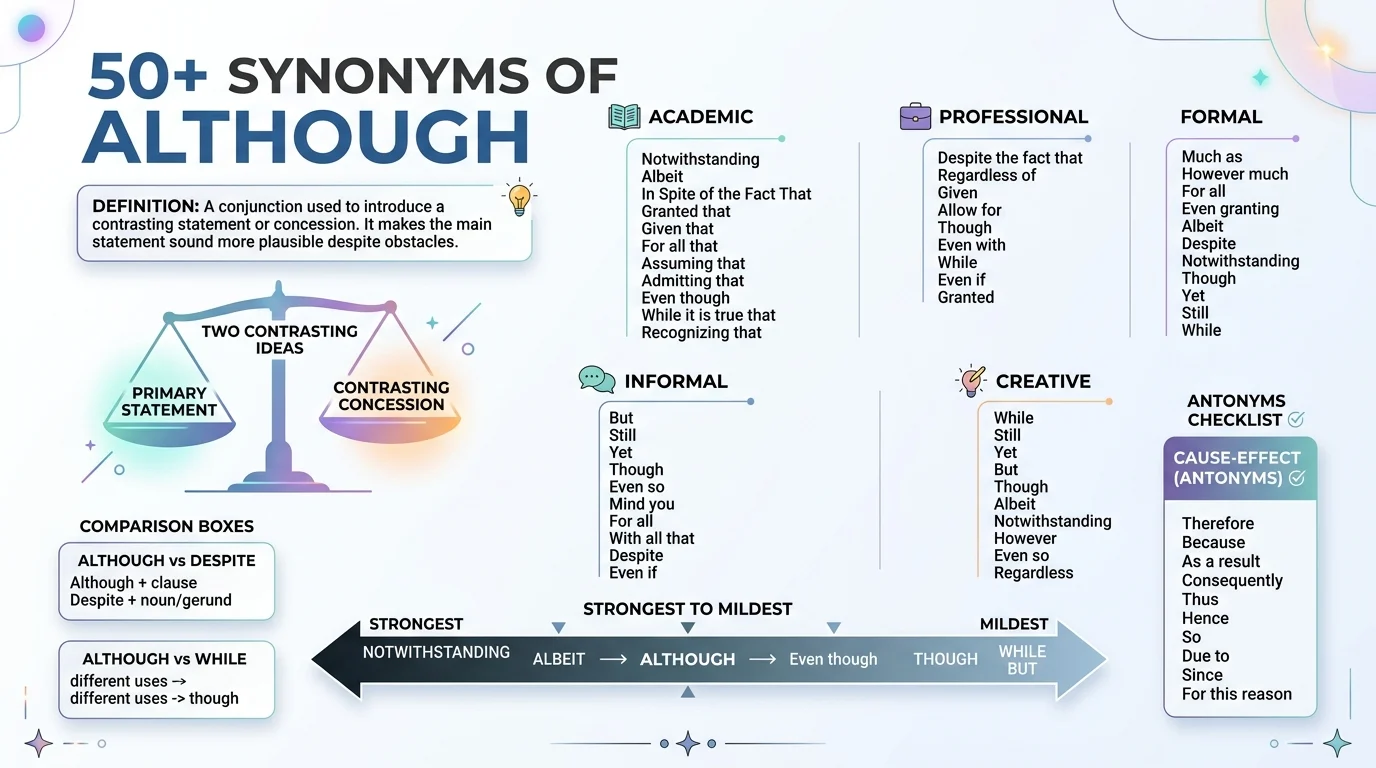
Meaning, Tone, and Context
Understanding the core meaning of “although” is the first step to using it effectively.
Simple Definition: In spite of the fact that; even though. Used to introduce a statement that contrasts with or qualifies something already said .
Part of Speech: Subordinating conjunction .
Overall Tone: Neutral. It simply shows a contrast between two ideas without emotional coloring.
Formality Level: Neutral. The word works in most contexts, from casual to formal.
Common Uses: Native English speakers use it constantly to show unexpected outcomes or contrasts. For example, “Although it was raining, we went for a walk,” or “She studied hard, although she still felt nervous” .
Word Forms: “Although” has no other grammatical forms. Related contrast words include though, even though, and albeit.
When and How to Use “Although”
“Although” is the perfect choice when you want to show contrast between two clauses. Here are seven realistic examples.
Professional: “Although the market is volatile, we remain optimistic about growth.”
Academic: “Although the study has limitations, the findings are significant.”
Workplace: “Although we faced challenges, the team delivered excellent results.”
Personal: “Although I was tired, I stayed up to finish the book.”
Email: “Although I appreciate your offer, I must decline at this time.”
Resume: “Although I have extensive experience, I am always eager to learn new skills.”
Social Media: “Although it was a long day, I am grateful for every moment.”
Best Synonyms of “Although”
No synonym is identical in every situation. Here is your guide to the best replacement for “although” based on your writing context.
Professional Writing: Whereas. It highlights clear differences between two ideas. “Whereas the previous report was optimistic, the new data suggests caution” .
Academic Writing: Albeit. This is ideal for introducing a concession in a more formal, compact way. “The study was successful, albeit with some limitations” .
Business Communication: While. A practical choice for showing contrast. “While we have made progress, there is still work to be done” .
Casual Conversation: Though. It tones down the formality and sounds natural. “Though it was raining, we went outside” .
Emotional Writing: Even though. This word carries more weight, emphasizing the strength of the contrast. “Even though I was exhausted, I pushed through” .
Creative Writing: Yet. It implies a surprising twist or unexpected outcome. “He was shy, yet confident on stage” .
Resume Writing: Despite. Use it for a stronger, more direct contrast. “Despite the challenges, I delivered results” .
When Not to Use “Although”
Using “although” can sound wrong or awkward in certain situations.
When You Mean “Because”: “Although” shows contrast. “Because” shows cause.
Better Choice: Because or since. “Since it was raining, we stayed inside.”
When You Need a Preposition: “Although” is a conjunction and must be followed by a clause. For nouns, use despite or in spite of.
Better Choice: Despite or in spite of. “Despite the rain, we went for a walk” .
When Starting Too Many Sentences: Overusing “although” at the start of sentences becomes repetitive.
Better Choice: Vary with though, while, or however. “The data is clear. However, we need more research.”
When It Sounds Too Formal: In casual conversation, “although” can sound stiff.
Better Choice: Though or but. “I wanted to go, but I was tired.”
Words Commonly Confused With “Although”
Several words are often mixed up with “although.” Here is how to keep them straight.
Word: Though
Difference: Means the same as “although” but is more casual and can be used at the end of a sentence .
When to Use: Use it in everyday conversation or informal writing.
Example: “It was raining, though we went out anyway.”
Word: Even though
Difference: Emphasizes a stronger contrast or surprise. “Although” is more neutral .
When to Use: Use this for dramatic or unexpected contrasts.
Example: “Even though I was scared, I spoke up.”
Word: While
Difference: Can mean “although” but can also mean “at the same time as.” Avoid ambiguity .
When to Use: Use it when you want to contrast two ideas.
Example: “While this method works, it is time-consuming.”
Word: Whereas
Difference: Highlights clear differences, often in formal writing .
When to Use: Use this for comparing two different things.
Example: “Whereas the first experiment failed, the second succeeded.”
Word: Albeit
Difference: Means “although” but is more formal and introduces a single word or short phrase .
When to Use: Use this for a concise concession.
Example: “The journey was long, albeit rewarding.”
Word: However
Difference: Shows contrast but is usually used between sentences or clauses. “Although” connects two clauses .
When to Use: Use this for strong contrast at the start of a new sentence.
Example: “The data is promising. However, we need more evidence.”
Best Synonyms of “Although” by Context
| Context | Best Synonym | Why It Works | Example |
|---|---|---|---|
| Formal writing | Whereas | Highlights clear differences. | “Whereas the old policy failed, the new one succeeded.” |
| Academic writing | Albeit | Concise and formal for concessions. | “The study was useful, albeit with some limitations.” |
| Professional communication | While | Versatile and widely understood. | “While we have made progress, challenges remain.” |
| Business emails | Though | Professional yet accessible. | “Though I understand your concern, we must move forward.” |
| Resume writing | Despite | Strong and direct contrast. | “Despite the obstacles, I achieved the targets.” |
| Workplace communication | Even though | Emphasizes the strength of the contrast. | “Even though we were short-staffed, we met the deadline.” |
| Casual conversation | But | Simple, natural, and conversational . | “I wanted to go, but I was too tired.” |
| Creative writing | Yet | Suggests a surprising twist. | “He was inexperienced, yet he succeeded.” |
| Emotional writing | Even so | Emphasizes the unexpected outcome . | “It was risky. Even so, they tried.” |
| Strong emphasis | Nonetheless | Formal and emphatic contrast . | “The evidence was weak. Nonetheless, they proceeded.” |
| Mild tone | While | Simple and unassuming. | “While the task is difficult, it is not impossible.” |
| Social media captions | Though | Casual and widely understood. | “Long day, though totally worth it.” |
How to Choose the Best Synonym of “Although”
Choosing the right word is a simple decision. Answer these questions.
What is my audience? For a professor or CEO, whereas or albeit is appropriate. For a friend, though or but is more natural.
What is my purpose? Are you trying to show a clear contrast, a surprise, or a concession? Use whereas for clear contrast, even though for surprise, and albeit for a concession.
Am I connecting two clauses or starting a new sentence? For connecting clauses, use although, though, or while. For starting a new sentence, use however or nonetheless .
What is the emotional strength? Even though and nonetheless are stronger. While and though are milder. Pick the one that matches your message.
Real Life Examples of “Although”
To truly master the word, it helps to see how it behaves in the wild and how a stronger synonym can elevate the sentence.
School: Basic: “Although I studied hard, I still felt nervous.” Improved: “Though I studied hard, I still felt nervous.”
College: Basic: “Although the research was limited, it was useful.” Improved: “The research was useful, albeit with some limitations” .
Workplace: Basic: “Although we faced challenges, we succeeded.” Improved: “Despite the challenges, we succeeded” .
Business: Basic: “Although the budget is tight, we can proceed.” Improved: “While the budget is tight, we can still proceed.”
Email: Basic: “Although I appreciate your help, I must decline.” Improved: “I appreciate your help; however, I must decline.”
Conversation: Basic: “Although I was tired, I went out.” Improved: “I was tired, but I went out anyway.”
Storytelling: Basic: “Although he was scared, he jumped.” Improved: “He was scared, yet he jumped.”
Top 10 Synonyms of “Although”
| Synonym | Simple Meaning | Best Used For | Example Sentence |
|---|---|---|---|
| Though | Despite the fact that; more casual | Casual conversation and informal writing | “Though it was cold, we enjoyed the trip.” |
| Even though | Despite the fact that; emphasizes contrast | Strong, dramatic, and emotional contexts | “Even though I was tired, I finished the report.” |
| While | At the same time as; or despite the fact that | Professional and neutral contexts | “While this is difficult, it is not impossible.” |
| Whereas | In contrast or comparison with | Formal writing and clear comparisons | “Whereas the first test failed, the second succeeded.” |
| Albeit | Although; in a limited way | Formal, academic, and concise contexts | “The trip was tiring, albeit enjoyable.” |
| Despite | In spite of; without being affected by | Strong, direct, and professional contexts | “Despite the rain, we continued.” |
| But | However; yet | Casual conversation and simple contrast | “I wanted to go, but I was busy.” |
| Yet | But at the same time; however | Creative and surprising contrast | “She was shy, yet she performed beautifully.” |
| However | Nevertheless; in spite of that | Formal and professional transitions | “The evidence is clear. However, we need more data.” |
| Nonetheless | In spite of that; nevertheless | Formal and emphatic contrast | “The team was inexperienced. Nonetheless, they won.” |
Synonyms of “Although” by Usage
Professional vs. Personal Synonyms
In the workplace (professional), choose while, whereas, or despite to show contrast in reports or emails. These words convey a polished and authoritative tone. “While the team faced challenges, the project was completed” is more professional than “Although the team faced challenges.”
With friends (personal), though or but keep the tone relaxed and relatable. These alternatives sound natural in everyday conversation.
Formal vs. Conversational Synonyms
For formal writing (reports, essays, professional documents), use whereas, albeit, or nonetheless. These choices maintain the sophisticated tone expected in professional documents.
For casual conversations and texting, use though, but, or yet. These options sound more natural and less pretentious .
Academic Synonyms
For research and essays, choose precise, authoritative words. Albeit is great for concise concessions, whereas for clear comparisons, and nonetheless for strong contrast. These words sound considered and scholarly.
Using precise academic vocabulary demonstrates expertise and careful thinking. Professors and reviewers expect this level of precision.
Professional and Business Synonyms
For maximum impact in professional writing, choose while for general contrasts, whereas for comparisons, and despite for direct opposition. These words demonstrate confidence and professional awareness.
Business leaders respond to language that conveys clarity and certainty. These synonyms project authority.
Creative and Literary Synonyms
To add emotion and imagery to your writing, choose yet or though. These words create rhythm and a sense of surprise.
Literary writers use these alternatives to build narrative tension and character development. They transform ordinary descriptions into evocative prose.
Slang or Modern Synonyms
In modern American slang, though is often used at the end of a sentence for emphasis. For example, “That was good, though.” This is acceptable in casual, friendly contexts. Avoid this in professional or academic writing.
Strongest to Mildest Synonyms
Mild: but, though, while
Moderate: although, even though, despite
Strong: whereas, albeit, yet
Very Strong: however, nonetheless, notwithstanding
Emotional vs. Neutral Synonyms
Emotional Synonyms: Even though, yet, nonetheless. These words often hint at surprise, determination, or drama. Use them when you want to evoke feeling.
Neutral Synonyms: Although, though, while. These words simply communicate factual contrast. Use them when you want to inform without emotional coloring.
Antonyms of “Although”
Here are 15 genuine opposites in terms of logical connection.
| Term | Meaning | Example Sentence |
|---|---|---|
| Because | For the reason that | “We stayed inside because it was raining.” |
| Since | For the reason that | “Since I was tired, I went to bed.” |
| As | Because; for the reason that | “As it was cold, we wore coats.” |
| Therefore | For that reason | “It was raining; therefore, we stayed inside.” |
| Thus | As a result | “The plan failed; thus, we tried something else.” |
| Consequently | As a consequence | “She worked hard; consequently, she was promoted.” |
| Hence | As a result of this | “He was late; hence, he missed the meeting.” |
| So | For that reason | “The weather was bad, so we stayed inside.” |
| Accordingly | In a way that is appropriate | “The team performed well; accordingly, they were rewarded.” |
| Subsequently | After a particular event | “The meeting ended; subsequently, we went to lunch.” |
| Henceforth | From this time onward | “The policy changed; henceforth, all reports must be submitted.” |
| Consequently | As a result of something | “The defendant was found guilty; consequently, he was sentenced.” |
| Thereupon | Immediately after that | “The signal was given; thereupon, the team advanced.” |
| Wherefore | For what reason or purpose | “The contract was broken; wherefore, we seek damages.” |
| Ergo | Therefore | “The evidence was clear; ergo, the argument was valid.” |
Comparison: “Although” vs Similar Words
Although vs. Though
Main Difference: Though is more casual and can be used at the end of a sentence .
Which Is Stronger? They are similar in meaning. Although is slightly more formal.
Which Is More Formal? Although is more formal. Though is neutral.
When to Use Each: Use although in formal writing. Use though in everyday conversation .
Examples:
Although: “Although the project was delayed, we finished.”
Though: “The project was delayed; we finished it, though.”
Although vs. Even Though
Main Difference: Even though emphasizes a stronger contrast or surprise .
Which Is Stronger? Even though is stronger.
Which Is More Formal? Both are used in formal and informal contexts.
When to Use Each: Use although for neutral contrast. Use even though for dramatic emphasis.
Examples:
Although: “Although he was scared, he spoke.”
Even though: “Even though he was terrified, he spoke up.”
Although vs. While
Main Difference: While can mean “although” but also means “at the same time as.” Avoid ambiguity .
Which Is Stronger? They are similar in contrast strength.
Which Is More Formal? Both are formal and professional.
When to Use Each: Use although for simple contrast. Use while when the timing is clear or for variety.
Examples:
Although: “Although it is expensive, it is worth it.”
While: “While it is expensive, it is worth it.”
Although vs. Whereas
Main Difference: Whereas highlights clear differences, often comparing two things .
Which Is Stronger? Whereas is stronger for formal comparisons.
Which Is More Formal? Whereas is more formal and legalistic.
When to Use Each: Use although for general contrast. Use whereas for formal comparisons.
Examples:
Although: “Although the first attempt failed, the second succeeded.”
Whereas: “Whereas the first attempt failed, the second succeeded.”
Although vs. Albeit
Main Difference: Albeit introduces a single word or short phrase, not a full clause .
Which Is Stronger? Albeit is more formal and concise.
Which Is More Formal? Albeit is very formal and academic.
When to Use Each: Use although for full clause contrast. Use albeit for concise concessions.
Examples:
Although: “Although it was difficult, she persevered.”
Albeit: “She persevered, albeit with difficulty” .
Although vs. However
Main Difference: However is used between sentences or after a semicolon. Although connects two clauses .
Which Is Stronger? However is stronger for emphatic contrast.
Which Is More Formal? Both are formal and professional.
When to Use Each: Use although inside a sentence. Use however to start a new sentence.
Examples:
Although: “Although the evidence is weak, the theory is accepted.”
However: “The evidence is weak. However, the theory is widely accepted.”
Common Phrases and Expressions with “Although”
Phrase: Although it is…
Meaning: Despite being a particular way.
Example Sentence: “Although it is expensive, many people buy it.”
Phrase: Although I/we/they…
Meaning: Despite the fact that the subject did something.
Example Sentence: “Although she studied hard, she still felt nervous” .
Phrase: Although I must say…
Meaning: Used to introduce a personal opinion with a concession.
Example Sentence: “Although I must say, I disagree with the assessment.”
Phrase: Although true…
Meaning: While something is true, another thing is also true.
Example Sentence: “Although true, this argument fails to consider the full picture.”
Common Mistakes to Avoid
Mistake 1: Using “although” when you mean “because”.
Incorrect: “Although it was raining, we went out.” (when the intended meaning is “because”)
Better: “Because it was raining, we stayed inside.”
Why: Although shows contrast. Because shows cause.
Mistake 2: Using “although” with a noun instead of a clause.
Incorrect: “Although the rain, we went out.”
Better: “Although it was raining, we went out.” or “Despite the rain, we went out” .
Why: Although is a conjunction and needs a full clause. Use despite or in spite of with nouns.
Mistake 3: Overusing “although” at the start of sentences.
Incorrect: “Although X. Although Y.”
Better: Vary with “though,” “while,” “however,” or “but.”
Why: Repetition makes writing sound robotic.
Mistake 4: Using “although” for a simple “but”.
Incorrect: “The project was delayed, although we managed.”
Better: “The project was delayed, but we managed.”
Why: “But” is simpler and more natural for casual contrast.
Mistake 5: Confusing “albeit” with “although”.
Incorrect: “Albeit it was raining, we went out.”
Better: “Although it was raining, we went out.” or “We went out, albeit in the rain” .
Why: Albeit does not introduce a full clause.
Frequently Asked Questions
1. What are the best synonyms of “although”?
The best synonyms depend on your context. For formal writing, choose whereas or albeit. And for casual conversation, though or but are ideal choices. For dramatic emphasis, use even though .
2. What are the best formal synonyms of “although”?
The best formal synonyms are whereas, albeit, and nonetheless. These words are suitable for academic papers, professional reports, and business communications .
3. What are common informal synonyms of “although”?
For informal settings, use though, but, or while. These alternatives sound more natural in everyday conversation .
4. What is another word for “although” in professional writing?
In professional writing, while is an excellent choice for general contrasts. Whereas is also strong for clear comparisons .
5. What is the difference between “although” and “albeit”?
While both show concession, although introduces a full clause. Albeit introduces a single word or short phrase . Use “albeit” for a more concise, formal concession.
6. What is the opposite of “although”?
The direct opposites (in terms of logical connection) of although are because, since, and therefore. These words show cause and effect rather than contrast.
Conclusion
“Although” is a fundamental word for showing contrast and concession in writing. The term is neutral and widely accepted in all contexts, yet it can sound repetitive if overused or too formal for casual conversation. The best choice among the synonyms of although depends entirely on your audience, tone, and purpose. Remember, no single synonym works perfectly in every situation. Your goal is to choose the word that communicates your message with the most clarity and impact. A practical tip for your vocabulary growth is to pay attention to how writers vary their contrast words and practice using different synonyms in your writing to avoid repetition.
Discover More:
- 50+ Synonyms of Ethereal: Meanings, Uses, Examples, and Best Alternatives 2026
- 50+ Synonyms of Goal: Meanings, Uses, Examples, and Best Alternatives 2026

Ella Parker is a professional content writer with a passion for creating clear, engaging, and well-researched articles. She focuses on delivering valuable insights and practical information across business, technology, and lifestyle topics.