Have you ever needed to describe an ambition or target but felt that “goal” did not fully capture its importance or scope? You want to motivate a team or clarify a vision, and the word “goal” comes to mind. But is it the best fit for your audience? Choosing the right synonym for “goal” can transform a simple statement into a powerful declaration of intent. This guide explores the best synonyms of goal, explaining exactly which word to use and when.
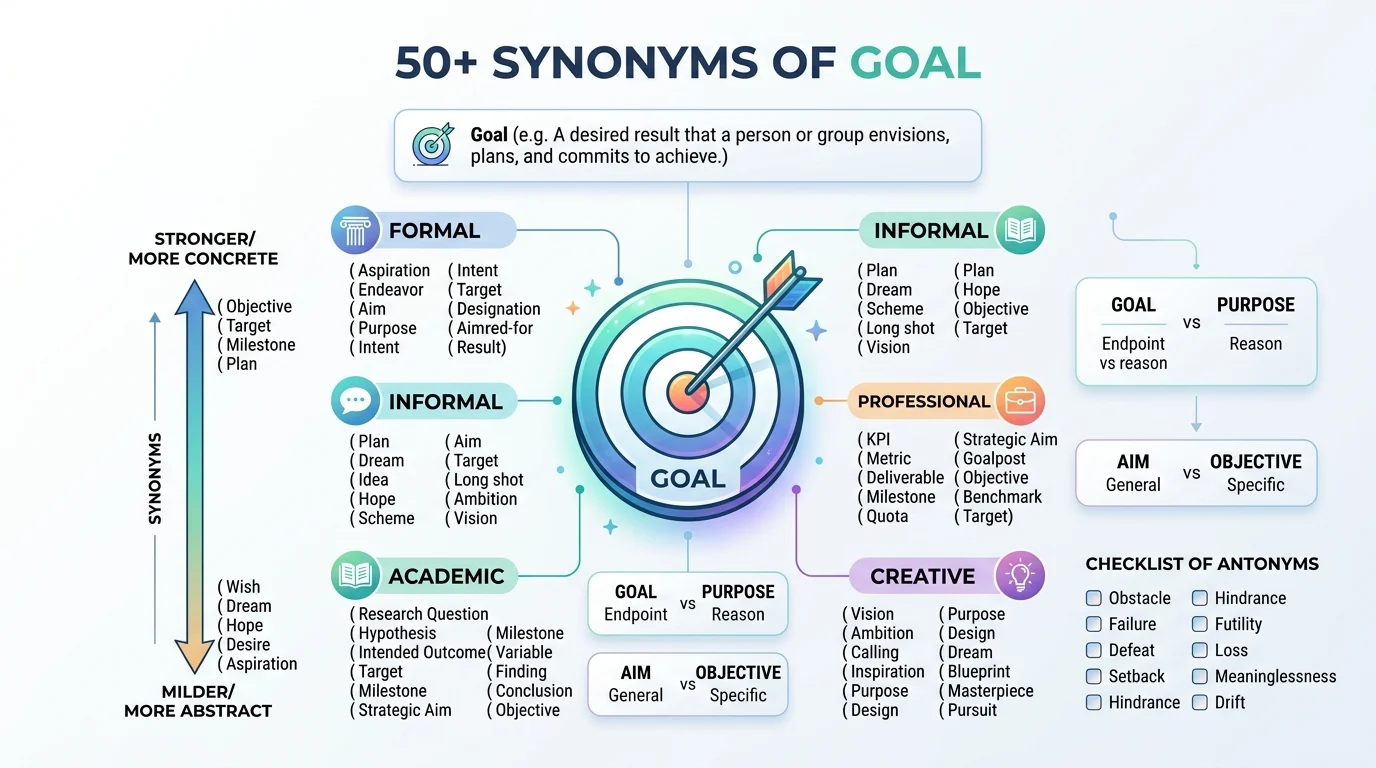
Quick Ans: “Goal” means an aim or desired result that someone works toward achieving. It is a neutral, versatile noun. For professional writing, choose objective or target. For casual conversation, use aim or purpose. In academic contexts, benchmark and milestone are strong choices. For a stronger, more inspiring impact, select aspiration or mission.
Meaning, Tone, and Context
Understanding the core meaning of “goal” is the first step to using it effectively.
Simple Definition: An aim or purpose. Something that you want to achieve.
Part of Speech: Noun.
Overall Tone: Neutral to positive. It represents ambition and forward movement.
Formality Level: Neutral. The word works in almost any context, from casual conversation to formal business planning.
Common Uses: Native English speakers use it constantly in personal and professional contexts. For example, “My goal is to learn Spanish,” or “The company achieved its quarterly goals.”
Word Forms: Related words include the noun goal-setting and the adjective goal-oriented.
When and How to Use “Goal”
“Goal” is the most common and versatile word in its category. Here are seven realistic examples.
Professional: “Our primary goal is to increase market share by 15% this year.”
Academic: “The student set a goal of completing her thesis by the spring semester.”
Workplace: “The team established a clear goal for the upcoming quarter.”
Personal: “Running a marathon has been a lifelong goal of mine.”
Email: “Please review the attached document outlining our goals for this fiscal year.”
Resume: “Achieved company goals through strategic planning and team collaboration.”
Social Media: “New year, new goals. Ready to crush it this year.”
Best Synonyms of “Goal”
No synonym is identical in every situation. Here is your guide to the best replacement for “goal” based on your writing context.
Professional Writing: Objective. It suggests a specific, measurable aim. “The primary objective of this initiative is to reduce costs.”
Academic Writing: Benchmark. This is ideal when discussing standards against which to measure progress. “The study established new benchmarks for cognitive development.”
Business Communication: Target. A practical and direct choice. “We have set a target of increasing sales by 20%.”
Casual Conversation: Aim. It tones down the formality and sounds natural. “My aim is to finish this book by Friday.”
Emotional Writing: Aspiration. This word carries weight, suggesting a deep or lofty ambition. “Her aspiration to help others inspired everyone.”
Creative Writing: Quest. It implies a journey or adventure. “His quest for knowledge took him across the world.”
Resume Writing: Objective. Use it to state a career aim. “Career objective: To lead innovative projects in a dynamic environment.”
When Not to Use “Goal”
Using “goal” can sound weak or vague in certain situations.
When It Sounds Too Vague: “Goal” can be too general. You might need a word that conveys more specificity.
Better Choice: Target. “We need to hit our sales target this quarter.”
When You Need a Measurable Standard: “Goal” is fine, but benchmark or metric is stronger.
Better Choice: Benchmark. “The industry benchmark for customer satisfaction is 90%.”
When Describing a Final Outcome: “Goal” works, but outcome or result is more precise.
Better Choice: Outcome. “The desired outcome of the training is improved performance.”
When It Sounds Too Ordinary: In creative or elevated writing, “goal” feels flat.
Better Choice: Mission. “Our mission is to empower communities through education.”
Words Commonly Confused With “Goal”
Several words are often mixed up with “goal.” Here is how to keep them straight.
Word: Objective
Difference: Suggests a specific, measurable outcome. “Goal” is broader and more general.
When to Use: Use it in business, project management, and planning contexts.
Example: “The primary objective is to complete the project within budget.”
Word: Target
Difference: Implies a specific number or quota. “Goal” is more flexible.
When to Use: Use this for sales, production, or metric-driven contexts.
Example: “The sales target for this quarter is $1 million.”
Word: Aim
Difference: Is often less formal and more personal. “Goal” is more neutral.
When to Use: Use it in conversation or personal statements.
Example: “My aim is to save enough money for a new car.”
Word: Purpose
Difference: Focuses on the reason for doing something. “Goal” is about the destination.
When to Use: Use this for deeper motivations or reasons.
Example: “The purpose of the meeting is to clarify the strategy.”
Word: Ambition
Difference: Implies a strong desire for success. “Goal” is more neutral.
When to Use: Use it for personal drive or long-term desires.
Example: “Her ambition to become CEO motivated her hard work.”
Word: Mission
Difference: Implies a broader, more important purpose. “Goal” is more specific.
When to Use: Use this for organizations, teams, or personal callings.
Example: “The company’s mission is to create sustainable products.”
Best Synonyms of “Goal” by Context
| Context | Best Synonym | Why It Works | Example |
|---|---|---|---|
| Formal writing | Objective | Suggests a specific, measurable aim. | “The project objective was clearly defined.” |
| Academic writing | Benchmark | Provides a standard for measurement. | “The study established new benchmarks for learning.” |
| Professional communication | Target | Practical and direct for business contexts. | “We met our quarterly sales target.” |
| Business emails | Objective | Professional and clear for planning. | “Please review the objectives outlined in the document.” |
| Resume writing | Objective | Standard term for career statements. | “Career objective: To advance in digital marketing.” |
| Workplace communication | Target | Emphasizes specific, measurable results. | “The team’s target is to onboard 10 new clients.” |
| Casual conversation | Aim | Simple, direct, and conversational. | “My aim is to learn a new language.” |
| Creative writing | Quest | Evokes adventure and journey. | “The hero’s quest for treasure led him far from home.” |
| Emotional writing | Aspiration | Suggests deep, lofty ambition. | “Her aspiration to create change inspired many.” |
| Strong emphasis | Mission | Implies a serious, important purpose. | “Our mission is to fight poverty through education.” |
| Mild tone | Aim | Simple and unassuming. | “My aim is to finish this task today.” |
| Social media captions | Goal | The most natural, widely understood choice. | “Setting new goals and making them happen.” |
How to Choose the Best Synonym of “Goal”
Choosing the right word is a simple decision. Answer these questions.
What is my audience? For a professor or CEO, objective or benchmark is powerful. For a friend, aim or purpose is more natural.
What is my purpose? Are you trying to motivate, inform, or plan? Use mission for motivation, objective for planning, and purpose for information.
Is the goal measurable? For specific, measurable outcomes, use target or benchmark. For broader aspirations, use aim or goal.
What is the emotional strength? Aspiration and mission are stronger. Aim and target are mild. Pick the one that matches your message.
Real Life Examples of “Goal”
To truly master the word, it helps to see how it behaves in the wild and how a stronger synonym can elevate the sentence.
School: Basic: “The teacher set a goal for the students.” Improved: “The teacher set a benchmark for the students to reach by the end of the semester.”
College: Basic: “Her goal is to graduate with honors.” Improved: “Her ambition is to graduate with honors and pursue research.”
Workplace: Basic: “We have a goal of increasing revenue.” Improved: “We have a target of increasing revenue by 10% this quarter.”
Business: Basic: “The company’s goal is to expand globally.” Improved: “The company’s mission is to expand globally while maintaining quality.”
Email: Basic: “Here are our goals for the project.” Improved: “Here are our objectives for the project, complete with timelines.”
Conversation: Basic: “My goal is to get fit.” Improved: “My aim is to get fit by running three times a week.”
Storytelling: Basic: “His goal was to find the treasure.” Improved: “His quest for the lost treasure consumed his every waking moment.”
Top 10 Synonyms of “Goal”
| Synonym | Simple Meaning | Best Used For | Example Sentence |
|---|---|---|---|
| Objective | A specific, measurable aim | Professional, business, and planning contexts. | “The objective of the project is to reduce waste.” |
| Target | A specific number or quota to hit | Sales, production, and metric-driven contexts. | “Our target is to sell 500 units this month.” |
| Aim | A direction or purpose | Casual conversation and personal statements. | “My aim is to be happier this year.” |
| Purpose | The reason for doing something | Deep motivations and organizational contexts. | “The purpose of the meeting is to align on strategy.” |
| Ambition | A strong desire for success | Personal drive and long-term goals. | “Her ambition to succeed is evident in her work.” |
| Mission | A broad, important purpose | Organizations, teams, and personal callings. | “Our mission is to serve the community.” |
| Benchmark | A standard for measuring progress | Academic, business, and performance contexts. | “We use industry benchmarks to track our performance.” |
| Milestone | A significant point in a journey | Project management and progress tracking. | “Reaching 50% completion was a major milestone.” |
| Aspiration | A deep or lofty ambition | Inspirational and emotional contexts. | “Her aspiration is to make a difference in the world.” |
| Quest | A journey of search or pursuit | Creative writing and storytelling. | “The hero’s quest took him through dangerous lands.” |
Synonyms of “Goal” by Usage
Professional vs. Personal Synonyms
In the workplace (professional), choose objective, target, or benchmark to describe aims. These words convey specificity and measurability. “The project objective is to launch by Q3” is more precise than “The project goal is to launch.”
With friends (personal), aim, purpose, or simply goal keep the tone relaxed and relatable. These alternatives sound natural in everyday conversation.
Formal vs. Conversational Synonyms
For formal writing (reports, essays, professional emails), use objective, benchmark, or mission. These choices maintain the sophisticated tone expected in professional documents.
For casual conversations and texting, use aim, purpose, or target (when specific). These options sound more natural and less pretentious.
Academic Synonyms
For research and essays, choose precise, authoritative words. Benchmark is great for standards of measurement, objective for research aims, and milestone for significant progress points. These words sound considered and scholarly.
Using precise academic vocabulary demonstrates expertise and careful thinking. Professors and reviewers expect this level of precision.
Professional and Business Synonyms
For maximum impact in business writing, choose objective for strategic aims, target for specific numbers, and mission for organizational purpose. These words demonstrate confidence and professional awareness.
Business leaders respond to language that conveys clarity and direction. These synonyms project authority.
Creative and Literary Synonyms
To add emotion and imagery to your writing, choose quest, aspiration, or ambition. These words create atmosphere and drama.
Literary writers use these alternatives to build narrative and character. They transform ordinary descriptions into evocative prose.
Slang or Modern Synonyms
There is no direct slang synonym for “goal” in mainstream American English. The simplest alternative in modern texting is literally just goal or aim. This straightforward approach works best for casual digital communication.
Strongest to Mildest Synonyms
Mild: aim, goal, purpose
Moderate: objective, target, milestone
Strong: ambition, mission, benchmark
Very Strong: aspiration, quest, calling
Emotional vs. Neutral Synonyms
Emotional Synonyms: Ambition, aspiration, quest, calling. These words often hint at passion, hope, or dramatic significance. Use them when you want to evoke feeling.
Neutral Synonyms: Objective, target, benchmark, milestone. These words simply communicate factual information. Use them when you want to inform without emotional coloring.
Antonyms of “Goal”
Here are 15 genuine opposites of “goal.”
| Antonym | Meaning | Example Sentence |
|---|---|---|
| Avoidance | The act of staying away from something | “His avoidance of responsibility was concerning.” |
| Aimlessness | Having no direction or purpose | “The aimlessness of the project frustrated the team.” |
| Purposelessness | Lack of meaning or direction | “The purposelessness of the meeting wasted everyone’s time.” |
| Indifference | Lack of interest or concern | “His indifference to success was evident.” |
| Idleness | Doing nothing productive | “Her idleness was a stark contrast to her peers.” |
| Passivity | Accepting without resistance | “The team’s passivity hindered progress.” |
| Neglect | Failing to care for or attend to | “His neglect of the project caused delays.” |
| Procrastination | Delaying action unnecessarily | “His procrastination prevented him from reaching his targets.” |
| Inaction | Lack of action or effort | “Inaction on the issue only made things worse.” |
| Stagnation | Lack of progress or development | “The stagnation of the company led to layoffs.” |
| Retreat | Withdrawing from a position | “The retreat from their goal was a setback.” |
| Abandonment | Giving up on something | “The abandonment of the project was disappointing.” |
| Failure | Lack of success | “Failure was not an option for the determined team.” |
| Defeat | Being beaten or overcome | “The defeat of the initiative was a blow.” |
| Futility | Pointlessness or uselessness | “The futility of the effort became clear.” |
Comparison: “Goal” vs Similar Words
Goal vs. Objective
Main Difference: Goal is broad and general. Objective is specific and measurable.
Which Is Stronger? Objective is stronger for planning and measurement.
Which Is More Formal? Objective is more formal and professional.
When to Use Each: Use goal for general ambitions. Use objective for specific, actionable aims.
Examples:
Goal: “My goal is to become a better public speaker.”
Objective: “The objective is to deliver five presentations this quarter.”
Goal vs. Target
Main Difference: Goal is flexible. Target implies a specific number or quota.
Which Is Stronger? Target is more specific and forceful.
Which Is More Formal? Both are used in formal and informal contexts.
When to Use Each: Use goal for qualitative aims. Use target for quantitative aims.
Examples:
Goal: “Our goal is to improve customer satisfaction.”
Target: “Our target is a 90% satisfaction score.”
Goal vs. Aim
Main Difference: Goal is more concrete. Aim feels more like a direction.
Which Is Stronger? Goal is more specific. Aim is more fluid.
Which Is More Formal? Both are neutral in formality. Aim is slightly more conversational.
When to Use Each: Use goal for specific outcomes. Use aim for general directions.
Examples:
Goal: “My goal is to run a marathon.”
Aim: “My aim is to be healthier.”
Goal vs. Purpose
Main Difference: Goal is the destination. Purpose is the reason for the journey.
Which Is Stronger? Purpose is deeper and more meaningful.
Which Is More Formal? Both are formal, but purpose feels more philosophical.
When to Use Each: Use goal for outcomes. Use purpose for motivations.
Examples:
Goal: “The goal is to increase profits.”
Purpose: “The purpose of the initiative is to create jobs.”
Goal vs. Mission
Main Difference: Goal is specific. Mission is broad and inspirational.
Which Is Stronger? Mission is far stronger and more important-sounding.
Which Is More Formal? Both are formal, but mission is more elevated.
When to Use Each: Use goal for everyday ambitions. Use mission for organizational or personal callings.
Examples:
Goal: “My goal is to get promoted.”
Mission: “The company’s mission is to revolutionize healthcare.”
Goal vs. Ambition
Main Difference: Goal is neutral. Ambition implies drive and desire for success.
Which Is Stronger? Ambition is stronger and more personal.
Which Is More Formal? Both are formal, but ambition has an emotional edge.
When to Use Each: Use goal for simple statements. Use ambition for passionate statements.
Examples:
Goal: “His goal is to be a manager.”
Ambition: “His ambition is to be the CEO someday.”
Common Phrases and Expressions with “Goal”
Phrase: Set a goal
Meaning: To decide on an aim.
Example Sentence: “She set a goal to exercise three times a week.”
Phrase: Achieve a goal
Meaning: To successfully reach an aim.
Example Sentence: “The team achieved its goal ahead of schedule.”
Phrase: Goal-oriented
Meaning: Focused on achieving aims.
Example Sentence: “She is a goal-oriented employee who always meets deadlines.”
Phrase: Long-term goal
Meaning: An aim that will take time to achieve.
Example Sentence: “His long-term goal is to start his own business.”
Phrase: Short-term goal
Meaning: An aim that can be achieved quickly.
Example Sentence: “Her short-term goal is to complete the training course.”
Phrase: Goal post
Meaning: The target or objective (often in sports).
Example Sentence: “The team moved the goal post with each new requirement.”
Common Mistakes to Avoid
Mistake 1: Using “goal” when you mean “objective”.
Incorrect: “The project goal is to deliver the report by Friday.”
Better: “The project objective is to deliver the report by Friday.”
Why: Objective implies a specific, measurable outcome. Goal is more general.
Mistake 2: Using “goal” when you mean “target”.
Incorrect: “Our goal is to sell $1 million.”
Better: “Our target is to sell $1 million.”
Why: Target implies a specific number or quota.
Mistake 3: Overusing “goal” in formal writing.
Incorrect: “The goal is this. The other goal is that.”
Better: “The objective is this. The target is that.”
Why: Variation in vocabulary demonstrates writing sophistication.
Mistake 4: Using “aim” when you mean “mission”.
Incorrect: “The company’s aim is to change the world.”
Better: “The company’s mission is to change the world.”
Why: Mission implies a larger, more important purpose.
Mistake 5: Using “ambition” when you mean a small goal.
Incorrect: “My ambition is to finish this email.”
Better: “My goal is to finish this email.”
Why: Ambition implies a strong, long-term desire. It sounds dramatic for small tasks.
Frequently Asked Questions
1. What are the best synonyms of “goal”?
The best synonyms depend on your context. For formal writing, choose objective or target.And for casual conversation, aim or purpose are ideal choices. For inspirational contexts, use mission or aspiration.
2. What are the best formal synonyms of “goal”?
The best formal synonyms are objective, benchmark, and milestone. These words are suitable for academic papers, professional reports, and business communications.
3. What are common informal synonyms of “goal”?
For informal settings, use aim, purpose, or simply goal. These alternatives sound more natural in everyday conversation.
4. What is another word for “goal” in professional writing?
In professional writing, objective is an excellent choice. It conveys a specific, measurable aim. Target is also strong for number-driven goals.
5. What is the difference between “goal” and “objective”?
While both indicate desired outcomes, goal is broad and general. Objective is specific and measurable. Use objective for actionable plans and goal for general aspirations.
6. What is the opposite of “goal”?
The most direct opposites (antonyms) of goal are avoidance, aimlessness, and purposelessness. These words describe a lack of direction or ambition.
Conclusion
“Goal” is a versatile and essential word for expressing ambition and direction. The term is neutral and widely understood, yet it can sound vague in certain contexts. The best choice among the synonyms of goal depends entirely on your audience, tone, and purpose.Remember, no single synonym works perfectly in every situation. Your goal is to choose the word that communicates your message with the most clarity and impact. A practical tip for your vocabulary growth is to practice using different synonyms in your goal-setting and planning documents to develop precision and confidence.
Discover More:
- 50+ Synonyms of Developed: Meanings, Uses, Examples, and Best Alternatives 2026
- 50+ Synonyms of Unfair: Meanings, Uses, Examples, and Best Alternatives

Ella Parker is a professional content writer with a passion for creating clear, engaging, and well-researched articles. She focuses on delivering valuable insights and practical information across business, technology, and lifestyle topics.