Have you ever needed to describe something that lasts only a short time but felt that “temporary” did not fully capture the fleeting nature? You want to emphasize brevity and impermanence, and the word “transient” comes to mind. But is it the best fit for your audience? Choosing the right synonym for “transient” can transform a simple description into a precise portrayal of something passing quickly. This guide explores the best synonyms of transient, explaining exactly which word to use and when.
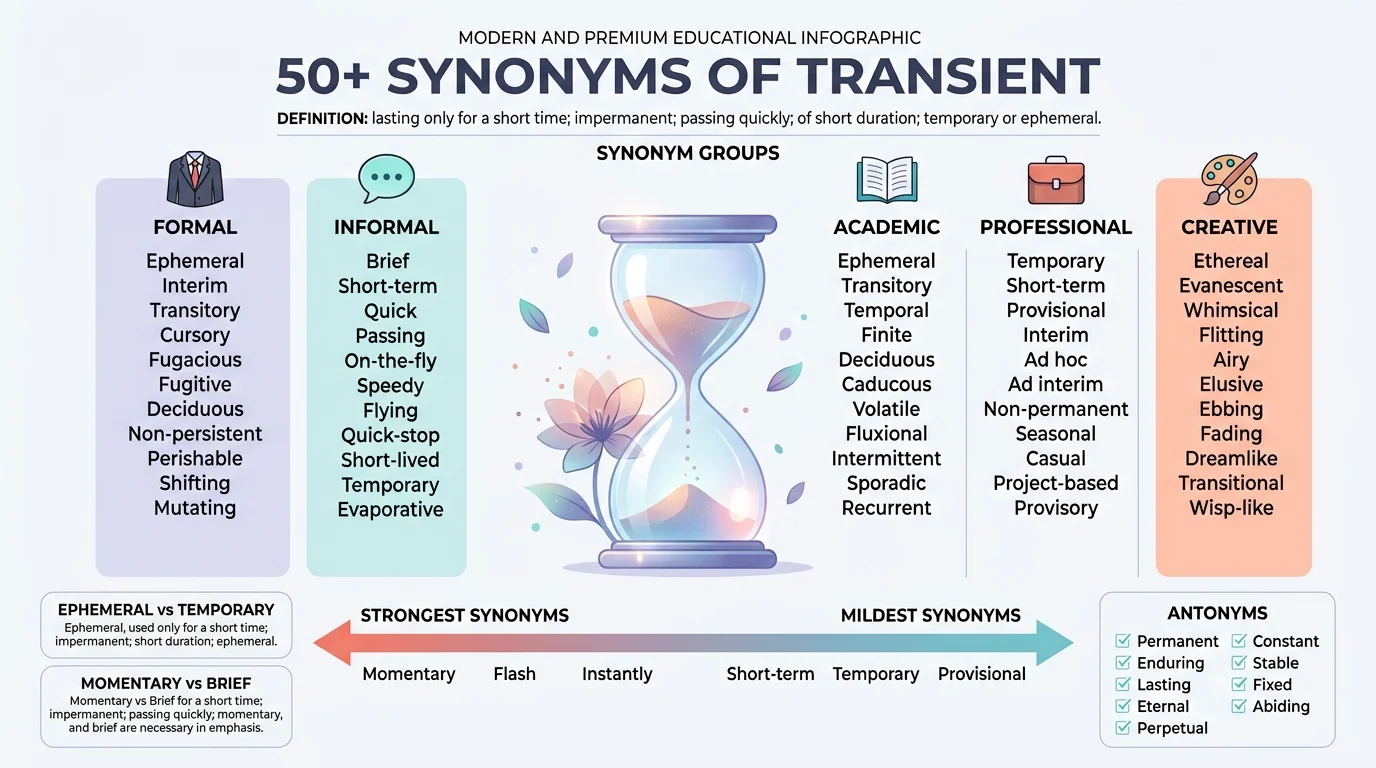
Quick Ans: “Transient” means lasting only for a short time or passing quickly. It is a neutral, formal adjective that describes impermanence. For professional writing, choose temporary or short-lived. For casual conversation, use brief or fleeting. In academic contexts, ephemeral and evanescent are strong choices. For a stronger, more poetic impact, select transitory or momentary.
Meaning, Tone, and Context
Understanding the core meaning of “transient” is the first step to using it effectively.
Simple Definition: Lasting for only a short period. Passing quickly or staying briefly.
Part of Speech: Adjective.
Overall Tone: Neutral. It describes impermanence without strong emotional coloring.
Formality Level: Formal. The word is appropriate in professional, academic, and literary contexts.
Common Uses: Native English speakers use it to describe things like weather, feelings, opportunities, or visitors that do not stay long. For example, “The transient nature of fame,” or “The storm was transient.”
Word Forms: Related words include the noun transience (or transiency) and the adverb transiently.
When and How to Use “Transient”
“Transient” is the perfect choice when you want to emphasize the brevity and impermanence of something. Here are seven realistic examples.
Professional: “The transient challenges we face today will not define our long-term success.”
Academic: “The study examines transient responses in the immune system.”
Workplace: “We need to address these transient issues before they become permanent.”
Personal: “Her transient mood shifts made it hard to keep up.”
Email: “Please note that this is a transient problem and will resolve shortly.”
Resume: “Managed transient projects that required rapid adaptation.”
Social Media: “Life is transient. Enjoy every moment while it lasts.”
Best Synonyms of “Transient”
No synonym is identical in every situation. Here is your guide to the best replacement for “transient” based on your writing context.
Professional Writing: Temporary. It suggests something that will end soon. “The temporary solution worked for now.”
Academic Writing: Ephemeral. This is ideal when discussing things that last a very short time. “The ephemeral nature of online trends.”
Business Communication: Short-term. A practical choice for planning. “We have short-term goals and long-term vision.”
Casual Conversation: Brief. It tones down the formality and sounds natural. “We had a brief meeting.”
Emotional Writing: Fleeting. This word carries a sense of preciousness or loss. “The fleeting moment of happiness was cherished.”
Creative Writing: Evanescent. It implies something vanishing like vapor. “The evanescent mist disappeared at dawn.”
Resume Writing: Short-term. Use it to describe project durations. “Managed short-term contracts effectively.”
When Not to Use “Transient”
Using “transient” can sound wrong or awkward in certain situations.
When It Sounds Too Formal: In casual conversation, “transient” sounds stiff.
Better Choice: Brief or short. “We had a brief chat.”
When You Mean Permanent Change: “Transient” describes temporary things. It is wrong for permanent changes.
Better Choice: Permanent or lasting. “The lasting impact was significant.”
When Describing Long Periods: “Transient” is only for short periods. For longer but still temporary, use temporary.
Better Choice: Temporary. “The temporary assignment lasted six months.”
When It Sounds Too Poetic: “Transient” can sound overly poetic in technical writing.
Better Choice: Short-lived. “The short-lived product was discontinued.”
Words Commonly Confused With “Transient”
Several words are often mixed up with “transient.” Here is how to keep them straight.
Word: Temporary
Difference: Means lasting for a limited time. “Transient” suggests even shorter duration.
When to Use: Use it for things that will end but may last a while.
Example: “The temporary position lasted six months.”
Word: Fleeting
Difference: Suggests passing quickly and sometimes precious. “Transient” is more neutral.
When to Use: Use this for moments that feel brief and often meaningful.
Example: “A fleeting glance passed between them.”
Word: Ephemeral
Difference: Implies very short existence, often natural. “Transient” is more general.
When to Use: Use this for things that disappear quickly.
Example: “The ephemeral beauty of cherry blossoms.”
Word: Short-lived
Difference: Means not lasting long. “Transient” can imply passing through.
When to Use: Use this for things that end quickly.
Example: “The short-lived trend faded quickly.”
Word: Momentary
Difference: Suggests lasting only a moment. “Transient” can last longer.
When to Use: Use this for things that happen in an instant.
Example: “A momentary lapse in judgment.”
Word: Evanescent
Difference: Suggests vanishing like vapor. “Transient” is more matter-of-fact.
When to Use: Use this for poetic or dramatic descriptions.
Example: “The evanescent fog lifted at dawn.”
Best Synonyms of “Transient” by Context
| Context | Best Synonym | Why It Works | Example |
|---|---|---|---|
| Formal writing | Ephemeral | Precise for very short duration. | “The ephemeral nature of fashion trends.” |
| Academic writing | Transitory | Formal and authoritative. | “The transitory effects were noted.” |
| Professional communication | Temporary | Clear and widely understood. | “We need a temporary solution.” |
| Business emails | Short-term | Practical for planning. | “This is a short-term priority.” |
| Resume writing | Short-lived | Emphasizes brevity. | “Managed short-lived projects.” |
| Workplace communication | Brief | Professional yet accessible. | “We had a brief discussion.” |
| Casual conversation | Short | Simple and natural. | “It was a short visit.” |
| Creative writing | Evanescent | Evocative and poetic. | “The evanescent mist faded away.” |
| Emotional writing | Fleeting | Suggests preciousness or loss. | “The fleeting moment was cherished.” |
| Strong emphasis | Momentary | Emphasizes extreme brevity. | “A momentary flash of insight.” |
| Mild tone | Passing | Simple and unassuming. | “It was just a passing thought.” |
| Social media captions | Fleeting | Relatable and emotional. | “Fleeting moments like this are priceless.” |
How to Choose the Best Synonym of “Transient”
Choosing the right word is a simple decision. Answer these questions.
What is my audience? For a professor or CEO, ephemeral or transitory is powerful. For a friend, brief or short is more natural.
What is my purpose? Are you trying to be poetic, factual, or practical? Use evanescent for poetry, temporary for facts, and short-term for practicality.
Am I describing a thing, a feeling, or a moment? For things, ephemeral works. For feelings, fleeting is better. And for moments, momentary is precise.
What is the emotional strength? Fleeting and evanescent are more emotional. Temporary and brief are neutral. Pick the one that matches your message.
Real Life Examples of “Transient”
To truly master the word, it helps to see how it behaves in the wild and how a stronger synonym can elevate the sentence.
School: Basic: “The rain was transient.” Improved: “The rain was brief and soon passed.”
College: Basic: “The study examined transient effects.” Improved: “The study examined transitory effects on the population.”
Workplace: Basic: “This is a transient problem.” Improved: “This is a temporary problem that will resolve soon.”
Business: Basic: “The trend was transient.” Improved: “The trend was short-lived and quickly replaced.”
Email: Basic: “This is a transient issue.” Improved: “This is a temporary issue we are addressing.”
Conversation: Basic: “We had a transient meeting.” Improved: “We had a brief meeting and moved on.”
Storytelling: Basic: “The transient fog covered the valley.” Improved: “The evanescent fog covered the valley before disappearing at dawn.”
Top 10 Synonyms of “Transient”
| Synonym | Simple Meaning | Best Used For | Example Sentence |
|---|---|---|---|
| Ephemeral | Lasting for a very short time | Academic, poetic, and natural contexts. | “The ephemeral beauty of the blossom was breathtaking.” |
| Temporary | Lasting for a limited time | Professional, business, and practical contexts. | “We hired a temporary employee.” |
| Transitory | Not lasting or permanent | Formal, academic, and authoritative contexts. | “The transitory nature of youth is often lamented.” |
| Fleeting | Passing quickly | Emotional, personal, and poetic contexts. | “He caught a fleeting glimpse of her.” |
| Short-lived | Not lasting long | General and straightforward contexts. | “The short-lived victory was celebrated.” |
| Momentary | Lasting only a moment | Emphatic and precise contexts. | “A momentary lapse caused the accident.” |
| Brief | Short in duration | Casual, professional, and general contexts. | “We had a brief conversation.” |
| Evanescent | Vanishing like vapor | Literary, poetic, and dramatic contexts. | “The evanescent mist lifted at dawn.” |
| Passing | Lasting only a short time | Mild, general, and everyday contexts. | “It was just a passing thought.” |
| Deciduous | Temporary or not permanent | Specialized, biological, and technical contexts. | “The deciduous tree lost its leaves in autumn.” |
Synonyms of “Transient” by Usage
Professional vs. Personal Synonyms
In the workplace (professional), choose temporary, short-term, or brief to describe duration. These words convey clarity and practicality. “We need a temporary solution” is more professional than “We need a transient solution.”
With friends (personal), short, quick, or brief keep the tone relaxed and relatable. These alternatives sound natural in everyday conversation.
Formal vs. Conversational Synonyms
For formal writing (reports, essays, professional emails), use ephemeral, transitory, or temporary. These choices maintain the sophisticated tone expected in professional documents.
For casual conversations and texting, use brief, short, or quick. These options sound more natural and less pretentious.
Academic Synonyms
For research and essays, choose precise, authoritative words. Ephemeral is great for short natural phenomena, transitory for temporary states, and temporary for general use. These words sound considered and scholarly.
Using precise academic vocabulary demonstrates expertise and careful thinking. Professors and reviewers expect this level of precision.
Professional and Business Synonyms
For maximum impact in business writing, choose short-term for planning, temporary for staffing, and brief for meetings. These words demonstrate confidence and professional awareness.
Business leaders respond to language that conveys practicality and clarity. These synonyms project authority.
Creative and Literary Synonyms
To add emotion and imagery to your writing, choose fleeting, evanescent, or momentary. These words create atmosphere and evoke feeling.
Literary writers use these alternatives to build mood and imagery. They transform ordinary descriptions into evocative prose.
Slang or Modern Synonyms
In modern American slang, quickie or fly-by-night are sometimes used for very short things, but these are informal and often negative. For example, “We had a quickie meeting,” or “The fly-by-night company disappeared.” These are acceptable only in very casual contexts.
Strongest to Mildest Synonyms
Mild: short, brief, passing
Moderate: temporary, short-lived, transient
Strong: transitory, fleeting, momentary
Very Strong: ephemeral, evanescent, fugitive
Emotional vs. Neutral Synonyms
Emotional Synonyms: Fleeting, evanescent, momentary. These words often hint at preciousness, loss, or beauty. Use them when you want to evoke feeling.
Neutral Synonyms: Temporary, brief, short-term. These words simply communicate factual information. Use them when you want to inform without emotional coloring.
Antonyms of “Transient”
Here are 15 genuine opposites of “transient.”
| Antonym | Meaning | Example Sentence |
|---|---|---|
| Permanent | Lasting forever | “The permanent change was welcomed.” |
| Eternal | Lasting forever without end | “Eternal love is a beautiful idea.” |
| Enduring | Long-lasting and persistent | “Their enduring friendship survived all challenges.” |
| Lasting | Continuing for a long time | “The lasting impression stayed with him.” |
| Perpetual | Never ending or changing | “The perpetual noise was exhausting.” |
| Constant | Unchanging over time | “The constant rain ruined the trip.” |
| Fixed | Not changing or moving | “The fixed schedule was easy to follow.” |
| Stable | Not likely to change | “The stable economy brought relief.” |
| Continuous | Uninterrupted in time | “The continuous flow of water was soothing.” |
| Immortal | Living forever | “The immortal legend was passed down.” |
| Indelible | Leaving a permanent mark | “The indelible memory stayed with her.” |
| Persistent | Continuing firmly | “The persistent rain flooded the streets.” |
| Abiding | Lasting a long time | “Their abiding love was inspiring.” |
| Infinite | Having no end | “The infinite sky stretched overhead.” |
| Everlasting | Lasting forever | “The everlasting beauty of nature amazed them.” |
Comparison: “Transient” vs Similar Words
Transient vs. Temporary
Main Difference: Transient suggests a shorter duration. Temporary can last longer.
Which Is Stronger? Transient is stronger for brevity. Temporary is more general.
Which Is More Formal? Transient is more formal. Temporary is neutral.
When to Use Each: Use transient for very short things. Use temporary for longer but limited things.
Examples:
Transient: “The transient feeling passed quickly.”
Temporary: “The temporary job lasted six months.”
Transient vs. Fleeting
Main Difference: Transient is neutral. Fleeting implies something precious or missed.
Which Is Stronger? Fleeting is more emotional and evocative.
Which Is More Formal? Transient is more formal. Fleeting is more poetic.
When to Use Each: Use transient for factual descriptions. Use fleeting for emotional moments.
Examples:
Transient: “The transient weather lasted only an hour.”
Fleeting: “The fleeting moment of joy was unforgettable.”
Transient vs. Ephemeral
Main Difference: Transient applies to many things. Ephemeral is often for natural or aesthetic things.
Which Is Stronger? Ephemeral is more precise and poetic.
Which Is More Formal? Both are formal, but ephemeral is more academic.
When to Use Each: Use transient for general brevity. Use ephemeral for natural or artistic brevity.
Examples:
Transient: “The transient visitor stayed only one night.”
Ephemeral: “The ephemeral cherry blossoms bloomed for a week.”
Transient vs. Short-lived
Main Difference: Transient can imply passing through. Short-lived is simply about duration.
Which Is Stronger? Short-lived is more direct and straightforward.
Which Is More Formal? Transient is more formal. Short-lived is neutral.
When to Use Each: Use transient for things that pass through. Use short-lived for things that end quickly.
Examples:
Transient: “The transient population moved frequently.”
Short-lived: “The short-lived trend faded quickly.”
Transient vs. Momentary
Main Difference: Transient can last hours or days. Momentary is only a moment.
Which Is Stronger? Momentary is stronger for extreme brevity.
Which Is More Formal? Both are formal.
When to Use Each: Use transient for short periods. Use momentary for instant moments.
Examples:
Transient: “The transient pain lasted a few hours.”
Momentary: “The momentary flash blinded him.”
Transient vs. Evanescent
Main Difference: Transient is matter-of-fact. Evanescent is poetic and implies vanishing.
Which Is Stronger? Evanescent is more dramatic and vivid.
Which Is More Formal? Evanescent is more literary and academic.
When to Use Each: Use transient for general brevity. Use evanescent for poetic disappearance.
Examples:
Transient: “The transient fog lifted by noon.”
Evanescent: “The evanescent mist vanished at dawn.”
Common Phrases and Expressions with “Transient”
Phrase: Transient nature
Meaning: The characteristic of being short-lived.
Example Sentence: “The transient nature of the weather makes planning difficult.”
Phrase: Transient moment
Meaning: A brief, passing instant.
Example Sentence: “He captured the transient moment in a photograph.”
Phrase: Transient population
Meaning: People who move frequently.
Example Sentence: “The city has a large transient population.”
Phrase: Transient happiness
Meaning: Brief or passing joy.
Example Sentence: “He chased transient happiness without success.”
Phrase: Transient visitor
Meaning: Someone who stays only a short time.
Example Sentence: “The transient visitor left the next morning.”
Common Mistakes to Avoid
Mistake 1: Using “transient” when you mean “temporary”.
Incorrect: “She took a transient job for six months.”
Better: “She took a temporary job for six months.”
Why: Temporary is better for longer periods. Transient is for very short periods.
Mistake 2: Using “transient” for permanent things.
Incorrect: “The transient monument stood for centuries.”
Better: “The permanent monument stood for centuries.”
Why: Transient means short-lived. Permanent means long-lasting.
Mistake 3: Overusing “transient” in casual conversation.
Incorrect: “We had a transient chat.”
Better: “We had a brief chat.”
Why: Brief sounds more natural in casual conversation.
Mistake 4: Using “ephemeral” when you mean “transient”.
Incorrect: “The ephemeral traffic jam lasted an hour.”
Better: “The temporary traffic jam lasted an hour.”
Why: Ephemeral is for very short things. Traffic jams last longer.
Mistake 5: Using “transient” to describe a feeling positively.
Incorrect: “She felt a transient warmth.”
Better: “She felt a brief warmth.”
Why: Transient can sound cold. Brief sounds warmer.
Frequently Asked Questions
1. What are the best synonyms of “transient”?
The best synonyms depend on your context. For formal writing, choose ephemeral or transitory. And for casual conversation, brief or short are ideal choices. For emotional moments, use fleeting.
2. What are the best formal synonyms of “transient”?
The best formal synonyms are ephemeral, transitory, and temporary. These words are suitable for academic papers, professional reports, and business communications.
3. What are common informal synonyms of “transient”?
For informal settings, use brief, short, or quick. These alternatives sound more natural in everyday conversation.
4. What is another word for “transient” in professional writing?
In professional writing, temporary is an excellent choice. It conveys limited duration clearly and professionally. Short-term is also strong for planning.
5. What is the difference between “transient” and “ephemeral”?
While both indicate brevity, transient is more general and can apply to many things. Ephemeral is often used for natural or artistic things that last a very short time. Use ephemeral for poetic or academic descriptions.
6. What is the opposite of “transient”?
The most direct opposites (antonyms) of transient are permanent, enduring, and lasting. These words describe things that last a long time.
Conclusion
“Transient” is a precise and elegant word for describing brevity and impermanence. The term is formal and widely accepted in professional contexts, yet it can sound overly formal in everyday conversation. The best choice among the synonyms of transient depends entirely on your audience, tone, and purpose. Remember, no single synonym works perfectly in every situation. Your goal is to choose the word that communicates your message with the most clarity and impact. A practical tip for your vocabulary growth is to notice how writers describe temporary things and practice using different synonyms in your writing.
Discover More:
- 50+ Synonyms of Unfair: Meanings, Uses, Examples, and Best Alternatives
- 50+ Synonyms of Ubiquitous: Meanings, Uses, Examples, and Best Alternatives

Amelia Brooks is a professional content writer and digital publishing specialist with a passion for creating clear, engaging, and informative content. She has extensive experience writing about technology, business, lifestyle, and online services.