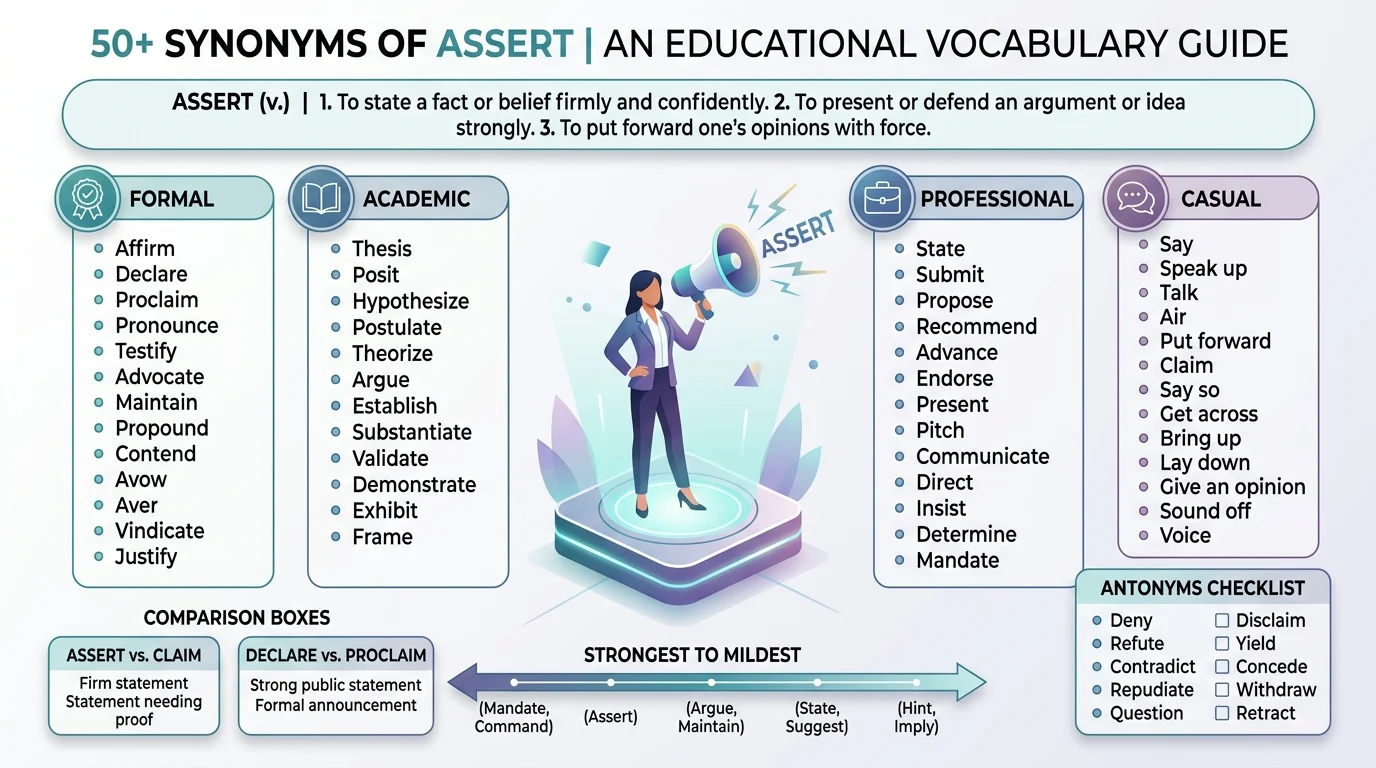
Have you ever needed to state something firmly or demand recognition for your rights but found yourself overusing the same word? You want to express confidence and conviction, and the word “assert” comes to mind. Choosing the right synonym for “assert” can transform a simple statement into a powerful declaration of belief or authority. This guide explores the best synonyms of assert, explaining exactly which word to use and when.
Quick Ans: “Assert” means to state something confidently and forcefully, often without needing proof or evidence . For strong declarations, choose declare or affirm. For formal contexts, use aver or avow. For standing up for rights, use insist or maintain. In philosophical contexts, posit or postulate are appropriate .
Meaning, Tone, and Context
Understanding the core meaning of “assert” is the first step to using it effectively.
Simple Definition: To state something positively and often forcefully; to demand that others accept or respect something .
Part of Speech: Verb.
Overall Tone: Confident and often forceful. It implies speaking without needing proof or evidence .
Formality Level: Neutral to formal. The word is appropriate in professional, academic, and legal contexts.
Common Uses: Native English speakers use it to declare facts, defend rights, or demand recognition. For example, “He asserted his innocence,” or “The group asserts that the policy is harmful” .
Word Forms: Related words include the noun assertion, the adjective assertive, and the adverb assertively.
When and How to Use “Assert”
“Assert” is the perfect choice when you want to state something confidently, especially in the face of potential disagreement . Here are seven realistic examples.
Professional: “The report asserts that the company’s new strategy will increase market share.”
Academic: “The researcher asserts that the findings align with previous studies.”
Legal: “The defendant continued to assert his innocence despite the evidence against him” .
Personal: “She learned to assert her independence from her parents by getting her own apartment” .
Workplace: “The manager needed to assert his authority over the team to maintain order.”
Email: “I must assert that the deadline is non-negotiable.”
Social Media: “It’s important to assert your values and stand up for what you believe in.”
Best Synonyms of “Assert”
No synonym is identical in every situation. Here is your guide to the best replacement for “assert” based on your writing context.
For Stating Confidently
Strong & Direct: Declare emphasizes open or public statement . “She declared her support for the candidate” .
Strong & Conviction: Affirm implies conviction based on evidence, experience, or faith . “He affirmed his belief in the project.”
Formal & Frank: Avow stresses frank declaration and acknowledgment of personal responsibility . “He avowed that all investors would be repaid in full” .
When Facing Doubt: Protest emphasizes affirming in the face of denial or doubt . “She protested that she had been misquoted” .
Legal & Formal: Aver is a formal synonym for declaring something to be true . “The witness averred that he saw the accused at the scene.”
Philosophical: Posit or Postulate are used in formal contexts to assume or propose something . “The theory posits a direct relationship between the two variables.”
For Defending Rights or Authority
Strong & Resolute: Insist means to be emphatic and refuse to budge . “I must insist on my right to see the document.”
Claim & Defend: Maintain means to argue for or uphold . “He maintained his position throughout the debate.”
To Insist on Having: Claim can be used when asserting a right . “She claimed her rightful inheritance.”
When Not to Use “Assert”
Using “assert” can sound wrong or awkward in certain situations.
When You Lack Confidence: “Assert” implies confidence. Use suggest or propose for tentative ideas.
Better Choice: Suggest. “I suggest we take a different approach.”
When You Want to Avoid Conflict: “Assert” can sound aggressive. Use state or mention for a neutral tone.
Better Choice: State. “I just want to state my opinion.”
When Presenting Evidence: “Assert” does not require proof . Use demonstrate or prove when you have evidence.
Better Choice: Demonstrate. “The data demonstrates the need for change.”
Words Commonly Confused With “Assert”
Several words are often mixed up with “assert.” Here is how to keep them straight.
Word: Declare
Difference: Stresses open or public statement. “Assert” is confident but can be private or public .
When to Use: Use it for making something known to the public.
Example: “The government declared a state of emergency.”
Word: Affirm
Difference: Implies conviction based on evidence or faith. “Assert” implies confidence without evidence .
When to Use: Use this when you have a strong personal conviction.
Example: “She affirmed her commitment to the organization.”
Word: Avow
Difference: Stresses frank acknowledgment of personal responsibility. “Assert” does not have this connotation .
When to Use: Use this when acknowledging something personally.
Example: “He avowed his love for her.”
Word: Protest
Difference: Emphasizes affirming in the face of denial or doubt. “Assert” is more neutral .
When to Use: Use this when someone is denying something.
Example: “He protested that he was innocent.”
Word: Maintain
Difference: Means to continue to assert something over time. “Assert” can be a one-time action .
When to Use: Use this for a position you consistently hold.
Example: “She maintained her stance throughout the debate.”
Word: Insist
Difference: Emphasizes refusing to budge. “Assert” emphasizes the act of stating confidently .
When to Use: Use this when you are being resolute.
Example: “I must insist on your presence.”
Best Synonyms of “Assert” by Context
| Context | Best Synonym | Why It Works | Example |
|---|---|---|---|
| Strong declaration | Declare | Emphasizes open, public statement . | “The president declared his intention to run again.” |
| Conviction-based statement | Affirm | Implies deep personal conviction . | “She affirmed her belief in equality.” |
| Facing opposition | Protest | Strongly asserts in the face of doubt . | “He protested that the charges were false.” |
| Formal acknowledgment | Avow | Stresses frank, personal declaration . | “The CEO avowed his commitment to the shareholders.” |
| Legal context | Aver | Formal and precise. | “The witness averred that he saw the suspect.” |
| Philosophical context | Posit / Postulate | Used for proposing theories. | “The theory posits a connection between poverty and crime” . |
| Defending rights | Insist | Emphasizes being resolute . | “She insisted on her right to speak.” |
| Maintaining position | Maintain | Suggests a consistent stance . | “He has always maintained that he is innocent.” |
How to Choose the Best Synonym of “Assert”
Choosing the right word is a simple decision. Answer these questions.
What is my audience? For a formal report, use declare, affirm, or aver. For a friend, use insist or claim.
What is my purpose? Are you making a public statement, defending a right, or proposing an idea? Use declare for public, insist for rights, and posit for ideas.
Do I have evidence? If you have proof, use demonstrate. If you are stating a belief, use assert or affirm. And if you are stating without proof, assert is the correct choice .
What is the emotional strength? Insist is stronger and more resolute. State is mild and neutral. Pick the one that matches your message.
Real Life Examples of “Assert”
To truly master the word, it helps to see how it behaves in the wild and how a stronger synonym can elevate the sentence.
School: Basic: “The student asserted the answer.” Improved: “The student declared the answer with confidence.”
College: Basic: “The researcher asserted the theory.” Improved: “The researcher postulated a new theory on climate change.”
Workplace: Basic: “He asserted his leadership.” Improved: “He demonstrated his leadership through decisive action.”
Legal: Basic: “He asserted his innocence.” Improved: “He averred his innocence before the judge.”
Email: Basic: “I assert the deadline is tomorrow.” Improved: “I must insist that the deadline is tomorrow.”
Conversation: Basic: “I assert my right to leave.” Improved: “I claim my right to leave early.”
Storytelling: Basic: “The knight asserted his honor.” Improved: “The knight avowed his honor before the court.”
Top 10 Synonyms of “Assert”
| Synonym | Simple Meaning | Best Used For | Example Sentence |
|---|---|---|---|
| Declare | State openly and publicly | Public announcements and declarations . | “The company declared its quarterly earnings.” |
| Affirm | State with strong conviction | Personal beliefs and commitments . | “He affirmed his commitment to the project.” |
| Avow | Acknowledge and state frankly | Personal declarations and confessions . | “She avowed her support for the new policy.” |
| Protest | Insist in the face of denial | Responding to accusations . | “He protested that he had not taken the money.” |
| Insist | Be resolute and refuse to budge | Demanding action or recognition . | “She insisted on seeing the manager.” |
| Maintain | Consistently assert over time | Ongoing positions and beliefs . | “The scholar has maintained this position for years.” |
| Aver | Declare formally as true | Legal and formal contexts . | “The witness averred that he had seen the crime.” |
| Posit | Assume or propose as true | Philosophical and theoretical contexts . | “The author posits that violence is learned behavior.” |
| Postulate | Propose as a basis for reasoning | Scientific and theoretical contexts . | “The theory postulates the existence of dark matter.” |
| Claim | Assert as a right or fact | Claiming ownership or credit . | “She claimed her inheritance from the estate.” |
Synonyms of “Assert” by Usage
Professional vs. Personal Synonyms
In the workplace (professional), choose declare, maintain, or aver to state positions. These words convey confidence and professionalism. “I must declare my support for the proposal” is more formal than “I assert my support.”
With friends (personal), insist or claim keep the tone relaxed and relatable. These alternatives sound natural in everyday conversation.
Formal vs. Conversational Synonyms
For formal writing (reports, essays, professional emails), use avow, aver, or affirm . These choices maintain the sophisticated tone expected in professional documents.
For casual conversations and texting, use insist, claim, or state. These options sound more natural and less pretentious.
Academic Synonyms
For research and essays, choose precise, authoritative words. Posit and postulate are great for theories . Maintain is suitable for arguments. These words sound considered and scholarly.
Professional and Business Synonyms
For maximum impact in business writing, choose declare for announcements, maintain for consistent positions, and insist for demands. These words demonstrate confidence and professional awareness.
Creative and Literary Synonyms
To add emotion and imagery to your writing, choose avow, declare, or protest. These words create drama and reveal character.
Strongest to Mildest Synonyms
Mild: state, mention, say
Moderate: assert, claim, maintain
Strong: declare, affirm, insist
Very Strong: avow, aver, protest, postulate
Emotional vs. Neutral Synonyms
Emotional Synonyms: Protest, avow, insist. These words often hint at passion, defiance, or strong conviction . Use them when you want to evoke feeling.
Neutral Synonyms: State, claim, maintain. These words simply communicate factual information. Use them when you want to inform without emotional coloring.
Antonyms of “Assert”
Here are the genuine opposites of “assert” .
| Antonym | Meaning | Example Sentence |
|---|---|---|
| Deny | Refuse to admit the truth | “He denied the accusations against him.” |
| Contradict | Declare the opposite | “His testimony contradicted the witness.” |
| Dispute | Question the truth | “The expert disputed the findings.” |
| Refute | Prove to be false | “The evidence refuted the claims.” |
| Retract | Withdraw a statement | “He retracted his earlier assertion.” |
| Concede | Admit something is true | “She conceded that she was wrong.” |
| Repudiate | Reject the validity | “He repudiated the charges.” |
Comparison: “Assert” vs Similar Words
Assert vs. Declare
Main Difference: “Declare” emphasizes open, public statement. “Assert” implies confidence without requiring proof .
Which Is Stronger? They are similar in strength. “Declare” is more formal and public.
Which Is More Formal? Both are formal, but “declare” is often used for official statements.
When to Use Each: Use “assert” for confident statements without proof. Use “declare” for public announcements.
Examples:
Assert: “The author asserts that poverty is the city’s most serious problem” .
Declare: “The government declared a state of emergency.”
Assert vs. Affirm
Main Difference: “Affirm” implies conviction based on evidence or faith. “Assert” implies confidence without needing evidence .
Which Is Stronger? They are similar. “Affirm” suggests deeper personal conviction.
Which Is More Formal? Both are formal.
When to Use Each: Use “assert” for confident statements. Use “affirm” when you want to emphasize deep conviction.
Examples:
Assert: “He asserted that modern music is just noise” .
Affirm: “She affirmed the existence of an afterlife” .
Assert vs. Avow
Main Difference: “Avow” stresses frank declaration and acknowledgment of personal responsibility. “Assert” does not have this connotation .
Which Is Stronger? “Avow” is stronger for personal responsibility.
Which Is More Formal? Both are very formal.
When to Use Each: Use “assert” for general statements. Use “avow” when acknowledging personal beliefs.
Examples:
Assert: “The group asserts that the smoking ban will negatively affect businesses” .
Avow: “He avowed that all investors would be repaid in full” .
Assert vs. Maintain
Main Difference: “Maintain” suggests consistently asserting something over time. “Assert” can be a one-time action .
Which Is Stronger? They are similar. “Maintain” implies persistence.
Which Is More Formal? Both are formal.
When to Use Each: Use “maintain” for a position you hold over time. Use “assert” for a single declaration.
Examples:
Assert: “He asserted his innocence at the trial.”
Maintain: “He has maintained his innocence for years.”
Assert vs. Insist
Main Difference: “Insist” emphasizes being resolute and refusing to budge. “Assert” emphasizes the act of stating confidently .
Which Is Stronger? “Insist” is stronger for demanding action or recognition.
Which Is More Formal? Both are neutral.
When to Use Each: Use “assert” for stating a fact or belief. Use “insist” when you are demanding something.
Examples:
Assert: “The authors assert that poverty is the city’s most serious problem” .
Insist: “I must insist on my right to see the document.”
Common Phrases and Expressions with “Assert”
Phrase: Assert oneself
Meaning: To speak or act in a way that demands attention or recognition .
Example Sentence: “If you want people to listen to your opinions, you need to learn how to assert yourself” .
Phrase: Assert authority
Meaning: To make it clear that you have authority .
Example Sentence: “The boss was reluctant to assert his authority over his employees” .
Phrase: Assert independence
Meaning: To demand freedom and autonomy .
Example Sentence: “She asserted her independence from her parents by getting her own apartment” .
Phrase: Assert innocence
Meaning: To state that one is not guilty .
Example Sentence: “Despite the evidence against him, he has continued to assert his innocence” .
Phrase: Assert rights
Meaning: To demand that others respect one’s rights .
Example Sentence: “The workers are asserting their rights to fair wages.”
Phrase: Assert a claim
Meaning: To demand something as a right .
Example Sentence: “The heirs are asserting their claim to the property.”
Common Mistakes to Avoid
Mistake 1: Using “assert” when you mean “prove”.
Incorrect: “The data asserts the need for change.”
Better: “The data demonstrates the need for change.”
Why: Assert implies a confident statement without proof. Demonstrate implies evidence.
Mistake 2: Using “assert” when you mean “suggest”.
Incorrect: “I assert we should take a break.”
Better: “I suggest we should take a break.”
Why: Assert is for confident statements. Suggest is for tentative ideas.
Mistake 3: Overusing “assert” in conversation.
Incorrect: “I assert that the movie is good.”
Better: “I think the movie is good.”
Why: Think sounds more natural in casual conversation.
Mistake 4: Confusing “assert” with “insist”.
Incorrect: “He asserted on his right to speak.”
Better: “He insisted on his right to speak.”
Why: Insist is used with “on” when demanding something.
Mistake 5: Using “assert” without an object.
Incorrect: “He asserted.”
Better: “He asserted his innocence.”
Why: Assert is a transitive verb and needs an object.
Frequently Asked Questions
1. What are the best synonyms of “assert”?
The best synonyms depend on your context. For strong declarations, choose declare or affirm. formal contexts, use aver or avow. For standing up for rights, use insist or maintain .
2. What are the best formal synonyms of “assert”?
The best formal synonyms are declare, affirm, avow, and aver. These words are suitable for academic papers, professional reports, and legal communications .
3. What are common informal synonyms of “assert”?
For informal settings, use insist, claim, or state. These alternatives sound more natural in everyday conversation .
4. What is the difference between “assert” and “declare”?
“Declare” stresses open and public statement. “Assert” implies stating confidently without need for proof .
5. What is the difference between “assert” and “affirm”?
“Affirm” implies conviction based on evidence, experience, or faith. “Assert” implies confidence without needing evidence .
6. What is the opposite of “assert”?
The most direct opposites (antonyms) of assert are deny, contradict, and dispute .
Conclusion
“Assert” is a powerful and confident word for stating beliefs and demanding recognition. The term is widely accepted in most contexts, yet it can sound too strong for tentative ideas or too formal for casual conversation. The best choice among the synonyms of assert depends entirely on your audience, tone, and purpose.Remember, no single synonym works perfectly in every situation. Your goal is to choose the word that communicates your message with the most clarity and impact. A practical tip for your vocabulary growth is to pay attention to how confident speakers and writers state their ideas and practice using different synonyms in your writing.









