Have you ever needed to describe something that is enough to meet a need or requirement but felt that “enough” or “adequate” did not fully capture the nuance? You want to highlight having the necessary quantity, quality, or degree, and the word “sufficient” comes to mind. But is it the best fit for your audience? Choosing the right synonym for “sufficient” can transform a simple statement into a precise assessment of adequacy, completeness, or capability. This guide explores the best synonyms of sufficient, explaining exactly which word to use and when.
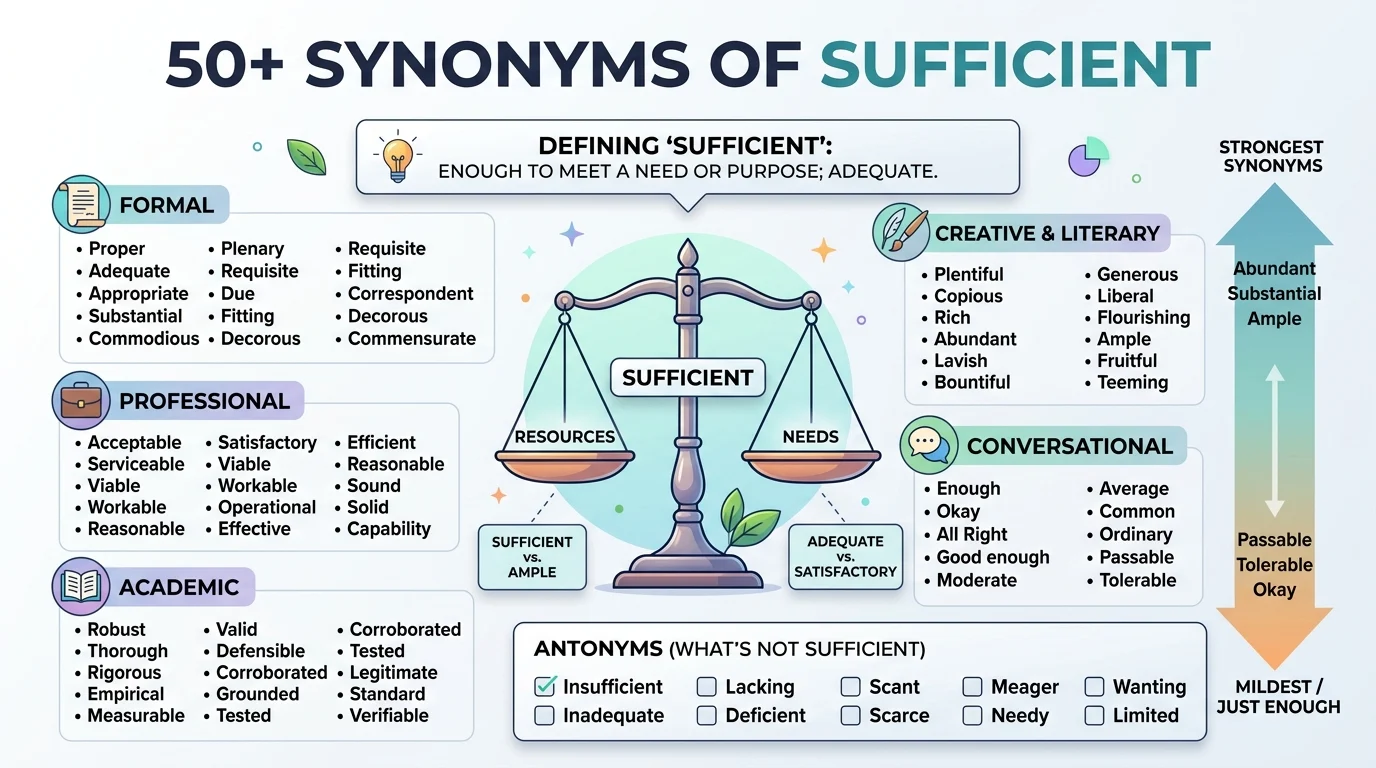
Quick Ans: “Sufficient” means having or providing as much as is needed, or enough to meet a specific requirement or need. It is a neutral-to-positive adjective. For formal writing, choose adequate or ample. For professional contexts, use satisfactory or acceptable. In academic settings, commensurate and requisite are strong choices. For a stronger emphasis on abundance, select plenty or abundant.
Meaning, Tone, and Context
Understanding the core meaning of “sufficient” is the first step to using it effectively.
Simple Definition: Enough to meet a need or purpose. As much as is required or necessary.
Part of Speech: Adjective.
Overall Tone: Neutral to positive. It indicates adequacy and fulfillment of requirements.
Formality Level: Formal. The word is most appropriate in professional, academic, and business contexts.
Common Uses: Native English speakers use it to describe resources, evidence, knowledge, amounts, and conditions. For example, “The evidence was sufficient to convict him,” or “We have sufficient funds to complete the project.”
Word Forms: Related words include the noun sufficiency, the adverb sufficiently, and the verb suffice.
When and How to Use “Sufficient”
“Sufficient” is the perfect choice when you want to emphasize that something meets a standard or requirement exactly. Here are seven realistic examples.
Professional: “The budget is sufficient to cover all projected expenses.”
Academic: “The study provided sufficient evidence to support the hypothesis.”
Workplace: “We have sufficient staff to handle the increased workload.”
Personal: “I believe I have sufficient experience to apply for this position.”
Email: “Please confirm that you have sufficient resources to complete the task.”
Resume: “Managed operations with sufficient resources to meet all deadlines.”
Social Media: “A sufficient amount of sleep is essential for a productive day.”
Best Synonyms of “Sufficient”
No synonym is identical in every situation. Here is your guide to the best replacement for “sufficient” based on your writing context.
Professional Writing: Adequate. It suggests meeting the minimum required standard. “The candidate has adequate qualifications for the role.”
Academic Writing: Commensurate. This is ideal when discussing things that are proportional to a requirement. “The salary is commensurate with the candidate’s experience.”
Business Communication: Satisfactory. A practical choice for meeting expectations. “The performance review was satisfactory.”
Casual Conversation: Enough. It tones down the formality and sounds natural. “We have enough food for everyone.”
Emotional Writing: Plentiful. This word carries weight, suggesting generosity or abundance. “The plentiful supply of water sustained the village.”
Creative Writing: Ample. It implies more than enough, with room to spare. “The ample garden provided space for all her flowers.”
Resume Writing: Competent. Use it to describe the ability to meet requirements. “I am competent in all areas of project management.”
When Not to Use “Sufficient”
Using “sufficient” can sound wrong or awkward in certain situations.
When It Sounds Too Formal: In casual conversation, “sufficient” sounds overly formal.
Better Choice: Enough or plenty. “We have enough time to get there.”
When You Mean “Exactly” Enough: “Sufficient” can be vague about exact amounts.
Better Choice: Exact or specific number. “We need exactly 50 people.”
When You Mean Abundant: “Sufficient” means just enough, not a lot.
Better Choice: Ample or abundant. “We have ample resources for everyone.”
When It Sounds Too Clinical: “Sufficient” can sound like a legal term.
Better Choice: Good enough. “The work is good enough.”
Words Commonly Confused With “Sufficient”
Several words are often mixed up with “sufficient.” Here is how to keep them straight.
Word: Adequate
Difference: Means meeting the minimum standard. “Sufficient” implies enough, but adequate often implies just barely enough.
When to Use: Use it when something meets requirements but no more.
Example: “His work was adequate, but not outstanding.”
Word: Ample
Difference: Means more than enough. “Sufficient” means exactly enough.
When to Use: Use this for quantities that are generous.
Example: “We have ample time to complete the project.”
Word: Satisfactory
Difference: Means acceptable or meeting approval. “Sufficient” is about quantity.
When to Use: Use this for quality or performance.
Example: “The product performance was satisfactory.”
Word: Enough
Difference: The most common and natural phrase. “Sufficient” is more formal.
When to Use: Use it in everyday situations.
Example: “Do you have enough money?”
Word: Abundant
Difference: Means existing in large quantities. “Sufficient” is about meeting a need.
When to Use: Use this for plentiful resources.
Example: “The region has abundant natural resources.”
Word: Scant
Difference: Means barely sufficient or not enough. “Sufficient” means enough.
When to Use: Use this for minimal amounts.
Example: “The scant evidence was not enough.”
Best Synonyms of “Sufficient” by Context
| Context | Best Synonym | Why It Works | Example |
|---|---|---|---|
| Formal writing | Adequate | Suggests meeting the minimum standard. | “The plan is adequate for our needs.” |
| Academic writing | Commensurate | Precise for proportional relationships. | “The salary is commensurate with experience.” |
| Professional communication | Satisfactory | Emphasizes meeting expectations. | “The candidate’s qualifications are satisfactory.” |
| Business emails | Enough | Professional yet accessible. | “We have enough resources to proceed.” |
| Resume writing | Competent | Highlights capability and meeting standards. | “Competent in financial analysis.” |
| Workplace communication | Adequate | The standard, neutral term. | “The staffing levels are adequate.” |
| Casual conversation | Enough | Simple, natural, and conversational. | “That is enough for me.” |
| Creative writing | Ample | Evokes generosity and abundance. | “The ample harvest filled the barns.” |
| Emotional writing | Plentiful | Suggests comfort and sufficiency. | “The plentiful food brought everyone joy.” |
| Strong emphasis | Abundant | Suggests great quantity. | “The abundant evidence proved the case.” |
| Mild tone | Passable | Simple and unassuming. | “His performance was passable.” |
| Social media captions | Enough | Widely understood and relatable. | “Enough is as good as a feast.” |
How to Choose the Best Synonym of “Sufficient”
Choosing the right word is a simple decision. Answer these questions.
What is my audience? For a professor or CEO, adequate or commensurate is powerful. For a friend, enough or plenty is more natural.
What is my purpose? Are you describing quantity, quality, or capability? Use adequate for quantity, satisfactory for quality, and competent for capability.
Am I describing resources, evidence, or performance? For resources, sufficient or ample work. And for evidence, adequate or convincing are better. For performance, satisfactory or acceptable are best.
What is the emotional strength? Abundant and plentiful are stronger. Passable and enough are mild. Pick the one that matches your message.
Real Life Examples of “Sufficient”
To truly master the word, it helps to see how it behaves in the wild and how a stronger synonym can elevate the sentence.
School: Basic: “The student had sufficient time to finish.” Improved: “The student had ample time to finish the exam.”
College: Basic: “The research provided sufficient data.” Improved: “The research provided adequate data to support the conclusion.”
Workplace: Basic: “We have sufficient staff.” Improved: “We have adequate staff to handle the increased workload.”
Business: Basic: “The budget was sufficient.” Improved: “The budget was commensurate with the project’s requirements.”
Email: Basic: “We have sufficient resources.” Improved: “We have enough resources to proceed with the plan.”
Conversation: Basic: “I have sufficient money.” Improved: “I have enough money to cover the expenses.”
Storytelling: Basic: “The village had sufficient food.” Improved: “The village had plentiful food to survive the winter.”
Top 10 Synonyms of “Sufficient”
| Synonym | Simple Meaning | Best Used For | Example Sentence |
|---|---|---|---|
| Adequate | Meeting the minimum standard | Formal, professional, and requirement contexts. | “The candidate’s skills are adequate for the role.” |
| Ample | More than enough | Creative, descriptive, and generous contexts. | “The ample supply of materials ensured success.” |
| Satisfactory | Acceptable and meeting expectations | Performance reviews, quality, and approval contexts. | “The test results were satisfactory.” |
| Commensurate | Proportional to the requirement | Academic, salary, and proportional contexts. | “The salary is commensurate with experience.” |
| Enough | As much as needed | Casual conversation and everyday contexts. | “We have enough time to catch the train.” |
| Abundant | Existing in large quantities | Natural resources, creative, and plentiful contexts. | “The region has abundant water supplies.” |
| Plentiful | Generous and sufficient amount | Personal, resource, and descriptive contexts. | “The plentiful harvest ensured survival.” |
| Competent | Capable of meeting requirements | Resumes, capabilities, and skills contexts. | “I am competent in data analysis.” |
| Sufficient | Enough for the need | Formal, general, and neutral contexts. | “The evidence was sufficient for a conviction.” |
| Passable | Just acceptable, not excellent | Casual, moderate, and mild contexts. | “The meal was passable but not great.” |
Synonyms of “Sufficient” by Usage
Professional vs. Personal Synonyms
In the workplace (professional), choose adequate, satisfactory, or competent to describe skills, performance, and resources. These words convey professionalism and objectivity. “The candidate has adequate qualifications” is more precise than “The candidate has enough qualifications.”
With friends (personal), enough, plenty, or just right keep the tone relaxed and relatable. These alternatives sound natural in everyday conversation.
Formal vs. Conversational Synonyms
For formal writing (reports, essays, professional emails), use adequate, commensurate, or satisfactory. These choices maintain the sophisticated tone expected in professional documents.
For casual conversations and texting, use enough, plenty, or just enough. These options sound more natural and less pretentious.
Academic Synonyms
For research and essays, choose precise, authoritative words. Commensurate is great for proportional relationships, adequate for evidence, and sufficient for general requirements. These words sound considered and scholarly.
Using precise academic vocabulary demonstrates expertise and careful thinking. Professors and reviewers expect this level of precision.
Professional and Business Synonyms
For maximum impact in business writing, choose adequate for meeting standards, commensurate for proportional compensation, and satisfactory for performance reviews. These words demonstrate confidence and professional awareness.
Business leaders respond to language that conveys clarity and objectivity. These synonyms project authority.
Creative and Literary Synonyms
To add emotion and imagery to your writing, choose ample, plentiful, or generous. These words create atmosphere and evoke feelings of sufficiency and comfort.
Literary writers use these alternatives to build setting and mood. They transform ordinary descriptions into evocative prose.
Slang or Modern Synonyms
In modern American slang, good enough or plenty can be used as casual alternatives. For example, “That is good enough,” or “We have plenty.” These are acceptable in casual contexts. Avoid them in professional or academic writing.
Strongest to Mildest Synonyms
Mild: enough, passable, acceptable
Moderate: sufficient, satisfactory, adequate
Strong: ample, competent, plentiful
Very Strong: abundant, generous, lavish
Emotional vs. Neutral Synonyms
Emotional Synonyms: Plentiful, generous, abundant. These words often hint at comfort, gratitude, or generosity. Use them when you want to evoke feeling.
Neutral Synonyms: Enough, adequate, sufficient. These words simply communicate factual information. Use them when you want to inform without emotional coloring.
Antonyms of “Sufficient”
Here are 15 genuine opposites of “sufficient.”
| Antonym | Meaning | Example Sentence |
|---|---|---|
| Insufficient | Not enough | “The insufficient evidence led to a dismissal.” |
| Inadequate | Not meeting the standard | “The inadequate resources caused the project to fail.” |
| Scant | Barely enough or not enough | “The scant information was not helpful.” |
| Meager | Lacking in quantity or quality | “The meager portions left everyone hungry.” |
| Deficient | Lacking in necessary quality | “The deficient funding cut the program short.” |
| Lacking | Not having enough | “The lacking support delayed the launch.” |
| Wanting | Missing or deficient | “The plan was wanting in several areas.” |
| Unsatisfactory | Not acceptable | “The unsatisfactory results were rejected.” |
| Scarce | Insufficient for demand | “Clean water is scarce in many regions.” |
| Sparse | Thinly dispersed or limited | “The sparse evidence was unconvincing.” |
| Incompetent | Lacking ability | “The incompetent manager was replaced.” |
| Failing | Not meeting expectations | “The failing grade was a disappointment.” |
| Poor | Low in quality or amount | “The poor attendance was a concern.” |
| Dwindling | Gradually decreasing | “The dwindling supplies were alarming.” |
| Exhausted | Used up completely | “The exhausted resources had to be replenished.” |
Comparison: “Sufficient” vs Similar Words
Sufficient vs. Adequate
Main Difference: Sufficient means enough for a specific need. Adequate means meeting the minimum standard or barely enough.
Which Is Stronger? Sufficient is stronger and implies meeting a requirement. Adequate often implies just barely meeting it.
Which Is More Formal? Both are formal.
When to Use Each: Use sufficient for general needs. Use adequate for minimum standards.
Examples:
Sufficient: “We have sufficient funds for the project.”
Adequate: “His performance was adequate, but not outstanding.”
Sufficient vs. Ample
Main Difference: Sufficient means exactly enough. Ample means more than enough.
Which Is Stronger? Ample is stronger and implies generosity.
Which Is More Formal? Both are formal, but ample is more descriptive.
When to Use Each: Use sufficient for meeting requirements. Use ample for having extra.
Examples:
Sufficient: “We have sufficient time to finish.”
Ample: “We have ample time to spare.”
Sufficient vs. Satisfactory
Main Difference: Sufficient is about quantity. Satisfactory is about quality and approval.
Which Is Stronger? They are different in application. Satisfactory implies meeting approval.
Which Is More Formal? Both are formal.
When to Use Each: Use sufficient for amounts. Use satisfactory for quality.
Examples:
Sufficient: “We have sufficient evidence.”
Satisfactory: “The results were satisfactory.”
Sufficient vs. Enough
Main Difference: Sufficient is formal. Enough is the common, natural phrase.
Which Is Stronger? They are identical in meaning. Sufficient is more formal.
Which Is More Formal? Sufficient is formal. Enough is neutral.
When to Use Each: Use sufficient in formal writing. Use enough in conversation.
Examples:
Sufficient: “The training was sufficient for the role.”
Enough: “We have enough food for everyone.”
Sufficient vs. Commensurate
Main Difference: Sufficient is about enough. Commensurate is about being proportional.
Which Is Stronger? Commensurate is more precise about relationships.
Which Is More Formal? Both are formal, but commensurate is more technical.
When to Use Each: Use sufficient for general needs. Use commensurate for proportional relationships.
Examples:
Sufficient: “We have sufficient resources.”
Commensurate: “The salary is commensurate with experience.”
Sufficient vs. Plentiful
Main Difference: Sufficient means enough. Plentiful means abundant and generous.
Which Is Stronger? Plentiful is stronger and suggests plenty to spare.
Which Is More Formal? Plentiful is more descriptive and slightly less formal.
When to Use Each: Use sufficient for exact needs. Use plentiful for abundance.
Examples:
Sufficient: “The harvest was sufficient to feed the village.”
Plentiful: “The plentiful rain produced a bountiful harvest.”
Common Phrases and Expressions with “Sufficient”
Phrase: Sufficient evidence
Meaning: Enough proof to make a decision or conviction.
Example Sentence: “The police had sufficient evidence to make an arrest.”
Phrase: Sufficient funds
Meaning: Enough money to cover expenses.
Example Sentence: “We do not have sufficient funds to proceed.”
Phrase: Sufficient time
Meaning: Enough time to complete a task.
Example Sentence: “Please allocate sufficient time for the presentation.”
Phrase: Sufficient experience
Meaning: Enough expertise or background.
Example Sentence: “The candidate has sufficient experience for the role.”
Phrase: Sufficient resources
Meaning: Enough materials or support.
Example Sentence: “The project has sufficient resources to succeed.”
Phrase: Self-sufficient
Meaning: Able to maintain oneself without outside help.
Example Sentence: “The community is self-sufficient in food production.”
Common Mistakes to Avoid
Mistake 1: Using “sufficient” when you mean “adequate”.
Incorrect: “His performance was sufficient, but not great.”
Better: “His performance was adequate, but not great.”
Why: Adequate is better for minimum standards.
Mistake 2: Using “sufficient” when you mean “ample”.
Incorrect: “We had sufficient food to feed an army.”
Better: “We had ample food to feed an army.”
Why: Ample suggests more than enough.
Mistake 3: Overusing “sufficient” in casual conversation.
Incorrect: “I have sufficient money for coffee.”
Better: “I have enough money for coffee.”
Why: Enough sounds more natural.
Mistake 4: Using “commensurate” when you mean “sufficient”.
Incorrect: “We have commensurate supplies.”
Better: “We have sufficient supplies.”
Why: Commensurate is about being proportional, not quantity.
Mistake 5: Using “satisfactory” when you mean “sufficient”.
Incorrect: “We have satisfactory resources.”
Better: “We have sufficient resources.”
Why: Satisfactory is about quality, not quantity.
Frequently Asked Questions
1. What are the best synonyms of “sufficient”?
The best synonyms depend on your context. For formal writing, choose adequate or commensurate. And for casual conversation, enough or plenty are ideal choices. For quality contexts, use satisfactory.
2. What are the best formal synonyms of “sufficient”?
The best formal synonyms are adequate, commensurate, and satisfactory. These words are suitable for academic papers, professional reports, and business communications.
3. What are common informal synonyms of “sufficient”?
For informal settings, use enough, plenty, or good enough. These alternatives sound more natural in everyday conversation.
4. What is another word for “sufficient” in professional writing?
In professional writing, adequate is an excellent choice. It conveys meeting the minimum standard. Commensurate is also strong for proportional relationships.
5. What is the difference between “sufficient” and “adequate”?
While both indicate enough, sufficient implies exactly enough for a need. Adequate implies meeting the minimum standard. Use sufficient for general needs and adequate for minimum requirements.
6. What is the opposite of “sufficient”?
The most direct opposites (antonyms) of sufficient are insufficient, inadequate, and deficient. These words describe things that are not enough.
Conclusion
“Sufficient” is a precise and formal word for describing enough quantity, quality, or resources to meet a need. The term is formal and widely accepted in most contexts, yet it can sound too clinical for everyday conversation. The best choice among the synonyms of sufficient depends entirely on your audience, tone, and purpose. Remember, no single synonym works perfectly in every situation. Your goal is to choose the word that communicates your message with the most clarity and impact. A practical tip for your vocabulary growth is to pay attention to how writers describe adequacy and practice using different synonyms in your writing.
Discover More:
- 50+ Synonyms of Summary: Meanings, Uses, Examples, and Best Alternatives 2026
- 50+ Synonyms of Vast: Meanings, Uses, Examples, and Best Alternatives 2026

Alexander Cole is a professional content writer and researcher who specializes in creating informative, reader-friendly, and well-researched articles. He is committed to publishing accurate, valuable, and engaging content that helps readers stay informed and make smarter decisions.