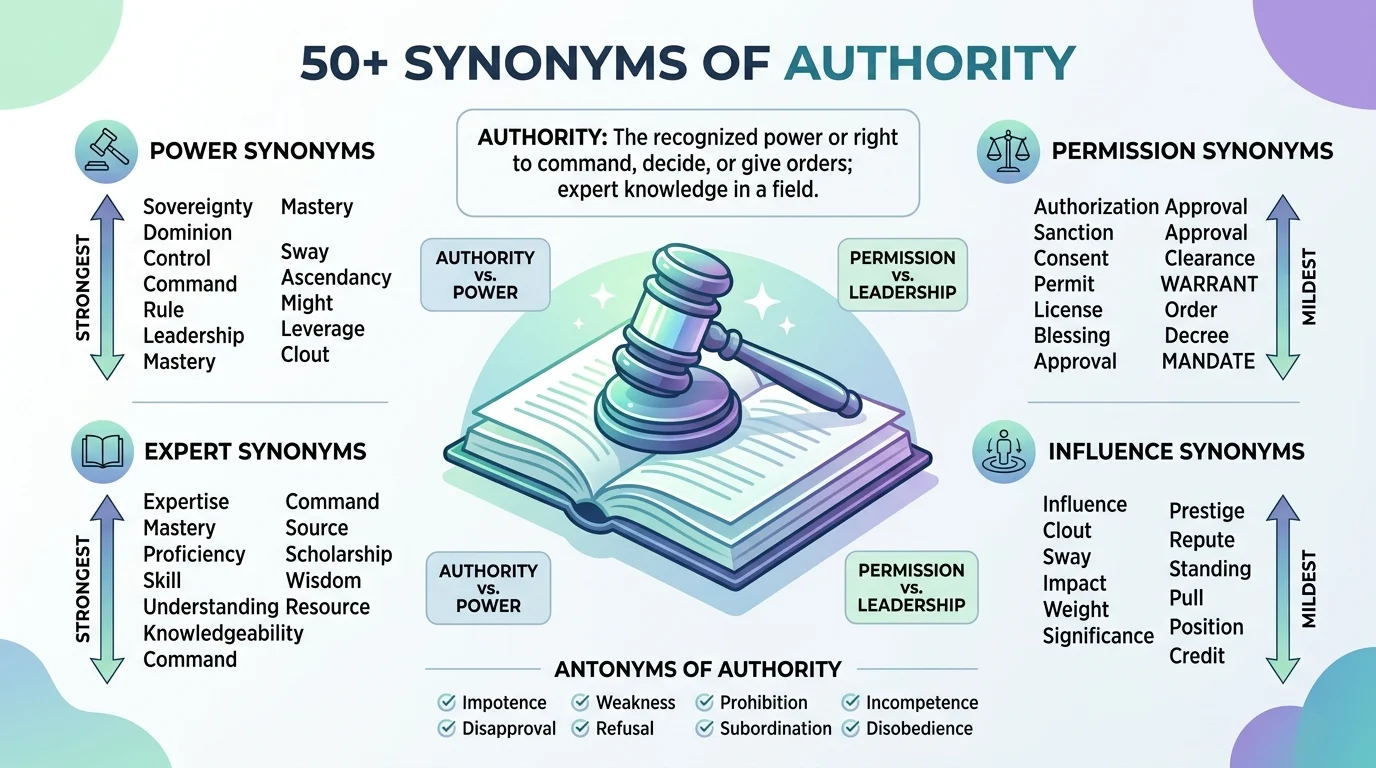
Have you ever struggled to describe someone’s right to lead, their expertise in a field, or the officials who enforce laws? You want to capture the power to command, the confidence of an expert, or the official permission to act, and the word “authority” comes to mind. Choosing the right synonym for “authority” can transform a general statement into a precise description of power, expertise, or control. This guide explores the best synonyms of authority, explaining exactly which word to use and when.
Quick Ans: “Authority” has multiple meanings: the power to give orders, an expert on a subject, or official permission . For power and control, choose command or jurisdiction . For an expert, use specialist or mentor . For official permission, use authorization or sanction .
Meaning, Tone, and Context
Understanding the core meaning of “authority” is the first step to using it effectively .
Simple Definition: The power or right to give orders, make decisions, and enforce obedience. It can also refer to an expert whose views are taken as definitive .
Part of Speech: Noun.
Overall Tone: Neutral. It can describe official power, personal confidence, or knowledge.
Formality Level: Formal. The word is primarily used in professional, academic, and legal contexts.
Common Uses: Native English speakers use it to describe the right to command, the officials who enforce laws, or a person with deep knowledge of a subject . For example, “She has the authority to approve the budget,” or “He is an authority on ancient history.”
Word Forms: Related words include the verb authorize, the adjective authoritative, and the adverb authoritatively.
When and How to Use “Authority”
“Authority” is the perfect choice when you want to emphasize the right to command, expertise, or official permission. Here are seven realistic examples.
Professional: “Only department managers have the authority to approve expenditures.”
Academic: “He is a leading authority on climate change policy.”
Workplace: “The CEO spoke with authority, inspiring confidence in the team.”
Legal: “The court has jurisdiction, or legal authority, to hear this case.”
Personal: “After years of practice, she handles difficult situations with authority.”
Email: “You have my full authority to negotiate the contract.”
Social Media: “Real authority comes from expertise and experience, not a title.”
Best Synonyms of “Authority”
No synonym is identical in every situation. Here is your guide to the best replacement for “authority” based on your writing context .
Describing Power and Control: Command or Jurisdiction. These emphasize the right to direct and make decisions . “The general has command of the entire division.”
Describing an Expert: Specialist or mentor. These refer to someone with deep knowledge in a field . “She is a renowned specialist in pediatric medicine.”
Describing Official Permission: Authorization or Sanction. These refer to the legal right or approval to act . “He was given authorization to access the building.”
Describing Official Bodies: Administration or Officials. These refer to the governing bodies or the people in power . “The local administration passed the new law.”
Describing Influence: Sway or Weight. These describe the power to affect opinions . “His opinion carried a lot of weight in the discussion.”
Describing Confidence: Assurance or Mastery. These describe the confident quality of an expert . “She spoke with masterful assurance.”
When Not to Use “Authority”
Using “authority” can sound wrong or awkward in certain situations.
When It Sounds Too Formal: In casual conversation, “authority” can sound overly official.
Better Choice: Power or say. “Do you have the final say?”
When You Mean Physical Force: “Authority” is about the right to command, not physical power .
Better Choice: Force or might. “The police used force to control the crowd.”
When You Mean A Simple Idea: “Authority” is a complex term, not a simple thought.
Better Choice: Opinion or viewpoint. “That is just his viewpoint.”
Words Commonly Confused With “Authority”
Several words are often mixed up with “authority.” Here is how to keep them straight .
Word: Power
Difference: “Power” is the general ability to act or force others. “Authority” is the specific right to do so .
When to Use: Use it for ability or physical strength.
Example: “The Prime Minister has the power to dismiss senior ministers.”
Word: Influence
Difference: “Influence” is the ability to affect others without formal right . “Authority” implies a formal right .
When to Use: Use this for persuasion.
Example: “As we grew older, I had less influence over him.”
Word: Control
Difference: “Control” is the power to direct and restrain . “Authority” is the right to do so .
When to Use: Use this for managing situations.
Example: “You are responsible for the students under your control.”
Word: Jurisdiction
Difference: “Jurisdiction” is official power within specific limits .
When to Use: Use this for legal or geographic limits.
Example: “The British police have no jurisdiction over foreign bank accounts.”
Word: Expert
Difference: “Expert” is a person with deep skill . “Authority” can also mean the person or the right .
When to Use: Use this for specific skills.
Example: “Professor Ahmed is an authority on Russian affairs.”
Best Synonyms of “Authority” by Context
| Context | Best Synonym | Why It Works | Example |
|---|---|---|---|
| Power and Control | Command or Jurisdiction | Emphasizes the right to direct | “The general has command of the division.” |
| Describing an Expert | Specialist or Mentor | Refers to deep knowledge | “She is a leading specialist in the field.” |
| Official Permission | Authorization or Sanction | Refers to legal approval | “He was given authorization to proceed.” |
| Official Bodies | Administration or Officials | Refers to governing bodies | “The administration passed the new law.” |
| Describing Influence | Sway or Weight | Describes power to affect opinions | “His opinion carried a lot of weight.” |
| Describing Confidence | Assurance or Mastery | Describes confident expertise | “She spoke with masterful assurance.” |
How to Choose the Best Synonym of “Authority”
Choosing the right word is a simple decision. Answer these questions.
What type of authority am I describing? For the right to command, use power, control, or jurisdiction. And for a knowledgeable person, use expert or specialist. For official permission, use authorization or sanction. For influence, use sway or weight.
What is my audience? For a professor or CEO, jurisdiction or mastery is powerful. For a friend, say or expert is more natural.
What is my purpose? Are you trying to describe legal right, personal confidence, or expertise? The correct synonym depends entirely on this.
What is the emotional strength? Supremacy is very strong. Say-so is mild. Pick the one that matches your message.
Real Life Examples of “Authority”
To truly master the word, it helps to see how it behaves in the wild.
School: Basic: “The principal has authority.” Improved: “The principal has the power to enforce school rules.”
College: Basic: “The professor is an authority.” Improved: “The professor is an expert in Renaissance history.”
Workplace: Basic: “The manager has authority.” Improved: “The manager has the authorization to approve the budget.”
Business: Basic: “They are the authority.” Improved: “They are the regulatory authority for the energy sector.”
Email: Basic: “I have authority.” Improved: “I have the official permission to sign the contract.”
Conversation: Basic: “She has authority.” Improved: “She is the real expert on that topic.”
Storytelling: Basic: “He spoke with authority.” Improved: “He spoke with the calm assurance of a true master.”
Top 15 Synonyms of “Authority”
| Synonym | Simple Meaning | Best Used For | Example Sentence |
|---|---|---|---|
| Command | The power to direct | Military, management | “The general has command of the entire division.” |
| Jurisdiction | Official power within limits | Legal, government contexts | “The court has no jurisdiction in this matter.” |
| Expert | A person with deep knowledge | Academic, professional | “He is an expert on corporate law.” |
| Specialist | A person focused on one area | Medical, technical fields | “She is a specialist in pediatric medicine.” |
| Mentor | A respected teacher or expert | Philosophy, business | “He is a fashion mentor.” |
| Authorization | Official approval | Legal, business contexts | “He received authorization to access the building.” |
| Sanction | Official permission | Legal, diplomatic contexts | “The sanctions were lifted.” |
| Administration | The governing body | Political, business | “The administration passed the new law.” |
| Officials | People with power | Government, law enforcement | “The officials issued a curfew.” |
| Sway | Influence over others | Political, social contexts | “He has a lot of sway in the community.” |
| Weight | Decisive influence | Professional, persuasive contexts | “His opinion carries a lot of weight.” |
| Assurance | Confident certainty | Personal, leadership contexts | “She spoke with great assurance.” |
| Mastery | Complete command of a subject | Academic, artistic contexts | “He has mastery over the subject.” |
| Dominion | Supreme power | Historical, formal contexts | “The kingdom extended its dominion.” |
| Prerogative | A special right or privilege | Formal, legal contexts | “It is a woman’s prerogative to change her mind.” |
Synonyms of “Authority” by Usage
Professional vs. Personal Synonyms
In the workplace (professional), choose command, authorization, or jurisdiction to describe rights and powers. These words convey professionalism and precision. “The manager has jurisdiction over this project” is more precise than “The manager has authority.”
With friends (personal), expert, know-how, or say-so keep the tone relaxed and relatable.
Formal vs. Conversational Synonyms
For formal writing (reports, essays, professional emails), use jurisdiction, mastery, or sovereignty. These choices maintain the sophisticated tone expected in professional documents.
For casual conversations and texting, use expert, say, or clout. These options sound more natural.
Academic Synonyms
For research and essays, choose precise words. Expert is great for knowledge, jurisdiction for legal contexts, and sovereignty for political contexts. These words sound considered and scholarly.
Professional and Business Synonyms
For maximum impact in business writing, choose authorization for permission, command for leadership, and sway for influence. These words demonstrate confidence.
Creative and Literary Synonyms
To add emotion and imagery to your writing, choose dominion or supremacy. These words create atmosphere and show power.
Strongest to Mildest Synonyms
Mild: say-so, weight, influence
Moderate: authority, power, command
Strong: jurisdiction, mastery, prerogative
Very Strong: dominion, supremacy, sovereignty
Emotional vs. Neutral Synonyms
Emotional Synonyms: Dominion, supremacy, mastery. These words hint at power and control.
Neutral Synonyms: Command, expert, permission. These words communicate factual information.
Antonyms of “Authority”
Here are genuine opposites of “authority” .
| Antonym | Meaning | Example Sentence |
|---|---|---|
| Subordination | The state of being subordinate | “His position is one of subordination.” |
| Weakness | Lack of power | “The weakness of his argument was exposed.” |
| Impotence | Powerlessness | “Her impotence in the situation was clear.” |
| Ineffectiveness | Lacking ability to cause change | “The committee’s ineffectiveness was frustrating.” |
| Anarchy | Lack of government | “The region descended into anarchy.” |
| Chaos | Complete disorder | “The chaos was a result of no authority.” |
| Insubordination | Disobedience to authority | “He was fired for insubordination.” |
| Disobedience | Refusal to follow orders | “The soldiers were punished for disobedience.” |
| Powerlessness | Having no power | “She felt a sense of powerlessness.” |
| Helplessness | Inability to act | “Their helplessness was evident.” |
Comparison: “Authority” vs Similar Words
Authority vs. Power
Main Difference: “Authority” is the right to command. “Power” is the ability to enforce it .
Which Is Stronger? “Power” is broader. “Authority” is more legitimate.
Which Is More Formal? Both are formal.
When to Use Each: Use “authority” for official right. Use “power” for general ability.
Examples:
Authority: “The prime minister has authority over the cabinet.”
Power: “The power to mold public opinion.”
Authority vs. Influence
Main Difference: “Authority” is a formal right. “Influence” is personal and unofficial .
Which Is Stronger? “Authority” is stronger for official decisions.
Which Is More Formal? Both are formal.
When to Use Each: Use “authority” for official roles. Use “influence” for persuasion.
Examples:
Authority: “She has the authority to approve the budget.”
Influence: “He used his influence to get the bill passed.”
Authority vs. Expert
Main Difference: “Authority” is a general term for right or person. “Expert” specifically means a knowledgeable person .
Which Is Stronger? “Expert” is more specific.
Which Is More Formal? Both are formal.
When to Use Each: Use “authority” for power. Use “expert” for knowledge.
Examples:
Authority: “He has the authority to make decisions.”
Expert: “She is a recognized expert in her field.”
Authority vs. Jurisdiction
Main Difference: “Jurisdiction” is authority within specific limits .
Which Is Stronger? “Authority” is broader. “Jurisdiction” is more precise.
Which Is More Formal? Both are formal.
When to Use Each: Use “authority” for general power. Use “jurisdiction” for legal boundaries.
Examples:
Authority: “The manager has authority over the staff.”
Jurisdiction: “The court has jurisdiction over the case.”
Common Phrases and Expressions with “Authority”
Phrase: Authority figure
Meaning: A person who has power over others.
Example Sentence: “She was a natural authority figure in the classroom.”
Phrase: In authority
Meaning: Holding an official power position.
Example Sentence: “The person in authority made the final decision.”
Phrase: On good authority
Meaning: Based on reliable information.
Example Sentence: “I heard it on good authority that they are moving.”
Phrase: The authorities
Meaning: The people in official power .
Example Sentence: “He reported the crime to the authorities.”
Phrase: Abuse of authority
Meaning: Misusing power.
Example Sentence: “The investigation revealed an abuse of authority.”
Phrase: Ultimate authority
Meaning: The final power.
Example Sentence: “The board has ultimate authority over hiring decisions.”
Common Mistakes to Avoid
Mistake 1: Using “authority” when you mean “influence”.
Incorrect: “He has authority over his friends.”
Better: “He has influence over his friends.”
Why: Authority implies official right; influence is personal.
Mistake 2: Using “authority” when you mean “expert”.
Incorrect: “She is a professor, which gives her authority.”
Better: “She is an expert in biology.”
Why: It is better to specify the person’s expertise than the abstract right.
Mistake 3: Overusing “authority” in a single paragraph.
Incorrect: “The authority was clear. The authority gave orders.”
Better: “The command was clear. The officer gave orders.”
Why: Variation in vocabulary demonstrates writing sophistication.
Mistake 4: Confusing “authority” with “force”.
Incorrect: “The authority of the storm was immense.”
Better: “The force of the storm was immense.”
Why: “Authority” is about power to command; “force” is physical power.
Frequently Asked Questions
1. What are the best synonyms of “authority”?
The best synonyms depend on your context. For power, choose command or jurisdiction. And for an expert, use specialist or mentor. For permission, use authorization or sanction .
2. What are the best formal synonyms of “authority”?
The best formal synonyms for power are jurisdiction and sovereignty. For an expert, use arbiter or connoisseur .
3. What are common informal synonyms of “authority”?
For informal settings, use say-so, clout, or expert.
4. What is another word for “authority” in professional writing?
In professional writing, command and authorization are excellent choices for describing power and official permissions .
5. What is the difference between “authority” and “power”?
“Authority” is the right to command. “Power” is the ability to enforce it .
6. What is the opposite of “authority”?
The most direct opposites of authority are subordination, weakness, and powerlessness .
Conclusion
“Authority” is a powerful and versatile word for describing the right to command, expert knowledge, and official permission. The best choice among the synonyms of authority depends entirely on your audience, tone, and purpose. Remember, no single synonym works perfectly in every situation. Your goal is to choose the word that communicates your message with the most clarity and impact. A practical tip for your vocabulary growth is to pay attention to how you use “authority” and challenge yourself to use one of these specific alternatives in your writing today.










2 thoughts on “50+ Synonyms of Authority: Meanings, Uses, Examples, and Best Alternatives 2026”