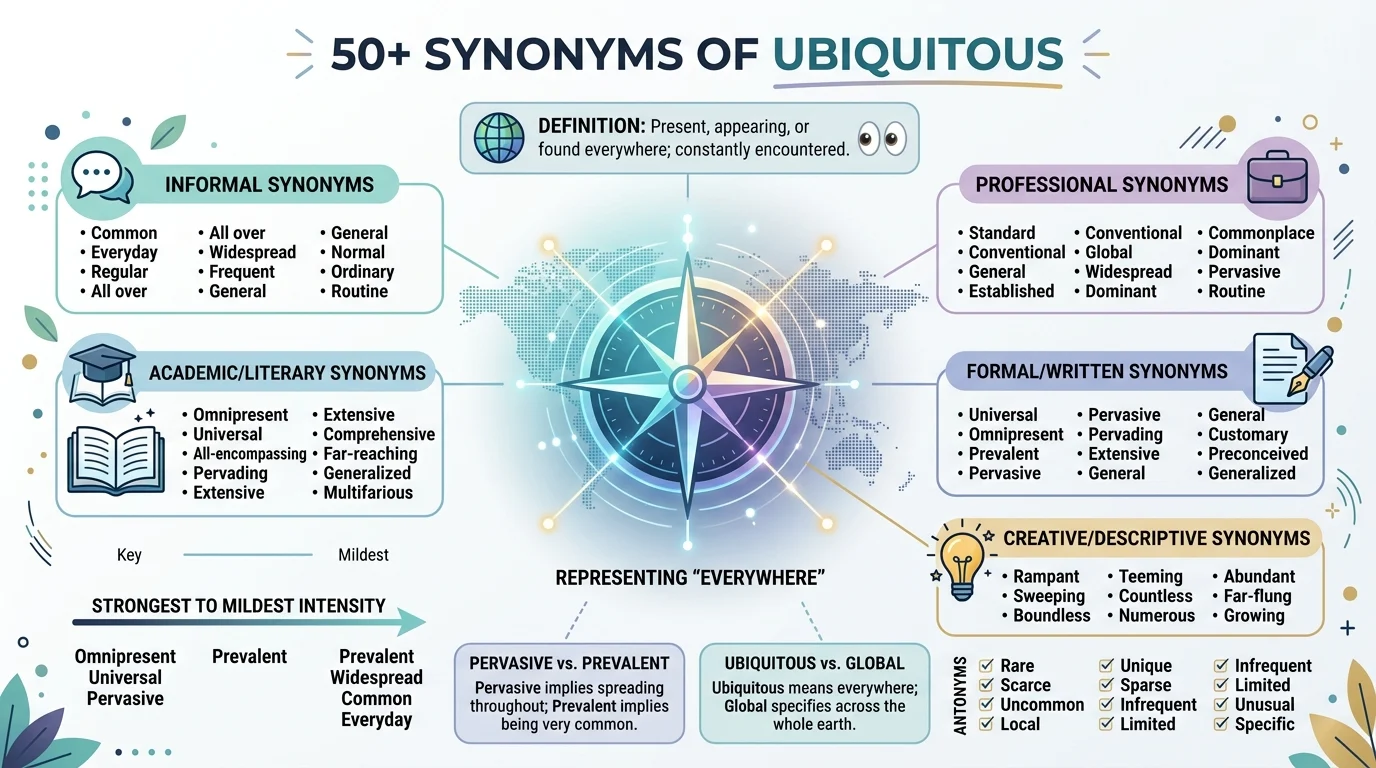
Ever find yourself leaning on the same word over and over in an email, an essay, or a social media caption? You want to describe something that seems to be everywhere, and the word “ubiquitous” comes to mind. But is it the right fit for your audience? Choosing the right synonym for “ubiquitous” can turn a vague statement into a vivid, precise description. This guide explores the best synonyms of ubiquitous, explaining exactly which word to use and when.
Quick Ans: “Ubiquitous” means being present everywhere at the same time or extremely widespread. It is a formal, neutral-to-positive adjective. For formal writing, use omnipresent or pervasive. For casual conversation, choose commonplace or widespread. In academic contexts, universal and prevalent are strong choices. For a softer meaning, select common. For a stronger, more dramatic impact, choose omnipresent.
Meaning, Tone, and Context
Understanding the core meaning of “ubiquitous” is the first step to using it effectively.
Simple Definition: Existing or being everywhere at the same time. Very commonly found.
Part of Speech: Adjective.
Overall Tone: Neutral to slightly formal. It describes a state of being widespread without inherently negative or positive emotion.
Formality Level: Formal. It is a sophisticated word suitable for academic, professional, and business writing.
Common Uses: Native English speakers use it to describe things that are constantly encountered in modern life. For example, “Smartphones are ubiquitous,” or “The smell of coffee was ubiquitous in the café.”
Word Forms: Related words include the noun ubiquity (or ubiquitousness) and the adverb ubiquitously.
When and How to Use “Ubiquitous”
“Ubiquitous” is the perfect choice when you want to emphasize that something is not just common, but seemingly inescapable and found everywhere. Here are seven realistic examples.
Professional: “In our industry, digital marketing is a ubiquitous tool for reaching new customers.”
Academic: “The study examines how social media has become a ubiquitous element of adolescent life.”
Workplace: “The ubiquitous use of project management software has streamlined our team’s workflow.”
Personal: “It feels like those new sneakers are ubiquitous. I see them everywhere I go.”
Email: “Given the ubiquitous nature of this issue, we need a company-wide solution.”
Resume: “Developed a ubiquitous company-wide training program that was adopted by all departments.”
Social Media: “This filter has become ubiquitous on my feed. Anyone else tired of it?”
Best Synonyms of “Ubiquitous”
No synonym is identical in every situation. Here is your guide to the best replacement for “ubiquitous” based on your writing context.
Professional Writing: Pervasive. It suggests something has spread widely and is influencing everything. “A culture of innovation is pervasive in the tech sector.”
Academic Writing: Universal. This is ideal when discussing principles, laws, or phenomena that apply to all cases. “Access to education is a universal goal.”
Business Communication: Widespread. A practical and clear choice for describing market trends or common practices. “There is widespread support for the new policy.”
Casual Conversation: Commonplace. It tones down the formality, meaning something is ordinary and not special. “Smartphones are so commonplace now.”
Emotional Writing: Omnipresent. This word carries a heavy, often philosophical or ominous weight, suggesting a presence that cannot be escaped. “In the aftermath of the storm, a sense of loss was omnipresent.”
Creative Writing: Ever-present. It implies a constant, continuous, and often comforting presence, like a background hum. “The ever-present hum of the city traffic was strangely soothing.”
Resume Writing: Pervasive. Use it to describe broad, impactful changes you implemented. “Implemented a pervasive data security protocol that reduced breaches by 15%.”
When Not to Use “Ubiquitous”
Using “ubiquitous” can sound out of place in certain situations.
When It Sounds Too General: Describing something as “ubiquitous” can be vague if you do not mean truly everywhere. It is less effective to say “The brand’s marketing is ubiquitous” if it is only in a few channels.
Better Choice: Widespread or common. “The brand’s marketing campaign was widespread across social media.”
When It Sounds Too Vague: The word is abstract. If you need concrete evidence, it fails.
Better Choice: Prevalent. “Stress is a prevalent issue among remote workers, with 70% reporting high levels.”
When It Is Too Formal: In a casual text, “This heat is ubiquitous!” sounds awkward.
Better Choice: Everywhere. “This heat is everywhere!” (or “It is so hot!”).
When It Feels Too Strong: “Pop music is ubiquitous” is dramatic. You might just mean it is very popular.
Better Choice: Common or popular. “Pop music is incredibly common in the mainstream charts.”
Words Commonly Confused With “Ubiquitous”
Several words are often mixed up with “ubiquitous.” Here is how to keep them straight.
Word: Pervasive
Difference: Focuses on spreading through and permeating something. “Ubiquitous” is about being everywhere. Pervasive is about the act of spreading.
When to Use: Use it to describe an idea, feeling, or problem that has diffused into all parts of a system.
Example: “A pervasive sense of anxiety was felt throughout the office.”
Word: Omnipresent
Difference: Often has a divine or philosophic tone, meaning present all the time. “Ubiquitous” is more often about physical presence in many places at once.
When to Use: Use this for qualities like God, the law, or an overwhelming feeling.
Example: “For many, the law is an omnipresent force in their daily lives.”
Word: Universal
Difference: Implies a quality or truth that applies to everyone or everything. “Ubiquitous” is about physical or observable presence.
When to Use: Use this for rights, truths, laws, or experiences that are shared by all.
Example: “The desire for happiness is a universal human trait.”
Word: Widespread
Difference: More general and less forceful. It describes something that covers a large area, but not necessarily everywhere.
When to Use: Use it when you want to be factual and less dramatic.
Example: “A widespread power outage affected the whole county.”
Best Synonyms of “Ubiquitous” by Context
| Context | Best Synonym | Why It Works | Example |
|---|---|---|---|
| Formal writing | Omnipresent | Adds a sense of inescapable, all-encompassing presence. | “The omnipresent threat of cyber attacks is a major concern.” |
| Academic writing | Universal | Describes principles or laws that apply in all instances. | “The theory outlines universal patterns in human behavior.” |
| Professional communication | Pervasive | Highlights the strong, all-influencing nature of a trend or problem. | “Burnout is a pervasive problem in the healthcare sector.” |
| Business emails | Widespread | A clear, concise, and professional alternative. | “There is widespread agreement on the quarterly targets.” |
| Resume writing | Pervasive | Emphasizes the broad, deep impact of your work. | “Created a pervasive customer feedback loop that improved products.” |
| Workplace communication | Commonplace | Neutral and factual without being overly dramatic. | “Hybrid meetings have become commonplace.” |
| Casual conversation | Everywhere | Simple, direct, and easily understood. | “Those tiny succulents are everywhere now.” |
| Creative writing | Ever-present | Conveys a sense of constant, often subtle, presence. | “The ever-present sound of the wind was the only company she had.” |
| Emotional writing | Omnipresent | Expresses an overwhelming, unavoidable feeling. | “In the hospital, a feeling of hope was omnipresent.” |
| Strong emphasis | Omnipresent | The most powerful, absolute synonym. | “The omnipresent surveillance state is a central theme.” |
| Mild tone | Common | Simple and unassuming. Good for everyday observations. | “Smartphone chargers are common, but not quite ubiquitous.” |
| Social media captions | Everywhere | Casual, punchy, and relatable. | “Seeing this aesthetic everywhere and I am not mad about it.” |
How to Choose the Best Synonym of “Ubiquitous”
Choosing the right word is a simple decision. Answer these questions.
What is my audience? For a professor or CEO, pervasive or omnipresent is powerful. For a friend, everywhere or commonplace is more natural.
What is my purpose? Are you trying to be dramatic, factual, or neutral? Use omnipresent for drama, widespread for facts, and common for a neutral observation.
Am I describing an object or a feeling? For physical things like phones, ubiquitous, widespread, or common are good. For abstract things like fear or culture, pervasive or omnipresent are better.
What is the emotional strength? Omnipresent is the strongest. Commonplace is the mildest. Pick the one that matches your message.
Real Life Examples of “Ubiquitous”
To truly master the word, it helps to see how it behaves in the wild and how a stronger synonym can elevate the sentence.
School: Basic: “The school’s mascot was a ubiquitous symbol.” Improved: “The school’s mascot was an ever-present symbol of school pride, cheering students on at every game.”
College: Basic: “Coffee shops are ubiquitous on campus.” Improved: “Coffee shops are pervasive on campus, a fixture in nearly every academic building and dormitory.”
Workplace: Basic: “Water coolers are ubiquitous in offices.” Improved: “Water coolers are commonplace in offices, serving as the hub for daily social interaction.”
Business: Basic: “The CEO’s influence was ubiquitous.” Improved: “The CEO’s influence was pervasive, shaping everything from the company’s mission to its daily operations.”
Email: Basic: “The problem is ubiquitous in the department.” Improved: “The problem is widespread in the department, affecting almost every team.”
Conversation: Basic: “Gym selfies are ubiquitous on Instagram.” Improved: “Gym selfies are everywhere on Instagram. It is a full-blown trend.”
Storytelling: Basic: “A smell of flowers was ubiquitous in the garden.” Improved: “A sweet smell of jasmine was ever-present in the garden, a constant companion as she walked the path.”
Top 10 Synonyms of “Ubiquitous”
| Synonym | Simple Meaning | Best Used For | Example Sentence |
|---|---|---|---|
| Omnipresent | Present everywhere at the same time | Formal, dramatic, and philosophical contexts. | “In the play, the ghost is an omnipresent figure.” |
| Pervasive | Spreading widely throughout something | Describing ideas, problems, or influences that permeate. | “A pervasive culture of secrecy hindered the investigation.” |
| Universal | Applying or existing everywhere | Academic, scientific, or philosophical universals. | “The concept of fairness is nearly universal across cultures.” |
| Widespread | Found over a large area | Factual, journalistic, and everyday descriptions of scale. | “There is widespread concern about the proposed budget cuts.” |
| Commonplace | Ordinary, not unusual | Casual conversation and neutral observations. | “Taking a gap year is commonplace among students here.” |
| Ever-present | Always existing or visible | Creative and emotional writing about constant presences. | “The ever-present threat of wildfires looms over the region.” |
| Prevalent | Widespread in a particular area at a particular time | Medical, sociological, and scientific findings. | “The flu is most prevalent during the winter months.” |
| Rife | Very common and widespread (often negative) | Negative conditions like disease, corruption, or rumors. | “The office was rife with rumors about the pending merger.” |
| Common | Occurring frequently | General, neutral statements about frequency. | “Headaches are a common side effect of this medication.” |
| Inescapable | Cannot be avoided or denied | Emotional or persuasive contexts emphasizing inevitability. | “The inescapable conclusion is that we need to change course.” |
Synonyms of “Ubiquitous” by Usage
Professional vs. Personal Synonyms
In the workplace (professional), choose pervasive or widespread to describe trends, problems, or influence. These words are authoritative and respected. “A pervasive culture of accountability” is more impactful than “a culture of accountability is everywhere.”
With friends (personal), commonplace, everywhere, or common keep the tone relaxed and relatable. These alternatives sound natural in everyday conversation.
Formal vs. Conversational Synonyms
For formal writing (reports, essays, professional emails), use omnipresent, universal, or pervasive. These choices maintain the sophisticated tone expected in professional documents.
For casual conversations and texting, use everywhere, commonplace, or everywhere you look. These options sound more natural and less pretentious.
Academic Synonyms
For research and essays, choose precise, authoritative words. Universal is great for general truths, prevalent for specific findings, and pervasive for influences or trends. These words sound considered and scholarly.
Using precise academic vocabulary demonstrates expertise and careful thinking. Professors and reviewers expect this level of precision.
Professional and Business Synonyms
For maximum impact in business writing, choose pervasive for influence, widespread for support or adoption, and global for market reach. These words demonstrate confidence and professional awareness.
Business leaders respond to language that conveys certainty and scale. These synonyms project authority.
Creative and Literary Synonyms
To add emotion and imagery to your writing, choose ever-present, all-pervading, inescapable, or omnipresent. These words create atmosphere and drama.
Literary writers use these alternatives to build mood and tension. They transform ordinary descriptions into evocative prose.
Slang or Modern Synonyms
There is no direct slang synonym for “ubiquitous” in mainstream American English. The simplest alternative in modern texting is literally just everywhere.
This straightforward approach works best for casual digital communication. Avoid forcing slang that does not exist.
Strongest to Mildest Synonyms
Mild: common, commonplace, common-or-garden
Moderate: widespread, prevalent, frequent, universal
Strong: pervasive, rampant, inescapable, rife
Very Strong: omnipresent, all-pervading
Emotional vs. Neutral Synonyms
Emotional Synonyms: Omnipresent, inescapable, ever-present, all-pervading. These words often hint at fear, dread, comfort, or dramatic significance. Use them when you want to evoke feeling.
Neutral Synonyms: Widespread, commonplace, prevalent, universal. These words simply communicate factual information. Use them when you want to inform without emotional coloring.
Antonyms of “Ubiquitous”
Here are 15 genuine opposites of “ubiquitous.”
| Antonym | Meaning | Example Sentence |
|---|---|---|
| Rare | Not occurring very often | “Sightings of the rare bird are a treat for any birder.” |
| Scarce | Insufficient for demand | “Clean drinking water is becoming scarce in many regions.” |
| Infrequent | Not occurring often | “Her visits to the office were infrequent at best.” |
| Uncommon | Not happening or seen often | “It is uncommon for him to miss a meeting.” |
| Limited | Confined within limits | “The store’s inventory was limited to local products.” |
| Confined | Restricted or kept within bounds | “The contagion was confined to one small village.” |
| Restricted | Limited in extent or scope | “Access to the building is restricted to employees.” |
| Sporadic | Occurring occasionally or at irregular intervals | “Sporadic power outages plagued the old city.” |
| Occasional | Occurring from time to time | “She made occasional trips to her hometown.” |
| Rarefied | Distant from the lives of ordinary people | “The rarefied world of high finance is mysterious to many.” |
| Isolated | Far away from others | “The research team worked in an isolated location.” |
| Extraordinary | Very unusual or remarkable | “For a man of his time, he possessed extraordinary foresight.” |
| Unfamiliar | Not known or recognized | “The language was unfamiliar to the tourists.” |
| Unusual | Not habitually occurring or done | “It is unusual to see snow in this part of the country.” |
| Exceptional | Unusual; not typical | “The weather was exceptional for this time of year.” |
Comparison: “Ubiquitous” vs Similar Words
Ubiquitous vs. Pervasive
Main Difference: Ubiquitous describes being everywhere. Pervasive describes the act of spreading throughout. A smell can be pervasive (it spreads), or a brand can be ubiquitous (it is everywhere).
Which Is Stronger? Ubiquitous is stronger for describing absolute presence. Pervasive is stronger for describing an influence that has saturated every part of a system.
Which Is More Formal? Both are formal, but pervasive is arguably more versatile in modern business and academic writing.
When to Use Each: Use ubiquitous for things you see everywhere. Use pervasive for forces, influences, and problems that spread.
Examples:
Ubiquitous: “Coffee shops are ubiquitous in the city.”
Pervasive: “A pervasive smell of burning filled the building.”
Ubiquitous vs. Omnipresent
Main Difference: While they are direct synonyms, omnipresent is more often associated with God or a spiritual, abstract, or inescapable force. Ubiquitous is more concrete.
Which Is Stronger? Omnipresent is the stronger, more dramatic word.
Which Is More Formal? Both are very formal.
When to Use Each: Use ubiquitous for everyday objects or trends. Use omnipresent for powerful feelings, abstract concepts, or in philosophical writing.
Examples:
Ubiquitous: “Those baggy jeans are ubiquitous in the high school.”
Omnipresent: “A sense of anxiety was omnipresent during the exam.”
Ubiquitous vs. Widespread
Main Difference: Ubiquitous is absolute, implying something is everywhere. Widespread is more measured, implying it covers a vast area.
Which Is Stronger? Ubiquitous is stronger, more dramatic, and more definitive.
Which Is More Formal? Both are formal, but widespread is often a better choice for neutral, factual reporting.
When to Use Each: Use ubiquitous when you want to emphasize inescapability. Use widespread for factual descriptions.
Examples:
Ubiquitous: “Smartphones are ubiquitous in modern society.”
Widespread: “There is widespread rainfall across the region.”
Ubiquitous vs. Universal
Main Difference: Universal applies to a quality or principle that is true for everyone or everything. Ubiquitous applies to a physical thing or concept being everywhere.
Which Is Stronger? They are strong in different ways. Universal is strong conceptually, while ubiquitous is strong spatially.
Which Is More Formal? Both are equally formal.
When to Use Each: Use universal for truths, rights, and laws. Use ubiquitous for physical presence.
Examples:
Ubiquitous: “The red cups were ubiquitous at the party.”
Universal: “The universal appeal of music unites people.”
Ubiquitous vs. Commonplace
Main Difference: Ubiquitous suggests you cannot escape something. Commonplace suggests it is ordinary and not special.
Which Is Stronger? Ubiquitous is far stronger.
Which Is More Formal? Ubiquitous is formal. Commonplace is neutral and casual.
When to Use Each: Use ubiquitous for emphasis. Use commonplace for a neutral observation.
Examples:
Ubiquitous: “Her face was ubiquitous on magazine covers.”
Commonplace: “Online shopping is now commonplace.”
Common Phrases and Expressions with “Ubiquitous”
Phrase: Ubiquitous presence
Meaning: A company, person, or thing that is found everywhere.
Example Sentence: “The tech giant’s ubiquitous presence in the market is a source of concern for competitors.”
Phrase: Ubiquitous in modern life
Meaning: A common feature of contemporary society.
Example Sentence: “Social media is so ubiquitous in modern life that it is hard to remember a time before it existed.”
Phrase: Seemingly ubiquitous
Meaning: Appearing to be everywhere, even if not literally.
Example Sentence: “The band’s hit single was seemingly ubiquitous that summer, playing from every radio and storefront.”
Common Mistakes to Avoid
Mistake 1: Using it when you mean “widespread”.
Incorrect: “The snowstorm was ubiquitous across the county.”
Better: “The snowstorm was widespread across the county.”
Why: The snowstorm is in a large area (widespread), but not everywhere (ubiquitous).
Mistake 2: Using it for something that is just “popular”.
Incorrect: “The new band is ubiquitous at the local bar.”
Better: “The new band is very popular at the local bar.”
Why: The band is popular, but not literally everywhere.
Mistake 3: Overusing it in casual conversation.
Incorrect: “This weather is so ubiquitous!” (referring to heat).
Better: “This heat is everywhere!”
Why: “Ubiquitous” is too formal for casual small talk.
Mistake 4: Using an informal synonym in a formal report.
Incorrect: “The company’s influence is everywhere in the industry.”
Better: “The company’s influence is pervasive in the industry.”
Why: Everywhere is too vague and informal for a professional report. Pervasive sounds more authoritative.
Mistake 5: Using “ubiquitous” to describe temporary trends.
Incorrect: “The viral dance is ubiquitous on TikTok this week.”
Better: “The viral dance is commonplace on TikTok this week.”
Why: The trend is widespread, but “ubiquitous” implies long-term or permanent presence.
Frequently Asked Questions
1. What are the best synonyms of “ubiquitous”?
The best synonyms depend on your context. For formal writing, choose omnipresent or pervasive. For casual conversation, widespread, commonplace, or simply everywhere are ideal choices.
2. What are the best formal synonyms of “ubiquitous”?
The best formal synonyms are omnipresent, pervasive, and universal. These words are suitable for academic papers, professional reports, and business communications.
3. What are common informal synonyms of “ubiquitous”?
For informal settings, use widespread, common, commonplace, or simply the adverb everywhere. These alternatives sound more natural in everyday conversation.
4. What is another word for “ubiquitous” in professional writing?
In professional writing, pervasive is an excellent choice. It conveys the idea of something spreading throughout a system, making it a powerful word for describing culture, problems, and trends.
5. What is the difference between “ubiquitous” and “omnipresent”?
While they both mean “everywhere,” omnipresent carries a heavier, more dramatic, and often philosophical or spiritual weight. Ubiquitous is more commonly used for concrete, everyday things.
6. What is the opposite of “ubiquitous”?
The most direct opposites (antonyms) of ubiquitous are rare, scarce, and infrequent. These words describe things that are not found everywhere.
Conclusion
“Ubiquitous” is a powerful word to describe something present everywhere. It is formal and descriptive but should be used carefully. The best choice among the synonyms of ubiquitous depends entirely on your audience, tone, and purpose. For a dramatic, formal effect, use omnipresent. And for a broad, factual scope, widespread or prevalent works perfectly. Also for spreading influences, choose pervasive. Remember, no single synonym works perfectly in every situation. Your goal is to choose the word that communicates your message with the most clarity and impact. A practical tip for your vocabulary growth is to maintain a personal “word log” and challenge yourself to use one new synonym in your writing each day.

Amelia Brooks is a professional content writer and digital publishing specialist with a passion for creating clear, engaging, and informative content. She has extensive experience writing about technology, business, lifestyle, and online services.