Have you ever needed to describe someone’s generous, compassionate, or considerate nature but felt that “nice” or “good” did not fully capture their character? You want to highlight warmth, empathy, and benevolence, and the word “kind” comes to mind. But is it the best fit for your audience? Choosing the right synonym for “kind” can transform a simple compliment into a powerful and precise description of someone’s character. This guide explores the best synonyms of kind, explaining exactly which word to use and when.
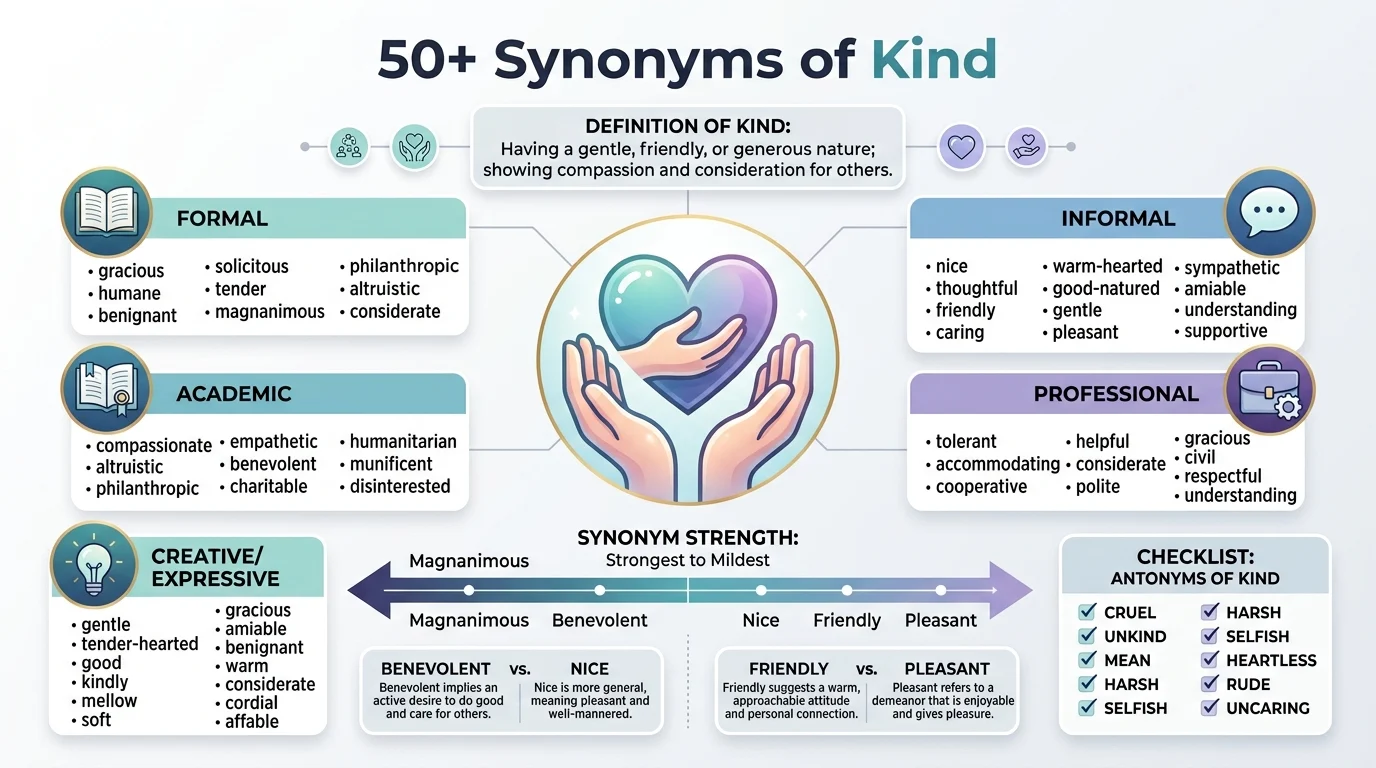
Quick Ans: “Kind” means having or showing a friendly, generous, and considerate nature. It is a positive, warm adjective. For formal writing, choose benevolent or compassionate. For casual conversation, use nice or good-hearted. In academic contexts, altruistic and empathetic are strong choices. For a stronger, more dramatic impact, select magnanimous or charitable.
Meaning, Tone, and Context
Understanding the core meaning of “kind” is the first step to using it effectively.
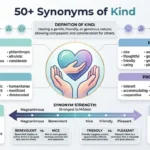
Simple Definition: Having or showing a friendly, generous, and considerate nature. Disposed to do good and show sympathy for others.
Part of Speech: Adjective (also a noun meaning “type”).
Overall Tone: Positive and warm. It indicates compassion, generosity, and thoughtfulness.
Formality Level: Neutral. The word works in almost all contexts, from casual to formal.
Common Uses: Native English speakers use it constantly to describe people, actions, words, and intentions. For example, “She is a kind person,” or “That was a kind thing to say.”
Word Forms: Related words include the noun kindness, the adverb kindly, and the adjective kindhearted.
When and How to Use “Kind”
“Kind” is the most common and versatile word in its category. Here are seven realistic examples.
Professional: “The manager was kind enough to offer me flexible working hours.”
Academic: “The study examines how kind behavior is fostered in early childhood.”
Workplace: “A kind word from a colleague can make a difficult day easier.”
Personal: “My grandmother was the kindest person I have ever known.”
Email: “Thank you for your kind and thoughtful response.”
Resume: “Recognized for fostering a kind and collaborative team environment.”
Social Media: “A kind gesture can change someone’s entire day. Spread kindness.”
Best Synonyms of “Kind”
No synonym is identical in every situation. Here is your guide to the best replacement for “kind” based on your writing context.
Professional Writing: Benevolent. It suggests a disposition to do good. “The benevolent policy helped many families.”
Academic Writing: Altruistic. This is ideal when discussing selfless concern for others. “The altruistic behavior was observed in the study.”
Business Communication: Considerate. A practical choice for thoughtfulness. “We appreciate your considerate approach.”
Casual Conversation: Nice. It tones down the formality and sounds natural. “She is a nice person.”
Emotional Writing: Compassionate. This word carries weight, suggesting deep empathy. “Her compassionate response moved everyone.”
Creative Writing: Magnanimous. It implies generosity and nobility. “The magnanimous king forgave his enemies.”
Resume Writing: Empathetic. Use it to highlight emotional intelligence. “Empathetic leader who understands team dynamics.”
When Not to Use “Kind”
Using “kind” can sound weak or imprecise in certain situations.
When It Sounds Too Simple: “Kind” can be too general. You might need a word that conveys more nuance.
Better Choice: Compassionate or empathetic. “She is a compassionate leader.”
When You Mean Generous: “Kind” is about being nice. Generous is about giving.
Better Choice: Generous. “He is generous with his time and resources.”
When You Mean Polite: “Kind” is about warmth. Polite is about manners.
Better Choice: Polite or courteous. “He is always polite to everyone.”
When It Sounds Too Familiar: In professional contexts, “kind” can be too informal.
Better Choice: Considerate or thoughtful. “Her considerate behavior is appreciated.”
Words Commonly Confused With “Kind”
Several words are often mixed up with “kind.” Here is how to keep them straight.
Word: Nice
Difference: Means pleasant and agreeable. “Kind” implies deeper warmth and generosity.
When to Use: Use it for pleasant interactions and appearances.
Example: “She is a nice person to talk to.”
Word: Generous
Difference: Means freely giving more than expected. “Kind” is broader.
When to Use: Use this for giving time, money, or resources.
Example: “He is generous with his time.”
Word: Compassionate
Difference: Means feeling sympathy for others. “Kind” is more general.
When to Use: Use this for people who deeply care about others’ suffering.
Example: “The compassionate nurse comforted the patient.”
Word: Benevolent
Difference: Means desiring to do good. “Kind” is more personal.
When to Use: Use this for formal contexts like policies or leaders.
Example: “The benevolent organization helped many.”
Word: Altruistic
Difference: Means selfless concern for others. “Kind” is more general.
When to Use: Use this for academic or philosophical contexts.
Example: “Her altruistic actions saved lives.”
Word: Considerate
Difference: Means thoughtful of others’ feelings. “Kind” is broader.
When to Use: Use this for someone who is careful not to inconvenience others.
Example: “He is considerate of his colleagues’ time.”
Best Synonyms of “Kind” by Context
| Context | Best Synonym | Why It Works | Example |
|---|---|---|---|
| Formal writing | Benevolent | Suggests a desire to do good. | “The benevolent policy helped the community.” |
| Academic writing | Altruistic | Precise for selfless behavior. | “The altruistic behavior was observed in the study.” |
| Professional communication | Considerate | Emphasizes thoughtfulness. | “We appreciate your considerate approach.” |
| Business emails | Kind | Professional yet warm. | “Thank you for your kind assistance.” |
| Resume writing | Empathetic | Highlights emotional intelligence. | “Empathetic leader who supports team growth.” |
| Workplace communication | Thoughtful | Neutral and clear. | “That was a thoughtful suggestion.” |
| Casual conversation | Nice | Simple, natural, and conversational. | “She is a nice person.” |
| Creative writing | Magnanimous | Evokes nobility and generosity. | “The magnanimous king pardoned his enemies.” |
| Emotional writing | Compassionate | Suggests deep empathy. | “Her compassionate response touched everyone.” |
| Strong emphasis | Benevolent | Suggests formal goodness. | “The benevolent leader inspired loyalty.” |
| Mild tone | Nice | Simple and unassuming. | “He was a nice man.” |
| Social media captions | Kind | Widely understood and relatable. | “Be kind. It costs nothing.” |
How to Choose the Best Synonym of “Kind”
Choosing the right word is a simple decision. Answer these questions.
What is my audience? For a professor or CEO, benevolent or altruistic is powerful. For a friend, nice or good-hearted is more natural.
What is my purpose? Are you trying to describe character, behavior, or intention? Use compassionate for character, generous for behavior, and benevolent for intention.
Am I describing a person or an action? For people, kind or compassionate work. For actions, thoughtful or considerate are better.
What is the emotional strength? Magnanimous is stronger. Nice is mild. Pick the one that matches your message.
Real Life Examples of “Kind”
To truly master the word, it helps to see how it behaves in the wild and how a stronger synonym can elevate the sentence.
School: Basic: “The teacher was kind.” Improved: “The teacher was compassionate and always helped struggling students.”
College: Basic: “The students were kind to each other.” Improved: “The students were altruistic, volunteering to help the community.”
Workplace: Basic: “The manager is kind.” Improved: “The manager is considerate, always respecting our time and needs.”
Business: Basic: “The company is kind to its employees.” Improved: “The company is benevolent, offering generous benefits and support.”
Email: Basic: “Thank you for being kind.” Improved: “Thank you for your thoughtful and thorough response.”
Conversation: Basic: “He was kind to me.” Improved: “He was really nice to me.”
Storytelling: Basic: “She was a kind queen.” Improved: “She was a magnanimous queen, beloved by all her subjects.”
Top 10 Synonyms of “Kind”
| Synonym | Simple Meaning | Best Used For | Example Sentence |
|---|---|---|---|
| Benevolent | Desiring to do good | Formal, professional, and charitable contexts. | “The benevolent foundation funded the project.” |
| Compassionate | Feeling sympathy for others | Emotional, medical, and personal contexts. | “The compassionate doctor comforted the family.” |
| Altruistic | Selflessly concerned for others | Academic, philosophical, and research contexts. | “The altruistic donation saved lives.” |
| Considerate | Thoughtful of others’ feelings | Workplace, personal, and professional contexts. | “She is considerate of everyone’s needs.” |
| Empathetic | Understanding others’ feelings | Leadership, personal, and psychological contexts. | “The empathetic manager supported the team.” |
| Generous | Giving freely and abundantly | Describing actions and behavior. | “He is generous with his time and money.” |
| Thoughtful | Showing careful consideration | Workplace, personal, and appreciative contexts. | “That was a thoughtful gift.” |
| Nice | Pleasant and agreeable | Casual conversation and everyday references. | “She is a nice person to know.” |
| Magnanimous | Very generous and forgiving | Creative, literary, and historical contexts. | “The magnanimous king spared his enemies.” |
| Good-hearted | Having a kind and generous nature | Emotional, personal, and conversational contexts. | “He is a good-hearted person.” |
Synonyms of “Kind” by Usage
Professional vs. Personal Synonyms
In the workplace (professional), choose considerate, empathetic, or thoughtful to describe behavior and leadership. These words convey professionalism and emotional intelligence. “Her considerate approach is appreciated” is more precise than “She is kind.”
With friends (personal), nice, good-hearted, or sweet keep the tone relaxed and relatable. These alternatives sound natural in everyday conversation.
Formal vs. Conversational Synonyms
For formal writing (reports, essays, professional emails), use benevolent, altruistic, or compassionate. These choices maintain the sophisticated tone expected in professional documents.
For casual conversations and texting, use nice, sweet, or good. These options sound more natural and less pretentious.
Academic Synonyms
For research and essays, choose precise, authoritative words. Altruistic is great for selfless behavior, empathetic for understanding, and compassionate for concern. These words sound considered and scholarly.
Using precise academic vocabulary demonstrates expertise and careful thinking. Professors and reviewers expect this level of precision.
Professional and Business Synonyms
For maximum impact in business writing, choose considerate for respect, empathetic for understanding, and thoughtful for attention to detail. These words demonstrate confidence and emotional intelligence.
Business leaders respond to language that conveys professionalism and care. These synonyms project authority.
Creative and Literary Synonyms
To add emotion and imagery to your writing, choose magnanimous, good-hearted, or charitable. These words create atmosphere and build character depth.
Literary writers use these alternatives to develop personality and theme. They transform ordinary descriptions into evocative prose.
Slang or Modern Synonyms
In modern American slang, sweet or cool can be used as casual alternatives. For example, “She is a sweet person,” or “He was cool about it.” These are acceptable in casual contexts. Avoid them in professional or academic writing.
Strongest to Mildest Synonyms
Mild: nice, sweet, good
Moderate: kind, thoughtful, considerate
Strong: compassionate, generous, benevolent
Very Strong: magnanimous, altruistic, charitable
Emotional vs. Neutral Synonyms
Emotional Synonyms: Compassionate, magnanimous, good-hearted. These words often hint at admiration, warmth, or inspiration. Use them when you want to evoke feeling.
Neutral Synonyms: Considerate, thoughtful, nice. These words simply communicate factual information. Use them when you want to inform without emotional coloring.
Antonyms of “Kind”
Here are 15 genuine opposites of “kind.”
| Antonym | Meaning | Example Sentence |
|---|---|---|
| Cruel | Willfully causing pain | “The cruel dictator oppressed his people.” |
| Mean | Unkind and nasty | “The mean comment hurt her feelings.” |
| Unkind | Not kind or considerate | “His unkind words were unforgivable.” |
| Harsh | Severe and cruel | “The harsh criticism was unnecessary.” |
| Heartless | Lacking compassion | “The heartless decision caused suffering.” |
| Malicious | Intending to cause harm | “The malicious rumor damaged his reputation.” |
| Spiteful | Showing malicious ill-will | “Her spiteful behavior alienated her friends.” |
| Callous | Insensitive and unsympathetic | “The callous remark showed no empathy.” |
| Hostile | Unfriendly and antagonistic | “The hostile environment was toxic.” |
| Vicious | Cruel and violent | “The vicious attack was unprovoked.” |
| Selfish | Lacking concern for others | “The selfish act hurt many people.” |
| Inconsiderate | Thoughtless of others | “The inconsiderate parking blocked the entrance.” |
| Unsympathetic | Not feeling compassion | “His unsympathetic response was disappointing.” |
| Ruthless | Having no pity | “The ruthless businessman exploited his workers.” |
| Cold-hearted | Lacking warmth and compassion | “The cold-hearted villain showed no remorse.” |
Comparison: “Kind” vs Similar Words
Kind vs. Nice
Main Difference: Kind implies genuine warmth and generosity. Nice implies pleasantness and agreeableness.
Which Is Stronger? Kind is stronger and more meaningful. Nice is often superficial.
Which Is More Formal? Both are neutral, but kind is more substantial.
When to Use Each: Use nice for simple pleasantness. Use kind for genuine warmth and care.
Examples:
Kind: “She is a kind person who always helps others.”
Nice: “He has a nice smile.”
Kind vs. Compassionate
Main Difference: Kind is general. Compassionate specifically means feeling sympathy for others’ suffering.
Which Is Stronger? Compassionate is stronger and more specific.
Which Is More Formal? Both are formal, but compassionate is often used in professional contexts.
When to Use Each: Use kind for general goodwill. Use compassionate for deep empathy.
Examples:
Kind: “She was kind to the new student.”
Compassionate: “The compassionate nurse comforted the patient.”
Kind vs. Benevolent
Main Difference: Kind is personal and warm. Benevolent is formal and implies a desire to do good.
Which Is Stronger? Benevolent is stronger in formal contexts.
Which Is More Formal? Benevolent is much more formal.
When to Use Each: Use kind for personal interactions. Use benevolent for formal organizations.
Examples:
Kind: “My neighbor is a kind person.”
Benevolent: “The benevolent organization helped many families.”
Kind vs. Considerate
Main Difference: Kind is about warmth and generosity. Considerate is about thoughtfulness and not inconveniencing others.
Which Is Stronger? They are different. Considerate emphasizes respect for others.
Which Is More Formal? Both are formal.
When to Use Each: Use kind for warmth. Use considerate for thoughtfulness.
Examples:
Kind: “She is a kind friend.”
Considerate: “He is considerate of his colleagues’ time.”
Kind vs. Generous
Main Difference: Kind is about being nice. Generous is about giving freely.
Which Is Stronger? Generous is more specific about giving.
Which Is More Formal? Both are formal.
When to Use Each: Use kind for general goodness. Use generous for giving time or money.
Examples:
Kind: “She is a kind person.”
Generous: “He is generous with his resources.”
Kind vs. Magnanimous
Main Difference: Kind is warm and personal. Magnanimous is noble and forgiving on a grand scale.
Which Is Stronger? Magnanimous is much stronger and more dramatic.
Which Is More Formal? Both are formal, but magnanimous is more literary.
When to Use Each: Use kind for everyday warmth. Use magnanimous for heroic forgiveness.
Examples:
Kind: “She is kind to her neighbors.”
Magnanimous: “The magnanimous king forgave his enemies.”
Common Phrases and Expressions with “Kind”
Phrase: Kind of (person/thing)
Meaning: A type or category. (This is a different use of the word.)
Example Sentence: “What kind of music do you like?”
Phrase: Kind and generous
Meaning: Both warm-hearted and giving.
Example Sentence: “She is a kind and generous person.”
Phrase: Kind words
Meaning: Pleasant and encouraging words.
Example Sentence: “His kind words brightened my day.”
Phrase: Kind gesture
Meaning: A considerate action.
Example Sentence: “The kind gesture was much appreciated.”
Phrase: Be kind to
Meaning: To treat someone with warmth.
Example Sentence: “Please be kind to your little brother.”
Phrase: Would you be so kind as to…
Meaning: A polite request.
Example Sentence: “Would you be so kind as to help me?”
Common Mistakes to Avoid
Mistake 1: Using “kind” when you mean “generous”.
Incorrect: “He is kind with his money.”
Better: “He is generous with his money.”
Why: Generous is specifically about giving.
Mistake 2: Using “kind” when you mean “nice”.
Incorrect: “She has a kind smile.”
Better: “She has a nice smile.”
Why: Nice is better for superficial pleasantness.
Mistake 3: Overusing “kind” in formal writing.
Incorrect: “The kind manager helped everyone.”
Better: “The considerate manager helped everyone.”
Why: Considerate sounds more professional.
Mistake 4: Using “kind” for negative intentions.
Incorrect: “He was kind of mean.”
Better: “He was somewhat mean.”
Why: Kind means good. It should not be paired with negative words.
Mistake 5: Using “nice” when you mean “kind”.
Incorrect: “He is nice to his employees.”
Better: “He is kind to his employees.”
Why: Kind implies deeper warmth and care.
Frequently Asked Questions
1. What are the best synonyms of “kind”?
The best synonyms depend on your context. For formal writing, choose benevolent or compassionate. And for casual conversation, nice or good-hearted are ideal choices. For academic contexts, use altruistic or empathetic.
2. What are the best formal synonyms of “kind”?
The best formal synonyms are benevolent, altruistic, and compassionate. These words are suitable for academic papers, professional reports, and business communications.
3. What are common informal synonyms of “kind”?
For informal settings, use nice, good, or sweet. These alternatives sound more natural in everyday conversation.
4. What is another word for “kind” in professional writing?
In professional writing, considerate is an excellent choice. It conveys thoughtfulness and respect for others. Empathetic is also strong for leadership contexts.
5. What is the difference between “kind” and “nice”?
While both indicate pleasantness, kind implies genuine warmth and generosity. Nice implies superficial pleasantness. Use kind for deep goodness and nice for simple agreeableness.
6. What is the opposite of “kind”?
The most direct opposites (antonyms) of kind are cruel, mean, and unkind. These words describe people who cause pain or lack compassion.
Conclusion
“Kind” is a versatile and essential word for describing warmth, generosity, and compassion. The term is neutral and widely understood in most contexts, yet it can sound too simple for professional settings or too vague for specific descriptions. The best choice among the synonyms of kind depends entirely on your audience, tone, and purpose. Remember, no single synonym works perfectly in every situation. Your goal is to choose the word that communicates your message with the most clarity and impact. A practical tip for your vocabulary growth is to notice the different ways people show kindness and practice using specific synonyms to describe them.
Discover More:
- 50+ Synonyms of Especially: Meanings, Uses, Examples, and Best Alternatives 2026
- 50+ Synonyms of Life: Meanings, Uses, Examples, and Best Alternatives 2026

Amelia Brooks is a professional content writer and digital publishing specialist with a passion for creating clear, engaging, and informative content. She has extensive experience writing about technology, business, lifestyle, and online services.