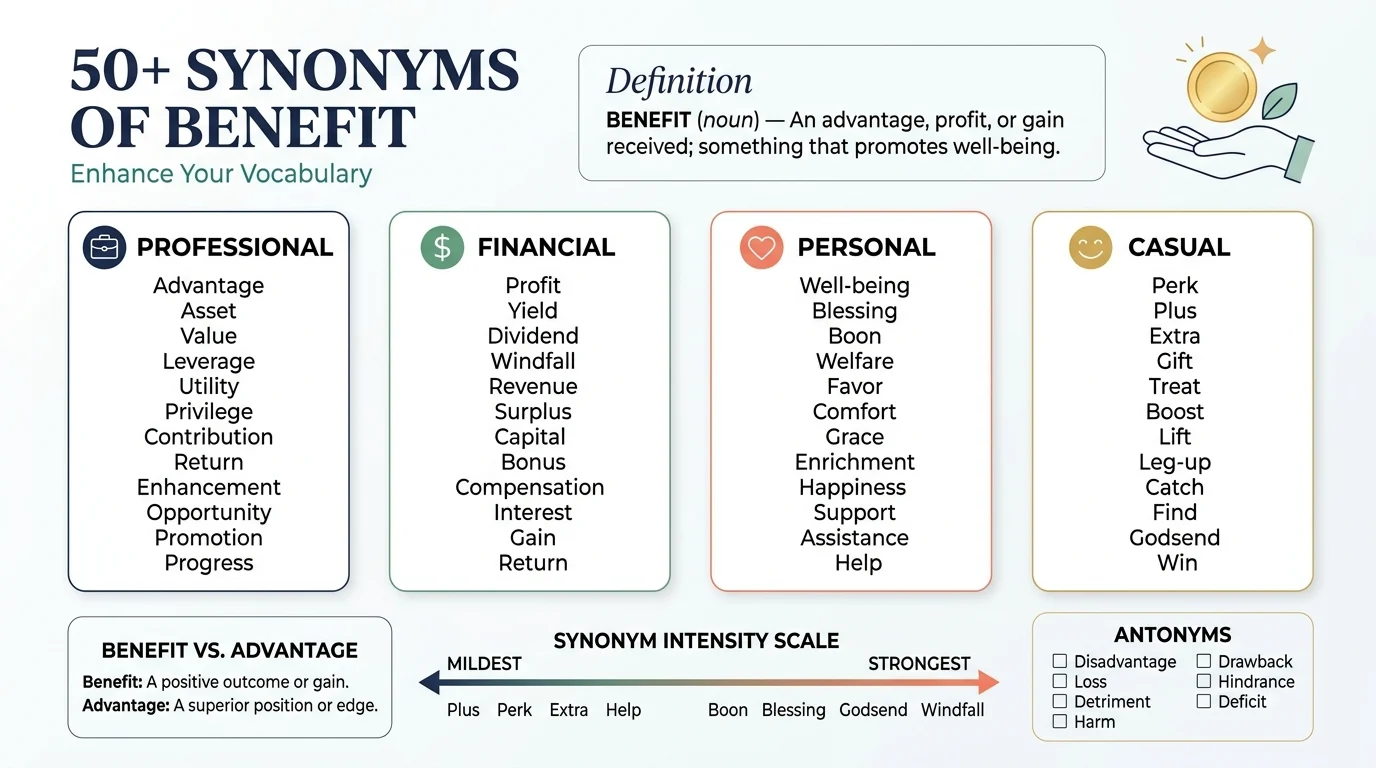
Have you ever needed to describe an advantage, a positive outcome, or a helpful effect but felt that “good thing” or “plus” was too casual? You want to capture the value something provides, and the word “benefit” comes to mind. Choosing the right synonym for “benefit” can transform a vague statement into a precise description of advantage, profit, or welfare. This guide explores the best synonyms of benefit, explaining exactly which word to use and when.
Quick Ans: “Benefit” means an advantage, profit, or positive effect gained from something. For professional writing, choose advantage or gain. For financial contexts, use profit or return. For personal welfare, use welfare or well-being. For describing a helpful effect, use perk or boon.
Meaning, Tone, and Context
Understanding the core meaning of “benefit” is the first step to using it effectively.
Simple Definition: An advantage or profit gained from something; a helpful or good effect.
Part of Speech: Noun and verb.
Overall Tone: Positive. It indicates value, advantage, or improvement.
Formality Level: Neutral to formal. The word is appropriate in most contexts.
Common Uses: Native English speakers use it to describe advantages of actions, financial returns, employee perks, and health improvements. For example, “The benefits of exercise are well documented,” or “The company offers excellent benefits.”
Word Forms: Related words include the adjective beneficial, the noun beneficiary, and the verb benefit.
When and How to Use “Benefit”
“Benefit” is the perfect choice when you want to describe a positive outcome or advantage. Here are seven realistic examples.
Professional: “The new software provides significant benefits for our productivity.”
Academic: “The study examines the health benefits of a Mediterranean diet.”
Workplace: “Employees receive a range of benefits, including health insurance.”
Personal: “One benefit of early rising is having quiet time to think.”
Email: “Please outline the benefits of this proposal for the board.”
Resume: “Implemented changes that delivered measurable benefits to the department.”
Social Media: “The benefit of daily walking goes far beyond physical health.”
Best Synonyms of “Benefit”
No synonym is identical in every situation. Here is your guide to the best replacement for “benefit” based on your writing context.
Professional Writing: Advantage. It emphasizes a favorable position or condition. “The main advantage of this approach is its simplicity.”
Academic Writing: Gain. It suggests something positive acquired. “The study showed significant gains in cognitive function.”
Business Communication: Profit. It focuses on financial return. “The investment generated substantial profit.”
Casual Conversation: Perk. It refers to a bonus or extra benefit. “One perk of the job is free coffee.”
Emotional Writing: Boon. It suggests a great benefit or blessing. “The rain was a boon for farmers.”
Creative Writing: Blessing. It implies something that brings happiness or good fortune. “Her support was a blessing during hard times.”
Resume Writing: Value. It emphasizes worth and importance. “Delivered value through strategic cost reductions.”
When Not to Use “Benefit”
Using “benefit” can sound wrong or awkward in certain situations.
When It Sounds Too Formal: In casual conversation, “benefit” can sound stiff.
Better Choice: Perk or plus. “One plus is the flexible schedule.”
When You Mean “Profit”: “Benefit” is broader. For financial contexts, be specific.
Better Choice: Profit or return. “The profit was substantial.”
When It Sounds Too Vague: “Benefit” can be unclear.
Better Choice: Advantage or gain. “The advantage is clear.”
When You Mean “Welfare”: For social programs, use the specific term.
Better Choice: Welfare or assistance. “The welfare program supports families.”
Words Commonly Confused With “Benefit”
Several words are often mixed up with “benefit.” Here is how to keep them straight.
Word: Advantage
Difference: A favorable condition or position. “Benefit” is the positive effect gained.
When to Use: Use it for a favorable circumstance.
Example: “The home team had a distinct advantage.”
Word: Profit
Difference: Financial gain. “Benefit” is broader and can be non-financial.
When to Use: Use this for money earned.
Example: “The company reported record profits.”
Word: Gain
Difference: Something acquired or won. “Benefit” is the positive outcome.
When to Use: Use this for improvements or acquisitions.
Example: “The gain in efficiency was significant.”
Word: Perk
Difference: An extra benefit from a job. “Benefit” can be more formal.
When to Use: Use this for employee extras.
Example: “Free lunch is a popular perk.”
Word: Boon
Difference: A great benefit or blessing. “Benefit” is more neutral.
When to Use: Use this for something very helpful.
Example: “The new bridge was a boon for the community.”
Word: Welfare
Difference: The health and happiness of people. “Benefit” is more specific.
When to Use: Use this for social programs.
Example: “The welfare of children is paramount.”
Best Synonyms of “Benefit” by Context
| Context | Best Synonym | Why It Works | Example |
|---|---|---|---|
| Formal writing | Advantage | Precise and professional | “The advantage of this method is clear.” |
| Academic writing | Gain | Suggests measurable improvement | “The gains in reading scores were significant.” |
| Professional communication | Value | Emphasizes worth | “We deliver value to our clients.” |
| Business emails | Return | Financial focus | “The return on investment was excellent.” |
| Resume writing | Value | Highlights contribution | “Delivered value through process improvements.” |
| Workplace communication | Perk | Common for employee extras | “The job comes with great perks.” |
| Casual conversation | Plus | Simple and natural | “One plus is the location.” |
| Creative writing | Boon | Evokes a blessing | “The rain was a boon for the crops.” |
| Emotional writing | Blessing | Suggests gratitude | “Her friendship was a blessing.” |
| Strong emphasis | Asset | Something valuable | “Her skills are a great asset.” |
| Mild tone | Good | Simple and unassuming | “It was good for everyone.” |
| Social media captions | Perk | Widely understood | “The best perk of working here.” |
How to Choose the Best Synonym of “Benefit”
Choosing the right word is a simple decision. Answer these questions.
What kind of benefit am I describing? For financial, use profit or return. And For personal, use perk or plus. For general, use advantage or gain.
What is my audience? For a formal report, use advantage or value. For a friend, use perk or plus.
What is my purpose? Are you trying to persuade, inform, or describe? The correct synonym depends entirely on this.
What is the emotional strength? Blessing and boon are stronger. Plus and good are milder. Pick the one that matches your message.
Real Life Examples of “Benefit”
To truly master the word, it helps to see how it behaves in the wild and how a stronger synonym can elevate the sentence.
School: Basic: “The benefit of reading is knowledge.” Improved: “The advantage of reading is expanded knowledge.”
College: Basic: “The benefit of the program is skills.” Improved: “The gain from the program is practical skills.”
Workplace: Basic: “The benefit is health insurance.” Improved: “The perk includes comprehensive health insurance.”
Business: Basic: “The benefit is higher profit.” Improved: “The return is significantly higher profit.”
Email: Basic: “This has many benefits.” Improved: “This offers many advantages.”
Conversation: Basic: “The benefit is flexibility.” Improved: “The plus is flexibility.”
Storytelling: Basic: “The benefit was a good harvest.” Improved: “The boon was a bountiful harvest.”
Top 10 Synonyms of “Benefit”
| Synonym | Simple Meaning | Best Used For | Example Sentence |
|---|---|---|---|
| Advantage | A favorable condition | Professional and formal contexts | “The advantage of early booking is lower prices.” |
| Gain | Something positive acquired | Academic and financial contexts | “The gains in productivity were impressive.” |
| Profit | Financial return | Business and financial contexts | “The company reported record profits.” |
| Perk | An extra benefit from a job | Workplace and casual contexts | “Free coffee is a popular perk.” |
| Boon | A great benefit | Literary and descriptive contexts | “The new road was a boon for the town.” |
| Blessing | Something that brings good fortune | Emotional and personal contexts | “Her support was a blessing.” |
| Value | Worth or importance | Professional and business contexts | “We deliver value to our customers.” |
| Asset | A valuable thing or quality | Professional and personal contexts | “Her experience is a great asset.” |
| Plus | A positive feature | Casual and conversational contexts | “The location is a big plus.” |
| Welfare | Health and happiness | Social and formal contexts | “The welfare of the community is a priority.” |
Synonyms of “Benefit” by Usage
Professional vs. Personal Synonyms
In the workplace (professional), choose advantage, value, or asset to describe positive outcomes. These words convey professionalism. “The advantage of this strategy is clear” is more precise than “The benefit is clear.”
With friends (personal), perk, plus, or good keep the tone relaxed and relatable.
Formal vs. Conversational Synonyms
For formal writing (reports, essays, professional emails), use advantage, gain, or value. These choices maintain the sophisticated tone expected in professional documents.
For casual conversations and texting, use perk, plus, or good. These options sound more natural.
Academic Synonyms
For research and essays, choose precise, authoritative words. Gain is great for measurable improvements, advantage for favorable conditions, and welfare for social contexts.
Professional and Business Synonyms
For maximum impact in business writing, choose profit for financial returns, value for client offerings, and asset for strengths. These words demonstrate confidence and professional awareness.
Creative and Literary Synonyms
To add emotion and imagery to your writing, choose boon or blessing. These words create atmosphere and convey gratitude.
Slang and Colloquial Synonyms
In modern American slang, perk and plus are the most common casual alternatives. For example, “That’s a nice perk,” or “It’s a plus.” These are acceptable in casual contexts.
Strongest to Mildest Synonyms
Mild: plus, good, help
Moderate: benefit, advantage, gain
Strong: profit, value, asset
Very Strong: boon, blessing, windfall
Emotional vs. Neutral Synonyms
Emotional Synonyms: Blessing, boon. These words often hint at gratitude and good fortune. Use them when you want to evoke feeling.
Neutral Synonyms: Advantage, gain, plus. These words simply communicate factual information. Use them when you want to inform without emotional coloring.
Antonyms of “Benefit”
Here are 15 genuine opposites of “benefit.”
| Antonym | Meaning | Example Sentence |
|---|---|---|
| Disadvantage | An unfavorable condition | “The disadvantage of the plan was its cost.” |
| Drawback | A negative feature | “The main drawback is the time required.” |
| Downside | A negative aspect | “The downside is the risk involved.” |
| Loss | Something lost | “The company reported a significant loss.” |
| Detriment | Something that causes harm | “The policy was to the detriment of workers.” |
| Harm | Physical or mental damage | “The medication caused more harm than good.” |
| Damage | Injury or loss | “The damage to the reputation was severe.” |
| Injury | Harm or hurt | “The injury was a setback.” |
| Cost | The price paid | “The cost outweighed the benefit.” |
| Penalty | A punishment or disadvantage | “The penalty for late payment was high.” |
| Liability | A disadvantage or burden | “The old building became a liability.” |
| Burden | A heavy load or responsibility | “The debt was a burden.” |
| Disability | A disadvantage | “His lack of experience was a disability.” |
| Obstacle | Something that blocks progress | “The obstacle was unexpected.” |
| Setback | A reversal or check | “The project suffered a major setback.” |
Comparison: “Benefit” vs Similar Words
Benefit vs. Advantage
Main Difference: “Advantage” is a favorable condition. “Benefit” is the positive effect gained.
Which Is Stronger? They are similar. “Advantage” is more about position.
Which Is More Formal? Both are formal.
When to Use Each: Use “advantage” for a favorable circumstance. Use “benefit” for the positive outcome.
Examples:
Benefit: “The benefit of exercise is better health.”
Advantage: “The advantage of the home team was clear.”
Benefit vs. Profit
Main Difference: “Profit” is strictly financial. “Benefit” is broader.
Which Is Stronger? “Profit” is more specific.
Which Is More Formal? Both are formal.
When to Use Each: Use “profit” for money. Use “benefit” for general advantages.
Examples:
Benefit: “The benefit of the program is improved skills.”
Profit: “The company reported record profits.”
Benefit vs. Gain
Main Difference: “Gain” is something positive acquired. “Benefit” is the positive outcome.
Which Is Stronger? They are similar. “Gain” is more about acquisition.
Which Is More Formal? Both are formal.
When to Use Each: Use “gain” for improvements or acquisitions. Use “benefit” for advantages.
Examples:
Benefit: “The benefit of the policy is clear.”
Gain: “The gain in productivity was significant.”
Benefit vs. Perk
Main Difference: “Perk” is an extra from a job. “Benefit” is broader.
Which Is Stronger? “Perk” is more casual.
Which Is More Formal? “Benefit” is more formal.
When to Use Each: Use “perk” in casual contexts. Use “benefit” in formal writing.
Examples:
Benefit: “The benefits include health insurance.”
Perk: “Free lunch is a great perk.”
Benefit vs. Boon
Main Difference: “Boon” is a great benefit or blessing. “Benefit” is more neutral.
Which Is Stronger? “Boon” is much stronger.
Which Is More Formal? “Boon” is more literary.
When to Use Each: Use “boon” for something very helpful. Use “benefit” for general advantages.
Examples:
Benefit: “The benefit of the new road is faster travel.”
Boon: “The new road was a boon for the town.”
Benefit vs. Welfare
Main Difference: “Welfare” is the health and happiness of people. “Benefit” is more specific.
Which Is Stronger? “Welfare” is broader and more social.
Which Is More Formal? “Welfare” is more formal.
When to Use Each: Use “welfare” for social programs. Use “benefit” for individual advantages.
Examples:
Benefit: “The benefit of the program is clear.”
Welfare: “The welfare of children is a priority.”
Common Phrases and Expressions with “Benefit”
Phrase: For the benefit of
Meaning: For the advantage of someone.
Example Sentence: “The event was organized for the benefit of the community.”
Phrase: Benefit of the doubt
Meaning: To believe someone’s statement without proof.
Example Sentence: “I gave him the benefit of the doubt.”
Phrase: Fringe benefit
Meaning: An extra benefit from a job.
Example Sentence: “A company car is a fringe benefit.”
Phrase: Cost-benefit analysis
Meaning: An evaluation of costs versus benefits.
Example Sentence: “We conducted a cost-benefit analysis before proceeding.”
Phrase: Reap the benefits
Meaning: To enjoy the positive results.
Example Sentence: “After years of hard work, she reaped the benefits.”
Phrase: Mutual benefit
Meaning: An advantage for both parties.
Example Sentence: “The partnership is based on mutual benefit.”
Common Mistakes to Avoid
Mistake 1: Using “benefit” when you mean “profit”.
Incorrect: “The benefit for the quarter was high.”
Better: “The profit for the quarter was high.”
Why: “Profit” is specifically financial.
Mistake 2: Using “benefit” when you mean “perk”.
Incorrect: “The best benefit of the job is free coffee.”
Better: “The best perk of the job is free coffee.”
Why: “Perk” is the casual term for job extras.
Mistake 3: Using “benefit” when you mean “advantage”.
Incorrect: “The benefit of the home team was clear.”
Better: “The advantage of the home team was clear.”
Why: “Advantage” is for favorable positions.
Mistake 4: Overusing “benefit” in casual conversation.
Incorrect: “The benefit of this place is the location.”
Better: “The plus of this place is the location.”
Why: “Plus” sounds more natural.
Mistake 5: Using “benefit” when you mean “welfare”.
Incorrect: “The benefit of the people is important.”
Better: “The welfare of the people is important.”
Why: “Welfare” is the correct term for social well-being.
Frequently Asked Questions
1. What are the best synonyms of “benefit”?
The best synonyms depend on your context. For professional writing, choose advantage or value. And For financial contexts, use profit or return. For casual conversation, use perk or plus.
2. What are the best formal synonyms of “benefit”?
The best formal synonyms are advantage, gain, and value. These words are suitable for academic papers, professional reports, and business communications.
3. What are common informal synonyms of “benefit”?
For informal settings, use perk, plus, or good. These alternatives sound more natural in everyday conversation.
4. What is another word for “benefit” in professional writing?
In professional writing, advantage is an excellent choice. It conveys a favorable condition. Value is also strong for contributions.
5. What is the difference between “benefit” and “profit”?
“Benefit” is a general advantage or positive effect. “Profit” specifically refers to financial gain. Use “profit” for money and “benefit” for broader advantages.
6. What is the opposite of “benefit”?
The most direct opposites (antonyms) of benefit are disadvantage, drawback, and downside.
Conclusion
“Benefit” is a versatile and essential word for describing advantages, gains, and positive outcomes. The best choice among the synonyms of benefit depends entirely on your audience, tone, and purpose. Remember, no single synonym works perfectly in every situation. Your goal is to choose the word that communicates your message with the most clarity and impact. A practical tip for your vocabulary growth is to pay attention to how writers describe advantages and practice using different synonyms in your writing.










1 thought on “50+ Synonyms of Benefit: Meanings, Uses, Examples, and Best Alternatives 2026”