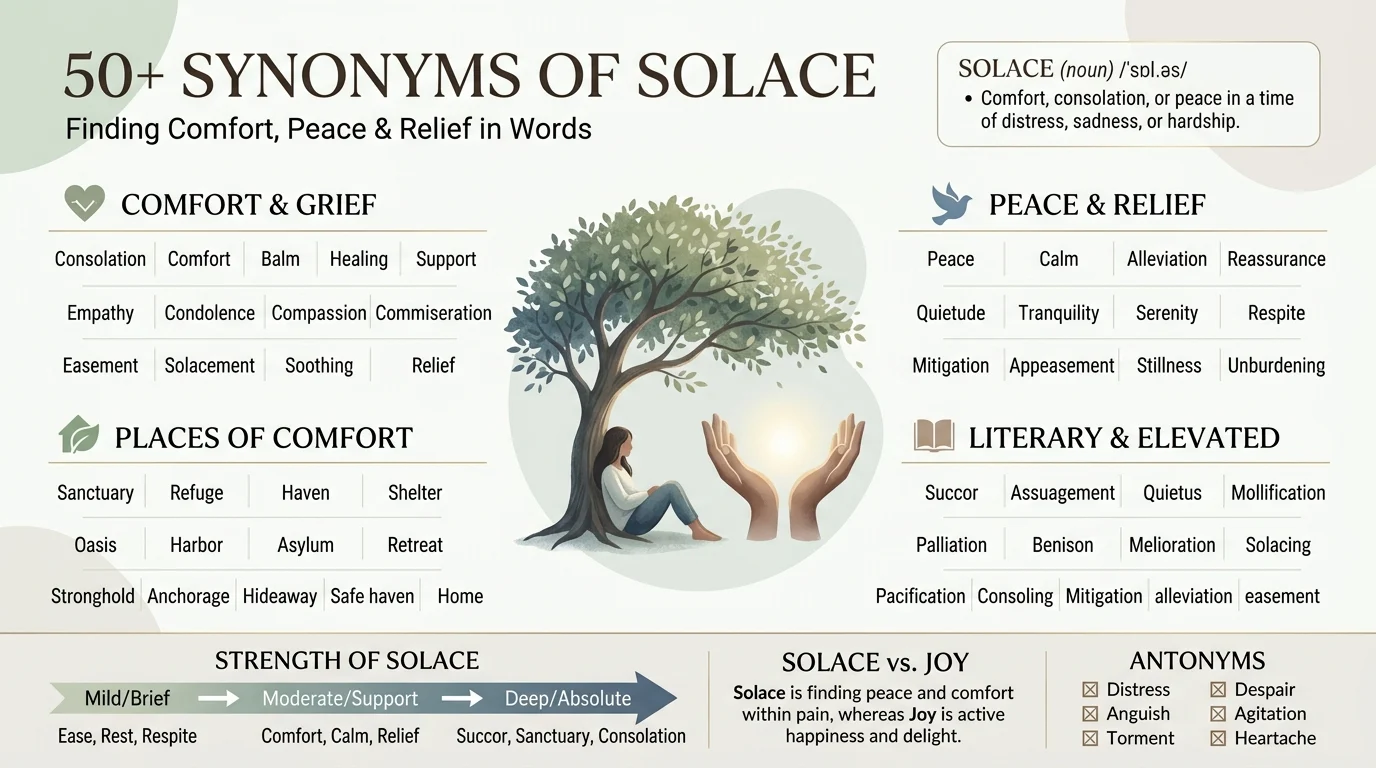
Have you ever needed to describe the comfort that eases grief or the relief that softens disappointment but felt that “comfort” or “peace” was too broad? You want to capture the specific act of consoling someone in distress, and the word “solace” comes to mind. Choosing the right synonym for “solace” can transform a simple description of comfort into a precise expression of emotional relief. This guide explores the best synonyms of solace, explaining exactly which word to use and when.
Quick Ans: “Solace” means comfort in sorrow, misfortune, or distress, or a source of that relief. It is a neutral-to-positive, formal noun. For emotional comfort, choose consolation or comfort. For relief from distress, use relief or soothing. For a source of comfort, use refuge or sanctuary. For spiritual contexts, blessing works well.
Meaning, Tone, and Context
Understanding the core meaning of “solace” is the first step to using it effectively.
Simple Definition: Comfort in sorrow, misfortune, or distress; alleviation of distress or anxiety; a source of comfort.
Part of Speech: Noun and verb.
Overall Tone: Positive and often solemn. It indicates relief and emotional support during difficult times.
Formality Level: Formal to literary. The word is most appropriate in written English, eulogies, and reflective contexts.
Common Uses: Native English speakers use it to describe emotional support during grief, a place of refuge, or an activity that brings peace. For example, “She found solace in music after the loss,” or “His letters were a great solace to her.”
Word Forms: Related words include the verb solace and the adjective solacing.
When and How to Use “Solace”
“Solace” is the perfect choice when you want to describe deep emotional comfort during hardship. Here are seven realistic examples.
Describing Grief Support: “After the funeral, the family found solace in their shared memories.”
Describing Personal Relief: “He sought solace in long walks along the beach.”
Professional: “The team took solace in the fact that they had performed to the best of their ability.”
Academic: “The poem explores how the speaker finds solace in nature after a loss.”
Workplace: “Employees found solace in the supportive words of their manager.”
Personal: “Her garden was her solace during difficult times.”
Social Media: “Sometimes a good book is the only solace you need.”
Best Synonyms of “Solace”
No synonym is identical in every situation. Here is your guide to the best replacement for “solace” based on your writing context.
Most Direct: Consolation is the closest formal synonym for comfort in grief. “The kind words offered little consolation.”
Everyday Comfort: Comfort is the broader, more accessible term. “She found comfort in her faith.”
Relief Context: Relief emphasizes the easing of distress. “It was a relief to hear the good news.”
Soothing Effect: Soothing emphasizes a calming effect. “The music provided a soothing balm for his anxiety.”
Place of Comfort: Refuge emphasizes a safe place from distress. “The library was her refuge from the chaos.”
Sacred Comfort: Sanctuary implies a sacred or protected place. “The church became a sanctuary for the grieving.”
Emotional Support: Succor is a literary synonym for help and relief. “He gave succor to those in need.”
When Not to Use “Solace”
Using “solace” can sound wrong or awkward in certain situations.
When It Sounds Too Literary: In casual conversation, “solace” can sound overly formal.
Better Choice: Comfort or relief. “I found comfort in talking to my friend.”
When You Mean “Distraction”: “Solace” is about comfort, not entertainment.
Better Choice: Distraction or entertainment. “The movie was a good distraction.”
When It Sounds Too Dramatic: For minor issues, “solace” can sound excessive.
Better Choice: Relief or ease. “It was a relief to finish the project.”
When You Mean “Solution”: “Solace” is emotional, not practical.
Better Choice: Solution or answer. “We need a solution to this problem.”
Words Commonly Confused With “Solace”
Several words are often mixed up with “solace.” Here is how to keep them straight.
Word: Consolation
Difference: A direct synonym, but often refers to what is offered to another. “Solace” can be self-sought.
When to Use: Use it when offering comfort to someone.
Example: “The kind words were a great consolation.”
Word: Comfort
Difference: Broader and more everyday. “Solace” implies deeper sorrow.
When to Use: Use it for general comfort and ease.
Example: “This blanket provides comfort.”
Word: Relief
Difference: Focuses on the easing of pain or anxiety. “Solace” includes emotional support.
When to Use: Use it when a burden is lifted.
Example: “The medicine brought relief.”
Word: Succor
Difference: A literary synonym for help and relief. “Solace” is more emotional.
When to Use: Use it in formal or literary contexts.
Example: “The charity offered succor to the refugees.”
Word: Refuge
Difference: A place of safety. “Solace” is the emotional comfort found there.
When to Use: Use it for a physical safe place.
Example: “The cabin was a refuge from the city.”
Word: Sanctuary
Difference: A sacred or protected place. “Solace” is the feeling.
When to Use: Use it for a holy or protected location.
Example: “The garden was her sanctuary.”
Best Synonyms of “Solace” by Context
| Context | Best Synonym | Why It Works | Example |
|---|---|---|---|
| Grief and loss | Consolation | Direct and formal | “The letter offered little consolation.” |
| Everyday comfort | Comfort | Broad and natural | “She found comfort in her friends.” |
| Relief from distress | Relief | Emphasizes easing | “The news brought immense relief.” |
| Calming effect | Soothing | Emphasizes calm | “The tea had a soothing effect.” |
| Place of safety | Refuge | Implies shelter | “The park was his refuge.” |
| Sacred comfort | Sanctuary | Implies protection | “The temple was a sanctuary.” |
| Literary context | Succor | Formal and literary | “He sought succor in poetry.” |
How to Choose the Best Synonym of “Solace”
Choosing the right word is a simple decision. Answer these questions.
What kind of comfort am I describing? For grief, use consolation. And For relief, use relief. For a place, use refuge or sanctuary.
What is my audience? For a eulogy, use solace or consolation. For a friend, use comfort.
What is my purpose? Are you offering comfort, describing a feeling, or naming a place? The correct synonym depends entirely on this.
What is the emotional strength? Solace and consolation are deeper. Comfort and relief are milder.
Real Life Examples of “Solace”
To truly master the word, it helps to see how it behaves in the wild and how a stronger synonym can elevate the sentence.
School: Basic: “The student found solace in reading.” Improved: “The student found comfort in reading.”
College: Basic: “The poem is about solace.” Improved: “The poem is about consolation after loss.”
Workplace: Basic: “The team found solace in their shared effort.” Improved: “The team found consolation in knowing they had done their best.”
Business: Basic: “The garden is a solace.” Improved: “The garden is a refuge from the stress of work.”
Email: Basic: “We hope this brings you solace.” Improved: “We hope this brings you comfort during this difficult time.”
Conversation: Basic: “Music is my solace.” Improved: “Music is my comfort.”
Storytelling: Basic: “The forest gave him solace.” Improved: “The forest was his sanctuary from the world.”
Top 10 Synonyms of “Solace”
| Synonym | Simple Meaning | Best Used For | Example Sentence |
|---|---|---|---|
| Consolation | Comfort in grief | Grief, loss, and formal contexts | “The kind words were a consolation.” |
| Comfort | Ease and relief | Everyday and emotional contexts | “She found comfort in her family.” |
| Relief | Easing of distress | Stress, anxiety, and pain | “The news brought relief.” |
| Soothing | Calming effect | Anxiety, stress, and physical discomfort | “The music was soothing.” |
| Refuge | A safe place | Physical and emotional safety | “The library was his refuge.” |
| Sanctuary | A sacred or safe place | Spiritual and protective contexts | “The garden was her sanctuary.” |
| Succor | Help and relief | Literary and formal contexts | “He offered succor to the weary.” |
| Peace | Freedom from disturbance | General and spiritual contexts | “She found peace in meditation.” |
| Ease | Freedom from difficulty | Everyday and physical contexts | “The medicine brought ease.” |
| Balm | Something that soothes | Emotional and poetic contexts | “Her words were a balm to his soul.” |
Synonyms of “Solace” by Usage
Professional vs. Personal Synonyms
In the workplace (professional), choose consolation, refuge, or relief to describe support and coping. These words convey empathy and professionalism.
With friends (personal), comfort, peace, or relief keep the tone relaxed and relatable.
Formal vs. Conversational Synonyms
For formal writing (reports, essays, eulogies), use consolation, succor, or sanctuary. For casual conversations, use comfort, relief, or peace.
Academic Synonyms
For research and essays, choose precise, authoritative words. Consolation is great for literary analysis, succor for historical contexts, and sanctuary for religious studies.
Professional and Business Synonyms
For maximum impact in business writing, choose relief for problem-solving and comfort for team support. These words demonstrate empathy and leadership.
Creative and Literary Synonyms
To add emotion and imagery to your writing, choose balm, succor, or sanctuary. These words create atmosphere and evoke deep feeling.
Slang and Colloquial Synonyms
There is no direct slang synonym for “solace” in mainstream American English. In modern texting, people use comfort or peace. Avoid slang in professional or academic writing.
Strongest to Mildest Synonyms
Mild: ease, relief, peace
Moderate: solace, comfort, soothing
Strong: consolation, refuge, sanctuary
Very Strong: succor, balm
Emotional vs. Neutral Synonyms
Emotional Synonyms: Solace, consolation, balm. These words hint at deep feeling and grief.
Neutral Synonyms: Relief, ease, comfort. These words communicate factual information.
Antonyms of “Solace”
Here are 15 genuine opposites of “solace.”
| Antonym | Meaning | Example Sentence |
|---|---|---|
| Distress | Extreme anxiety or suffering | “The news caused her great distress.” |
| Agony | Extreme physical or mental suffering | “He was in agony after the accident.” |
| Torment | Severe suffering | “The memories tormented him.” |
| Misery | Great unhappiness | “The poverty caused widespread misery.” |
| Anguish | Severe mental suffering | “She cried out in anguish.” |
| Despair | Complete loss of hope | “He fell into despair.” |
| Grief | Deep sorrow | “Her grief was overwhelming.” |
| Sorrow | Deep distress | “He expressed his sorrow.” |
| Discomfort | Slight pain or unease | “The heat caused discomfort.” |
| Anxiety | Worry and unease | “The uncertainty caused anxiety.” |
| Turmoil | State of confusion | “The country was in turmoil.” |
| Affliction | Cause of pain | “The disease was a terrible affliction.” |
| Woe | Great sorrow | “The tale was full of woe.” |
| Heartache | Emotional anguish | “The breakup caused heartache.” |
| Suffering | The state of undergoing pain | “The suffering was immense.” |
Comparison: “Solace” vs Similar Words
Solace vs. Consolation
Main Difference: “Consolation” is often what is offered to another. “Solace” can be self-sought and is more literary.
Which Is Stronger? They are similar. “Solace” is more literary.
Which Is More Formal? Both are formal.
When to Use Each: Use “consolation” when offering comfort. Use “solace” for self-comfort.
Examples:
Solace: “He found solace in music.”
Consolation: “Her words were a consolation to him.”
Solace vs. Comfort
Main Difference: “Comfort” is broader and more everyday. “Solace” implies deeper sorrow.
Which Is Stronger? “Solace” is deeper and more literary.
Which Is More Formal? “Solace” is more formal.
When to Use Each: Use “comfort” in everyday contexts. Use “solace” for deep grief.
Examples:
Solace: “She sought solace after the tragedy.”
Comfort: “The blanket provided comfort.”
Solace vs. Relief
Main Difference: “Relief” focuses on the easing of pain or anxiety. “Solace” includes emotional support.
Which Is Stronger? “Solace” is more emotional.
Which Is More Formal? Both are formal.
When to Use Each: Use “relief” for physical or practical easing. Use “solace” for emotional support.
Examples:
Solace: “He found solace in prayer.”
Relief: “The medicine brought relief.”
Solace vs. Refuge
Main Difference: “Refuge” is a place of safety. “Solace” is the emotional comfort found there.
Which Is Stronger? They serve different purposes. “Refuge” is physical.
Which Is More Formal? Both are formal.
When to Use Each: Use “refuge” for a safe place. Use “solace” for emotional comfort.
Examples:
Solace: “He found solace in her presence.”
Refuge: “The cabin was a refuge from the storm.”
Solace vs. Succor
Main Difference: “Succor” is a literary synonym for help and relief. “Solace” is more emotional.
Which Is Stronger? “Succor” is more active.
Which Is More Formal? Both are formal.
When to Use Each: Use “succor” in literary contexts. Use “solace” for emotional comfort.
Examples:
Solace: “She found solace in his words.”
Succor: “The charity offered succor to the refugees.”
Solace vs. Sanctuary
Main Difference: “Sanctuary” implies a sacred or protected place. “Solace” is the feeling of comfort.
Which Is Stronger? “Sanctuary” is more specific.
Which Is More Formal? Both are formal.
When to Use Each: Use “sanctuary” for a place. Use “solace” for the feeling.
Examples:
Solace: “He found solace in the garden.”
Sanctuary: “The garden was her sanctuary.”
Common Phrases and Expressions with “Solace”
Phrase: Find solace in
Meaning: To discover comfort in something.
Example Sentence: “She found solace in her faith.”
Phrase: Seek solace
Meaning: To look for comfort.
Example Sentence: “He sought solace in nature.”
Phrase: Take solace
Meaning: To derive comfort from something.
Example Sentence: “We take solace in knowing he lived a full life.”
Phrase: A source of solace
Meaning: Something that provides comfort.
Example Sentence: “Her garden was a source of solace.”
Phrase: Solace for the soul
Meaning: Deep spiritual comfort.
Example Sentence: “Music is solace for the soul.”
Common Mistakes to Avoid
Mistake 1: Using “solace” when you mean “comfort”.
Incorrect: “The hotel provided solace.”
Better: “The hotel provided comfort.”
Why: “Solace” is for emotional grief, not physical comfort.
Mistake 2: Using “solace” in casual conversation.
Incorrect: “I found solace in a good movie.”
Better: “I found comfort in a good movie.”
Why: “Solace” is too formal for casual speech.
Mistake 3: Using “solace” when you mean “relief”.
Incorrect: “The test results were a solace.”
Better: “The test results were a relief.”
Why: “Relief” is more appropriate for anxiety about outcomes.
Mistake 4: Using “solace” when you mean “solution”.
Incorrect: “We need a solace to this problem.”
Better: “We need a solution to this problem.”
Why: “Solace” is emotional, not practical.
Mistake 5: Overusing “solace” in a single paragraph.
Incorrect: “She found solace. His solace was music. The solace helped.”
Better: “She found comfort. His refuge was music. The consolation helped.”
Why: Variation in vocabulary demonstrates writing sophistication.
Frequently Asked Questions
1. What are the best synonyms of “solace”?
The best synonyms depend on your context. For grief, choose consolation. And For everyday comfort, use comfort or relief. For a place of safety, use refuge or sanctuary.
2. What are the best formal synonyms of “solace”?
The best formal synonyms are consolation, succor, and sanctuary. These words are suitable for eulogies, academic papers, and literary writing.
3. What are common informal synonyms of “solace”?
For informal settings, use comfort, relief, or peace. These alternatives sound more natural in everyday conversation.
4. What is another word for “solace” in professional writing?
In professional writing, consolation or relief are excellent choices. They convey empathy without being overly literary.
5. What is the difference between “solace” and “consolation”?
“Consolation” is often what is offered to another. “Solace” can be self-sought and is more literary. Both refer to comfort in grief.
6. What is the opposite of “solace”?
The most direct opposites (antonyms) of solace are distress, agony, and despair. These words describe suffering and lack of comfort.
Conclusion
“Solace” is a beautiful and formal word for describing comfort in sorrow, misfortune, or distress. The term is literary and widely accepted in reflective and formal contexts, yet it can sound too dramatic for everyday situations. The best choice among the synonyms of solace depends entirely on your audience, tone, and purpose. Remember, no single synonym works perfectly in every situation. Your goal is to choose the word that communicates your message with the most clarity and impact. A practical tip for your vocabulary growth is to pay attention to how writers describe comfort and grief and practice using different synonyms in your writing.










1 thought on “50+ Synonyms of Solace: Meanings, Uses, Examples, and Best Alternatives 2026”