Have you ever needed to describe resistance, a male animal, or a dollar but felt that “buck” was too informal or unclear? You want to capture the specific meaning, whether it is opposing pressure, a deer, or money, and the word “buck” comes to mind. Choosing the right synonym for “buck” can transform a vague statement into a precise expression of resistance, currency, or animal classification. This guide explores the best synonyms of buck, explaining exactly which word to use and when.
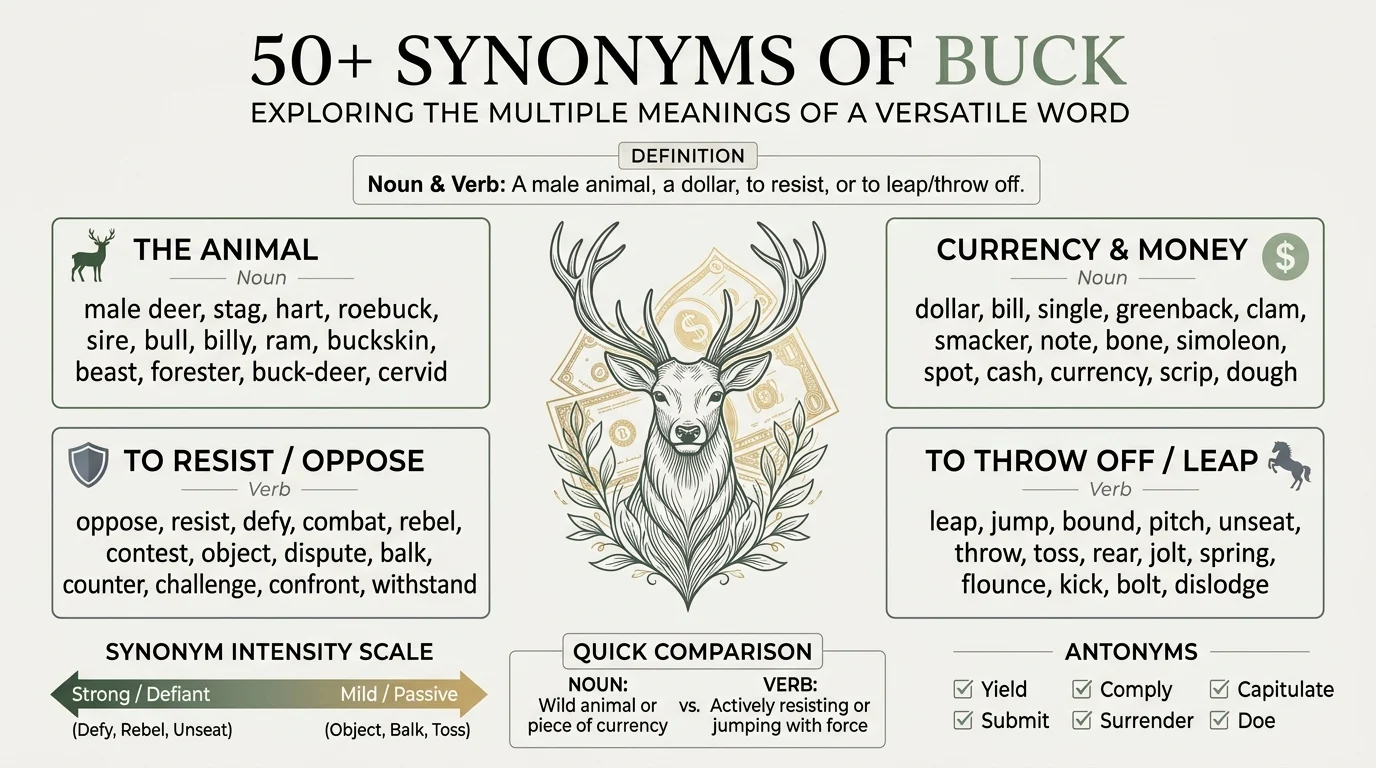
Quick Ans: “Buck” has three main meanings: a male deer, a dollar, or the act of resisting. For the animal, choose stag, hart, or male deer. For money, use dollar, greenback, or currency. For resistance, use resist, oppose, or rebel. For throwing off, use throw, unseat, or dislodge.
Meaning, Tone, and Context
Understanding the core meaning of “buck” is the first step to using it effectively.
Simple Definition: A male deer or rabbit; an informal term for a US dollar; to resist or oppose; to throw off or unseat.
Part of Speech: Noun and verb.
Overall Tone: Informal to neutral. The word is common in American English, especially in casual and rural contexts.
Formality Level: Informal. The word is most appropriate in casual conversations, journalism, and American English.
Common Uses: Native English speakers use it for animals (“a buck in the meadow”), money (“twenty bucks”), resistance (“buck the trend”), and rodeo (“bucked off the horse”).
Word Forms: Related words include the verb buck, the noun bucker, and the adjective bucked.
When and How to Use “Buck”
“Buck” is the perfect choice when you want to describe resistance, a male deer, or money in casual contexts. Here are seven realistic examples.
Animal: “A large buck stood at the edge of the forest.”
Money: “I only have a few bucks in my wallet.”
Resistance: “She refused to buck the system and followed the rules.”
Rodeo: “The cowboy was bucked off the wild horse.”
Trend: “The company bucked the trend and increased profits.”
Idiomatic: “He decided to pass the buck to his assistant.”
Informal: “Can you lend me ten bucks until Friday?”
Best Synonyms of “Buck”
No synonym is identical in every situation. Here is your guide to the best replacement for “buck” based on your writing context.
For the Animal (Male Deer)
Most Formal: Stag means a male deer. “The stag stood proudly on the ridge.”
Literary: Hart means a mature male deer. “The hart fled through the forest.”
General: Male deer is the clearest term. “A male deer was spotted near the river.”
Rabbit: Buck also means a male rabbit. “The buck rabbit guarded the burrow.”
For Money (Dollar)
Most Common: Dollar is the formal term. “The ticket costs fifty dollars.”
Slang: Greenback means a US dollar bill. “He paid with a crisp greenback.”
Slang: Clam is old slang for a dollar. “It cost me a few clams.”
Formal: Currency means money in general. “The local currency is the dollar.”
Informal: Quid means pounds in British English. “It costs twenty quid.”
For Resistance (Oppose)
Most Direct: Resist means to oppose. “She resisted the change.”
Oppose: Oppose means to disagree with. “He opposed the new policy.”
*Rebel: Rebel means to defy authority. “The students rebelled against the rules.”
Defy: Defy means to openly resist. “He defied the orders.”
For Throwing Off (Unseat)
Most Direct: Throw means to propel. “The horse threw the rider.”
Unseat: Unseat means to remove from a seat. “The bull unseated the cowboy.”
Dislodge: Dislodge means to remove from position. “The impact dislodged the rider.”
Topple: Topple means to cause to fall. “The sudden movement toppled the rider.”
When Not to Use “Buck”
Using “buck” can sound wrong or awkward in certain situations.
When You Mean “Dollar” Formally: “Buck” is informal. Use “dollar” in formal writing.
Better Choice: Dollar. “The cost is fifty dollars.”
When You Mean “Stag” Formally: “Buck” is common but informal. Use “stag” in formal writing.
Better Choice: Stag. “The stag is a male deer.”
When You Mean “Resist” Formally: “Buck” is informal. Use “resist” or “oppose.”
Better Choice: Resist. “She resisted the pressure.”
Words Commonly Confused With “Buck”
| Word | Difference | When to Use | Example |
|---|---|---|---|
| Stag | Male deer | Formal and literary | “The stag stood proudly.” |
| Hart | Mature male deer | Literary and poetic | “The hart fled.” |
| Dollar | US currency | Formal and general | “It costs ten dollars.” |
| Resist | Oppose | Formal and general | “She resisted the change.” |
| Oppose | Disagree with | Formal and political | “He opposed the policy.” |
| Unseat | Remove from position | Formal and dramatic | “The bull unseated the rider.” |
Best Synonyms of “Buck” by Context
| Context | Best Synonym | Why It Works | Example |
|---|---|---|---|
| Formal writing | Stag | Formal and precise | “The stag stood on the ridge.” |
| Academic writing | Male deer | Clear and scientific | “The male deer was observed.” |
| Professional | Dollar | Formal and clear | “The budget is one million dollars.” |
| Business | Currency | Financial and formal | “The local currency is stable.” |
| Resistance | Resist | Formal and direct | “She resisted the change.” |
| Rodeo | Unseat | Dramatic and specific | “The bull unseated the cowboy.” |
| Casual | Buck | Simple and natural | “It costs ten bucks.” |
How to Choose the Best Synonym of “Buck”
Choosing the right word is a simple decision. Answer these questions.
What type of buck am I describing? For the animal, use stag or hart. And For money, use dollar or currency. For resistance, use resist or oppose. For throwing off, use unseat or throw.
What is my audience? For a formal report, use stag or dollar. For a friend, use buck or greenback.
What is my purpose? Are you describing an animal, money, or resistance? The correct synonym depends entirely on this.
What is the emotional strength? Rebel and defy are stronger. Resist is neutral. Pick the one that matches your message.
Real Life Examples of “Buck”
School: Basic: “The buck ran away.” Improved: “The stag ran into the forest.”
College: Basic: “It costs twenty bucks.” Improved: “It costs twenty dollars.”
Workplace: Basic: “He bucked the system.” Improved: “He resisted the system.”
Business: Basic: “The company bucked the trend.” Improved: “The company defied the trend.”
Email: Basic: “Send me fifty bucks.” Improved: “Please send me fifty dollars.”
Conversation: Basic: “The horse bucked him off.” Improved: “The horse unseated him.”
Storytelling: Basic: “The buck stood in the clearing.” Improved: “The hart stood motionless in the clearing.”
Top 10 Synonyms of “Buck”
| Synonym | Simple Meaning | Best Used For | Example Sentence |
|---|---|---|---|
| Stag | Male deer | Formal and literary | “The stag stood on the ridge.” |
| Hart | Mature male deer | Literary and poetic | “The hart fled through the woods.” |
| Dollar | US currency | Formal and general | “The ticket costs fifty dollars.” |
| Greenback | US dollar bill | Slang and informal | “He paid with a greenback.” |
| Currency | Money in general | Financial and formal | “The local currency is stable.” |
| Resist | Oppose | Formal and general | “She resisted the change.” |
| Oppose | Disagree with | Formal and political | “He opposed the policy.” |
| Rebel | Defy authority | Strong and political | “The students rebelled.” |
| Defy | Openly resist | Strong and dramatic | “He defied the orders.” |
| Unseat | Remove from position | Dramatic and rodeo | “The bull unseated the cowboy.” |
Synonyms of “Buck” by Usage
Professional vs. Personal Synonyms
In the workplace, choose dollar, resist, or oppose. With friends, use buck, greenback, or rebel.
Formal vs. Conversational Synonyms
For formal writing, use stag, dollar, or resist. For casual conversations, use buck, greenback, or rebel.
Academic Synonyms
For research and essays, choose male deer for biology, currency for economics, and resist for psychology.
Professional and Business Synonyms
For maximum impact, choose dollar for budgets, currency for finance, and oppose for policy.
Creative and Literary Synonyms
To add emotion and imagery, choose hart, stag, or defy. These words create atmosphere.
Slang or Modern Synonyms
In modern American slang, buck, greenback, clam, or quid are common. For example, “It costs a few bucks.” These are casual and should be avoided in formal writing.
Strongest to Mildest Synonyms
Mild: resist, oppose, dollar
Moderate: buck, stag, currency
Strong: rebel, defy, unseat
Very Strong: hart, greenback, topple
Emotional vs. Neutral Synonyms
Emotional Synonyms: Rebel, defy, hart. These words hint at strength or beauty. Use them when you want to evoke feeling.
Neutral Synonyms: Dollar, stag, resist. These words communicate factual information.
Antonyms of “Buck”
| Antonym | Meaning | Example Sentence |
|---|---|---|
| Doe | Female deer | “The doe grazed in the meadow.” |
| Hind | Female deer | “The hind protected her fawn.” |
| Submit | Yield to authority | “He submitted to the rules.” |
| Comply | Obey | “She complied with the request.” |
| Obey | Follow orders | “The soldiers obeyed.” |
| Yield | Give way | “He yielded to pressure.” |
| Conform | Follow standards | “They conformed to expectations.” |
| Accept | Agree to | “She accepted the decision.” |
| Surrender | Give up | “He surrendered to the demands.” |
| Agree | Consent | “They agreed to the terms.” |
| Support | Back or endorse | “He supported the policy.” |
| Cooperate | Work together | “They cooperated with authorities.” |
| Assent | Express approval | “She assented to the plan.” |
| Acquiesce | Accept reluctantly | “He acquiesced to the change.” |
| Relent | Give in | “She relented after hours.” |
Comparison: “Buck” vs Similar Words
Buck vs. Stag
Main Difference: “Stag” is formal. “Buck” is informal.
Which Is Stronger? Both are similar.
Which Is More Formal? “Stag” is more formal.
When to Use Each: Use “stag” in formal writing. Use “buck” in casual conversation.
Examples:
Buck: “The buck stood in the clearing.”
Stag: “The stag stood on the ridge.”
Buck vs. Hart
Main Difference: “Hart” is literary and poetic. “Buck” is common.
Which Is Stronger? “Hart” is more evocative.
Which Is More Formal? “Hart” is more formal.
When to Use Each: Use “hart” in poetry. Use “buck” in general contexts.
Examples:
Buck: “A buck grazed nearby.”
Hart: “The hart fled through the forest.”
Buck vs. Dollar
Main Difference: “Dollar” is formal. “Buck” is slang.
Which Is Stronger? Both are similar.
Which Is More Formal? “Dollar” is more formal.
When to Use Each: Use “dollar” in formal writing. Use “buck” in casual conversation.
Examples:
Buck: “It costs ten bucks.”
Dollar: “It costs ten dollars.”
Buck vs. Resist
Main Difference: “Resist” is formal. “Buck” is informal.
Which Is Stronger? Both are similar.
Which Is More Formal? “Resist” is more formal.
When to Use Each: Use “resist” in formal writing. Use “buck” in casual conversation.
Examples:
Buck: “He bucked the system.”
Resist: “He resisted the system.”
Buck vs. Unseat
Main Difference: “Unseat” is specific to throwing off. “Buck” is broader.
Which Is Stronger? “Unseat” is more specific.
Which Is More Formal? “Unseat” is more formal.
When to Use Each: Use “unseat” in rodeo contexts. Use “buck” in general contexts.
Examples:
Buck: “The horse bucked him off.”
Unseat: “The bull unseated the cowboy.”
Buck vs. Rebel
Main Difference: “Rebel” is stronger and more political. “Buck” is milder.
Which Is Stronger? “Rebel” is stronger.
Which Is More Formal? Both are neutral.
When to Use Each: Use “rebel” for defiance. Use “buck” for resistance.
Examples:
Buck: “She bucked the trend.”
Rebel: “The students rebelled against the rules.”
Common Phrases and Expressions with “Buck”
Phrase: Pass the buck
Meaning: Shift responsibility to someone else.
Example Sentence: “He always tries to pass the buck.”
Phrase: Buck up
Meaning: Cheer up or hurry up.
Example Sentence: “Buck up, things will get better.”
Phrase: Buck the trend
Meaning: Go against the general direction.
Example Sentence: “The company bucked the trend and grew.”
Phrase: Big bucks
Meaning: A lot of money.
Example Sentence: “He earns big bucks.”
Phrase: Buck wild
Meaning: Wild and uncontrolled.
Example Sentence: “The party was buck wild.”
Phrase: Buck naked
Meaning: Completely naked.
Example Sentence: “He ran out buck naked.”
Common Mistakes to Avoid
Mistake 1: Using “buck” when you mean “dollar” formally.
Incorrect: “The contract is worth fifty bucks.”
Better: “The contract is worth fifty dollars.”
Why: “Dollars” is formal.
Mistake 2: Using “buck” when you mean “stag” formally.
Incorrect: “The buck is a male deer.”
Better: “The stag is a male deer.”
Why: “Stag” is formal.
Mistake 3: Overusing “buck” in conversation.
Incorrect: “I need some bucks.”
Better: “I need some cash.”
Why: “Cash” sounds more natural.
Mistake 4: Using “buck” when you mean “resist” formally.
Incorrect: “She bucked the policy.”
Better: “She resisted the policy.”
Why: “Resisted” is formal.
Mistake 5: Using “buck” when you mean “unseat”.
Incorrect: “The bull bucked the cowboy.”
Better: “The bull unseated the cowboy.”
Why: “Unseated” is more precise.
Frequently Asked Questions
1. What are the best synonyms of “buck”?
The best synonyms depend on your context. For the animal, choose stag or hart. And For money, use dollar or currency. For resistance, use resist or oppose. For throwing off, use unseat or throw.
2. What are the best formal synonyms of “buck”?
The best formal synonyms are stag, dollar, and resist. These words are suitable for academic papers, professional reports, and business communications.
3. What are common informal synonyms of “buck”?
For informal settings, use buck, greenback, clam, or quid. These alternatives sound more natural in everyday conversation.
4. What is another word for “buck” in professional writing?
In professional writing, dollar is an excellent choice for money. Stag is also strong for the animal. Resist is best for opposition.
5. What is the difference between “buck” and “stag”?
“Buck” is informal. “Stag” is formal. Both mean a male deer. Use “stag” in formal writing and “buck” in casual conversation.
6. What is the opposite of “buck”?
The most direct opposites (antonyms) of buck are doe, hind, submit, and comply. These words describe the female animal or yielding to authority.
Conclusion
“Buck” is a versatile and informal word with multiple meanings in American English. The term is widely accepted in casual conversation, journalism, and rural contexts, yet it can sound too informal for formal writing or too vague without context. The best choice among the synonyms of buck depends entirely on your audience, tone, and purpose. Remember, no single synonym works perfectly in every situation. Your goal is to choose the word that communicates your message with the most clarity and impact. A practical tip for your vocabulary growth is to pay attention to how writers use context to clarify meaning and practice using different synonyms in your writing.









