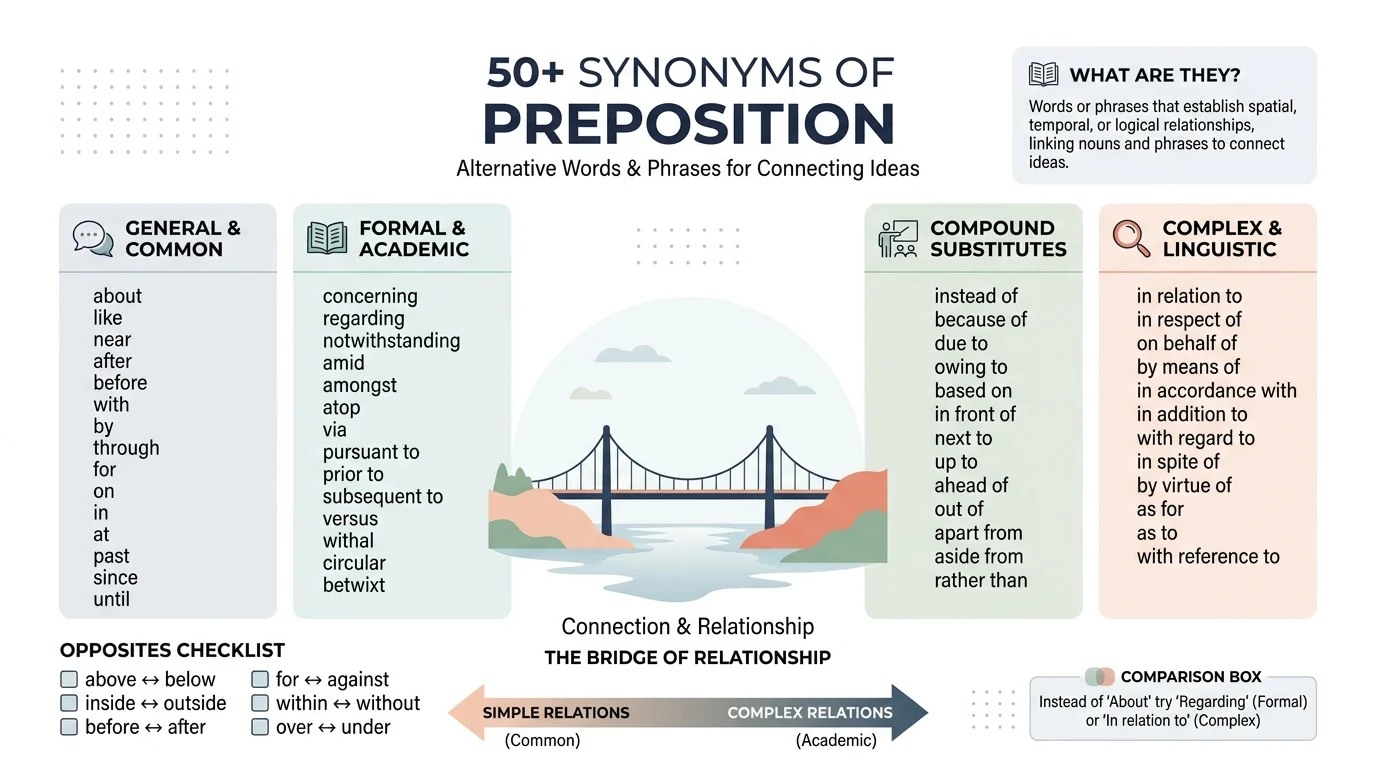
Have you ever needed to describe a word that shows the relationship between other words but felt that “preposition” was too technical or narrow? You want to capture the connecting function of these small but powerful words, and the term “preposition” comes to mind. Choosing the right synonym or alternative for “preposition” can help you understand and explain how words like “in,” “on,” and “at” function in sentences. This guide explores the best synonyms and alternatives for preposition, explaining exactly which word to use and when.
Quick Ans: “Preposition” is a grammatical term for a word that shows the relationship between a noun or pronoun and other words in a sentence. For general reference, use connecting word or relational word. For teaching contexts, use function word or linking word. For linguistic analysis, use particle or adposition. For casual conversation, use small word or position word.
Meaning, Tone, and Context
Understanding the core meaning of “preposition” is the first step to using it effectively.
Simple Definition: A word governing, and usually preceding, a noun or pronoun and expressing a relation to another word or element in the clause.
Part of Speech: Noun (grammatical term).
Overall Tone: Neutral and technical. It is a descriptive term used in grammar and linguistics.
Formality Level: Formal to neutral. The term is used in academic, educational, and professional contexts.
Common Uses: Native English speakers and teachers use it to describe words like “in,” “on,” “at,” “by,” “with,” “about,” “under,” and “between.”
Word Forms: Related words include the adjective prepositional and the adverb prepositionally.
When and How to Use “Preposition”
“Preposition” is the perfect choice when you want to describe a word that shows relationships between other words. Here are seven realistic examples.
Educational: “The teacher explained that ‘under’ is a preposition in the sentence.”
Academic: “The study analyzed the use of prepositions in academic writing.”
Professional: “Clear use of prepositions improves communication.”
Grammar: “A preposition typically comes before its object.”
Language Learning: “English learners often struggle with prepositions.”
Writing: “The preposition ‘between’ indicates a relationship involving two things.”
Social Media: “Grammar tip: a preposition shows the relationship between words.”
Best Synonyms and Alternatives of “Preposition”
No synonym is identical in every situation. Here is your guide to the best replacement or alternative for “preposition” based on your writing context.
For General Reference
Most Common: Connecting word means a word that connects or relates. “Prepositions are connecting words.”
Relational word: Relational word means a word showing relationship. “Relational words like ‘with’ and ‘without’ are prepositions.”
Function word: Function word means a word with little meaning but grammatical function. “Prepositions are function words.”
Linking word: Linking word means a word that links parts of a sentence. “Linking words include prepositions and conjunctions.”
For Linguistic and Academic Contexts
Particle: Particle means a small word with grammatical function. “Some particles function as prepositions.”
Adposition: Adposition is the general term for prepositions and postpositions. “Adpositions show spatial or temporal relations.”
Grammatical word: Grammatical word means a word with grammatical purpose. “Prepositions are grammatical words.”
Structural word: Structural word means a word that provides structure. “Structural words include prepositions.”
For Teaching and Learning
Small word: Small word is a simple term for prepositions. “Prepositions are small words that show position.”
Position word: Position word means a word showing position. “Position words like ‘on’ and ‘under’ are prepositions.”
Location word: Location word means a word showing location. “Location words help describe where things are.”
Time word: Time word means a word showing time. “Time words like ‘before’ and ‘after’ are prepositions.”
For Specific Types
Preposition of place: Preposition of place shows location. “In, on, and at are prepositions of place.”
Preposition of time: Preposition of time shows when. “Before, after, and during are prepositions of time.”
Preposition of movement: Preposition of movement shows direction. “To, from, and through are prepositions of movement.”
Preposition of manner: Preposition of manner shows how. “By and with are prepositions of manner.”
When Not to Use “Preposition”
Using “preposition” can sound wrong or awkward in certain situations.
When You Mean “Conjunction”: Conjunctions join clauses. Prepositions show relationships.
Better Choice: Conjunction. “And, but, and or are conjunctions.”
When You Mean “Adverb”: Adverbs modify verbs. Prepositions show relationships.
Better Choice: Adverb. “Quickly and slowly are adverbs.”
When It Sounds Too Technical: In casual conversation, “preposition” can sound formal.
Better Choice: Small word or linking word. “Small words like ‘in’ and ‘on’ show position.”
Words Commonly Confused With “Preposition”
| Word | Difference | When to Use | Example |
|---|---|---|---|
| Conjunction | Joins clauses or words | Grammar and writing | “And, but, or.” |
| Adverb | Modifies verbs or adjectives | Grammar and writing | “Quickly, very, well.” |
| Pronoun | Replaces a noun | Grammar and writing | “He, she, it.” |
| Article | Specifies a noun | Grammar and writing | “A, an, the.” |
| Interjection | Expresses emotion | Grammar and writing | “Wow, oh, hey.” |
| Particle | Small grammatical word | Linguistics | “Up, off, out.” |
Best Synonyms and Alternatives of “Preposition” by Context
| Context | Best Alternative | Why It Works | Example |
|---|---|---|---|
| Formal writing | Function word | Formal and precise | “Prepositions are function words.” |
| Academic writing | Adposition | Standard in linguistics | “Adpositions show relationships.” |
| Teaching | Position word | Simple and clear | “Position words show location.” |
| Casual conversation | Small word | Simple and natural | “Small words like ‘in’ and ‘on’.” |
| Language learning | Connecting word | Descriptive and helpful | “Connecting words link ideas.” |
| Grammar | Relational word | Precise and clear | “Relational words show relationships.” |
How to Choose the Best Synonym or Alternative of “Preposition”
Choosing the right word is a simple decision. Answer these questions.
What type of preposition am I describing? For place, use preposition of place. And For time, use preposition of time. For movement, use preposition of movement.
What is my audience? For a grammar class, use preposition or function word. For a child, use small word or position word.
What is my purpose? Are you teaching, analyzing, or explaining? The correct alternative depends entirely on this.
What is the context? For linguistics, use adposition. For general grammar, use connecting word.
Real Life Examples of “Preposition”
School: Basic: “The preposition is ‘under’.” Improved: “The connecting word in the sentence is ‘under’.”
College: Basic: “The study examined prepositions.” Improved: “The study examined adpositions in academic texts.”
Workplace: Basic: “Use prepositions correctly.” Improved: “Use function words correctly in your writing.”
Business: Basic: “Prepositions are important.” Improved: “Relational words clarify meaning in contracts.”
Email: Basic: “Check your prepositions.” Improved: “Check your connecting words for clarity.”
Conversation: Basic: “What is a preposition?” Improved: “What is a small word like ‘in’ called?”
Storytelling: Basic: “The preposition set the scene.” Improved: “The position word painted the scene.”
Top 10 Synonyms and Alternatives of “Preposition”
| Alternative | Simple Meaning | Best Used For | Example Sentence |
|---|---|---|---|
| Connecting word | A word that connects or relates | General and teaching | “Prepositions are connecting words.” |
| Relational word | A word showing relationship | Grammar and writing | “Relational words show how things relate.” |
| Function word | A word with grammatical purpose | Academic and linguistics | “Function words include prepositions.” |
| Linking word | A word that links parts of a sentence | Writing and teaching | “Linking words improve flow.” |
| Particle | A small grammatical word | Linguistics | “Some particles act as prepositions.” |
| Adposition | General term for prepositions and postpositions | Academic and linguistics | “Adpositions show spatial relations.” |
| Position word | A word showing position | Teaching and learning | “Position words like ‘on’ and ‘under’.” |
| Location word | A word showing location | Teaching and learning | “Location words describe where.” |
| Time word | A word showing time | Teaching and learning | “Time words like ‘before’ and ‘after’.” |
| Small word | A simple term for prepositions | Casual and teaching | “Small words like ‘in’ and ‘at’.” |
Synonyms of “Preposition” by Usage
Professional vs. Personal Synonyms
In the workplace, choose function word, relational word, or connecting word. With friends, use small word or position word.
Formal vs. Conversational Synonyms
For formal writing, use function word, adposition, or relational word. For casual conversations, use small word or linking word.
Academic Synonyms
For research and essays, choose adposition for linguistics, function word for grammar, and particle for specific analyses.
Professional and Business Synonyms
For maximum impact, choose function word for clarity, relational word for contracts, and connecting word for communication.
Creative and Literary Synonyms
To add variety, choose position word or location word. These create vivid imagery.
Slang or Modern Synonyms
In modern American slang, there is no common slang for preposition. Small word is the simplest alternative.
Strongest to Mildest Synonyms
Mild: small word, linking word
Moderate: connecting word, position word
Strong: function word, relational word
Very Strong: adposition, particle, grammatical word
Emotional vs. Neutral Synonyms
Emotional Synonyms: There are no emotional synonyms for this technical term.
Neutral Synonyms: Preposition, function word, connecting word. These words communicate factual information.
Antonyms of “Preposition”
| Antonym | Meaning | Example Sentence |
|---|---|---|
| Content word | A word with meaning | “Nouns and verbs are content words.” |
| Lexical word | A word with semantic meaning | “Lexical words carry meaning.” |
| Noun | A naming word | “The noun is the subject.” |
| Verb | An action word | “The verb shows action.” |
| Adjective | A describing word | “The adjective modifies the noun.” |
| Adverb | A word modifying a verb | “The adverb modifies the verb.” |
| Pronoun | A word replacing a noun | “The pronoun replaces the noun.” |
| Conjunction | A joining word | “The conjunction joins clauses.” |
| Interjection | An exclamation | “The interjection shows emotion.” |
| Article | A specifying word | “The article specifies the noun.” |
| Determiner | A limiting word | “The determiner limits the noun.” |
| Numeral | A number word | “The numeral shows quantity.” |
| Quantifier | A word showing amount | “The quantifier shows amount.” |
| Negation | A negative word | “The negation reverses meaning.” |
| Modal | A word showing possibility | “The modal shows possibility.” |
Comparison: “Preposition” vs Similar Words
Preposition vs. Conjunction
Main Difference: Prepositions show relationships. Conjunctions join clauses.
Which Is Stronger? They are different functions.
Which Is More Formal? Both are grammatical terms.
When to Use Each: Use “preposition” for relationships. Use “conjunction” for joining.
Examples:
Preposition: “The book is on the table.”
Conjunction: “I like tea and coffee.”
Preposition vs. Adverb
Main Difference: Prepositions show relationships. Adverbs modify verbs.
Which Is Stronger? They are different functions.
Which Is More Formal? Both are grammatical terms.
When to Use Each: Use “preposition” for relationships. Use “adverb” for modification.
Examples:
Preposition: “She walked into the room.”
Adverb: “She walked quickly.”
Preposition vs. Particle
Main Difference: Particles are small words that may function as prepositions. Prepositions are a specific category.
Which Is Stronger? “Particle” is broader.
Which Is More Formal? “Particle” is more linguistic.
When to Use Each: Use “particle” in linguistics. Use “preposition” in grammar.
Examples:
Preposition: “He climbed up the ladder.”
Particle: “He looked up the word.”
Preposition vs. Adposition
Main Difference: Adposition is the general term. Preposition is a type of adposition.
Which Is Stronger? “Adposition” is more technical.
Which Is More Formal? “Adposition” is more formal.
When to Use Each: Use “adposition” in linguistics. Use “preposition” in general grammar.
Examples:
Preposition: “The cat is under the table.”
Adposition: “Adpositions show spatial relations.”
Preposition vs. Function Word
Main Difference: Function word is a broader category. Preposition is a type of function word.
Which Is Stronger? “Function word” is broader.
Which Is More Formal? Both are formal.
When to Use Each: Use “function word” for the category. Use “preposition” for the specific type.
Examples:
Preposition: “In is a preposition.”
Function word: “In, and, and the are function words.”
Preposition vs. Connecting Word
Main Difference: Connecting word is a general term. Preposition is a specific grammatical category.
Which Is Stronger? “Connecting word” is simpler.
Which Is More Formal? “Preposition” is more formal.
When to Use Each: Use “connecting word” for teaching. Use “preposition” for grammar.
Examples:
Preposition: “The preposition shows the relationship.”
Connecting word: “Prepositions are connecting words.”
Common Phrases and Expressions with “Preposition”
Phrase: Prepositional phrase
Meaning: A phrase beginning with a preposition.
Example Sentence: “In the morning is a prepositional phrase.”
Phrase: Object of a preposition
Meaning: The noun or pronoun following a preposition.
Example Sentence: “In ‘on the table,’ table is the object of the preposition.”
Phrase: Stranded preposition
Meaning: A preposition at the end of a sentence.
Example Sentence: “What are you looking at?” is a stranded preposition.”
Phrase: Preposition of place
Meaning: A preposition showing location.
Example Sentence: “In, on, and at are prepositions of place.”
Phrase: Preposition of time
Meaning: A preposition showing when.
Example Sentence: “Before, after, and during are prepositions of time.”
Common Mistakes to Avoid
Mistake 1: Confusing prepositions with conjunctions.
Incorrect: “I like tea and coffee and the morning.”
Better: “I like tea and coffee in the morning.”
Why: “In” is a preposition. “And” is a conjunction.
Mistake 2: Using the wrong preposition.
Incorrect: “I am good in math.”
Better: “I am good at math.”
Why: “At” is the correct preposition for skills.
Mistake 3: Ending sentences with prepositions in formal writing.
Incorrect: “This is the book I was looking for.”
Better: “This is the book for which I was looking.”
Why: Formal writing prefers avoiding stranded prepositions.
Mistake 4: Omitting necessary prepositions.
Incorrect: “I am going the store.”
Better: “I am going to the store.”
Why: “To” is required to show direction.
Mistake 5: Using too many prepositions.
Incorrect: “The book on the table in the room on the left.”
Better: “The book on the table in the left room.”
Why: Too many prepositions clutter the sentence.
Frequently Asked Questions
1. What are the best synonyms of “preposition”?
The best alternatives depend on your context. For general reference, use connecting word or relational word.And For teaching, use function word or position word. For linguistics, use adposition or particle.
2. What are the best formal alternatives of “preposition”?
The best formal alternatives are function word, adposition, and relational word. These terms are suitable for academic papers, professional reports, and linguistic analyses.
3. What are common informal alternatives of “preposition”?
For informal settings, use small word or linking word. These alternatives sound more natural in everyday conversation.
4. What is another word for “preposition” in teaching?
In teaching, position word or location word are excellent choices. They convey the function simply and clearly.
5. What is the difference between “preposition” and “conjunction”?
Prepositions show relationships between words. Conjunctions join words or clauses. Use “preposition” for relationships and “conjunction” for joining.
6. What is the opposite of “preposition”?
The most direct opposites of preposition are content word, noun, and verb. These words carry meaning rather than showing relationships.
Conclusion
“Preposition” is a fundamental grammatical term for describing words that show relationships between other words. The term is technical and widely accepted in educational, academic, and linguistic contexts, yet it can sound too formal for casual conversation or too narrow for broader discussions of grammar. The best alternative for preposition depends entirely on your audience, tone, and purpose. Remember, no single synonym works perfectly in every situation. Your goal is to choose the word that communicates your message with the most clarity and impact. A practical tip for your vocabulary growth is to pay attention to how prepositions function in sentences and practice using different alternatives in your writing.









