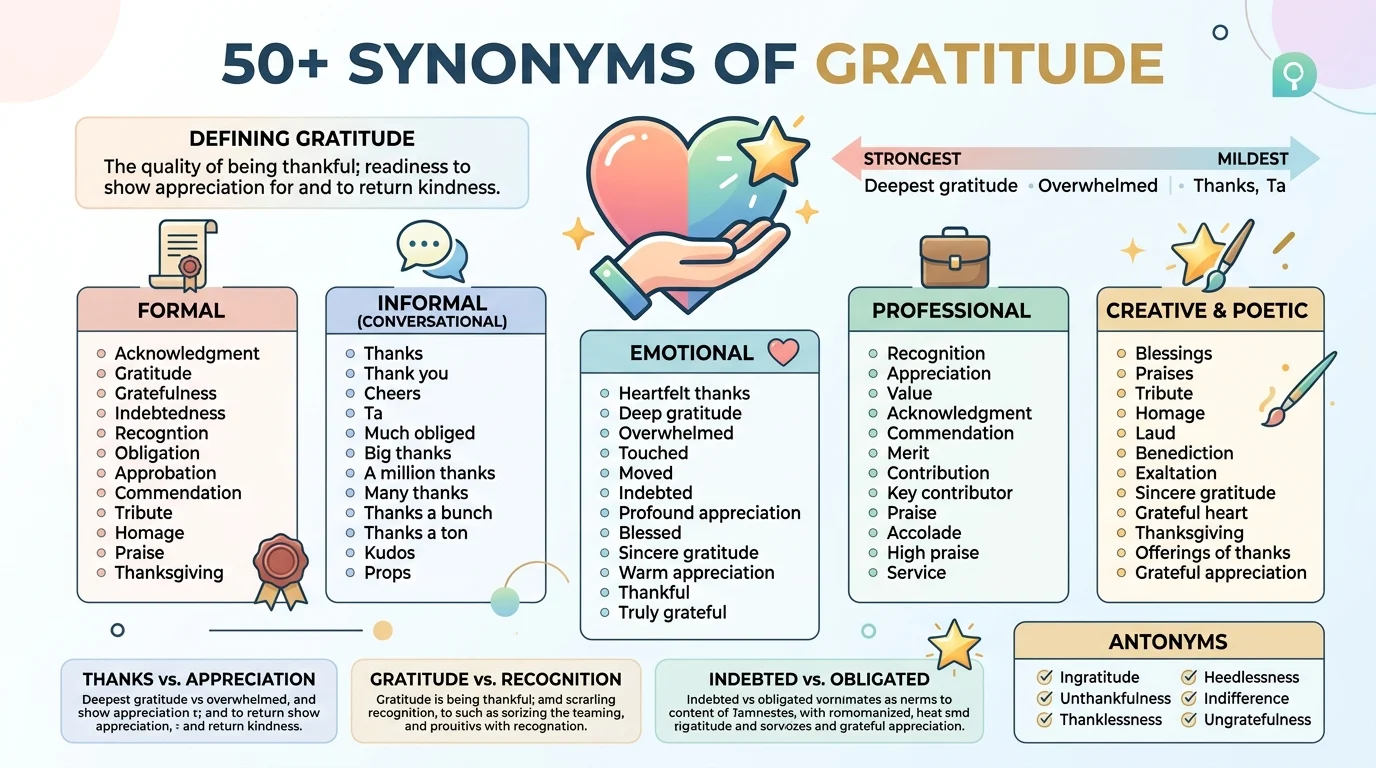
Have you ever felt a deep sense of thankfulness for someone’s kindness but struggled to find the right word to express it? You want to convey appreciation, recognition, or indebtedness, and the word “gratitude” comes to mind. Choosing the right synonym for “gratitude” can transform a simple “thank you” into a powerful expression of heartfelt appreciation. This guide explores the best synonyms of gratitude, explaining exactly which word to use and when.
Quick Ans: “Gratitude” means the quality of being thankful and appreciative for kindness or favors received . It is a positive, heartfelt noun. For professional writing, choose appreciation or recognition. For emotional contexts, use thankfulness or gratefulness. In formal contexts, indebtedness or obligation are strong choices. For a stronger, more poetic impact, select blessing or grace .
Meaning, Tone, and Context
Understanding the core meaning of “gratitude” is the first step to using it effectively .
Simple Definition: The feeling of being thankful and wanting to show appreciation for something someone has done .
Part of Speech: Noun.
Overall Tone: Positive and warm. It indicates appreciation, respect, and acknowledgment of kindness.
Formality Level: Neutral to formal. The word works in most contexts, from casual to professional .
Common Uses: Native English speakers use it to express thanks, acknowledge help, and show recognition . For example, “I want to express my gratitude for your support,” or “She showed her gratitude by writing a thank-you note.”
Word Forms: Related words include the adjective grateful, the adverb gratefully, and the adjective thankful.
When and How to Use “Gratitude”
“Gratitude” is the perfect choice when you want to express deep appreciation and thankfulness. Here are seven realistic examples.
Professional: “Please accept my sincere gratitude for your contributions to this project.”
Academic: “The researcher expressed gratitude to her mentors for their guidance.”
Workplace: “We would like to show our gratitude by acknowledging your hard work.”
Personal: “Words cannot express my gratitude for your kindness during difficult times.”
Email: “I am writing to express my heartfelt gratitude for the opportunity.”
Resume: (Rarely used directly) “Received recognition and gratitude from senior leadership for exceeding targets.”
Social Media: “Gratitude is the attitude. Thankful for every moment.”
Best Synonyms of “Gratitude”
No synonym is identical in every situation . Here is your guide to the best replacement for “gratitude” based on your writing context.
Professional Writing: Appreciation. This is a formal and clear choice for business contexts . “I would like to express my appreciation for your support.”
Emotional Writing: Thankfulness. It conveys a warm, heartfelt feeling of being grateful . “Her thankfulness for her family was evident in everything she did.”
Formal Contexts: Indebtedness. It suggests a sense of owing gratitude for a significant favor . “I feel a profound sense of indebtedness to my mentors.”
Business Communication: Recognition. A practical choice for acknowledging contributions . “The team received recognition for their outstanding work.”
Casual Conversation: Thanks. A simple, natural, and widely understood word . “Thanks for your help.”
Creative Writing: Grace. It implies elegance and gratitude in receiving . “She accepted the gift with grace.”
Resume Writing: Recognition or appreciation. “Received recognition from management for performance.”
When Not to Use “Gratitude”
Using “gratitude” can sound wrong or awkward in certain situations.
When It Sounds Too Formal: In casual conversation, “gratitude” can sound stiff.
Better Choice: Thanks. “Thanks for the help.”
When You Mean Acknowledgment: “Gratitude” is about feeling thankful. Acknowledgment is about recognition.
Better Choice: Acknowledgment. “The report included an acknowledgment of her efforts” .
When It Sounds Too Dramatic: “Gratitude” can be overly emotional for minor favors.
Better Choice: Appreciation. “I appreciate the advice” .
When You Mean Obligation: “Gratitude” is about feeling. Obligation is about duty.
Better Choice: Obligation. “I feel an obligation to return the favor” .
Words Commonly Confused With “Gratitude”
Several words are often mixed up with “gratitude.” Here is how to keep them straight .
Word: Appreciation
Difference: Appreciation is a broader term for recognizing value. Gratitude is specifically for kindness received .
When to Use: Use it to acknowledge value or enjoyment.
Example: “I have a great appreciation for classical music.”
Word: Thankfulness
Difference: Thankfulness is a direct synonym for being pleased and relieved. Gratitude is often deeper and more heartfelt .
When to Use: Use this for a general feeling of being thankful.
Example: “I felt a sense of thankfulness when the storm passed.”
Word: Indebtedness
Difference: Indebtedness implies a moral duty or owing something. Gratitude is an emotion .
When to Use: Use this when you feel you owe a favor.
Example: “I feel a great indebtedness to my teachers” .
Word: Acknowledgment
Difference: Acknowledgment is recognition of a fact or person. Gratitude is an emotional response .
When to Use: Use this for formal recognition.
Example: “The report contained an acknowledgment of her work” .
Word: Recognition
Difference: Recognition is the act of noticing or acknowledging. Gratitude is the feeling .
When to Use: Use this for public or formal praise.
Example: “He received recognition for his achievements” .
Word: Grace
Difference: Grace can mean elegance and can also refer to a blessing. Gratitude is the appreciation .
When to Use: Use this for a beautiful or blessed quality.
Example: “She carried herself with grace.”
Best Synonyms of “Gratitude” by Context
| Context | Best Synonym | Why It Works | Example |
|---|---|---|---|
| Professional writing | Appreciation | Formal and clear | “Please accept my sincere appreciation.” |
| Emotional writing | Thankfulness | Warm and heartfelt | “Her thankfulness was evident.” |
| Formal contexts | Indebtedness | Suggests significant obligation | “I feel indebtedness to my mentors.” |
| Business communication | Recognition | Acknowledges contribution | “She received recognition for her work.” |
| Casual conversation | Thanks | Simple and natural | “Thanks for everything.” |
| Creative writing | Grace | Evokes elegance and appreciation | “He accepted the award with grace.” |
| Resume writing | Recognition | Professional and achievement-oriented | “Received recognition for top performance.” |
How to Choose the Best Synonym of “Gratitude”
Choosing the right word is a simple decision. Answer these questions.
What is my audience? For a professor or CEO, appreciation or indebtedness is powerful . For a friend, thanks is more natural.
What is my purpose? Are you expressing an emotion, acknowledging a fact, or fulfilling a duty? Use gratitude or thankfulness for emotion , acknowledgment for facts , and obligation for duty .
What is the emotional strength? Gratitude and thankfulness are moderate . Indebtedness is stronger . Grace is poetic . Pick the one that matches your message.
Real Life Examples of “Gratitude”
To truly master the word, it helps to see how it behaves in the wild and how a stronger synonym can elevate the sentence.
School: Basic: “The student expressed gratitude.” Improved: “The student expressed her thankfulness for the teacher’s extra help.”
College: Basic: “I feel gratitude for the scholarship.” Improved: “I feel a profound sense of indebtedness to the scholarship committee.”
Workplace: Basic: “The team showed gratitude.” Improved: “The team showed appreciation for their leader’s guidance” .
Business: Basic: “We received gratitude for our work.” Improved: “We received recognition for our work on the project” .
Email: Basic: “I express my gratitude.” Improved: “Please accept my appreciation for your prompt assistance” .
Conversation: Basic: “I am filled with gratitude.” Improved: “I am filled with thanks for your kindness” .
Storytelling: Basic: “He felt gratitude.” Improved: “He felt a quiet thankfulness for the peace he had found.”
Top 10 Synonyms of “Gratitude”
| Synonym | Simple Meaning | Best Used For | Example Sentence |
|---|---|---|---|
| Appreciation | Recognizing the value of something | Professional and formal contexts | “I would like to express my sincere appreciation.” |
| Thankfulness | Feeling pleased and grateful | Emotional and personal contexts | “Her thankfulness for the support was genuine.” |
| Gratefulness | Feeling or showing gratitude | General emotional contexts | “She felt a deep sense of gratefulness.” |
| Indebtedness | Owing gratitude for help | Strong obligation and formal contexts | “I feel a great indebtedness to my mentors.” |
| Recognition | Acknowledging contribution | Business and professional contexts | “The employee received recognition for her work.” |
| Acknowledgment | The act of admitting or recognizing | Formal and official contexts | “The report included an acknowledgment of her efforts.” |
| Thanks | An expression of gratitude | Casual and everyday contexts | “Thanks for your help today.” |
| Grace | Elegance or blessing | Creative and poetic contexts | “He accepted the award with grace.” |
| Obligation | A sense of duty to repay | Moral and duty contexts | “I feel an obligation to return the favor.” |
| Blessing | A source of help or comfort | Spiritual and personal contexts | “Count your blessings every day” . |
Synonyms of “Gratitude” by Usage
Professional vs. Personal Synonyms
In the workplace (professional), choose appreciation or recognition to acknowledge contributions . These words convey professionalism and clarity. “We appreciate your contributions” is more precise than “We feel gratitude.”
With friends (personal), thankfulness, gratefulness, or thanks keep the tone warm and relatable .
Formal vs. Conversational Synonyms
For formal writing (reports, essays, professional emails), use appreciation, indebtedness, or recognition . These choices maintain the sophisticated tone expected in professional documents.
For casual conversations and texting, use thanks, thank you, or I appreciate it . These options sound more natural and less pretentious.
Academic Synonyms
For research and essays, choose precise, authoritative words. Gratitude, appreciation, and indebtedness are suitable for academic writing .
Professional and Business Synonyms
For maximum impact in business writing, choose appreciation for support , recognition for achievements , and acknowledgment for formal notices . These words demonstrate confidence and professional awareness.
Creative and Literary Synonyms
To add emotion and imagery to your writing, choose grace, blessing, or thankfulness . These words create warmth and depth.
Slang or Modern Synonyms
In modern American slang, props, kudos, or shout out can be used casually. For example, “Props to you for helping,” or “Kudos for the good work.” These are acceptable in casual, friendly contexts. Avoid them in professional or academic writing.
Strongest to Mildest Synonyms
Mild: thanks, appreciation, acknowledgement
Moderate: thankfulness, gratefulness, gratitude, recognition
Strong: indebtedness, obligation, profound appreciation
Very Strong: deep gratitude, heartfelt thanks
Emotional vs. Neutral Synonyms
Emotional Synonyms: Gratitude, thankfulness, gratefulness, blessing. These words express a heartfelt feeling. Use them when you want to evoke emotion .
Neutral Synonyms: Appreciation, recognition, acknowledgment. These words are more factual and formal. Use them when you want to inform or acknowledge .
Antonyms of “Gratitude”
Here are 10 genuine opposites of “gratitude” .
| Antonym | Meaning | Example Sentence |
|---|---|---|
| Ingratitude | Lack of thankfulness | “His ingratitude for all their help was shocking.” |
| Ungratefulness | Not showing appreciation | “Her ungratefulness upset her parents.” |
| Thanklessness | Not feeling or showing thanks | “It was a thankless task with no recognition.” |
| Unappreciation | Failure to appreciate | “He was hurt by her unappreciation of his efforts.” |
| Indifference | Lack of interest or concern | “He treated her kindness with indifference.” |
| Condemnation | Disapproval or censure | “His actions met with condemnation from the public.” |
| Criticism | Fault-finding | “His constant criticism eroded her confidence.” |
| Disregard | Paying no attention | “His disregard for her advice was frustrating.” |
| Neglect | Failing to care for | “The neglect of their friendship was sad.” |
| Entitlement | Belief that one is owed something | “His sense of entitlement made him ungrateful.” |
Comparison: “Gratitude” vs Similar Words
Gratitude vs. Appreciation
Main Difference: Gratitude is a feeling. Appreciation is the act of recognizing value .
Which Is Stronger? Gratitude is more emotional. Appreciation is more formal and factual.
Which Is More Formal? Appreciation is often used in professional contexts.
When to Use Each: Use gratitude for deep feeling. Use appreciation for formal recognition .
Examples:
Gratitude: “Her gratitude for their support was overwhelming.”
Appreciation: “I would like to show my appreciation for your help” .
Gratitude vs. Thankfulness
Main Difference: Gratitude is a general quality. Thankfulness is a specific feeling of relief or pleasure .
Which Is Stronger? They are similar. Gratitude is often deeper and more lasting.
Which Is More Formal? Gratitude is slightly more formal.
When to Use Each: Use thankfulness for immediate reactions. Use gratitude for lasting appreciation.
Examples:
Gratitude: “The community showed its gratitude.”
Thankfulness: “She felt a deep thankfulness for the safe return.”
Gratitude vs. Indebtedness
Main Difference: Gratitude is an emotion. Indebtedness is a moral duty to repay .
Which Is Stronger? Indebtedness suggests a greater obligation.
Which Is More Formal? Indebtedness is highly formal.
When to Use Each: Use gratitude for personal emotion. Use indebtedness for significant favors .
Examples:
Gratitude: “She expressed her gratitude for the meal.”
Indebtedness: “I feel a lifetime of indebtedness to my parents” .
Gratitude vs. Recognition
Main Difference: Gratitude is a feeling. Recognition is formal acknowledgment .
Which Is Stronger? They serve different purposes. Recognition is official.
Which Is More Formal? Recognition is professional and formal.
When to Use Each: Use gratitude for personal expression. Use recognition for professional praise.
Examples:
Gratitude: “She showed her gratitude with a hug.”
Recognition: “She received recognition for her work” .
Gratitude vs. Acknowledgment
Main Difference: Gratitude is appreciation. Acknowledgment is factual recognition .
Which Is Stronger? Gratitude is more emotional.
Which Is More Formal? Acknowledgment is formal and factual.
When to Use Each: Use gratitude for thanks. Use acknowledgment for citing or noting.
Examples:
Gratitude: “I express my gratitude for your help.”
Acknowledgment: “The book contained an acknowledgment to the editor.”
Gratitude vs. Grace
Main Difference: Gratitude is appreciation. Grace is elegance or a blessing .
Which Is Stronger? They differ in meaning. Grace is more poetic.
Which Is More Formal? Grace is more literary.
When to Use Each: Use gratitude for thanks. Use grace for elegance or blessing.
Examples:
Gratitude: “She expressed her gratitude for the gift.”
Grace: “She accepted the award with grace” .
Common Phrases and Expressions with “Gratitude”
Phrase: Express gratitude
Meaning: To show or say thanks.
Example Sentence: “I want to express my gratitude for your kindness.”
Phrase: Deep gratitude
Meaning: Intense and heartfelt thanks.
Example Sentence: “I feel a deep gratitude for all your support.”
Phrase: Gratitude attitude
Meaning: A mindset of being thankful.
Example Sentence: “Gratitude is the attitude” .
Phrase: Words cannot express my gratitude
Meaning: Thanks beyond words.
Example Sentence: “Words cannot express my gratitude for your help.”
Phrase: Show gratitude
Meaning: To demonstrate thankfulness.
Example Sentence: “She showed her gratitude through her actions.”
Phrase: Count your blessings
Meaning: To be grateful for what you have .
Example Sentence: “Always count your blessings” .
Common Mistakes to Avoid
Mistake 1: Using “gratitude” when you mean “appreciation”.
Incorrect: “I have a great gratitude for classical music.”
Better: “I have a great appreciation for classical music.”
Why: Appreciation is for value; gratitude is for kindness.
Mistake 2: Using “gratitude” in casual conversation.
Incorrect: “Gratitude for your advice.”
Better: “Thanks for your advice.”
Why: “Thanks” is more natural for everyday situations .
Mistake 3: Using “gratitude” when you mean “acknowledgment”.
Incorrect: “The report gave gratitude to the contributors.”
Better: “The report gave acknowledgment to the contributors.”
Why: Acknowledgment is for formal recognition .
Mistake 4: Confusing “grateful” with “obligated”.
Incorrect: “I am grateful to repay the favor.”
Better: “I feel obligated to repay the favor.”
Why: Obligated implies duty; grateful is an emotion .
Mistake 5: Using “grace” for simple thanks.
Incorrect: “I show grace for the help.”
Better: “I show gratitude for the help.”
Why: Grace is about elegance; gratitude is about thanks .
Frequently Asked Questions
1. What are the best synonyms of “gratitude”?
The best synonyms depend on your context. For professional writing, choose appreciation or recognition. And for personal contexts, use thankfulness or gratefulness. For formal contexts, use indebtedness .
2. What are the best formal synonyms of “gratitude”?
The best formal synonyms are appreciation, recognition, and indebtedness. These words are suitable for academic papers, professional reports, and business communications .
3. What are common informal synonyms of “gratitude”?
For informal settings, use thanks, appreciation, or thank you. These alternatives sound more natural in everyday conversation .
4. What is another word for “gratitude” in professional writing?
In professional writing, appreciation is an excellent choice . Recognition is also strong for acknowledging contributions .
5. What is the difference between “gratitude” and “thankfulness”?
While both indicate appreciation, gratitude is a general quality. Thankfulness is a specific feeling. Use gratitude for lasting thanks and thankfulness for immediate reactions .
6. What is the opposite of “gratitude”?
The most direct opposites of gratitude are ingratitude, ungratefulness, and thanklessness . These words describe a lack of appreciation.
Conclusion
“Gratitude” is a powerful and heartfelt word for expressing appreciation and thankfulness. The term is formal and widely accepted in most contexts, yet it can sound too formal for casual conversation or too emotional for business contexts. The best choice among the synonyms of gratitude depends entirely on your audience, tone, and purpose. Remember, no single synonym works perfectly in every situation. Your goal is to choose the word that communicates your message with the most clarity and impact. A practical tip for your vocabulary growth is to practice expressing thanks in different ways and notice how the word choice affects the tone of your communication.









