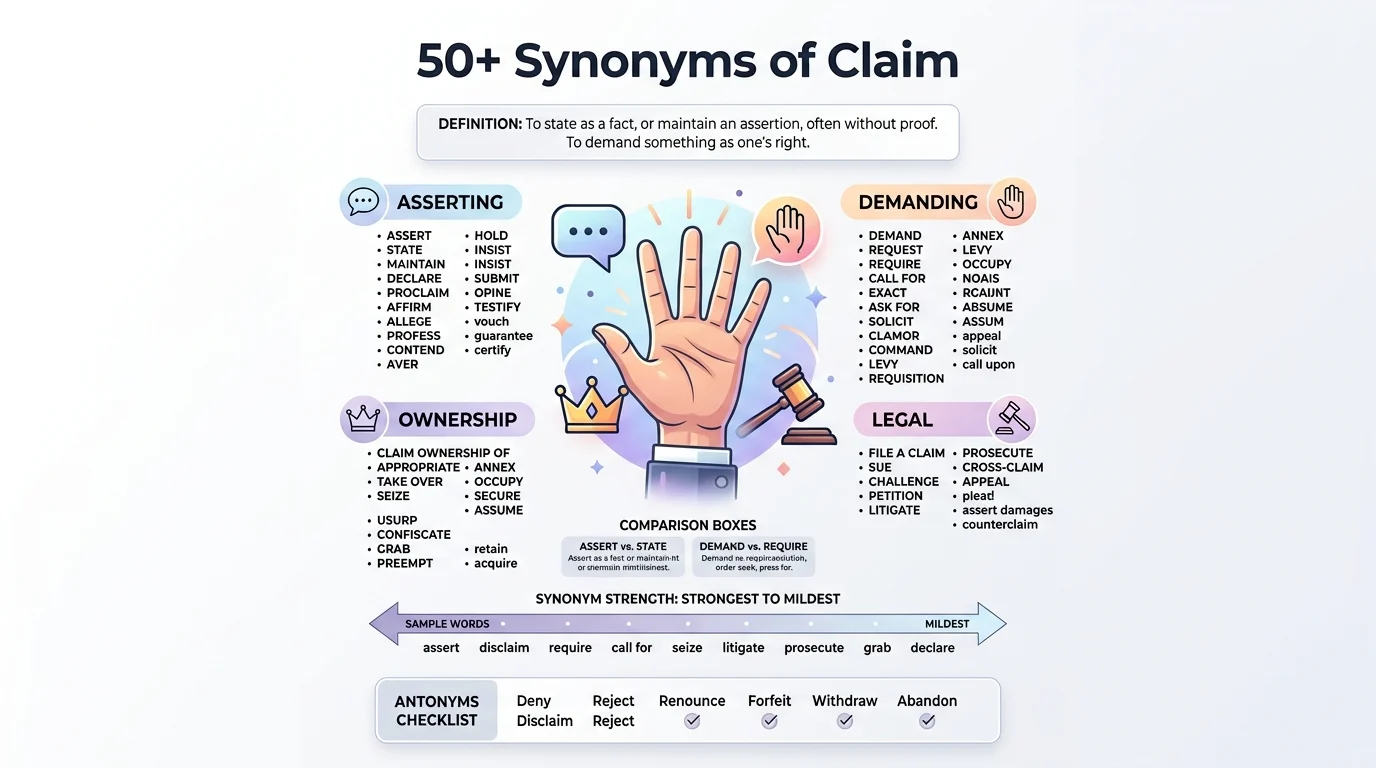
Have you ever needed to state something as true, demand something as your right, or assert ownership but felt that “say” or “take” was too weak? You want to convey authority, certainty, or entitlement, and the word “claim” comes to mind. Choosing the right synonym for “claim” can transform a simple statement into a powerful declaration of truth, right, or possession. This guide explores the best synonyms of claim, explaining exactly which word to use and when.
Quick Ans: “Claim” means to state something as true, demand something as a right, or assert ownership. For formal writing, choose assert or declare. For legal contexts, use allege or contend. For demanding rights, use demand or insist. For ownership, use appropriate or confiscate. For casual conversation, use say or state.
Meaning, Tone, and Context
Understanding the core meaning of “claim” is the first step to using it effectively.
Simple Definition: To state or assert that something is true, typically without proof; to demand something as a right; to take possession of something.
Part of Speech: Verb and noun.
Overall Tone: Neutral to assertive. It can indicate confidence, entitlement, or accusation.
Formality Level: Neutral to formal. The word is appropriate in most contexts.
Common Uses: Native English speakers use it to assert facts (“He claims he was there”), demand rights (“She claimed her inheritance”), and take ownership (“The company claimed the land”).
Word Forms: Related words include the noun claimant, the adjective claimable, and the noun claim.
When and How to Use “Claim”
“Claim” is the perfect choice when you want to state, demand, or take possession. Here are seven realistic examples.
Professional: “The report claims a significant increase in productivity.”
Legal: “The defendant claims he was not at the scene.”
Academic: “The study claims a link between the two variables.”
Workplace: “She claimed credit for the team’s success.”
Personal: “He claims to be an expert in the field.”
Email: “I would like to claim my reimbursement for travel expenses.”
Social Media: “The influencer claims the product changed her life.”
Best Synonyms of “Claim”
No synonym is identical in every situation. Here is your guide to the best replacement for “claim” based on your writing context.
For Asserting Truth
Most Formal: Assert means to state confidently. “He asserted his innocence.”
Declare: Declare means to announce officially. “The government declared a state of emergency.”
Allege: Allege means to claim without proof. “The report alleges misconduct.”
Contend: Contend means to argue or assert. “The lawyer contended that the evidence was flawed.”
For Demanding Rights
Demand: Demand means to ask forcefully. “The workers demanded better pay.”
*Insist: Insist means to demand firmly. “She insisted on her right to speak.”
Exact: Exact means to demand and obtain. “He exacted revenge.”
For Taking Ownership
Appropriate: Appropriate means to take for one’s own use. “He appropriated the funds for personal use.”
Confiscate: Confiscate means to take with authority. “The police confiscated the evidence.”
Seize: Seize means to take hold of forcibly. “The government seized the property.”
For Stating Without Proof
Profess: Profess means to claim or declare. “He professed his innocence.”
Purport: Purport means to appear or claim to be. “The document purports to be official.”
Allege: Allege means to claim without proof. “The article alleges corruption.”
When Not to Use “Claim”
Using “claim” can sound wrong or awkward in certain situations.
When You Mean “Prove”: “Claim” is about assertion, not proof.
Better Choice: Prove or demonstrate. “The evidence proves his guilt.”
When You Mean “Say”: “Claim” implies doubt. “Say” is neutral.
Better Choice: Say or state. “He said he was tired.”
When It Sounds Too Formal: In casual conversation, “claim” can sound stiff.
Better Choice: Say or reckon. “He says he is coming.”
Words Commonly Confused With “Claim”
| Word | Difference | When to Use | Example |
|---|---|---|---|
| Assert | State confidently | Formal and assertive | “He asserted his rights.” |
| Declare | Announce officially | Official and public | “The government declared war.” |
| Allege | Claim without proof | Legal and accusatory | “The report alleges fraud.” |
| Contend | Argue or assert | Debate and argument | “The lawyer contended the evidence.” |
| Demand | Ask forcefully | Rights and requests | “She demanded an apology.” |
| Profess | Claim or declare | Formal and personal | “He professed his love.” |
Best Synonyms of “Claim” by Context
| Context | Best Synonym | Why It Works | Example |
|---|---|---|---|
| Formal writing | Assert | Formal and confident | “He asserted his position.” |
| Legal context | Allege | Legal and accusatory | “The report alleges misconduct.” |
| Professional | Declare | Official and clear | “The CEO declared the results.” |
| Demanding rights | Demand | Forceful and direct | “They demanded justice.” |
| Taking ownership | Seize | Forceful and legal | “The government seized the assets.” |
| Casual conversation | Say | Simple and natural | “He says he knows her.” |
How to Choose the Best Synonym of “Claim”
Choosing the right word is a simple decision. Answer these questions.
What type of claim am I describing? For asserting truth, use assert or declare. And For demanding rights, use demand or insist. For taking ownership, use seize or confiscate. For unproven claims, use allege or profess.
What is my audience? For a formal report, use assert or allege. For a friend, use say or state.
What is my purpose? Are you stating, demanding, or taking? The correct synonym depends entirely on this.
What is the emotional strength? Demand and seize are stronger. Say and state are milder. Pick the one that matches your message.
Real Life Examples of “Claim”
School: Basic: “The student claims he did the work.” Improved: “The student asserts that he completed the work.”
College: Basic: “The article claims a link.” Improved: “The article alleges a link between the variables.”
Workplace: Basic: “She claims credit.” Improved: “She declared her contribution to the project.”
Business: Basic: “The company claims the land.” Improved: “The company seized the land.”
Email: Basic: “I claim my expenses.” Improved: “I would like to demand reimbursement for my expenses.”
Conversation: Basic: “He claims he is busy.” Improved: “He says he is busy.”
Storytelling: Basic: “The hero claimed the throne.” Improved: “The hero asserted his right to the throne.”
Top 10 Synonyms of “Claim”
| Synonym | Simple Meaning | Best Used For | Example Sentence |
|---|---|---|---|
| Assert | State confidently | Formal and assertive | “He asserted his innocence.” |
| Declare | Announce officially | Official and public | “The government declared a holiday.” |
| Allege | Claim without proof | Legal and accusatory | “The report alleges fraud.” |
| Contend | Argue or assert | Debate and argument | “The lawyer contended the evidence.” |
| Demand | Ask forcefully | Rights and requests | “She demanded an apology.” |
| Insist | Demand firmly | Rights and beliefs | “He insisted on his innocence.” |
| Seize | Take hold of forcibly | Ownership and legal | “The government seized the property.” |
| Appropriate | Take for one’s own use | Ownership and ethics | “He appropriated the funds.” |
| Profess | Claim or declare | Formal and personal | “He professed his loyalty.” |
| Purport | Appear or claim to be | Formal and descriptive | “The document purports to be official.” |
Synonyms of “Claim” by Usage
Professional vs. Personal Synonyms
In the workplace, choose assert, declare, or contend. With friends, use say or state.
Formal vs. Conversational Synonyms
For formal writing, use assert, allege, contend, or profess. For casual conversations, use say or state.
Academic Synonyms
For research and essays, choose allege for unproven claims, assert for confident claims, and contend for arguments.
Professional and Business Synonyms
For maximum impact, choose declare for announcements, assert for positions, and seize for ownership.
Creative and Literary Synonyms
To add emotion and imagery, choose profess, purport, or contend. These words create atmosphere.
Slang or Modern Synonyms
In modern American slang, say, reckon, or call dibs are common. For example, “I call dibs on that seat.” These are casual and should be avoided in formal writing.
Strongest to Mildest Synonyms
Mild: say, state, mention
Moderate: claim, assert, profess
Strong: declare, contend, allege
Very Strong: demand, insist, seize, confiscate
Emotional vs. Neutral Synonyms
Emotional Synonyms: Demand, insist, profess. These words hint at strong feeling. Use them when you want to evoke emotion.
Neutral Synonyms: Claim, assert, state. These words communicate factual information.
Antonyms of “Claim”
| Antonym | Meaning | Example Sentence |
|---|---|---|
| Deny | Refuse to admit | “He denied the accusation.” |
| Disclaim | Renounce a claim | “She disclaimed any responsibility.” |
| Relinquish | Give up a claim | “He relinquished his rights.” |
| Surrender | Give up possession | “They surrendered the territory.” |
| Forfeit | Lose as a penalty | “He forfeited his claim.” |
| Concede | Admit something is true | “She conceded the point.” |
| Disavow | Deny responsibility | “He disavowed the statement.” |
| Renounce | Formally give up | “She renounced her claim.” |
| Abdicate | Give up a throne | “The king abdicated.” |
| Waive | Give up a right | “He waived his right to appeal.” |
| Cede | Give up territory | “The country ceded the land.” |
| Disown | Refuse to acknowledge | “He disowned his family.” |
| Recant | Withdraw a statement | “He recanted his testimony.” |
| Retract | Withdraw a claim | “She retracted her accusation.” |
| Dispute | Challenge a claim | “He disputed the findings.” |
Comparison: “Claim” vs Similar Words
Claim vs. Assert
Main Difference: “Assert” is more confident and formal. “Claim” can imply doubt.
Which Is Stronger? “Assert” is stronger for confidence.
Which Is More Formal? “Assert” is more formal.
When to Use Each: Use “assert” for confident statements. Use “claim” for general statements.
Examples:
Claim: “He claims he was there.”
Assert: “He asserts his innocence.”
Claim vs. Declare
Main Difference: “Declare” is official and public. “Claim” is broader.
Which Is Stronger? “Declare” is stronger for official statements.
Which Is More Formal? “Declare” is more formal.
When to Use Each: Use “declare” for announcements. Use “claim” for general statements.
Examples:
Claim: “She claims to be an expert.”
Declare: “The government declared a holiday.”
Claim vs. Allege
Main Difference: “Allege” is legal and implies lack of proof. “Claim” is broader.
Which Is Stronger? “Allege” is more specific to unproven claims.
Which Is More Formal? “Allege” is more formal.
When to Use Each: Use “allege” in legal contexts. Use “claim” in general contexts.
Examples:
Claim: “He claims he is innocent.”
Allege: “The report alleges misconduct.”
Claim vs. Demand
Main Difference: “Demand” is forceful. “Claim” is about stating or taking.
Which Is Stronger? “Demand” is stronger.
Which Is More Formal? Both are formal.
When to Use Each: Use “demand” for forceful requests. Use “claim” for rights.
Examples:
Claim: “She claimed her inheritance.”
Demand: “She demanded her inheritance.”
Claim vs. Seize
Main Difference: “Seize” is forceful taking. “Claim” is asserting ownership.
Which Is Stronger? “Seize” is stronger and more physical.
Which Is More Formal? Both are formal.
When to Use Each: Use “seize” for forceful taking. Use “claim” for asserting rights.
Examples:
Claim: “He claimed the land.”
Seize: “The government seized the land.”
Claim vs. Profess
Main Difference: “Profess” is formal and personal. “Claim” is broader.
Which Is Stronger? “Profess” is more formal.
Which Is More Formal? “Profess” is more formal.
When to Use Each: Use “profess” for personal declarations. Use “claim” for general statements.
Examples:
Claim: “He claims to love her.”
Profess: “He professed his love.”
Common Phrases and Expressions with “Claim”
Phrase: Claim responsibility
Meaning: Admit to doing something.
Example Sentence: “The group claimed responsibility for the attack.”
Phrase: Claim credit
Meaning: Take recognition for something.
Example Sentence: “She claimed credit for the team’s success.”
Phrase: Claim a life
Meaning: Cause someone’s death.
Example Sentence: “The accident claimed three lives.”
Phrase: Claim victory
Meaning: Announce that you have won.
Example Sentence: “The candidate claimed victory.”
Phrase: Stake a claim
Meaning: Assert ownership.
Example Sentence: “They staked a claim to the land.”
Phrase: Claim damages
Meaning: Seek compensation.
Example Sentence: “He claimed damages for the injury.”
Common Mistakes to Avoid
Mistake 1: Using “claim” when you mean “prove”.
Incorrect: “The evidence claims his guilt.”
Better: “The evidence proves his guilt.”
Why: “Claim” is assertion. “Prove” is demonstration.
Mistake 2: Using “claim” when you mean “say”.
Incorrect: “He claimed he was tired.”
Better: “He said he was tired.”
Why: “Claim” implies doubt. “Say” is neutral.
Mistake 3: Overusing “claim” in conversation.
Incorrect: “She claims she knows him.”
Better: “She says she knows him.”
Why: “Says” sounds more natural.
Mistake 4: Using “claim” when you mean “demand”.
Incorrect: “He claimed an apology.”
Better: “He demanded an apology.”
Why: “Demand” is forceful.
Mistake 5: Using “claim” when you mean “seize”.
Incorrect: “The police claimed the evidence.”
Better: “The police confiscated the evidence.”
Why: “Confiscate” is the legal term.
Frequently Asked Questions
1. What are the best synonyms of “claim”?
The best synonyms depend on your context. For asserting truth, choose assert or declare. And For demanding rights, use demand or insist. For taking ownership, use seize or confiscate. For unproven claims, use allege or profess.
2. What are the best formal synonyms of “claim”?
The best formal synonyms are assert, allege, and contend. These words are suitable for academic papers, professional reports, and legal documents.
3. What are common informal synonyms of “claim”?
For informal settings, use say or state. These alternatives sound more natural in everyday conversation.
4. What is another word for “claim” in professional writing?
In professional writing, assert is an excellent choice. It conveys confidence and formality. Declare is also strong for announcements.
5. What is the difference between “claim” and “assert”?
“Claim” can imply doubt. “Assert” is more confident and formal. Use “assert” for strong statements and “claim” for general statements.
6. What is the opposite of “claim”?
The most direct opposites (antonyms) of claim are deny, disclaim, and relinquish. These words describe giving up or refusing a claim.
Conclusion
“Claim” is a versatile and powerful word for asserting truth, demanding rights, and taking ownership. The term is neutral and widely accepted in most contexts, yet it can sound too weak for confident statements or too strong for casual conversation. The best choice among the synonyms of claim depends entirely on your audience, tone, and purpose. Remember, no single synonym works perfectly in every situation. Your goal is to choose the word that communicates your message with the most clarity and impact. A practical tip for your vocabulary growth is to pay attention to how writers assert and demand and practice using different synonyms in your writing.









