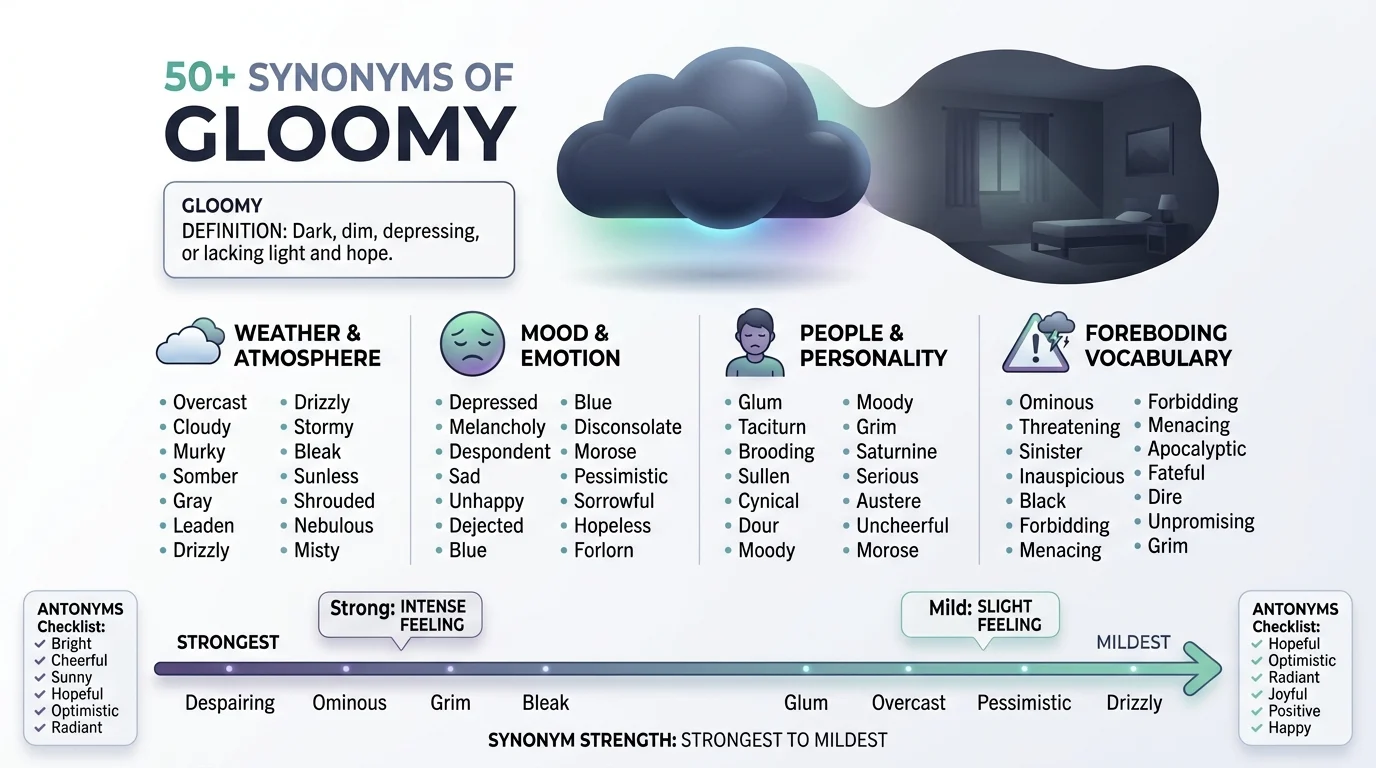
Have you ever needed to describe a dark, depressing atmosphere or a person who seems perpetually sad but felt that “sad” or “dark” was too simple? You want to capture the heaviness, the lack of light, or the sense of foreboding, and the word “gloomy” comes to mind. Choosing the right synonym for “gloomy” can transform a basic description into a precise expression of darkness, sadness, or despair. This guide explores the best synonyms of gloomy, explaining exactly which word to use and when.
Quick Ans: “Gloomy” means dark, depressing, or lacking hope. For weather and physical darkness, choose dim, dark, or overcast. For mood and atmosphere, use depressing, dreary, or somber. For people and attitudes, use melancholy, morose, or despondent. For a sense of foreboding, use ominous or foreboding.
Meaning, Tone, and Context
Understanding the core meaning of “gloomy” is the first step to using it effectively.
Simple Definition: Dark or poorly lit; causing or feeling depression or despondency; pessimistic or hopeless.
Part of Speech: Adjective.
Overall Tone: Negative. It indicates darkness, sadness, or a lack of hope.
Formality Level: Neutral. The word works in most contexts, from casual to literary.
Common Uses: Native English speakers use it to describe weather (“a gloomy day”), places (“a gloomy room”), moods (“a gloomy mood”), and forecasts (“a gloomy outlook”).
Word Forms: Related words include the noun gloom, the adverb gloomily, and the noun gloominess.
When and How to Use “Gloomy”
“Gloomy” is the perfect choice when you want to describe darkness, sadness, or pessimism. Here are seven realistic examples.
Weather: “The gloomy sky threatened rain all day.”
Physical Space: “The old house had a gloomy, abandoned feel.”
Mood: “He was in a gloomy mood after the bad news.”
Outlook: “The economic forecast is gloomy.”
Literary: “The novel opens with a gloomy description of the moors.”
Professional: “The report painted a gloomy picture of the company’s future.”
Social Media: “Gloomy weather calls for cozy blankets and hot cocoa.”
Best Synonyms of “Gloomy”
No synonym is identical in every situation. Here is your guide to the best replacement for “gloomy” based on your writing context.
For Weather and Physical Darkness
Most Direct: Dark is the simplest synonym for lack of light. “The dark clouds gathered.”
Overcast: Overcast means covered with clouds. “The sky was overcast.”
Dim: Dim means not bright. “The dim lighting made it hard to read.”
Murky: Murky means dark and gloomy, often dirty. “The murky water was uninviting.”
For Mood and Atmosphere
Depressing: Depressing means causing sadness. “The news was depressing.”
Dreary: Dreary means dull and depressing. “The dreary waiting room was uncomfortable.”
Somber: Somber means dark and serious. “The somber atmosphere was palpable.”
Dismal: Dismal means depressing and dreary. “The dismal weather ruined the picnic.”
For People and Attitudes
Melancholy: Melancholy means a pensive sadness. “He had a melancholy expression.”
Morose: Morose means sullen and ill-tempered. “She was morose after the argument.”
Despondent: Despondent means in low spirits from loss of hope. “He was despondent after losing his job.”
Dour: Dour means stern and gloomy. “His dour face rarely showed emotion.”
For Foreboding
Ominous: Ominous means giving the impression of something bad happening. “The ominous silence was unsettling.”
Foreboding: Foreboding means a feeling that something bad will happen. “A sense of foreboding filled the room.”
When Not to Use “Gloomy”
Using “gloomy” can sound wrong or awkward in certain situations.
When You Mean “Sad”: “Gloomy” is about atmosphere. “Sad” is about emotion.
Better Choice: Sad. “She felt sad.”
When You Mean “Dark”: “Gloomy” implies mood. “Dark” is purely visual.
Better Choice: Dark. “The room was dark.”
When It Sounds Too Negative: “Gloomy” can be overly pessimistic.
Better Choice: Realistic or cautious. “The forecast is cautious.”
Words Commonly Confused With “Gloomy”
| Word | Difference | When to Use | Example |
|---|---|---|---|
| Dark | Lack of light | Physical darkness | “The room was dark.” |
| Sad | Feeling sorrow | Emotional state | “She felt sad.” |
| Depressing | Causing sadness | Atmosphere and events | “The news was depressing.” |
| Somber | Serious and dark | Formal and solemn contexts | “The somber ceremony was respectful.” |
| Dismal | Depressing and dreary | Weather and outcomes | “The dismal weather continued.” |
| Melancholy | Pensive sadness | Literary and emotional | “A melancholy mood settled over him.” |
Best Synonyms of “Gloomy” by Context
| Context | Best Synonym | Why It Works | Example |
|---|---|---|---|
| Weather | Overcast | Specific to clouds | “The sky was overcast.” |
| Physical darkness | Dim | Not bright | “The dim lighting was soft.” |
| Mood | Depressing | Causes sadness | “The news was depressing.” |
| Atmosphere | Somber | Serious and dark | “The somber mood was felt by all.” |
| Person | Melancholy | Pensive sadness | “He was melancholy.” |
| Forecast | Dismal | Depressing outcome | “The forecast is dismal.” |
| Foreboding | Ominous | Suggests bad things | “The ominous clouds gathered.” |
| Literary | Dreary | Dull and depressing | “The dreary landscape stretched ahead.” |
How to Choose the Best Synonym of “Gloomy”
Choosing the right word is a simple decision. Answer these questions.
What type of gloom am I describing? For weather, use overcast or dismal. And For mood, use depressing or somber. For people, use melancholy or morose. For foreboding, use ominous.
What is my audience? For a formal report, use somber or dismal. For a friend, use gloomy or sad.
What is my purpose? Are you describing weather, a mood, or a person? The correct synonym depends entirely on this.
What is the emotional strength? Ominous is stronger for foreboding. Dim is milder for darkness. Pick the one that matches your message.
Real Life Examples of “Gloomy”
School: Basic: “The weather is gloomy.” Improved: “The weather is overcast and dismal.”
College: Basic: “The mood is gloomy.” Improved: “The mood is somber and reflective.”
Workplace: Basic: “The forecast is gloomy.” Improved: “The forecast is dismal.”
Business: Basic: “The report is gloomy.” Improved: “The report paints a depressing picture.”
Email: Basic: “The news is gloomy.” Improved: “The news is somber.”
Conversation: Basic: “He is gloomy.” Improved: “He is melancholy.”
Storytelling: Basic: “The house was gloomy.” Improved: “The house was dreary and foreboding.”
Top 10 Synonyms of “Gloomy”
| Synonym | Simple Meaning | Best Used For | Example Sentence |
|---|---|---|---|
| Dark | Lacking light | Physical darkness | “The dark room was eerie.” |
| Overcast | Covered with clouds | Weather | “The sky was overcast.” |
| Depressing | Causing sadness | Mood and events | “The news was depressing.” |
| Somber | Dark and serious | Formal and solemn contexts | “The somber ceremony was respectful.” |
| Dismal | Depressing and dreary | Weather and outcomes | “The dismal weather continued.” |
| Melancholy | Pensive sadness | Literary and emotional | “A melancholy mood settled over him.” |
| Morose | Sullen and ill-tempered | Personality and mood | “He was morose after the argument.” |
| Despondent | In low spirits | Emotional state | “She was despondent after the loss.” |
| Ominous | Suggesting bad things | Foreboding | “The ominous silence was unsettling.” |
| Dreary | Dull and depressing | Atmosphere and weather | “The dreary landscape stretched ahead.” |
Synonyms of “Gloomy” by Usage
Professional vs. Personal Synonyms
In the workplace, choose somber, dismal, or depressing. With friends, use gloomy, sad, or down.
Formal vs. Conversational Synonyms
For formal writing, use somber, dismal, melancholy, or ominous. For casual conversations, use gloomy, sad, or dark.
Academic Synonyms
For research and essays, choose somber for tone, dismal for outcomes, and melancholy for literary analysis.
Professional and Business Synonyms
For maximum impact, choose dismal for forecasts, somber for tone, and depressing for news.
Creative and Literary Synonyms
To add emotion and imagery, choose melancholy, dreary, ominous, or foreboding. These words create atmosphere.
Slang or Modern Synonyms
In modern American slang, down, bummed, or in a funk are common. For example, “I am feeling down today.” These are casual and should be avoided in formal writing.
Strongest to Mildest Synonyms
Mild: dim, overcast, down
Moderate: gloomy, sad, depressing
Strong: somber, dismal, melancholy
Very Strong: morose, despondent, ominous, foreboding
Emotional vs. Neutral Synonyms
Emotional Synonyms: Melancholy, despondent, morose. These words hint at deep sadness. Use them when you want to evoke feeling.
Neutral Synonyms: Dark, overcast, dim. These words simply communicate factual information about light.
Antonyms of “Gloomy”
| Antonym | Meaning | Example Sentence |
|---|---|---|
| Bright | Full of light | “The bright room was cheerful.” |
| Sunny | Full of sunshine | “The sunny day was perfect.” |
| Cheerful | Happy and optimistic | “Her cheerful attitude was contagious.” |
| Hopeful | Feeling optimism | “The hopeful news lifted spirits.” |
| Optimistic | Expecting good things | “He is optimistic about the future.” |
| Radiant | Shining brightly | “Her radiant smile lit up the room.” |
| Lively | Full of energy | “The lively party was fun.” |
| Joyful | Feeling great happiness | “The joyful celebration was wonderful.” |
| Light | Not dark | “The light room was airy.” |
| Clear | Free from clouds | “The clear sky was blue.” |
| Upbeat | Cheerful and optimistic | “The upbeat music was energizing.” |
| Encouraging | Giving hope | “The encouraging words helped.” |
| Promising | Showing potential | “The promising results were exciting.” |
| Vibrant | Full of energy and life | “The vibrant colors were beautiful.” |
| Blissful | Extremely happy | “The blissful moment was peaceful.” |
Comparison: “Gloomy” vs Similar Words
Gloomy vs. Dark
Main Difference: “Gloomy” implies mood and sadness. “Dark” is purely visual.
Which Is Stronger? “Gloomy” is stronger for atmosphere.
Which Is More Formal? Both are neutral.
When to Use Each: Use “dark” for physical darkness. Use “gloomy” for mood.
Examples:
Gloomy: “The gloomy room felt oppressive.”
Dark: “The dark room was hard to see in.”
Gloomy vs. Sad
Main Difference: “Gloomy” is about atmosphere. “Sad” is about emotion.
Which Is Stronger? “Gloomy” is more atmospheric.
Which Is More Formal? Both are neutral.
When to Use Each: Use “sad” for personal emotion. Use “gloomy” for atmosphere.
Examples:
Gloomy: “The gloomy weather matched his mood.”
Sad: “She felt sad after the news.”
Gloomy vs. Depressing
Main Difference: “Depressing” means causing sadness. “Gloomy” means dark and sad.
Which Is Stronger? “Depressing” is stronger for cause.
Which Is More Formal? Both are neutral.
When to Use Each: Use “depressing” for events. Use “gloomy” for atmosphere.
Examples:
Gloomy: “The gloomy forecast was discouraging.”
Depressing: “The news was depressing.”
Gloomy vs. Somber
Main Difference: “Somber” is formal and serious. “Gloomy” is more atmospheric.
Which Is Stronger? “Somber” is more formal and respectful.
Which Is More Formal? “Somber” is more formal.
When to Use Each: Use “somber” for ceremonies. Use “gloomy” for weather and mood.
Examples:
Gloomy: “The gloomy day was dreary.”
Somber: “The somber ceremony was respectful.”
Gloomy vs. Melancholy
Main Difference: “Melancholy” is a pensive sadness. “Gloomy” is more general.
Which Is Stronger? “Melancholy” is more literary and emotional.
Which Is More Formal? “Melancholy” is more formal.
When to Use Each: Use “melancholy” in literary contexts. Use “gloomy” in general contexts.
Examples:
Gloomy: “He was in a gloomy mood.”
Melancholy: “He was melancholy and reflective.”
Gloomy vs. Ominous
Main Difference: “Ominous” suggests something bad will happen. “Gloomy” is about darkness and sadness.
Which Is Stronger? “Ominous” is stronger for foreboding.
Which Is More Formal? Both are formal.
When to Use Each: Use “ominous” for threats. Use “gloomy” for mood.
Examples:
Gloomy: “The gloomy sky threatened rain.”
Ominous: “The ominous silence was unsettling.”
Common Phrases and Expressions with “Gloomy”
Phrase: Gloomy weather
Meaning: Dark, cloudy weather.
Example Sentence: “The gloomy weather matched his mood.”
Phrase: Gloomy outlook
Meaning: A pessimistic forecast.
Example Sentence: “The economic outlook is gloomy.”
Phrase: Gloomy mood
Meaning: A sad or depressed mood.
Example Sentence: “A gloomy mood settled over the group.”
Phrase: Gloomy picture
Meaning: A depressing description.
Example Sentence: “The report painted a gloomy picture.”
Phrase: Gloomy face
Meaning: A sad or serious expression.
Example Sentence: “He had a gloomy face after the meeting.”
Common Mistakes to Avoid
Mistake 1: Using “gloomy” when you mean “sad”.
Incorrect: “She felt gloomy.”
Better: “She felt sad.”
Why: “Gloomy” is about atmosphere. “Sad” is about emotion.
Mistake 2: Using “gloomy” when you mean “dark”.
Incorrect: “The room was gloomy.”
Better: “The room was dark.”
Why: “Dark” is purely visual. “Gloomy” implies mood.
Mistake 3: Overusing “gloomy” in conversation.
Incorrect: “The weather is gloomy.”
Better: “The weather is dreary.”
Why: “Dreary” is more natural for weather.
Mistake 4: Using “gloomy” when you mean “serious”.
Incorrect: “The meeting was gloomy.”
Better: “The meeting was somber.”
Why: “Somber” is more appropriate for serious occasions.
Mistake 5: Using “gloomy” when you mean “ominous”.
Incorrect: “The silence was gloomy.”
Better: “The silence was ominous.”
Why: “Ominous” is stronger for foreboding.
Frequently Asked Questions
1. What are the best synonyms of “gloomy”?
The best synonyms depend on your context. For weather, choose overcast or dismal.And For mood, use depressing or somber. For people, use melancholy or morose.
2. What are the best formal synonyms of “gloomy”?
The best formal synonyms are somber, dismal, and melancholy. These words are suitable for academic papers, professional reports, and literary writing.
3. What are common informal synonyms of “gloomy”?
For informal settings, use down, sad, or blue. These alternatives sound more natural in everyday conversation.
4. What is another word for “gloomy” in professional writing?
In professional writing, somber is an excellent choice. It conveys seriousness and formality. Dismal is also strong for forecasts.
5. What is the difference between “gloomy” and “dark”?
“Gloomy” implies sadness and depression. “Dark” is purely about lack of light. Use “gloomy” for mood and “dark” for physical darkness.
6. What is the opposite of “gloomy”?
The most direct opposites (antonyms) of gloomy are bright, sunny, and cheerful. These words describe light and happiness.
Conclusion
“Gloomy” is a powerful and evocative word for describing darkness, sadness, and pessimism. The term is neutral and widely accepted in most contexts, yet it can sound too atmospheric for simple darkness or too general for deep sadness. The best choice among the synonyms of gloomy depends entirely on your audience, tone, and purpose. Remember, no single synonym works perfectly in every situation. Your goal is to choose the word that communicates your message with the most clarity and impact. A practical tip for your vocabulary growth is to pay attention to how writers create atmosphere and practice using different synonyms in your writing.










1 thought on “50+ Synonyms of Gloomy: Meanings, Uses, Examples, and Best Alternatives 2026”