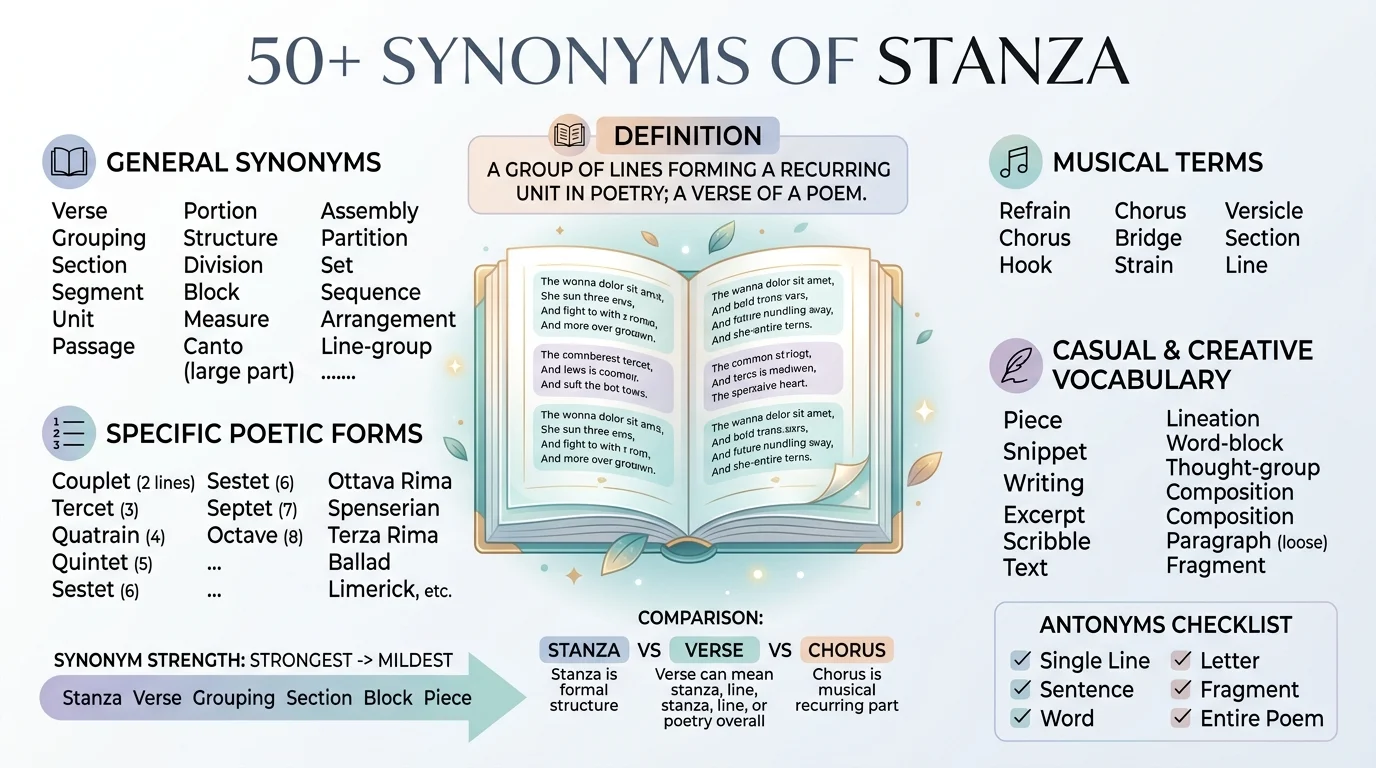
Have you ever needed to describe a group of lines in a poem but felt that “stanza” was too technical or repetitive? You want to capture the structure, rhythm, or grouping of verses, and the word “stanza” comes to mind. Choosing the right synonym for “stanza” can transform a general observation into a precise description of poetic form, verse, or lyrical structure. This guide explores the best synonyms of stanza, explaining exactly which word to use and when.
Quick Ans: “Stanza” means a group of lines forming a unit in a poem, often with a fixed length, meter, or rhyme scheme. For general poetic contexts, choose verse or strophe. For specific forms, use quatrain, couplet, or sestet. For musical contexts, use refrain or chorus. For casual conversation, use section or part.
Meaning, Tone, and Context
Understanding the core meaning of “stanza” is the first step to using it effectively.
Simple Definition: A group of lines forming a unit in a poem, often with a fixed length, meter, or rhyme scheme.
Part of Speech: Noun.
Overall Tone: Neutral and technical. It is a literary and poetic term.
Formality Level: Formal to neutral. The word is used in literary analysis, education, and poetry.
Common Uses: Native English speakers use it in poetry analysis, English classes, and discussions of song lyrics. For example, “The poem has four stanzas,” or “The first stanza introduces the theme.”
Word Forms: Related words include the adjective stanzaic and the noun stanzaic form.
When and How to Use “Stanza”
“Stanza” is the perfect choice when you want to describe a group of lines in a poem. Here are seven realistic examples.
Academic: “The poem consists of five stanzas, each with four lines.”
Literary Analysis: “The final stanza reveals the poem’s true meaning.”
Education: “Students were asked to analyze the rhyme scheme of each stanza.”
Music: “The song’s second stanza repeats the chorus.”
Creative Writing: “She wrote a stanza about loss and longing.”
Professional: “The editor suggested breaking the long stanza into two.”
Social Media: “This stanza from the poem really resonates with me.”
Best Synonyms of “Stanza”
No synonym is identical in every situation. Here is your guide to the best replacement for “stanza” based on your writing context.
For General Poetic Contexts
Most Common: Verse means a group of lines in a poem. “The first verse sets the scene.”
Formal: Strophe means a stanza in a poem, especially in classical Greek poetry. “The strophe and antistrophe alternate.”
General: Section means a distinct part. “The final section of the poem is powerful.”
Part: Part means a division. “The first part introduces the theme.”
For Specific Stanza Forms
Quatrain: Quatrain means a four-line stanza. “The quatrain has an ABAB rhyme scheme.”
Couplet: Couplet means a two-line stanza. “The poem ends with a rhyming couplet.”
Sestet: Sestet means a six-line stanza. “The sestet follows the octave in a Petrarchan sonnet.”
Octave: Octave means an eight-line stanza. “The octave presents the problem.”
For Musical Contexts
Refrain: Refrain means a repeated stanza or line. “The refrain is repeated after each verse.”
Chorus: Chorus means a repeated section in a song. “The chorus is catchy.”
Bridge: Bridge means a contrasting section. “The bridge connects the verse and chorus.”
For Casual Contexts
Block: Block means a group of lines. “The poem is divided into blocks of four lines.”
Group: Group means a collection. “Each group of lines has a different rhyme.”
Chunk: Chunk means a portion. “Read the next chunk of the poem.”
When Not to Use “Stanza”
Using “stanza” can sound wrong or awkward in certain situations.
When You Mean “Line”: “Stanza” is a group of lines. “Line” is a single line.
Better Choice: Line or verse. “The first line is memorable.”
When You Mean “Poem”: “Stanza” is part of a poem. “Poem” is the whole work.
Better Choice: Poem or verse. “The poem is beautiful.”
When It Sounds Too Technical: In casual conversation, “stanza” can sound academic.
Better Choice: Verse or part. “The first part is my favorite.”
Words Commonly Confused With “Stanza”
| Word | Difference | When to Use | Example |
|---|---|---|---|
| Verse | A group of lines or a single line | General and musical | “The verse is repeated.” |
| Line | A single line of poetry | Specific and technical | “The line has ten syllables.” |
| Strophe | A stanza in classical poetry | Formal and classical | “The strophe is chanted.” |
| Quatrain | A four-line stanza | Specific form | “The quatrain rhymes ABAB.” |
| Couplet | A two-line stanza | Specific form | “The couplet is rhymed.” |
| Refrain | A repeated line or stanza | Musical and poetic | “The refrain is repeated.” |
Best Synonyms of “Stanza” by Context
| Context | Best Synonym | Why It Works | Example |
|---|---|---|---|
| Formal writing | Strophe | Formal and classical | “The strophe is followed by the antistrophe.” |
| Academic writing | Verse | Standard in analysis | “The verse is analyzed.” |
| Poetic form | Quatrain | Specific to four lines | “The quatrain is common in English poetry.” |
| Poetic form | Couplet | Specific to two lines | “The couplet ends the sonnet.” |
| Music | Refrain | Musical and poetic | “The refrain is repeated.” |
| Music | Chorus | Musical and specific | “The chorus is catchy.” |
| Casual conversation | Part | Simple and natural | “The first part is my favorite.” |
How to Choose the Best Synonym of “Stanza”
Choosing the right word is a simple decision. Answer these questions.
What type of stanza am I describing? For general, use verse or section. And For specific forms, use quatrain, couplet, or sestet. For music, use refrain or chorus.
What is my audience? For a formal analysis, use strophe or quatrain. For a friend, use part or verse.
What is my purpose? Are you analyzing poetry, describing music, or teaching? The correct synonym depends entirely on this.
What is the emotional strength? Strophe is formal. Part is simple. Pick the one that matches your message.
Real Life Examples of “Stanza”
School: Basic: “The poem has four stanzas.” Improved: “The poem has four quatrains.”
College: Basic: “Analyze the first stanza.” Improved: “Analyze the first strophe.”
Workplace: Basic: “The stanza is too long.” Improved: “The verse is too long.”
Music: Basic: “The stanza repeats.” Improved: “The refrain repeats.”
Email: Basic: “I like the second stanza.” Improved: “I like the second verse.”
Conversation: Basic: “The stanza is beautiful.” Improved: “The part is beautiful.”
Storytelling: Basic: “The final stanza is powerful.” Improved: “The final strophe is powerful.”
Top 10 Synonyms of “Stanza”
| Synonym | Simple Meaning | Best Used For | Example Sentence |
|---|---|---|---|
| Verse | A group of lines in a poem | General and musical | “The verse is repeated.” |
| Strophe | A stanza in classical poetry | Formal and classical | “The strophe is chanted.” |
| Quatrain | A four-line stanza | Specific poetic form | “The quatrain rhymes ABAB.” |
| Couplet | A two-line stanza | Specific poetic form | “The couplet is rhymed.” |
| Sestet | A six-line stanza | Specific poetic form | “The sestet follows the octave.” |
| Octave | An eight-line stanza | Specific poetic form | “The octave presents the problem.” |
| Refrain | A repeated line or stanza | Musical and poetic | “The refrain is repeated.” |
| Chorus | A repeated section in a song | Musical | “The chorus is catchy.” |
| Section | A distinct part | General and prose | “The final section is powerful.” |
| Part | A division | Casual and general | “The first part is my favorite.” |
Synonyms of “Stanza” by Usage
Professional vs. Personal Synonyms
In academic writing, choose strophe, quatrain, or couplet. With friends, use verse, part, or section.
Formal vs. Conversational Synonyms
For formal writing, use strophe, quatrain, or sestet. For casual conversations, use verse, part, or section.
Academic Synonyms
For research and essays, choose quatrain for four-line stanzas, couplet for two-line stanzas, and strophe for classical forms.
Professional and Business Synonyms
For editing and publishing, choose verse for general contexts, stanza for technical precision, and section for prose.
Creative and Literary Synonyms
To add emotion and imagery, choose strophe, refrain, or chorus. These words create atmosphere.
Slang or Modern Synonyms
In modern American slang, verse or part are common. For example, “That verse is fire.” These are casual and should be avoided in formal writing.
Strongest to Mildest Synonyms
Mild: part, section, block
Moderate: stanza, verse, refrain
Strong: strophe, quatrain, couplet
Very Strong: sestet, octave, chorus
Emotional vs. Neutral Synonyms
Emotional Synonyms: Refrain, chorus. These words hint at repetition and emotion. Use them when you want to evoke feeling.
Neutral Synonyms: Stanza, verse, section. These words communicate factual information.
Antonyms of “Stanza”
| Antonym | Meaning | Example Sentence |
|---|---|---|
| Prose | Ordinary writing without poetic structure | “The novel is written in prose.” |
| Line | A single line of poetry | “The line is short.” |
| Sentence | A grammatical unit | “The sentence is long.” |
| Paragraph | A group of sentences | “The paragraph is clear.” |
| Chapter | A main division of a book | “The chapter is exciting.” |
| Passage | A section of text | “The passage is beautiful.” |
| Excerpt | A short extract | “The excerpt is from a poem.” |
| Quote | A repeated phrase | “The quote is famous.” |
| Fragment | A small part | “The fragment is incomplete.” |
| Phrase | A group of words | “The phrase is memorable.” |
| Clause | A grammatical unit | “The clause is independent.” |
| Word | A single unit of language | “The word is powerful.” |
| Syllable | A unit of pronunciation | “The syllable is stressed.” |
| Sound | A unit of sound | “The sound is soft.” |
| Letter | A written character | “The letter is capital.” |
Comparison: “Stanza” vs Similar Words
Stanza vs. Verse
Main Difference: “Stanza” is a group of lines. “Verse” can be a single line or a group of lines.
Which Is Stronger? “Stanza” is more specific.
Which Is More Formal? Both are formal.
When to Use Each: Use “stanza” for poetic structure. Use “verse” for general poetry or music.
Examples:
Stanza: “The poem has four stanzas.”
Verse: “The first verse is beautiful.”
Stanza vs. Strophe
Main Difference: “Strophe” is a classical term. “Stanza” is general.
Which Is Stronger? “Strophe” is more formal.
Which Is More Formal? “Strophe” is more formal.
When to Use Each: Use “strophe” in classical analysis. Use “stanza” in general contexts.
Examples:
Stanza: “The stanza has four lines.”
Strophe: “The strophe is chanted.”
Stanza vs. Quatrain
Main Difference: “Quatrain” is a four-line stanza. “Stanza” is general.
Which Is Stronger? “Quatrain” is more specific.
Which Is More Formal? Both are formal.
When to Use Each: Use “quatrain” for four-line stanzas. Use “stanza” for general contexts.
Examples:
Stanza: “The stanza is long.”
Quatrain: “The quatrain rhymes ABAB.”
Stanza vs. Couplet
Main Difference: “Couplet” is a two-line stanza. “Stanza” is general.
Which Is Stronger? “Couplet” is more specific.
Which Is More Formal? Both are formal.
When to Use Each: Use “couplet” for two-line stanzas. Use “stanza” for general contexts.
Examples:
Stanza: “The stanza ends the poem.”
Couplet: “The couplet is rhymed.”
Stanza vs. Refrain
Main Difference: “Refrain” is a repeated line or stanza. “Stanza” is general.
Which Is Stronger? “Refrain” is more specific to repetition.
Which Is More Formal? Both are formal.
When to Use Each: Use “refrain” for repeated sections. Use “stanza” for general contexts.
Examples:
Stanza: “The stanza is repeated.”
Refrain: “The refrain is repeated.”
Stanza vs. Section
Main Difference: “Section” is general. “Stanza” is specific to poetry.
Which Is Stronger? “Stanza” is more specific.
Which Is More Formal? Both are neutral.
When to Use Each: Use “section” in prose. Use “stanza” in poetry.
Examples:
Stanza: “The stanza is beautiful.”
Section: “The section is clear.”
Common Phrases and Expressions with “Stanza”
Phrase: First stanza
Meaning: The opening group of lines.
Example Sentence: “The first stanza introduces the theme.”
Phrase: Final stanza
Meaning: The last group of lines.
Example Sentence: “The final stanza is powerful.”
Phrase: Stanza form
Meaning: The structure of stanzas.
Example Sentence: “The poem uses a fixed stanza form.”
Phrase: Stanza break
Meaning: The space between stanzas.
Example Sentence: “The stanza break creates pause.”
Phrase: Stanzaic poem
Meaning: A poem with stanzas.
Example Sentence: “The stanzaic poem is well-structured.”
Common Mistakes to Avoid
Mistake 1: Using “stanza” when you mean “line”.
Incorrect: “The first stanza is ten syllables.”
Better: “The first line is ten syllables.”
Why: “Stanza” is a group of lines.
Mistake 2: Using “stanza” when you mean “poem”.
Incorrect: “The stanza is beautiful.”
Better: “The poem is beautiful.”
Why: “Stanza” is part of a poem.
Mistake 3: Overusing “stanza” in conversation.
Incorrect: “I like the second stanza.”
Better: “I like the second verse.”
Why: “Verse” sounds more natural.
Mistake 4: Using “stanza” when you mean “verse”.
Incorrect: “The song’s stanza is catchy.”
Better: “The song’s chorus is catchy.”
Why: “Chorus” is for songs.
Mistake 5: Using “stanza” when you mean “strophe”.
Incorrect: “The Greek chorus sang the stanza.”
Better: “The Greek chorus sang the strophe.”
Why: “Strophe” is for classical poetry.
Frequently Asked Questions
1. What are the best synonyms of “stanza”?
The best synonyms depend on your context. For general, choose verse or section. And For specific forms, use quatrain, couplet, or sestet. For music, use refrain or chorus.
2. What are the best formal synonyms of “stanza”?
The best formal synonyms are strophe, quatrain, and couplet. These words are suitable for academic papers, literary analysis, and poetry criticism.
3. What are common informal synonyms of “stanza”?
For informal settings, use verse, part, or section. These alternatives sound more natural in everyday conversation.
4. What is another word for “stanza” in professional writing?
In professional writing, verse is an excellent choice. It conveys poetic structure. Strophe is also strong for classical contexts.
5. What is the difference between “stanza” and “verse”?
“Stanza” is a group of lines. “Verse” can be a single line or a group of lines. Use “stanza” for structure and “verse” for general poetry.
6. What is the opposite of “stanza”?
The most direct opposites (antonyms) of stanza are prose, line, and sentence. These words describe non-poetic or smaller units of writing.
Conclusion
“Stanza” is a precise and essential word for describing the structure of poetry. The term is formal and widely accepted in literary and academic contexts, yet it can sound too technical for casual conversation or too specific for general descriptions. The best choice among the synonyms of stanza depends entirely on your audience, tone, and purpose. Remember, no single synonym works perfectly in every situation. Your goal is to choose the word that communicates your message with the most clarity and impact. A practical tip for your vocabulary growth is to pay attention to how poets and critics describe poetic structure and practice using different synonyms in your writing.