Have you ever needed to describe the process of acquiring knowledge but felt that “learn” did not fully capture the depth of the experience? You want to express growth, discovery, or mastery, and the word “learn” comes to mind. But is it the best fit for your audience? Choosing the right synonym for “learn” can transform a simple statement into a vivid description of intellectual growth and personal development. This guide explores the best synonyms of learn, explaining exactly which word to use and when.
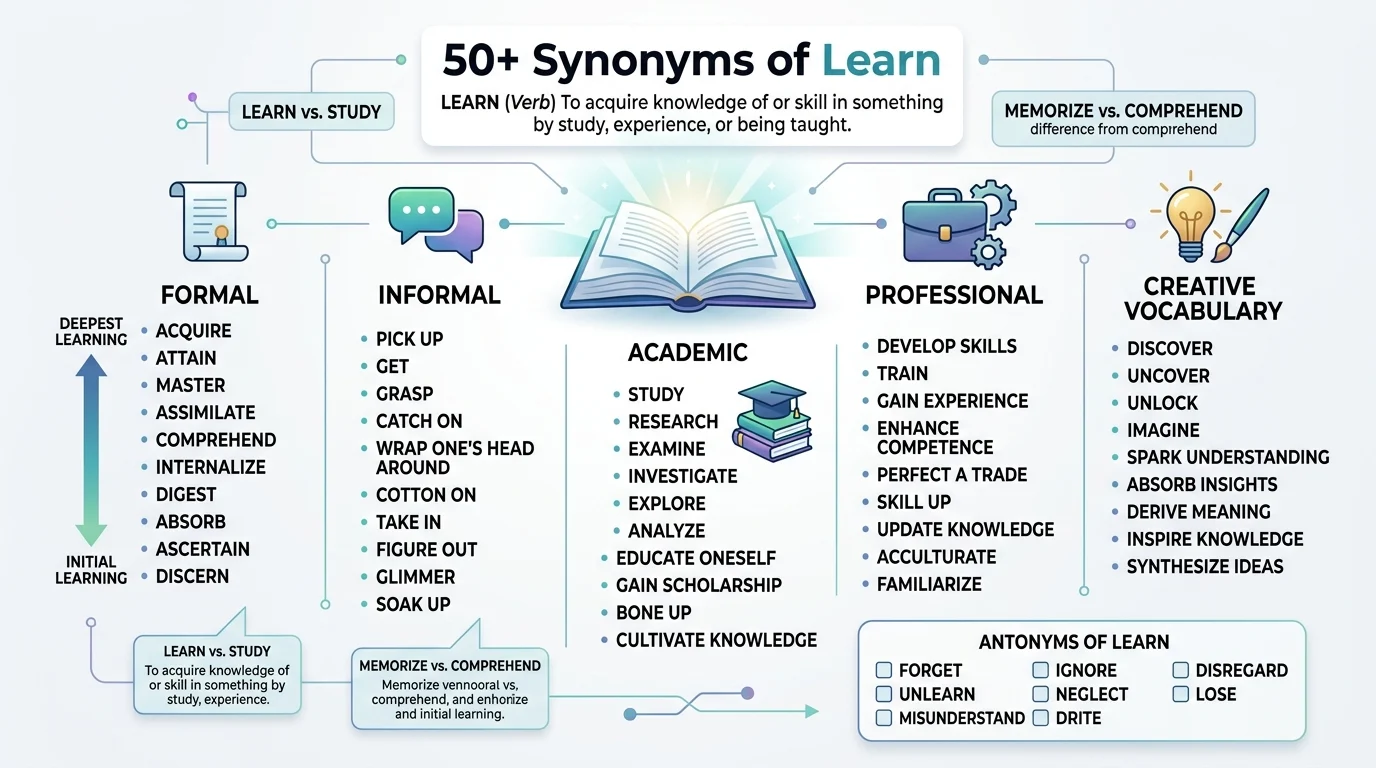
Quick Ans: “Learn” means to acquire knowledge or skill through study, experience, or teaching. It is a neutral, versatile verb. For formal writing, choose acquire or ascertain. For casual conversation, use pick up or get the hang of. In academic contexts, master and comprehend are strong choices. For a stronger, more dramatic impact, select absorb or internalize.
Meaning, Tone, and Context
Understanding the core meaning of “learn” is the first step to using it effectively.
Simple Definition: To get knowledge or skill in a new subject or activity. To become aware of something.
Part of Speech: Verb.
Overall Tone: Neutral. It describes the process of acquiring knowledge without inherent emotion.
Formality Level: Neutral. The word works in almost any context, from casual conversation to formal academic writing.
Common Uses: Native English speakers use it constantly. For example, “I learned Spanish in high school,” or “She learned about the news from social media.”
Word Forms: Related words include the noun learner and the adjective learned (pronounced LUR-ned, meaning knowledgeable).
When and How to Use “Learn”
“Learn” is the most common and versatile word in its category. Here are seven realistic examples.
Professional: “Our team needs to learn the new software by next quarter.”
Academic: “Students learn through a combination of lectures and hands-on practice.”
Workplace: “New employees learn company procedures during their first week.”
Personal: “I want to learn how to cook authentic Italian cuisine.”
Email: “Please learn the new protocol before implementing it with clients.”
Resume: “Demonstrated ability to learn new technologies quickly and independently.”
Social Media: “Learning to paint has been the most rewarding journey of my year.”
Best Synonyms of “Learn”
No synonym is identical in every situation. Here is your guide to the best replacement for “learn” based on your writing context.
Professional Writing: Acquire. It suggests obtaining a skill or knowledge systematically. “She acquired expertise in data analysis through years of practice.”
Academic Writing: Master. This is ideal when discussing achieving complete knowledge or skill. “Students must master calculus before advancing to physics.”
Business Communication: Understand. A practical choice for grasping concepts. “We need to understand the market dynamics before launching.”
Casual Conversation: Pick up. It tones down the formality, meaning learning informally. “I picked up a few phrases during my trip to France.”
Emotional Writing: Absorb. This word carries weight, suggesting deep, almost unconscious learning. “She absorbed her father’s wisdom over many years.”
Creative Writing: Internalize. It implies making knowledge part of oneself. “He internalized the values of his community.”
Resume Writing: Master. Use it to describe achieving a high level of proficiency. “Mastered project management methodologies and led multiple successful initiatives.”
When Not to Use “Learn”
Using “learn” can sound weak or imprecise in certain situations.
When You Mean “Discover”: “Learn” can mean becoming aware of something, but discover is stronger.
Better Choice: Discover. “She discovered the truth after years of research.”
When You Need a Formal Tone: In academic writing, learn can sound too simple.
Better Choice: Ascertain or comprehend. “The study aimed to ascertain the effects of the treatment.”
When Describing Teaching: “Learn” is about receiving knowledge, not giving it.
Better Choice: Teach or instruct. “He teaches math at the university.”
When You Mean “Memorize”: “Learn” is broad, but memorize is specific.
Better Choice: Memorize. “She memorized all the formulas for the exam.”
Words Commonly Confused With “Learn”
Several words are often mixed up with “learn.” Here is how to keep them straight.
Word: Study
Difference: Means to devote time to learning. “Learn” is the result. Study is the process.
When to Use: Use it when referring to the act of reading and practicing.
Example: “I study French every evening.”
Word: Master
Difference: Means to become highly proficient. “Learn” can mean basic understanding.
When to Use: Use this for achieving full command of a subject.
Example: “He mastered the art of negotiation.”
Word: Understand
Difference: Means to comprehend meaning. “Learn” is about acquiring knowledge.
When to Use: Use this for grasping concepts.
Example: “I understand the theory completely.”
Word: Discover
Difference: Means to find something previously unknown. “Learn” is about acquiring known information.
When to Use: Use this for new findings or revelations.
Example: “She discovered a new species of butterfly.”
Word: Acquire
Difference: Means to obtain systematically. “Learn” is more general.
When to Use: Use this for skills or knowledge obtained through effort.
Example: “He acquired fluency in three languages.”
Word: Comprehend
Difference: Means to grasp fully. “Learn” can be superficial.
When to Use: Use it for deep, complete understanding.
Example: “She comprehended the complex theory easily.”
Best Synonyms of “Learn” by Context
| Context | Best Synonym | Why It Works | Example |
|---|---|---|---|
| Formal writing | Acquire | Suggests systematic obtaining of knowledge. | “The internship enabled her to acquire valuable skills.” |
| Academic writing | Master | Indicates complete command of a subject. | “The goal is to master the principles of physics.” |
| Professional communication | Understand | Practical and clear for business contexts. | “We need to understand our clients’ needs.” |
| Business emails | Familiarize | Professional and precise. | “Please familiarize yourself with the new guidelines.” |
| Resume writing | Master | Conveys high-level proficiency. | “Mastered advanced Excel functions.” |
| Workplace communication | Grasp | Emphasizes comprehension. | “He grasped the concept quickly.” |
| Casual conversation | Pick up | Simple, natural, and conversational. | “I picked up some Spanish in high school.” |
| Creative writing | Internalize | Evokes deep, personal absorption. | “She internalized her grandmother’s stories.” |
| Emotional writing | Absorb | Suggests deep, unconscious learning. | “He absorbed the values of his culture.” |
| Strong emphasis | Comprehend | Implies full understanding. | “She comprehended the complexity of the situation.” |
| Mild tone | Learn | Simple and unassuming. Good for general use. | “He learns new things every day.” |
| Social media captions | Pick up | Relatable and casual. | “Picked up a new skill this weekend.” |
How to Choose the Best Synonym of “Learn”
Choosing the right word is a simple decision. Answer these questions.
What is my audience? For a professor or CEO, acquire or master is powerful. For a friend, pick up or get the hang of is more natural.
What is my purpose? Are you trying to show growth, demonstrate achievement, or describe a process? Use master for achievement, study for process, and discover for revelation.
Am I describing a skill or knowledge? For skills, master or acquire work well. For knowledge, comprehend or understand are better.
What is the emotional strength? Absorb and internalize are stronger. Pick up and learn are mild. Pick the one that matches your message.
Real Life Examples of “Learn”
To truly master the word, it helps to see how it behaves in the wild and how a stronger synonym can elevate the sentence.
School: Basic: “The students learned about ancient Rome.” Improved: “The students studied ancient Rome through primary sources.”
College: Basic: “She learned the theory quickly.” Improved: “She comprehended the theory after just one lecture.”
Workplace: Basic: “New employees learn the system.” Improved: “New employees familiarize themselves with the system during training.”
Business: Basic: “We learned from our mistakes.” Improved: “We absorbed the lessons from our mistakes and improved.”
Email: Basic: “Please learn the new software.” Improved: “Please acquire proficiency in the new software by next week.”
Conversation: Basic: “I learned to cook.” Improved: “I picked up cooking during quarantine.”
Storytelling: Basic: “He learned patience.” Improved: “He internalized the value of patience over many years.”
Top 10 Synonyms of “Learn”
| Synonym | Simple Meaning | Best Used For | Example Sentence |
|---|---|---|---|
| Acquire | To obtain systematically | Professional, academic, and formal contexts. | “She acquired fluency in Japanese.” |
| Master | To achieve complete command | Academic, professional, and achievement contexts. | “He mastered the piano at age twelve.” |
| Understand | To grasp meaning | Everyday, business, and educational contexts. | “I finally understand the concept.” |
| Comprehend | To fully understand | Academic, formal, and complex contexts. | “She comprehended the complex theory easily.” |
| Pick up | To learn informally | Casual conversation and everyday contexts. | “I picked up some Italian on vacation.” |
| Study | To devote time to learning | Academic, professional, and focused contexts. | “He studies economics at the university.” |
| Absorb | To take in deeply | Emotional, creative, and immersive contexts. | “She absorbed her mentor’s teaching.” |
| Internalize | To make part of oneself | Psychological, emotional, and developmental contexts. | “He internalized the values of honesty.” |
| Grasp | To take hold mentally | Professional, educational, and quick-learning contexts. | “She grasped the concept immediately.” |
| Discover | To find something previously unknown | Scientific, adventurous, and revelatory contexts. | “He discovered the truth after years.” |
Synonyms of “Learn” by Usage
Professional vs. Personal Synonyms
In the workplace (professional), choose acquire, master, or understand to describe developing skills. These words convey seriousness and precision. “She acquired expertise in data science” is more impactful than “She learned data science.”
With friends (personal), pick up, get the hang of, or simply learn keep the tone relaxed and relatable. These alternatives sound natural in everyday conversation.
Formal vs. Conversational Synonyms
For formal writing (reports, essays, professional emails), use acquire, comprehend, or ascertain. These choices maintain the sophisticated tone expected in professional documents.
For casual conversations and texting, use pick up, get the hang of, or figure out. These options sound more natural and less pretentious.
Academic Synonyms
For research and essays, choose precise, authoritative words. Ascertain is great for discovering facts, comprehend for deep understanding, and master for complete proficiency. These words sound considered and scholarly.
Using precise academic vocabulary demonstrates expertise and careful thinking. Professors and reviewers expect this level of precision.
Professional and Business Synonyms
For maximum impact in business writing, choose acquire for obtaining skills, familiarize for introduction, and understand for comprehension. These words demonstrate confidence and professional awareness.
Business leaders respond to language that conveys precision and capability. These synonyms project authority.
Creative and Literary Synonyms
To add emotion and imagery to your writing, choose absorb, internalize, or imbibe. These words create atmosphere and depth.
Literary writers use these alternatives to build character and theme. They transform ordinary descriptions into evocative prose.
Slang or Modern Synonyms
There is no direct slang synonym for “learn” in mainstream American English. In modern texting, people use pick up, get, or figure out. This straightforward approach works best for casual digital communication.
Strongest to Mildest Synonyms
Mild: learn, pick up, get
Moderate: study, grasp, understand
Strong: acquire, master, comprehend
Very Strong: absorb, internalize, ascertain
Emotional vs. Neutral Synonyms
Emotional Synonyms: Absorb, internalize, imbibe. These words often hint at deep personal growth or transformation. Use them when you want to evoke feeling.
Neutral Synonyms: Learn, study, understand, grasp. These words simply communicate factual information. Use them when you want to inform without emotional coloring.
Antonyms of “Learn”
Here are 15 genuine opposites of “learn.”
| Antonym | Meaning | Example Sentence |
|---|---|---|
| Forget | To lose knowledge or memory | “She forgot everything she learned in high school.” |
| Ignore | To pay no attention to | “He ignored the warning signs.” |
| Neglect | To fail to care for or pay attention | “She neglected her studies.” |
| Misunderstand | To interpret incorrectly | “He misunderstood the instructions.” |
| Overlook | To fail to notice | “The manager overlooked the error.” |
| Unlearn | To lose or discard knowledge | “He had to unlearn bad habits.” |
| Disregard | To pay no attention to | “She disregarded the advice.” |
| Confuse | To make unclear or uncertain | “The conflicting information confused him.” |
| Misinterpret | To understand wrongly | “She misinterpreted his intentions.” |
| Mistake | To understand incorrectly | “He mistook her meaning completely.” |
| Miss | To fail to catch or understand | “She missed the point of the lecture.” |
| Misread | To read or interpret incorrectly | “He misread the situation.” |
| Skip | To omit or not include | “He skipped the chapter.” |
| Evade | To avoid or escape | “She evaded the question.” |
| Dismiss | To reject as unimportant | “He dismissed her concerns.” |
Comparison: “Learn” vs Similar Words
Learn vs. Study
Main Difference: Learn is the result. Study is the process.
Which Is Stronger? Neither. They complement each other.
Which Is More Formal? Both are neutral in formality.
When to Use Each: Use learn for the result. Use study for the action.
Examples:
Learn: “She learned French in two years.”
Study: “He studies for three hours every night.”
Learn vs. Master
Main Difference: Learn can be basic. Master implies complete proficiency.
Which Is Stronger? Master is much stronger.
Which Is More Formal? Both are formal, but master is more impressive.
When to Use Each: Use learn for everyday acquisition. Use master for advanced achievement.
Examples:
Learn: “I learned to play chess.”
Master: “He mastered the game of chess.”
Learn vs. Understand
Main Difference: Learn is acquiring knowledge. Understand is grasping meaning.
Which Is Stronger? They are different. Understand implies depth.
Which Is More Formal? Both are neutral in formality.
When to Use Each: Use learn for new knowledge. Use understand for comprehension.
Examples:
Learn: “She learned the formula.”
Understand: “She understood the concept.”
Learn vs. Acquire
Main Difference: Learn is general. Acquire is systematic and formal.
Which Is Stronger? Acquire is more formal and precise.
Which Is More Formal? Acquire is more formal.
When to Use Each: Use learn in everyday contexts. Use acquire in professional contexts.
Examples:
Learn: “I learned to cook.”
Acquire: “She acquired culinary skills.”
Learn vs. Discover
Main Difference: Learn involves known information. Discover involves new findings.
Which Is Stronger? Discover is more dramatic and exciting.
Which Is More Formal? Both are used in formal and informal contexts.
When to Use Each: Use learn for known information. Use discover for new findings.
Examples:
Learn: “She learned about the war from textbooks.”
Discover: “She discovered a new fossil.”
Learn vs. Comprehend
Main Difference: Learn is acquiring. Comprehend is fully understanding.
Which Is Stronger? Comprehend implies deeper understanding.
Which Is More Formal? Comprehend is more formal.
When to Use Each: Use learn for initial acquisition. Use comprehend for deep understanding.
Examples:
Learn: “He learned the vocabulary.”
Comprehend: “He comprehended the philosophy.”
Common Phrases and Expressions with “Learn”
Phrase: Learn the ropes
Meaning: To learn the basic skills of a job or activity.
Example Sentence: “It took her a week to learn the ropes at her new job.”
Phrase: Learn from experience
Meaning: To gain knowledge from past events.
Example Sentence: “He learned from experience that honesty is the best policy.”
Phrase: Live and learn
Meaning: We learn from our experiences, especially mistakes.
Example Sentence: “I made a mistake, but live and learn.”
Phrase: Learn by heart
Meaning: To memorize completely.
Example Sentence: “She learned the poem by heart.”
Phrase: Learn the hard way
Meaning: To learn through difficult experiences.
Example Sentence: “He learned the hard way to check his work carefully.”
Phrase: Learning curve
Meaning: The rate of progress in learning.
Example Sentence: “The new software has a steep learning curve.”
Common Mistakes to Avoid
Mistake 1: Using “learn” when you mean “teach”.
Incorrect: “He learned me how to cook.”
Better: “He taught me how to cook.”
Why: Learn is for receiving knowledge. Teach is for giving it.
Mistake 2: Using “learn” when you mean “memorize”.
Incorrect: “I learned all the formulas for the exam.”
Better: “I memorized all the formulas for the exam.”
Why: Memorizing is just remembering. Learning is deeper understanding.
Mistake 3: Overusing “learn” in formal writing.
Incorrect: “The study learned that exercise is beneficial.”
Better: “The study found that exercise is beneficial.”
Why: Studies find things, not learn them.
Mistake 4: Using “learn” when you mean “discover”.
Incorrect: “He learned a new species.”
Better: “He discovered a new species.”
Why: Discover means finding something new to the world.
Mistake 5: Using “pick up” in formal writing.
Incorrect: “She picked up the concepts in the seminar.”
Better: “She acquired the concepts in the seminar.”
Why: Pick up is too casual for formal contexts.
Frequently Asked Questions
1. What are the best synonyms of “learn”?
The best synonyms depend on your context. For formal writing, choose acquire or ascertain.And for casual conversation, pick up or get the hang of are ideal choices. For deep understanding, use comprehend or master.
2. What are the best formal synonyms of “learn”?
The best formal synonyms are acquire, ascertain, and comprehend. These words are suitable for academic papers, professional reports, and business communications.
3. What are common informal synonyms of “learn”?
For informal settings, use pick up, get the hang of, or figure out. These alternatives sound more natural in everyday conversation.
4. What is another word for “learn” in professional writing?
In professional writing, acquire is an excellent choice. It conveys systematic obtaining of knowledge. Master is also strong for achieving proficiency.
5. What is the difference between “learn” and “study”?
While both relate to acquiring knowledge, learn is the result (what you get). Study is the process (what you do). Use learn for the outcome and study for the activity.
6. What is the opposite of “learn”?
The most direct opposites (antonyms) of learn are forget, ignore, and overlook. These words describe failing to acquire or retain knowledge.
Conclusion
“Learn” is a versatile and essential verb for describing the acquisition of knowledge and skills. The term is neutral and widely understood, yet it can sound vague or imprecise in certain contexts. The best choice among the synonyms of learn depends entirely on your audience, tone, and purpose.Remember, no single synonym works perfectly in every situation. Your goal is to choose the word that communicates your message with the most clarity and impact. A practical tip for your vocabulary growth is to practice using different synonyms for “learn” in your daily writing and conversation.
Discover More:
- 50+ Synonyms of Required: Meanings, Uses, Examples, and Best Alternatives 2026
- 50+ Synonyms of Goal: Meanings, Uses, Examples, and Best Alternatives 2026

Alexander Cole is a professional content writer and researcher who specializes in creating informative, reader-friendly, and well-researched articles. He is committed to publishing accurate, valuable, and engaging content that helps readers stay informed and make smarter decisions.