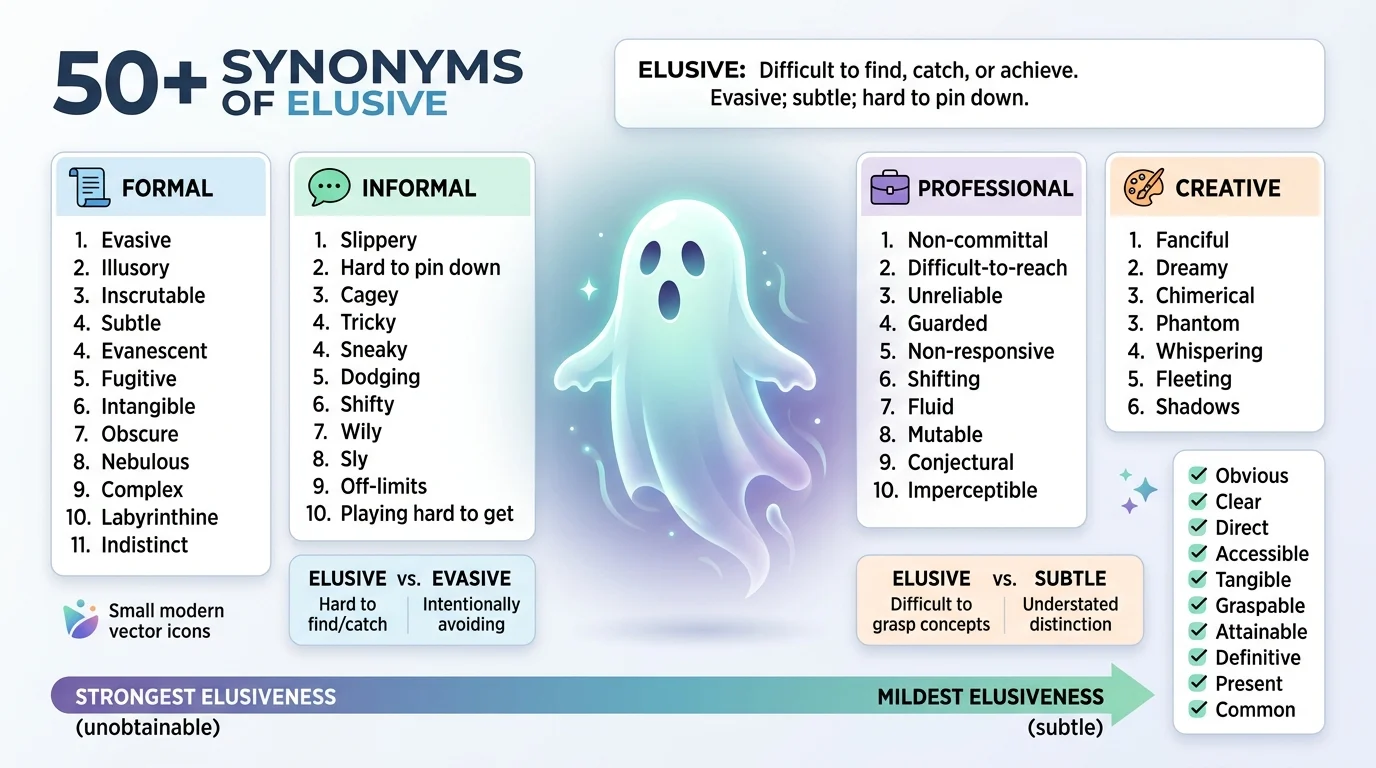
Have you ever tried to describe something that is frustratingly hard to find, define, or remember, but felt that “hard to find” did not capture the nuance? You want to highlight difficulty in grasping, capturing, or understanding, and the word “elusive” comes to mind. But is it the best fit for your audience? Choosing the right synonym for “elusive” can transform a simple observation into a precise description of difficulty, intangibility, or clever avoidance. This guide explores the best synonyms of elusive, explaining exactly which word to use and when.
Quick Ans: “Elusive” means difficult to find, catch, achieve, or remember. It often describes something that slips away from grasp or understanding . It is a neutral-to-slightly-frustrated adjective. For formal writing, choose evasive or intangible. For casual conversation, use slippery or tricky. In academic contexts, abstruse and nebulous are strong choices. For a stronger, more dramatic impact, select fleeting or ephemeral.
Meaning, Tone, and Context
Understanding the core meaning of “elusive” is the first step to using it effectively.
Simple Definition: Difficult to find, catch, or achieve. Hard to remember or define.
Part of Speech: Adjective.
Overall Tone: Neutral to slightly negative. It indicates frustration, mystery, or transience.
Formality Level: Neutral. The word works in most contexts, from casual to formal.
Common Uses: Native English speakers use it to describe memories, goals, ideas, criminals, and answers. For example, “The answer remains elusive,” or “Happiness can be elusive.”
Word Forms: Related words include the noun elusiveness and the adverb elusively.
When and How to Use “Elusive”
“Elusive” is the perfect choice when you want to emphasize the difficulty of capturing or understanding something. Here are seven realistic examples.
Professional: “A comprehensive solution to the problem remains elusive.”
Academic: “The definition of consciousness is notoriously elusive.”
Workplace: “The key to increasing productivity has been elusive.”
Personal: “The memory of that day has remained elusive.”
Email: “The data we need has proven elusive despite our efforts.”
Resume: “Developed a process to achieve targets that once seemed elusive.”
Social Media: “The perfect shot was elusive, but I kept trying.”
Best Synonyms of “Elusive”
No synonym is identical in every situation. Here is your guide to the best replacement for “elusive” based on your writing context.
Professional Writing: Evasive. It suggests intentional avoidance. “The suspect gave evasive answers.” .
Academic Writing: Abstruse. This is ideal for concepts that are hard to understand. “The abstruse theory was debated by experts.”
Business Communication: Unattainable. A practical choice for difficult goals. “The target seemed unattainable.”
Casual Conversation: Slippery. It tones down the formality and sounds natural. “Finding a good plumber is a slippery task.”
Emotional Writing: Fleeting. This word carries weight, suggesting transience. “Happiness can be a fleeting feeling.”
Creative Writing: Ephemeral. It implies temporary and fleeting beauty. “The ephemeral joy of childhood was remembered fondly.”
Resume Writing: Elusive. This is the standard, expected term for describing hard-to-reach goals.
When Not to Use “Elusive”
Using “elusive” can sound wrong or awkward in certain situations.
When It Sounds Too Dramatic: “Elusive” is dramatic. It is wrong for simple difficulty.
Better Choice: Hard or difficult. “The problem is difficult to solve.”
When You Mean Intentional Avoidance: “Elusive” often means hard to find. Evasive is for intentional avoidance .
Better Choice: Evasive. “The witness gave evasive answers.”
When It Sounds Too Vague: “Elusive” can be vague if you need specifics.
Better Choice: Undefined or unclear. “The details are unclear.”
When It Is Too Formal: In casual conversation, “elusive” can sound out of place.
Better Choice: Hard to pin down or slippery. “That idea is hard to pin down.”
Words Commonly Confused With “Elusive”
Several words are often mixed up with “elusive.” Here is how to keep them straight .
Word: Evasive
Difference: Means intentionally avoiding. “Elusive” means hard to find or achieve.
When to Use: Use it for people who avoid answering.
Example: “The politician gave evasive answers.”
Word: Fleeting
Difference: Means brief and short-lived. “Elusive” means hard to catch.
When to Use: Use this for moments and feelings.
Example: “The fleeting moment of happiness was beautiful.”
Word: Ephemeral
Difference: Means lasting for a very short time. “Elusive” is about difficulty.
When to Use: Use this for beauty, trends, and temporary things.
Example: “The ephemeral beauty of cherry blossoms is famous.”
Word: Slippery
Difference: Means hard to hold onto physically or metaphorically. “Elusive” is more formal.
When to Use: Use this in casual contexts .
Example: “The slippery fish escaped.”
Word: Nebulous
Difference: Means vague and unclear. “Elusive” is about difficulty in achieving .
When to Use: Use this for abstract concepts.
Example: “The concept remains nebulous.”
Word: Abstruse
Difference: Means hard to understand. “Elusive” means hard to achieve or find .
When to Use: Use this for complex theories.
Example: “The abstruse theory was confusing.”
Best Synonyms of “Elusive” by Context
| Context | Best Synonym | Why It Works | Example |
|---|---|---|---|
| Formal writing | Evasive | Suggests intentional avoidance. | “The suspect’s evasive tactics frustrated police.” |
| Academic writing | Abstruse | Precise for complex theories. | “The abstruse text required a specialist.” |
| Professional communication | Unattainable | Emphasizes difficulty. | “The target seemed unattainable.” |
| Business emails | Hard to pin down | Professional yet clear. | “The issue is hard to pin down.” |
| Resume writing | Elusive | The standard, expected term. | “Achieved a goal that once seemed elusive.” |
| Workplace communication | Slippery | Neutral and widely understood. | “That problem is a slippery one.” |
| Casual conversation | Hard to find | Simple, natural, and conversational. | “A good mechanic is hard to find.” |
| Creative writing | Ephemeral | Evokes transient beauty. | “The ephemeral nature of youth is bittersweet.” |
| Emotional writing | Fleeting | Suggests brief and precious moments. | “Love can be a fleeting feeling.” |
| Strong emphasis | Inscrutable | Suggests impossible to understand. | “The inscrutable mystery baffled everyone.” |
| Mild tone | Tricky | Simple and unassuming. | “That is a tricky situation.” |
| Social media captions | Slippery | Widely understood and relatable. | “Success feels slippery sometimes.” |
How to Choose the Best Synonym of “Elusive”
Choosing the right word is a simple decision. Answer these questions.
What is my audience? For a professor or CEO, abstruse or evasive is powerful. For a friend, slippery or hard to find is more natural.
What is my purpose? Are you describing an idea, a goal, or a person? Use abstruse for ideas, unattainable for goals, and evasive for people.
Am I describing difficulty or intentional avoidance? For difficulty, elusive works. For avoidance, use evasive .
What is the emotional strength? Fleeting and ephemeral are more emotional. Hard to find is mild. Pick the one that matches your message.
Real Life Examples of “Elusive”
To truly master the word, it helps to see how it behaves in the wild and how a stronger synonym can elevate the sentence.
School: Basic: “The right answer was elusive.” Improved: “The right answer proved evasive during the test.”
College: Basic: “The definition is elusive.” Improved: “The definition is abstruse and hard to grasp.”
Workplace: Basic: “The solution remains elusive.” Improved: “The solution remains hard to pin down despite multiple attempts.”
Business: Basic: “The goal was elusive.” Improved: “The goal was unattainable with current resources.”
Email: Basic: “The evidence is elusive.” Improved: “The evidence has proven hard to find.”
Conversation: Basic: “Finding a good mechanic is elusive.” Improved: “Finding a good mechanic is a slippery task.”
Storytelling: Basic: “The butterfly was elusive.” Improved: “The butterfly was ephemeral, disappearing into the light.”
Top 10 Synonyms of “Elusive”
| Synonym | Simple Meaning | Best Used For | Example Sentence |
|---|---|---|---|
| Evasive | Intentionally avoiding | People, answers, and avoidance contexts. | “The witness gave evasive answers.” |
| Abstruse | Hard to understand | Academic, philosophical, and complex contexts. | “The abstruse theory baffled students.” |
| Unattainable | Impossible to achieve | Goals, targets, and practical contexts. | “The goal was unattainable.” |
| Slippery | Hard to hold onto | Casual, physical, and metaphorical contexts . | “The subject is a slippery one.” |
| Fleeting | Brief and short-lived | Emotions, moments, and time contexts. | “The fleeting moment passed quickly.” |
| Ephemeral | Lasting a short time | Beauty, trends, and temporary things. | “The ephemeral joy of childhood is remembered fondly.” |
| Nebulous | Vague and unclear | Concepts, ideas, and abstract contexts. | “The concept remains nebulous.” |
| Inscrutable | Impossible to understand | Mysteries, faces, and serious contexts. | “The inscrutable mystery baffled all.” |
| Hard to pin down | Difficult to describe or locate | Everyday and casual contexts. | “The issue is hard to pin down.” |
| Tricky | Difficult to deal with | Situations, problems, and practical contexts. | “That is a tricky situation.” |
Synonyms of “Elusive” by Usage
Professional vs. Personal Synonyms
In the workplace (professional), choose evasive, unattainable, or hard to pin down to describe challenges. These words convey professionalism and precision. “The target seemed unattainable” is more precise than “The target seemed elusive.”
With friends (personal), slippery, hard to find, or tricky keep the tone relaxed and relatable. These alternatives sound natural in everyday conversation.
Formal vs. Conversational Synonyms
For formal writing (reports, essays, professional emails), use abstruse, evasive, or inscrutable. These choices maintain the sophisticated tone expected in professional documents.
For casual conversations and texting, use slippery, hard to find, or tricky. These options sound more natural and less pretentious.
Academic Synonyms
For research and essays, choose precise, authoritative words. Abstruse is great for complex theories, nebulous for vague concepts, and inscrutable for complete mysteries . These words sound considered and scholarly.
Using precise academic vocabulary demonstrates expertise and careful thinking. Professors and reviewers expect this level of precision.
Professional and Business Synonyms
For maximum impact in business writing, choose unattainable for difficult goals, evasive for avoidance, and hard to pin down for challenging issues. These words demonstrate confidence and professional awareness.
Business leaders respond to language that conveys clarity and practicality. These synonyms project authority.
Creative and Literary Synonyms
To add emotion and imagery to your writing, choose fleeting or ephemeral. These words create atmosphere and evoke transience .
Literary writers use these alternatives to build mood and theme. They transform ordinary descriptions into evocative prose.
Slang or Modern Synonyms
In modern American slang, ghost (as a verb) or elusive itself are sometimes used. For example, “He ghosted me,” or “That goal is elusive.” Ghosting means to disappear, which can relate to elusiveness. Use with caution in formal contexts.
Strongest to Mildest Synonyms
Mild: tricky, hard to find, difficult
Moderate: elusive, slippery, evasive
Strong: abstruse, nebulous, unattainable
Very Strong: inscrutable, ephemeral, fleeting
Emotional vs. Neutral Synonyms
Emotional Synonyms: Fleeting, ephemeral, inscrutable. These words often hint at frustration, mystery, or poignancy. Use them when you want to evoke feeling .
Neutral Synonyms: Hard to find, difficult, tricky. These words simply communicate factual information. Use them when you want to inform without emotional coloring.
Antonyms of “Elusive”
Here are 15 genuine opposites of “elusive.”
| Antonym | Meaning | Example Sentence |
|---|---|---|
| Obvious | Easily understood or seen | “The obvious answer was clear to everyone.” |
| Clear | Easy to perceive or understand | “The clear instructions were helpful.” |
| Accessible | Easy to reach or obtain | “The accessible resources were used.” |
| Permanent | Lasting indefinitely | “The permanent solution was implemented.” |
| Tangible | Perceptible by touch | “The tangible results were impressive.” |
| Concrete | Specific and definite | “The concrete evidence confirmed the theory.” |
| Certain | Known for sure | “The certain outcome was predicted.” |
| Unambiguous | Leaving no doubt | “The unambiguous answer was appreciated.” |
| Comprehensible | Able to be understood | “The comprehensible text was perfect for students.” |
| Discernible | Noticeable or detectable | “The discernible pattern was found.” |
| Attainable | Able to be achieved | “The attainable goal motivated the team.” |
| Reachable | Able to be reached | “The reachable summit was a goal.” |
| Definable | Able to be defined | “The definable concept was simple.” |
| Graspable | Able to be understood | “The graspable idea was explained.” |
| Mundane | Ordinary and everyday | “The mundane tasks were quickly completed.” |
Comparison: “Elusive” vs Similar Words
Elusive vs. Evasive
Main Difference: Elusive means hard to catch or understand. Evasive means intentionally avoiding .
Which Is Stronger? Evasive implies deliberate action. Elusive implies difficulty.
Which Is More Formal? Both are formal.
When to Use Each: Use elusive for difficulty. Use evasive for avoidance .
Examples:
Elusive: “The answer remains elusive.”
Evasive: “The politician gave evasive answers.”
Elusive vs. Fleeting
Main Difference: Elusive means hard to catch. Fleeting means brief and short-lived.
Which Is Stronger? They are different. Fleeting emphasizes time. Elusive emphasizes difficulty.
Which Is More Formal? Both are formal.
When to Use Each: Use elusive for difficulty in grasping. Use fleeting for brief duration.
Examples:
Elusive: “The concept is elusive.”
Fleeting: “The fleeting moment was beautiful.”
Elusive vs. Abstruse
Main Difference: Elusive means hard to achieve or find. Abstruse means hard to understand.
Which Is Stronger? Abstruse is more specific to intellectual difficulty.
Which Is More Formal? Both are formal.
When to Use Each: Use abstruse for complex theories. Use elusive for general difficulty.
Examples:
Elusive: “The solution is elusive.”
Abstruse: “The abstruse text required a specialist.”
Elusive vs. Slippery
Main Difference: Elusive is formal. Slippery is casual.
Which Is Stronger? They are similar in meaning.
Which Is More Formal? Elusive is formal. Slippery is informal .
When to Use Each: Use elusive in formal writing. Use slippery in casual conversation.
Examples:
Elusive: “The concept is elusive.”
Slippery: “That problem is a slippery one.”
Elusive vs. Ephemeral
Main Difference: Elusive means hard to catch. Ephemeral means short-lived.
Which Is Stronger? They are different. Ephemeral is more poetic.
Which Is More Formal? Both are formal.
When to Use Each: Use elusive for difficulty in grasping. Use ephemeral for transience.
Examples:
Elusive: “The memory is elusive.”
Ephemeral: “The ephemeral bloom faded quickly.”
Elusive vs. Nebulous
Main Difference: Elusive means hard to achieve or find. Nebulous means vague and unclear .
Which Is Stronger? They are similar. Nebulous is about clarity.
Which Is More Formal? Both are formal.
When to Use Each: Use elusive for difficulty. Use nebulous for vagueness .
Examples:
Elusive: “The answer is elusive.”
Nebulous: “The concept remains nebulous.”
Common Phrases and Expressions with “Elusive”
Phrase: Elusive goal
Meaning: A target that is hard to achieve.
Example Sentence: “The elusive goal of perfection was never reached.”
Phrase: Elusive memory
Meaning: A memory that is hard to recall.
Example Sentence: “The elusive memory of childhood happiness was cherished.”
Phrase: Elusive concept
Meaning: An idea that is hard to understand.
Example Sentence: “The concept of time remains elusive.”
Phrase: Elusive truth
Meaning: The truth that is hard to find.
Example Sentence: “The elusive truth was uncovered after years.”
Phrase: Elusive prey
Meaning: An animal or target that is hard to catch.
Example Sentence: “The elusive prey escaped the hunter.”
Phrase: Elusive feeling
Meaning: A feeling that is hard to define.
Example Sentence: “The elusive feeling of happiness was fleeting.”
Common Mistakes to Avoid
Mistake 1: Using “elusive” when you mean “evasive”.
Incorrect: “The elusive witness avoided answering.”
Better: “The evasive witness avoided answering” .
Why: Evasive means intentionally avoiding.
Mistake 2: Using “elusive” when you mean “fleeting”.
Incorrect: “The elusive moment passed quickly.”
Better: “The fleeting moment passed quickly.”
Why: Fleeting emphasizes short duration.
Mistake 3: Using “elusive” for physically slippery things.
Incorrect: “The elusive fish jumped away.”
Better: “The slippery fish jumped away.”
Why: Slippery is better for physical difficulty.
Mistake 4: Overusing “elusive” in casual conversation.
Incorrect: “My car keys are elusive.”
Better: “My car keys are hard to find.”
Why: Hard to find sounds more natural.
Mistake 5: Using “abstruse” when you mean “elusive”.
Incorrect: “The elusively abstruse memory was gone.”
Better: “The elusive memory was gone.”
Why: Abstruse is for complex ideas.
Frequently Asked Questions
1. What are the best synonyms of “elusive”?
The best synonyms depend on your context. For formal writing, choose evasive or abstruse. And for casual conversation, slippery or tricky are ideal choices . For emotional writing, use fleeting or ephemeral.
2. What are the best formal synonyms of “elusive”?
The best formal synonyms are evasive, abstruse, and nebulous. These words are suitable for academic papers, professional reports, and business communications .
3. What are common informal synonyms of “elusive”?
For informal settings, use slippery, tricky, or hard to pin down. These alternatives sound more natural in everyday conversation.
4. What is another word for “elusive” in professional writing?
In professional writing, evasive is an excellent choice for people who avoid answering. Unattainable is strong for goals that are hard to achieve.
5. What is the difference between “elusive” and “fleeting”?
While both indicate difficulty, elusive means hard to catch or achieve. Fleeting means brief and short-lived. Use elusive for difficulty and fleeting for duration.
6. What is the opposite of “elusive”?
The most direct opposites (antonyms) of elusive are obvious, clear, and accessible. These words describe things that are easy to find or understand.
Conclusion
“Elusive” is a powerful and evocative word for describing difficulty in capturing, understanding, or achieving something. The term is widely accepted in most contexts, yet it can sound too dramatic for simple difficulty or too formal for casual conversation. The best choice among the synonyms of elusive depends entirely on your audience, tone, and purpose. Remember, no single synonym works perfectly in every situation. Your goal is to choose the word that communicates your message with the most clarity and impact. A practical tip for your vocabulary growth is to pay attention to how writers describe things that are hard to grasp and practice using different synonyms in your writing.
Discover More:
- 50+ Synonyms of Although: Meanings, Uses, Examples, and Best Alternatives 2026
- 50+ Synonyms of Vast: Meanings, Uses, Examples, and Best Alternatives 2026

Amelia Brooks is a professional content writer and digital publishing specialist with a passion for creating clear, engaging, and informative content. She has extensive experience writing about technology, business, lifestyle, and online services.