Have you ever wanted to express optimism about the future but felt that “hope” was too simple or overused? You want to convey belief, expectation, or quiet confidence, and the word “hope” comes to mind. Choosing the right synonym for “hope” can transform a basic statement into a powerful expression of faith, ambition, or resilience. This guide explores the best synonyms of hope, explaining exactly which word to use and when.
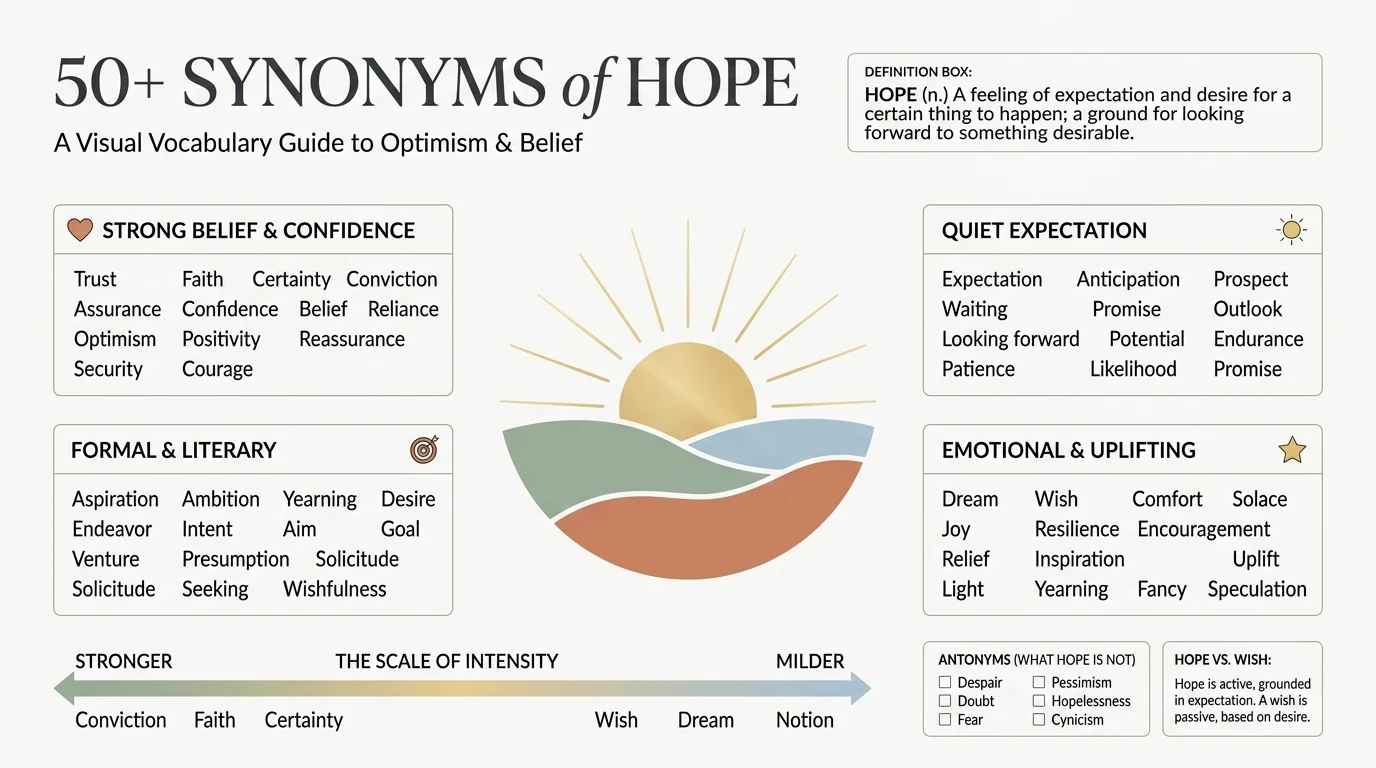
Quick Ans: “Hope” means a feeling of expectation and desire for a certain thing to happen, or a person or thing that may help or save someone. For strong conviction, choose faith or confidence. For quiet expectation, use optimism or expectation. In formal writing, aspiration and anticipation work well. For emotional writing, longing or yearning are powerful.
Meaning, Tone, and Context
Understanding the core meaning of “hope” is the first step to using it effectively.
Simple Definition: A feeling of expectation and desire for a particular thing to happen; a ground for believing that something good may happen.
Part of Speech: Noun and verb.
Overall Tone: Positive. It indicates optimism, desire, and belief in a favorable outcome.
Formality Level: Neutral. The word is appropriate in all contexts, from casual to formal.
Common Uses: Native English speakers use it to describe personal wishes, collective optimism, and religious faith. For example, “I hope you feel better soon,” or “The hope of a better future kept them going.”
Word Forms: Related words include the adjective hopeful, the adverb hopefully, the adjective hopeless, and the noun hopefulness.
When and How to Use “Hope”
“Hope” is the perfect choice when you want to express desire for a positive outcome. Here are seven realistic examples.
Professional: “We hope to finalize the agreement by the end of the quarter.”
Academic: “The study offers hope for new treatments.”
Workplace: “The team is hopeful about meeting the deadline.”
Personal: “I hope you have a wonderful birthday.”
Email: “I hope this message finds you well.”
Resume: (Rarely used) “I hope to contribute to your organization’s success.” (Better: “I aim to contribute…”)
Social Media: “Never lose hope. Better days are coming.”
Best Synonyms of “Hope”
No synonym is identical in every situation. Here is your guide to the best replacement for “hope” based on your writing context.
For Strong Belief
Faith: Suggests complete trust or confidence, often without proof. “She had faith that everything would work out.”
Confidence: Implies belief based on evidence or experience. “He has confidence in the team’s ability.”
Trust: Suggests reliance on someone or something. “I trust that you will do the right thing.”
For Quiet Expectation
Optimism: A general disposition to expect the best. “Her optimism is contagious.”
Expectation: A strong belief that something will happen. “There is an expectation of improvement.”
Anticipation: Excitement about something expected. “The anticipation was building.”
For Formal Contexts
Aspiration: A hope or ambition to achieve something. “Her aspiration is to become a doctor.”
Anticipation: The action of expecting something. “We await your reply with anticipation.”
Prospect: The possibility of a future event. “The prospect of a promotion motivated him.”
For Emotional Contexts
Longing: A yearning desire. “She felt a deep longing for home.”
Yearning: An intense feeling of longing. “His yearning for adventure was strong.”
Wish: A desire or hope for something. “She made a wish upon a star.”
When Not to Use “Hope”
Using “hope” can sound weak or vague in certain situations.
When You Need Certainty: “Hope” implies uncertainty. If you are certain, use a stronger word.
Better Choice: Confidence or certainty. “I am confident this will work.”
When You Mean “Expect”: “Hope” is about desire. “Expect” is about belief based on likelihood.
Better Choice: Expect. “I expect the package to arrive tomorrow.”
When It Sounds Too Casual: In formal writing, “hope” can sound informal.
Better Choice: Aspire or anticipate. “We anticipate a favorable outcome.”
Words Commonly Confused With “Hope”
Word: Faith
Difference: “Faith” implies trust without proof. “Hope” is a desire for something.
When to Use: Use it for religious or deep trust contexts.
Example: “She has faith in God.”
Word: Optimism
Difference: A general attitude. “Hope” is specific to a desired outcome.
When to Use: Use it for a general positive outlook.
Example: “His optimism is inspiring.”
Word: Expectation
Difference: A belief that something will happen. “Hope” is a desire.
When to Use: Use it for likely outcomes.
Example: “The expectation is that prices will rise.”
Word: Wish
Difference: A desire, often unrealistic. “Hope” is more grounded.
When to Use: Use it for fantasies or casual desires.
Example: “I wish I could fly.”
Word: Aspiration
Difference: A strong desire to achieve something. “Hope” can be passive.
When to Use: Use it for goals and ambitions.
Example: “Her aspiration is to lead the company.”
Word: Despair
Difference: The opposite of hope. Means complete loss of hope.
When to Use: Use it for hopeless situations.
Example: “He fell into despair after the loss.”
Best Synonyms of “Hope” by Context
| Context | Best Synonym | Why It Works | Example |
|---|---|---|---|
| Strong belief | Faith | Implies deep trust | “She had faith in the outcome.” |
| Quiet expectation | Optimism | General positive outlook | “His optimism is refreshing.” |
| Formal writing | Aspiration | Goal-oriented | “Her aspiration is to excel.” |
| Emotional writing | Longing | Deep desire | “He felt a longing for peace.” |
| Business | Prospect | Future possibility | “The prospect of growth is good.” |
| Casual | Wish | Simple desire | “I wish you the best.” |
| Religious | Faith | Spiritual trust | “Faith gives me strength.” |
| General | Expectation | Belief something will happen | “There is an expectation of success.” |
How to Choose the Best Synonym of “Hope”
Choosing the right word is a simple decision. Answer these questions.
What type of hope am I expressing? For deep belief, use faith or confidence. And For general optimism, use optimism. For a goal, use aspiration.
What is my audience? For a formal report, use aspiration or anticipation. For a friend, use wish or optimism.
What is my purpose? Are you expressing a wish, a belief, or a goal? The correct synonym depends entirely on this.
What is the emotional strength? Longing and yearning are stronger. Wish is milder. Pick the one that matches your message.
Real Life Examples of “Hope”
School: “The student has hope for a better grade.” Improved: “The student is optimistic about improving her grade.”
College: “The research offers hope for a cure.” Improved: “The research offers promise for a future cure.”
Workplace: “We hope to finish on time.” Improved: “We are confident we will finish on time.”
Business: “The company hopes for growth.” Improved: “The company anticipates significant growth.”
Email: “I hope you are well.” Improved: “I trust you are well.”
Conversation: “I hope it doesn’t rain.” Improved: “I wish it doesn’t rain.”
Storytelling: “Hope kept them alive.” Improved: “Faith kept them alive through the ordeal.”
Top 10 Synonyms of “Hope”
| Synonym | Simple Meaning | Best Used For | Example Sentence |
|---|---|---|---|
| Faith | Complete trust or confidence | Religious and deep belief contexts | “She had faith that all would be well.” |
| Optimism | Hopefulness and confidence | General attitude and outlook | “His optimism is inspiring.” |
| Confidence | Belief in oneself or others | Professional and personal contexts | “She has confidence in her abilities.” |
| Expectation | A strong belief something will happen | Formal and predictive contexts | “There is an expectation of success.” |
| Aspiration | A hope or ambition | Career and goal contexts | “Her aspiration is to become a leader.” |
| Anticipation | Expecting something with excitement | Formal and event contexts | “The anticipation was palpable.” |
| Prospect | The possibility of a future event | Business and opportunity contexts | “The prospect of growth is exciting.” |
| Longing | A deep, emotional desire | Emotional and literary contexts | “She felt a longing for home.” |
| Yearning | An intense longing | Emotional and poetic contexts | “His yearning for adventure was strong.” |
| Wish | A desire for something | Casual and personal contexts | “I wish you all the best.” |
Synonyms of “Hope” by Usage
Professional vs. Personal Synonyms
In the workplace (professional), choose confidence, expectation, or aspiration. With friends (personal), use wish, optimism, or faith.
Formal vs. Conversational Synonyms
For formal writing, use aspiration, anticipation, or prospect. For casual conversations, use wish or optimism.
Academic Synonyms
For research and essays, choose aspiration, expectation, or prospect. These words sound considered and scholarly.
Professional and Business Synonyms
For maximum impact in business writing, choose confidence for belief, expectation for predictions, and aspiration for goals.
Creative and Literary Synonyms
To add emotion and imagery, choose longing, yearning, or faith. These words create atmosphere.
Slang and Colloquial Synonyms
In modern American slang, fingers crossed or hoping for the best are common. For example, “Fingers crossed for good weather.” These are acceptable in casual contexts.
Strongest to Mildest Synonyms
Mild: wish, optimism, expectation
Moderate: hope, confidence, prospect
Strong: faith, aspiration, anticipation
Very Strong: longing, yearning, conviction
Emotional vs. Neutral Synonyms
Emotional Synonyms: Longing, yearning, faith. These words hint at deep feelings.
Neutral Synonyms: Expectation, prospect, optimism. These words communicate factual information.
Antonyms of “Hope”
| Antonym | Meaning | Example Sentence |
|---|---|---|
| Despair | Complete loss of hope | “He fell into despair after the loss.” |
| Hopelessness | The state of having no hope | “The hopelessness was overwhelming.” |
| Despondency | Low spirits from loss of hope | “She struggled with despondency.” |
| Pessimism | Expecting the worst | “His pessimism was draining.” |
| Cynicism | Distrust of human motives | “Her cynicism made her bitter.” |
| Defeatism | Acceptance of defeat | “The defeatism was palpable.” |
| Gloom | Partial darkness; depression | “The gloom was heavy.” |
| Melancholy | A feeling of sadness | “A deep melancholy settled over him.” |
| Doubt | Lack of certainty | “Doubt crept into her mind.” |
| Fear | An unpleasant emotion caused by threat | “Fear gripped the village.” |
| Anxiety | A feeling of worry | “The anxiety was constant.” |
| Dread | Anticipate with great apprehension | “She felt dread about the news.” |
| Discouragement | Loss of confidence | “He felt discouraged after the rejection.” |
| Dejection | Sadness and despondency | “The dejection was evident.” |
| Futility | Pointlessness | “A sense of futility set in.” |
Comparison: “Hope” vs Similar Words
Hope vs. Faith
Main Difference: “Faith” is trust without proof. “Hope” is a desire for something.
Which Is Stronger? “Faith” is stronger and more absolute.
Which Is More Formal? Both are neutral.
When to Use Each: Use “faith” for deep belief. Use “hope” for a wish.
Examples:
Hope: “I hope you succeed.”
Faith: “I have faith in you.”
Hope vs. Optimism
Main Difference: “Optimism” is a general attitude. “Hope” is specific.
Which Is Stronger? “Optimism” is broader.
Which Is More Formal? Both are neutral.
When to Use Each: Use “optimism” for a general outlook. Use “hope” for a specific desire.
Examples:
Hope: “I hope it works.”
Optimism: “She faces life with optimism.”
Hope vs. Expectation
Main Difference: “Expectation” is a belief. “Hope” is a desire.
Which Is Stronger? “Expectation” is more certain.
Which Is More Formal? “Expectation” is more formal.
When to Use Each: Use “expectation” for likely outcomes. Use “hope” for desired outcomes.
Examples:
Hope: “I hope the weather is good.”
Expectation: “The expectation is that prices will rise.”
Hope vs. Aspiration
Main Difference: “Aspiration” is a strong desire to achieve. “Hope” is more passive.
Which Is Stronger? “Aspiration” is stronger and more active.
Which Is More Formal? “Aspiration” is more formal.
When to Use Each: Use “aspiration” for goals. Use “hope” for wishes.
Examples:
Hope: “I hope to visit someday.”
Aspiration: “Her aspiration is to lead the company.”
Hope vs. Wish
Main Difference: “Wish” is a desire, often unrealistic. “Hope” is more grounded.
Which Is Stronger? “Wish” is often stronger emotionally.
Which Is More Formal? “Hope” is more formal.
When to Use Each: Use “wish” for fantasies. Use “hope” for realistic desires.
Examples:
Hope: “I hope you feel better.”
Wish: “I wish I could fly.”
Common Phrases and Expressions with “Hope”
Phrase: Hope for the best
Meaning: Remain optimistic.
Example Sentence: “We can only hope for the best.”
Phrase: Give up hope
Meaning: Stop believing something good will happen.
Example Sentence: “Don’t give up hope.”
Phrase: Ray of hope
Meaning: A small sign of improvement.
Example Sentence: “The news brought a ray of hope.”
Phrase: High hopes
Meaning: Great expectations.
Example Sentence: “She had high hopes for the project.”
Phrase: False hope
Meaning: Unrealistic optimism.
Example Sentence: “The rumors gave false hope.”
Phrase: Hope against hope
Meaning: Hope despite low odds.
Example Sentence: “She hoped against hope that he would return.”
Common Mistakes to Avoid
Mistake 1: Using “hope” when you mean “expect”.
Incorrect: “I hope the package arrives tomorrow.” (when you know it’s shipped)
Better: “I expect the package to arrive tomorrow.”
Why: “Expect” is for likely outcomes.
Mistake 2: Using “hope” in formal writing.
Incorrect: “We hope the results are favorable.”
Better: “We anticipate favorable results.”
Why: “Anticipate” is more formal.
Mistake 3: Overusing “hope” in conversation.
Incorrect: “I hope this, I hope that.”
Better: “I trust things will work out.”
Why: Variation improves writing.
Mistake 4: Using “hope” when you mean “faith”.
Incorrect: “I have hope in God.”
Better: “I have faith in God.”
Why: “Faith” is the correct word for spiritual trust.
Mistake 5: Confusing “hope” with “wish”.
Incorrect: “I hope I were a millionaire.”
Better: “I wish I were a millionaire.”
Why: “Wish” is for hypotheticals.
Frequently Asked Questions
1. What are the best synonyms of “hope”?
The best synonyms depend on your context. For strong belief, choose faith or confidence. And For quiet expectation, use optimism or expectation. For formal writing, use aspiration.
2. What are the best formal synonyms of “hope”?
The best formal synonyms are aspiration, anticipation, and prospect. These words are suitable for academic papers and professional reports.
3. What are common informal synonyms of “hope”?
For informal settings, use wish, optimism, or fingers crossed.
4. What is another word for “hope” in professional writing?
In professional writing, confidence or expectation are excellent choices.
5. What is the difference between “hope” and “faith”?
“Faith” is trust without proof. “Hope” is a desire for something.
6. What is the opposite of “hope”?
The most direct opposites are despair, hopelessness, and pessimism.
Conclusion
“Hope” is a universal and powerful word for expressing desire, belief, and optimism. The best choice among the synonyms of hope depends entirely on your audience, tone, and purpose. Remember, no single synonym works perfectly in every situation. Your goal is to choose the word that communicates your message with the most clarity and impact. A practical tip for your vocabulary growth is to pay attention to how hope is expressed in different contexts and practice using different synonyms in your writing.










1 thought on “50+ Synonyms of Hope: Meanings, Uses, Examples, and Best Alternatives 2026”