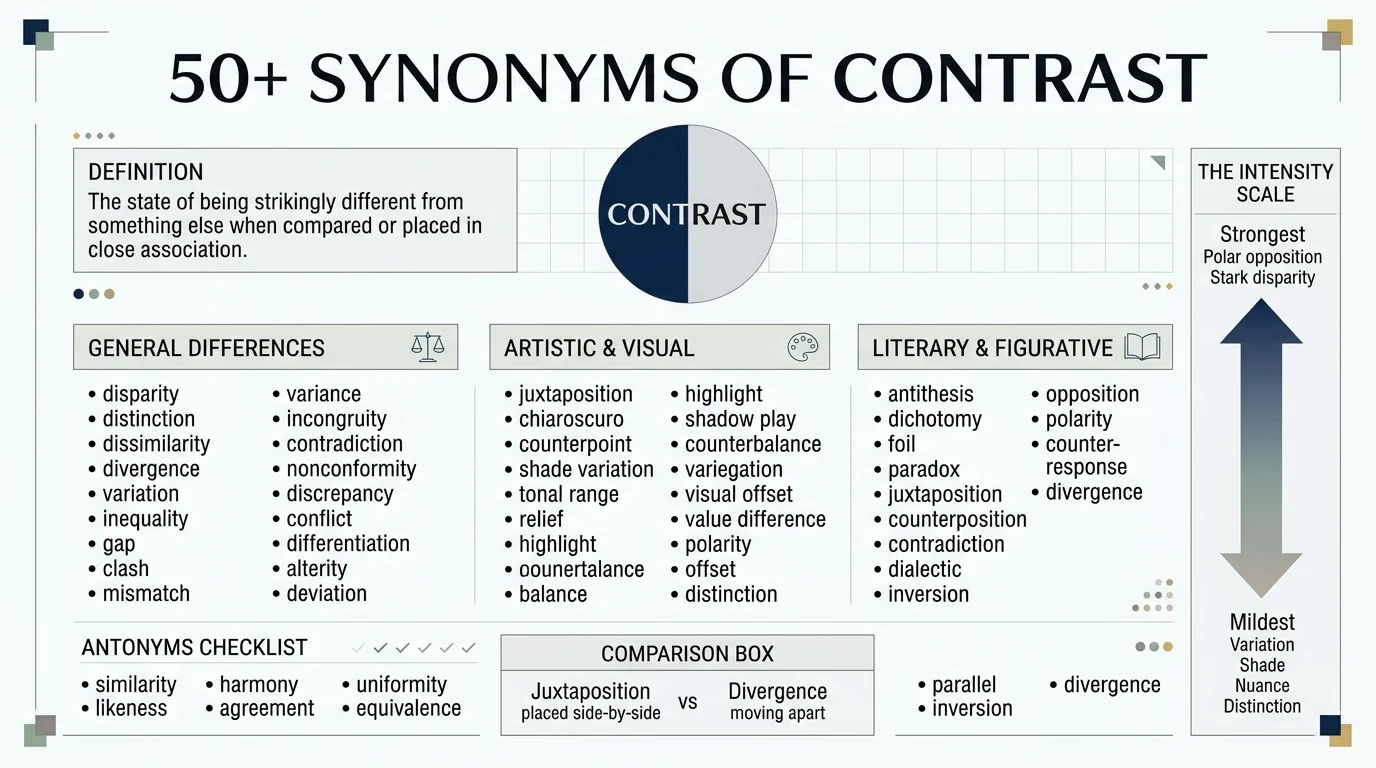
Have you ever needed to point out how two things differ, or highlight the striking difference between light and dark, good and evil, or success and failure? You want to emphasize the distinction, and the word “contrast” comes to mind. Choosing the right synonym for “contrast” can transform a simple observation into a powerful comparison that sharpens your meaning. This guide explores the best synonyms of contrast, explaining exactly which word to use and when.
Quick Ans: “Contrast” means the state of being strikingly different from something else, or the act of comparing to show differences. For formal writing, choose disparity or divergence. For casual conversation, use difference or gap. For artistic contexts, use juxtaposition or opposition. For sharp distinctions, use distinction or polarity. For literary analysis, use antithesis.
Meaning, Tone, and Context
Understanding the core meaning of “contrast” is the first step to using it effectively.
Simple Definition: The state of being strikingly different from something else, typically in a way that highlights the differences. Also, the act of comparing two things to show their differences.
Part of Speech: Noun and verb.
Overall Tone: Neutral. It is a descriptive and analytical term used across multiple fields.
Formality Level: Neutral to formal. The word is appropriate in most contexts.
Common Uses: Native English speakers use it to describe visual differences (light and dark), comparative differences (before and after), and literary devices (character foils). For example, “There is a sharp contrast between the two proposals,” or “The artist used contrast to create drama.”
Word Forms: Related words include the verb contrast, the adjective contrasting, and the adverb contrastingly.
When and How to Use “Contrast”
“Contrast” is the perfect choice when you want to highlight differences or compare two things. Here are seven realistic examples.
Visual: “The contrast between the black and white tiles was striking.”
Comparative: “There is a stark contrast between his public and private persona.”
Literary: “The author uses contrast to develop the theme of good versus evil.”
Professional: “The report highlights the contrast between projected and actual results.”
Academic: “The study examines the contrast between urban and rural lifestyles.”
Personal: “I love the contrast of sweet and salty flavors in this dish.”
Social Media: “The contrast between these before and after photos is incredible.”
Best Synonyms of “Contrast”
No synonym is identical in every situation. Here is your guide to the best replacement for “contrast” based on your writing context.
For General Differences
Most Common: Difference is the most straightforward synonym. “The difference between the two is obvious.”
Strong Difference: Disparity suggests a significant or unfair difference. “The disparity in income is growing.”
Diverging Paths: Divergence suggests moving apart or differing from a standard. “The divergence of their opinions was clear.”
Gap: Gap suggests a space or separation. “The gap between rich and poor is widening.”
For Visual and Artistic Contexts
Side by Side: Juxtaposition means placing two things together for contrast. “The juxtaposition of the modern building with the old church was striking.”
Direct Opposition: Opposition suggests direct contrast or conflict. “The opposition of colors created a bold effect.”
For Sharp Distinctions
Clear Distinction: Distinction means a clear difference. “There is a clear distinction between the two theories.”
Extreme Difference: Polarity suggests opposite extremes. “The polarity of their views made compromise difficult.”
For Literary and Philosophical Contexts
Literary Contrast: Antithesis is the direct opposite or a rhetorical device using contrast. “The antithesis of love is not hate but indifference.”
Striking Difference: Foils are characters who contrast with each other. “The two characters serve as foils to one another.”
When Not to Use “Contrast”
Using “contrast” can sound wrong or awkward in certain situations.
When You Mean “Comparison”: “Contrast” highlights differences. “Comparison” highlights similarities or both.
Better Choice: Comparison. “The comparison of the two products revealed many similarities.”
When You Mean “Conflict”: “Contrast” is about differences. “Conflict” is about struggle.
Better Choice: Conflict. “The conflict between the two departments was ongoing.”
When It Sounds Too Formal: In casual conversation, “contrast” can sound stiff.
Better Choice: Difference or gap. “The difference is huge.”
Words Commonly Confused With “Contrast”
Several words are often mixed up with “contrast.” Here is how to keep them straight.
Word: Comparison
Difference: Shows similarities and differences. “Contrast” shows only differences.
When to Use: Use it when examining both similarities and differences.
Example: “The comparison of the two novels revealed many shared themes.”
Word: Difference
Difference: A general word for how things are not the same. “Contrast” implies a striking or deliberate difference.
When to Use: Use it for any distinction.
Example: “The difference between the two is minor.”
Word: Disparity
Difference: Suggests an unfair or significant gap. “Contrast” is neutral.
When to Use: Use it for inequality.
Example: “The disparity in pay was unacceptable.”
Word: Juxtaposition
Difference: Specifically means placing two things side by side for contrast. “Contrast” is the result.
When to Use: Use it in artistic or literary contexts.
Example: “The juxtaposition of the two images was powerful.”
Word: Antithesis
Difference: The direct opposite of something. “Contrast” is a broader comparison.
When to Use: Use it for extremes.
Example: “The antithesis of success is failure.”
Word: Distinction
Difference: A clear difference or honor. “Contrast” emphasizes the striking nature of the difference.
When to Use: Use it for clear boundaries.
Example: “There is a clear distinction between the two concepts.”
Best Synonyms of “Contrast” by Context
| Context | Best Synonym | Why It Works | Example |
|---|---|---|---|
| General difference | Difference | Simple and direct | “The difference is obvious.” |
| Significant gap | Disparity | Implies inequality | “The disparity in wealth is growing.” |
| Diverging paths | Divergence | Suggests moving apart | “The divergence of opinions was clear.” |
| Visual arts | Juxtaposition | Artistic and deliberate | “The juxtaposition of colors was striking.” |
| Sharp distinction | Distinction | Clear and precise | “There is a clear distinction between the two.” |
| Extreme difference | Polarity | Suggests opposites | “The polarity of their views caused conflict.” |
| Literary analysis | Antithesis | Rhetorical and philosophical | “The antithesis of love is indifference.” |
| Character analysis | Foils | Literary and dramatic | “The two characters are foils.” |
How to Choose the Best Synonym of “Contrast”
Choosing the right word is a simple decision. Answer these questions.
What type of contrast am I describing? For visual, use juxtaposition. And For general difference, use difference. For inequality, use disparity. For literary, use antithesis.
What is my audience? For a professor, use antithesis or divergence. For a friend, use difference or gap.
What is my purpose? Are you analyzing, describing, or arguing? The correct synonym depends entirely on this.
What is the emotional strength? Disparity and polarity are stronger. Difference is neutral. Pick the one that matches your message.
Real Life Examples of “Contrast”
To truly master the word, it helps to see how it behaves in the wild and how a stronger synonym can elevate the sentence.
School: Basic: “The contrast between the two stories is clear.” Improved: “The difference between the two stories is clear.”
College: Basic: “The paper examines the contrast between the theories.” Improved: “The paper examines the divergence between the two theories.”
Workplace: Basic: “There is a contrast between the two departments.” Improved: “There is a disparity between the two departments’ budgets.”
Business: Basic: “The contrast in performance is notable.” Improved: “The gap in performance is notable.”
Email: Basic: “The contrast between the options is significant.” Improved: “The distinction between the options is significant.”
Conversation: Basic: “I love the contrast of hot and cold.” Improved: “I love the difference between hot and cold.”
Storytelling: Basic: “The contrast between the characters was powerful.” Improved: “The juxtaposition of the two characters was powerful.”
Top 10 Synonyms of “Contrast”
| Synonym | Simple Meaning | Best Used For | Example Sentence |
|---|---|---|---|
| Difference | The state of being unlike | General and everyday contexts | “The difference between the two is clear.” |
| Disparity | A significant or unfair difference | Social, economic, and formal contexts | “The disparity in income is growing.” |
| Divergence | The process of moving apart | Academic, analytical, and formal contexts | “The divergence of their views was unexpected.” |
| Juxtaposition | Placing two things together for contrast | Artistic, literary, and visual contexts | “The juxtaposition of old and new was striking.” |
| Distinction | A clear difference | Formal and precise contexts | “There is a clear distinction between the two.” |
| Polarity | Extreme opposition | Philosophical and analytical contexts | “The polarity of their opinions was extreme.” |
| Antithesis | The direct opposite | Literary, rhetorical, and philosophical contexts | “The antithesis of love is indifference.” |
| Opposition | Direct contrast or conflict | General and formal contexts | “The opposition of the two forces was clear.” |
| Gap | A space or separation | Social, economic, and general contexts | “The gap between rich and poor is widening.” |
| Foils | Characters who contrast with each other | Literary and dramatic contexts | “The two characters are foils to each other.” |
Synonyms of “Contrast” by Usage
Professional vs. Personal Synonyms
In the workplace (professional), choose disparity, divergence, or distinction to describe differences. These words convey professionalism and precision. “The disparity in performance is concerning” is more precise than “The contrast in performance is concerning.”
With friends (personal), difference, gap, or contrast keep the tone relaxed and relatable.
Formal vs. Conversational Synonyms
For formal writing (reports, essays, professional emails), use disparity, divergence, or antithesis. These choices maintain the sophisticated tone expected in professional documents.
For casual conversations and texting, use difference, gap, or contrast. These options sound more natural.
Academic Synonyms
For research and essays, choose precise, authoritative words. Disparity is great for sociology, divergence for science, and antithesis for literature.
Professional and Business Synonyms
For maximum impact in business writing, choose disparity for inequality, gap for market differences, and distinction for clear differentiators.
Creative and Literary Synonyms
To add emotion and imagery to your writing, choose juxtaposition, antithesis, or foils. These words create depth and meaning.
Strongest to Mildest Synonyms
Mild: difference, gap, distinction
Moderate: contrast, disparity, divergence
Strong: juxtaposition, opposition, polarity
Very Strong: antithesis, foils
Emotional vs. Neutral Synonyms
Emotional Synonyms: Disparity, polarity. These words often hint at injustice or extreme division. Use them when you want to evoke feeling.
Neutral Synonyms: Difference, distinction. These words simply communicate factual information. Use them when you want to inform without emotional coloring.
Antonyms of “Contrast”
| Antonym | Meaning | Example Sentence |
|---|---|---|
| Similarity | The state of being alike | “The similarity between the two is striking.” |
| Resemblance | The state of being similar | “There is a strong resemblance between them.” |
| Sameness | The state of being identical | “The sameness of the two designs was obvious.” |
| Uniformity | The state of being uniform | “The uniformity of the buildings was striking.” |
| Consistency | The state of being consistent | “The consistency of the results was reassuring.” |
| Agreement | The state of being in accord | “The agreement between the two parties was reached.” |
Comparison: “Contrast” vs Similar Words
Contrast vs. Comparison
Main Difference: “Contrast” highlights differences. “Comparison” highlights similarities and differences.
Which Is Stronger? “Contrast” is more focused on differences.
Which Is More Formal? Both are formal.
When to Use Each: Use “contrast” for differences. Use “comparison” for both.
Examples:
Contrast: “The contrast between the two is striking.”
Comparison: “The comparison of the two products was thorough.”
Contrast vs. Difference
Main Difference: “Difference” is general. “Contrast” implies a striking or deliberate difference.
Which Is Stronger? “Contrast” is stronger and more dramatic.
Which Is More Formal? Both are neutral.
When to Use Each: Use “difference” for any distinction. Use “contrast” for striking distinctions.
Examples:
Contrast: “The contrast between the two styles is dramatic.”
Difference: “The difference is minor.”
Contrast vs. Disparity
Main Difference: “Disparity” implies inequality or unfairness. “Contrast” is neutral.
Which Is Stronger? “Disparity” is stronger and often negative.
Which Is More Formal? Both are formal.
When to Use Each: Use “disparity” for inequality. Use “contrast” for general differences.
Examples:
Contrast: “The contrast between the two is clear.”
Disparity: “The disparity in income is unacceptable.”
Contrast vs. Juxtaposition
Main Difference: “Juxtaposition” is the act of placing together for contrast. “Contrast” is the resulting difference.
Which Is Stronger? “Juxtaposition” is more specific to the act.
Which Is More Formal? “Juxtaposition” is more formal and artistic.
When to Use Each: Use “juxtaposition” in artistic contexts. Use “contrast” in general contexts.
Examples:
Contrast: “The contrast between the colors is strong.”
Juxtaposition: “The juxtaposition of the two images was powerful.”
Contrast vs. Antithesis
Main Difference: “Antithesis” is the direct opposite. “Contrast” is a broader comparison.
Which Is Stronger? “Antithesis” is stronger and more absolute.
Which Is More Formal? “Antithesis” is more formal and literary.
When to Use Each: Use “antithesis” for extremes. Use “contrast” for general differences.
Examples:
Contrast: “There is a contrast between the two ideas.”
Antithesis: “The antithesis of love is indifference.”
Contrast vs. Polarity
Main Difference: “Polarity” suggests extreme opposition. “Contrast” is broader.
Which Is Stronger? “Polarity” is stronger and more extreme.
Which Is More Formal? Both are formal.
When to Use Each: Use “polarity” for extreme opposites. Use “contrast” for general differences.
Examples:
Contrast: “The contrast between the two views is clear.”
Polarity: “The polarity of their opinions was extreme.”
Common Phrases and Expressions with “Contrast”
Phrase: In contrast
Meaning: Used to show a difference.
Example Sentence: “In contrast to his brother, he is very outgoing.”
Phrase: Sharp contrast
Meaning: A very clear difference.
Example Sentence: “There is a sharp contrast between the two designs.”
Phrase: Stark contrast
Meaning: A very obvious and harsh difference.
Example Sentence: “The stark contrast between rich and poor is evident.”
Phrase: By contrast
Meaning: Used to introduce a different point.
Example Sentence: “By contrast, the second option is much cheaper.”
Phrase: Contrast with
Meaning: To differ from something.
Example Sentence: “His actions contrast with his words.”
Phrase: Contrast ratio
Meaning: The difference in brightness in a display.
Example Sentence: “The monitor has a high contrast ratio.”
Common Mistakes to Avoid
Mistake 1: Using “contrast” when you mean “comparison”.
Incorrect: “The contrast of the two products showed many similarities.”
Better: “The comparison of the two products showed many similarities.”
Why: “Contrast” shows differences. “Comparison” shows both.
Mistake 2: Using “contrast” when you mean “conflict”.
Incorrect: “The contrast between the two departments was ongoing.”
Better: “The conflict between the two departments was ongoing.”
Why: “Conflict” is about struggle. “Contrast” is about differences.
Mistake 3: Using “contrast” in casual conversation.
Incorrect: “The contrast between the two is big.”
Better: “The difference between the two is big.”
Why: “Difference” sounds more natural in casual conversation.
Mistake 4: Using “contrast” when you mean “disparity”.
Incorrect: “The contrast in pay is unfair.”
Better: “The disparity in pay is unfair.”
Why: “Disparity” implies inequality.
Mistake 5: Using “contrast” when you mean “juxtaposition”.
Incorrect: “The contrast of the two images was artistic.”
Better: “The juxtaposition of the two images was artistic.”
Why: “Juxtaposition” is the act of placing together.
Frequently Asked Questions
1. What are the best synonyms of “contrast”?
The best synonyms depend on your context. For general differences, choose difference or disparity. And For artistic contexts, use juxtaposition. For literary analysis, use antithesis.
2. What are the best formal synonyms of “contrast”?
The best formal synonyms are disparity, divergence, and distinction. These words are suitable for academic papers, professional reports, and formal writing.
3. What are common informal synonyms of “contrast”?
For informal settings, use difference, gap, or contrast. These alternatives sound more natural in everyday conversation.
4. What is another word for “contrast” in professional writing?
In professional writing, disparity is an excellent choice for inequality. Divergence is also strong for analytical contexts.
5. What is the difference between “contrast” and “comparison”?
“Contrast” highlights differences. “Comparison” highlights both similarities and differences. Use “contrast” for differences and “comparison” for both.
6. What is the opposite of “contrast”?
The most direct opposites of “contrast” are similarity, resemblance, and sameness. These words describe things that are alike.
Conclusion
“Contrast” is a versatile and essential word for highlighting differences and sharpening meaning. The best choice among the synonyms of contrast depends entirely on your audience, tone, and purpose.Remember, no single synonym works perfectly in every situation. Your goal is to choose the word that communicates your message with the most clarity and impact. A practical tip for your vocabulary growth is to pay attention to how writers and speakers highlight differences and practice using different synonyms in your writing.










1 thought on “50+ Synonyms of Contrast: Meanings, Uses, Examples, and Best Alternatives 2026”