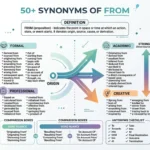
Have you ever considered that the smallest words often carry the most complex meanings and functions? You want to express relationships between things, and the word “of” comes to mind. But is it the best fit for your context? Understanding the synonyms of “of” and when to use them can transform your writing from repetitive and vague to precise and professional. This guide explores the best synonyms of “of,” explaining exactly which alternative to use and when.
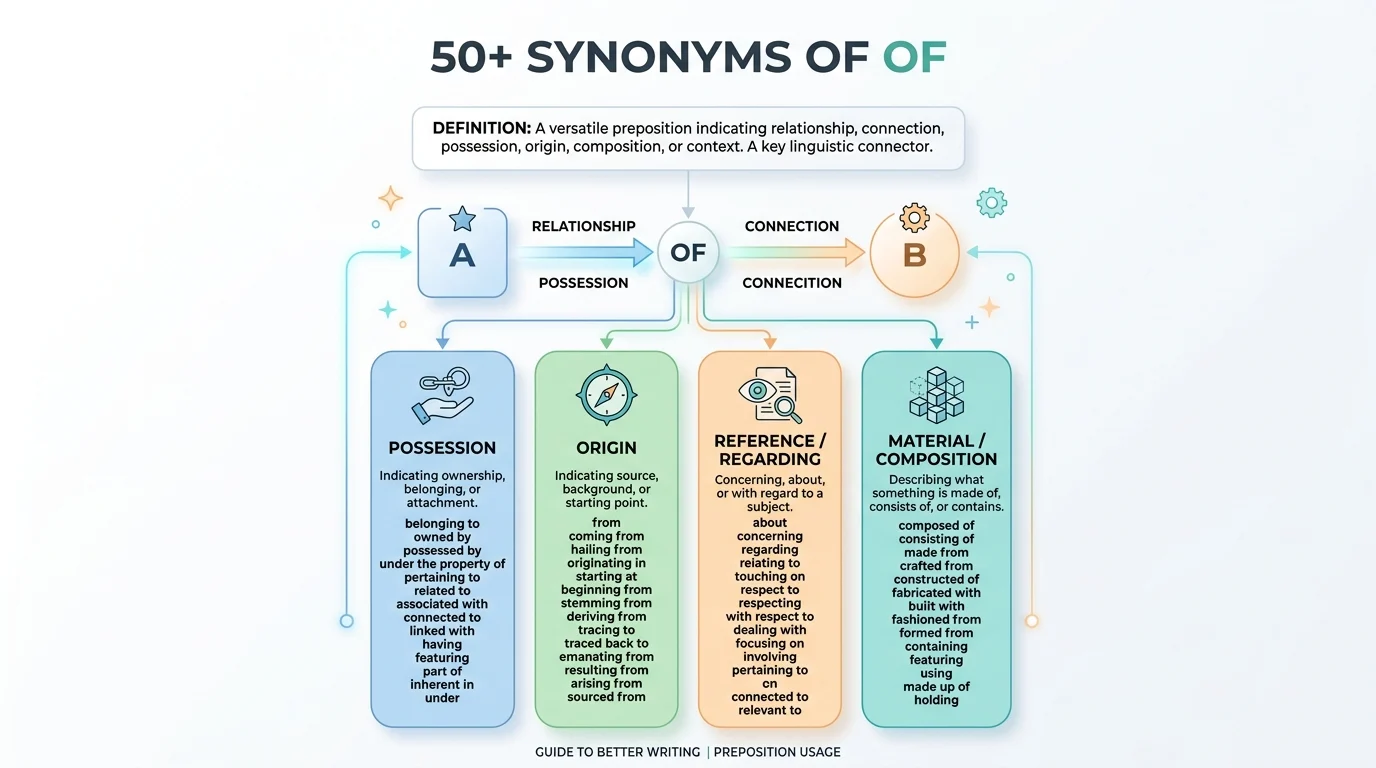
Quick Ans: “Of” is a preposition indicating relationships such as possession, origin, belonging, material, cause, or association . It is a neutral, versatile function word. For indicating possession, use belonging to or ‘s. For showing origin or source, choose from or coming from . For describing subject matter or reference, use about, concerning, or regarding . For indicating material or composition, use made from, consisting of, or composed of . For expressing cause, choose because of or owing to . For formal writing, pertaining to or in relation to . In casual conversation, on or like are simpler alternatives .
Meaning, Tone, and Context
Understanding the core meaning and function of “of” is the first step to using it effectively or replacing it with a more precise synonym.
Simple Definition: A preposition used to show relationships between things, including possession, origin, belonging, material, cause, and reference .
Part of Speech: Preposition .
Overall Tone: Neutral. It is a function word with no inherent emotional coloring.
Formality Level: Neutral. It works in all contexts but can be replaced with more formal or conversational synonyms.
Common Uses: Native English speakers use it constantly. Some common roles include :
- Possession/Belonging: The house of my sister (or more commonly, my sister’s house).
- Origin/Source: The plays of Shakespeare.
- Material/Content: A dress of silk.
- Cause/Motive: To die of hunger.
- Reference/Subject: Talk of peace.
- Association: The king of France.
- Quantity: A pint of milk.
- Apposition: The city of Chicago.
The Top 10 Synonyms of “Of”
No synonym is identical in every situation. Here is your guide to the best alternatives for “of” based on its function.
For Possession:
- Belonging to – “The car belonging to my neighbor.”
- Associated with – “The risks associated with the procedure.”
For Origin/Source:
- From – “A letter from my mother.”
- Coming from – “The tradition coming from ancient times.”
Subject Matter/Reference:
- About – “A book about history.”
- Concerning – “The rules concerning safety.”
- Regarding – “An update regarding the project.”
Material/Composition:
- Made from – “A statue made from marble.”
- Consisting of – “A committee consisting of five members.”
- Composed of – “Water composed of hydrogen and oxygen.”
For Cause/Motive:
- Because of – “The delay because of traffic.”
- Owing to – “The success owing to her efforts.”
For General Formal Relationship:
- Pertaining to – “Documents pertaining to the case.”
- Related to – “Issues related to climate change.”
- In regard to – “In regard to your inquiry.”
- With respect to – “With respect to the deadline.”
When and How to Use the Synonyms of “Of”
Choosing the right synonym for “of” depends entirely on the specific relationship you want to express. Here are seven realistic examples showing how different synonyms function.
Possession: “The car of my friend is red.” -> “The car belonging to my friend is red.” (More formal)
Origin: “She is a student of Harvard.” -> “She is a student from Harvard.” (Common and precise)
Subject Matter: “I read a report of the incident.” -> “I read a report concerning the incident.” (Formal and clear)
Material: “The table of solid oak is heavy.” -> “The table made from solid oak is heavy.” (Descriptive)
Quantity: “A glass of milk.” -> No change needed; this is a standard use.
Association: “The house of the doctor is on the corner.” -> “The house belonging to the doctor is on the corner.” (More specific)
Cause: “He fainted of exhaustion.” -> “He fainted because of exhaustion.” (Clearer and more common)
When to Use a Synonym Instead of “Of”
While “of” is a functional and common word, sometimes a synonym can add clarity or stylistic flair.
When “Of” Sounds Too Vague: In formal or legal documents, “of” can be ambiguous. “The contract of the client” vs. “The contract pertaining to the client” is clearer.
Better Choice: Pertaining to, relating to, or in regard to.
When You Want to Be More Formal: “Talking of the policy” vs. “A discussion regarding the policy” sounds more professional.
Better Choice: Regarding, concerning, or with respect to.
When You Want to Be More Casual: “The play of Shakespeare” vs. “A Shakespeare play” is more conversational.
Better Choice: ‘s (possessive apostrophe) or restructuring the sentence.
When Describing the “Makeup” of Something: “A committee of six members” vs. “A committee consisting of six members” emphasizes composition.
Better Choice: Consisting of, composed of, or made from.
Words Commonly Confused With “Of”
Several words are often mixed up with “of.” Here is how to keep them straight.
Word: Have
Difference: “Have” is a verb expressing possession or used in perfect tenses (e.g., I have seen). “Of” is a preposition. They are often confused in phrases like “could have” (correct) vs. “could of” (incorrect) .
When to Use: Use “have” as a verb.
Example: “He should have arrived by now.” (Correct)
Word: From
Difference: “From” specifically indicates origin, source, or separation. “Of” is broader and can indicate possession or association .
When to Use: Use “from” when you want to highlight source or origin.
Example: “She comes from New York.” vs. “She is a friend of mine.”
Word: Off
Difference: “Off” is a preposition or adverb indicating separation, departure, or removal. “Of” is a function word showing relationships .
When to Use: Use “off” for physical separation.
Example: “The book fell off the shelf.”
Word: About
Difference: “About” is commonly used as a synonym for “of” when indicating the subject or topic .
When to Use: Use “about” when you mean “concerning” the subject.
Example: “A story about a hero.” (vs. “A story of a hero.”)
Top 10 Most Effective Synonyms for “Of”
| Synonym | Simple Meaning/Function | Best Used For | Example Sentence |
|---|---|---|---|
| About | Concerning the subject of | General reference and topic contexts . | “We talked about the plan.” |
| Regarding | On the subject of | Formal communication and emails . | “Regarding your inquiry…” |
| Concerning | About a particular subject | Formal writing, reports . | “The documents concerning the case are here.” |
| From | Indicating origin or source | Showing where something comes from . | “A gift from my grandmother.” |
| Belonging to | Indicating possession or ownership | Clarifying ownership . | “The car belonging to the CEO.” |
| Consisting of | Made up of | Describing composition . | “The team consisting of experts.” |
| Made from | Formed or constructed from | Describing materials . | “The wine made from grapes.” |
| Because of | As a result of | Indicating cause or reason . | “The delay because of the weather.” |
| Pertaining to | Relating to a specific subject | Very formal legal, academic contexts . | “The laws pertaining to taxation.” |
| ‘s (Apostrophe s) | Possessive form | Casual and formal writing to show possession . | “My mother’s house.” |
Synonyms of “Of” by Usage
Possession and Belonging
The most common function of “of” is to show possession, which can be rephrased for clarity.
- ‘s (Apostrophe s): This is the most natural and common way to show possession in modern English, especially for people and animals .
- Example: “The roof of the house.” -> “The house’s roof.”
- Belonging to: This is a more formal and explicit way to state ownership .
- Example: “The car of my father.” -> “The car belonging to my father.”
- Associated with: This indicates a connection rather than direct ownership .
- Example: “The risks associated with the job.”
Origin and Source
When “of” shows where something comes from, “from” is often a perfect substitute.
- From: Clearly indicates a point of origin .
- Example: “The plays of Shakespeare.” -> “The plays from Shakespeare.”
- Coming from: A more descriptive way to indicate origin .
- Example: “A tradition coming from the ancient world.”
Subject Matter and Reference
When “of” introduces the subject of a discussion or document, more specific synonyms are available.
- About: The most common and general synonym .
- Example: “A book of poetry.” -> “A book about poetry.”
- Concerning: More formal and indicates that the material is important to the subject .
- Example: “Rules of conduct.” -> “Rules concerning conduct.”
- Regarding: Similar to “concerning” but often used in introductions to topics .
- Example: “An email of the situation.” -> “An email regarding the situation.”
- Pertaining to: Very formal and specific, often used in legal or academic writing .
- Example: “Documents pertaining to the case.”
Material and Composition
If “of” describes what something is made from, use these alternatives.
- Made from: Describes the transformation from a raw material to a finished product .
- Example: “A statue of marble.” -> “A statue made from marble.”
- Made of: Similar to “made from,” but often used when the material is still visible or a key component.
- Example: “A ring of gold.” -> “A ring made of gold.”
- Consisting of: Describes the components or members that make up a whole .
- Example: “A committee of ten.” -> “A committee consisting of ten members.”
Cause and Reason
Using synonyms for “of” when it indicates a reason can make your writing clearer.
- Because of: Explains the reason for something directly .
- Example: “He died of old age.” -> “He died because of old age.”
- Owing to: A formal alternative to “because of” .
- Example: “The delay was of weather.” -> “The delay was owing to weather.”
Strongest vs. Mildest Synonyms
As a functional preposition, “of” doesn’t have an inherent “strength” like a descriptive adjective. However, the clarity and formality of its synonyms vary.
Most General (Mildest): of, on, like
Moderately Formal: about, from, made of
Formal: regarding, concerning, belonging to
Very Formal (Strongest): pertaining to, in regard to, consisting of
Common Mistakes to Avoid
Mistake 1: Confusing “of” with “have”.
Incorrect: “I could of done it.”
Better: “I could have done it.”
Why: “Could’ve” is a contraction of “could have,” not “could of.” “Of” is a preposition, not a verb .
Mistake 2: Using “of” before a personal pronoun.
Incorrect: “The sister of me is here.”
Better: “My sister is here.”
Why: Use possessive determiners (my, your, his) instead of “of + me” .
Mistake 3: Using “of” with short noun phrases when ‘s is better.
Incorrect: “The car of my friend is new.”
Better: “My friend’s car is new.”
Why: The possessive apostrophe (‘s) is the standard, more natural way to show possession in modern English .
Mistake 4: Using “of” when “from” is needed for origin.
Incorrect: “He is a student of Harvard.”
Better: “He is a student from Harvard.”
Why: “From” more accurately conveys origin.
Mistake 5: Overusing “of” in a sentence.
Incorrect: “The color of the door of the house of the neighbor was red.”
Better: “The neighbor’s house door was red.”
Why: Overusing “of” can make sentences clunky and confusing. Using possessive forms or restructuring the sentence often improves readability.
Frequently Asked Questions
1. What are the best synonyms for “of”?
The best synonyms for “of” depend on its function. For possession, use belonging to or ‘s. And for origin, use from. For subject matter, use about, concerning, or regarding .
2. What is the difference between “of” and “have”?
“Of” is a preposition used to show relationships, such as possession or origin. “Have” is a verb used to show possession, experience, or to form perfect tenses (e.g., “I have seen”). Confusing them is a common grammar error .
3. Can “from” be used as a synonym for “of”?
Yes, “from” is a common synonym for “of” when “of” indicates origin or source. For example, “a man of good family” vs. “a man from a good family” .
4. Is it correct to say “a friend of me”?
No, it is grammatically incorrect to say “a friend of me.” You should say “a friend of mine” or “my friend” .
5. What is a more formal way to say “of” in a business email?
In a formal business email, you can use regarding, concerning, with respect to, or pertaining to to indicate the subject . For example, “Regarding your inquiry…” .
6. What is the opposite of “of”?
As a function word, “of” doesn’t have a direct opposite, but antonyms can be listed based on its function: not related to, separate from . When “of” indicates belonging, the opposite could be separated from .
Conclusion
“Of” is an essential, versatile, and functional preposition in the English language. The term is neutral and used constantly, yet it can be replaced with more precise or formal alternatives depending on the relationship it expresses. The best choice among the synonyms of “of” depends entirely on your audience, tone, and purpose. Remember, no single synonym works perfectly in every situation. Your goal is to choose the word that communicates your message with the most clarity and impact. A practical tip for your vocabulary growth is to pay attention to how “of” is used in the texts you read and consider if a synonym would have been more precise or natural.
Discover More:
- 50+ Synonyms of Developed: Meanings, Uses, Examples, and Best Alternatives 2026
- 50+ Synonyms of Radiation: Meanings, Uses, Examples, and Best Alternatives 2026

Amelia Brooks is a professional content writer and digital publishing specialist with a passion for creating clear, engaging, and informative content. She has extensive experience writing about technology, business, lifestyle, and online services.