Have you ever struggled to find a more precise word than “things” when writing an essay, an email, or a professional document? You want to describe objects, concepts, or possessions, and the word “things” comes to mind. But is it the best fit for your audience? Choosing the right synonym for “things” can transform vague, informal language into clear, specific communication. This guide explores the best synonyms of things, explaining exactly which word to use and when.
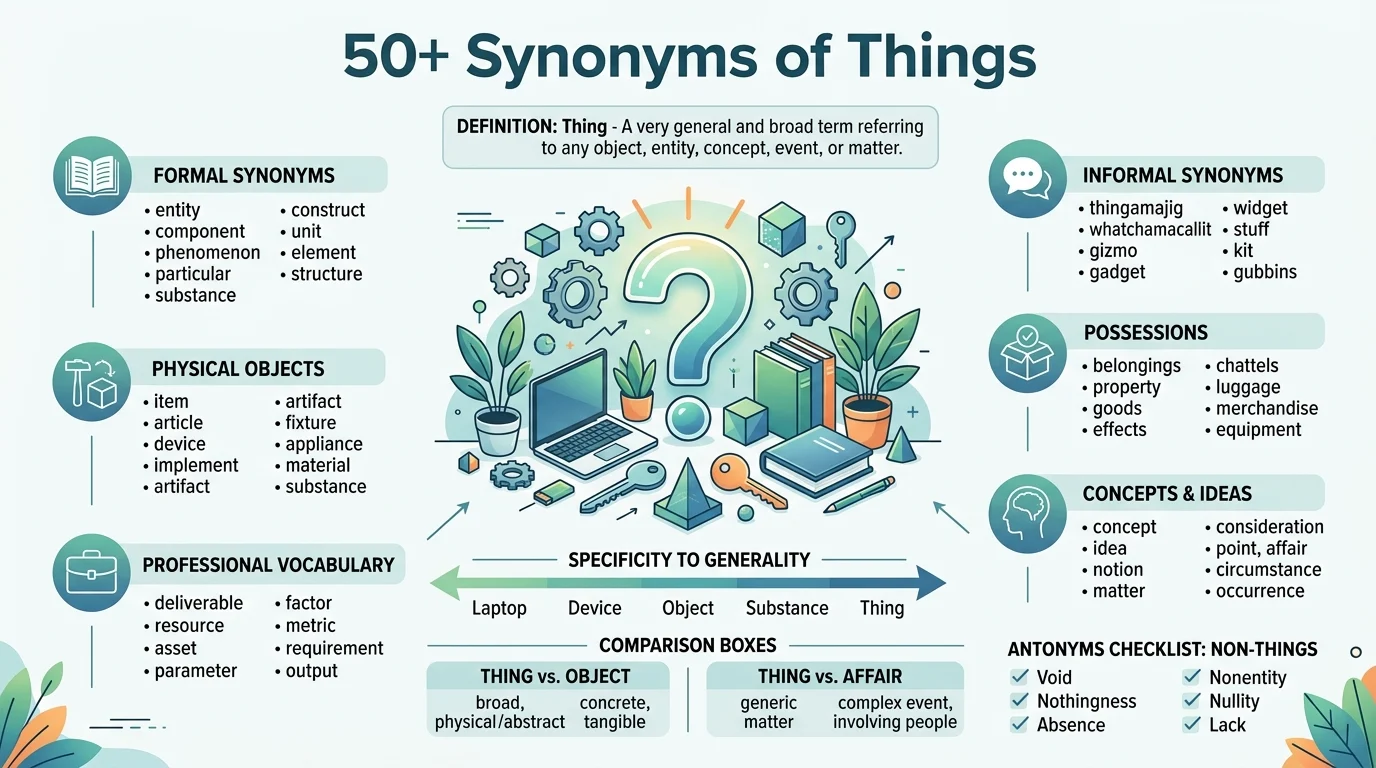
Quick Ans: “Things” is an extremely general noun that can refer to objects, possessions, ideas, matters, or events. It is informal and vague. For physical objects, choose items or objects. For possessions, use belongings or possessions. For abstract concepts, select concepts or ideas. In formal writing, articles, materials, or elements are strong choices. For a softer, more neutral tone, use stuff in casual contexts.
Meaning, Tone, and Context
Understanding the core meaning of “things” is the first step to using it effectively.
Simple Definition: An unspecified object, concept, or matter. Plural can refer to possessions, affairs, or general circumstances.
Part of Speech: Noun.
Overall Tone: Neutral to informal. It can sound vague and imprecise in formal contexts.
Formality Level: Informal. The word is best suited for casual conversation and should be avoided in academic or professional writing.
Common Uses: Native English speakers use it constantly to avoid being specific. For example, “I have things to do,” or “She packed her things.” It can refer to almost anything.
Word Forms: The singular thing and plural things. Related words include the adjective thingy (informal).
When and How to Use “Things”
“Things” is the most common and versatile word in its category. Here are seven realistic examples.
Professional: “We have several things to discuss in the meeting.” (Better: “We have several items to discuss”)
Academic: “The study examines many things about human behavior.” (Better: “The study examines many factors about human behavior”)
Workplace: “I need to organize my things before the move.” (Better: “I need to organize my belongings“)
Personal: “Can you help me move these things?” (Better: “Can you help me move these boxes?”)
Email: “I have a few things to mention in the report.” (Better: “I have a few points to mention”)
Resume: “Managed many things in the department.” (Better: “Managed multiple projects in the department”)
Social Media: “Things I love about this city…” (Casual and acceptable in this context)
Best Synonyms of “Things”
No synonym is identical in every situation. Here is your guide to the best replacement for “things” based on your writing context.
Professional Writing: Items. It suggests distinct, countable objects or entries. “The agenda includes several items for discussion”.
Academic Writing: Elements or factors. These are precise for components of a system. “The study identified three key factors”.
Business Communication: Articles. A formal word for individual objects or goods. “The shipment contained several articles”.
Casual Conversation: Stuff. It tones down the formality and sounds natural. “I need to pack my stuff”.
Writing About Concepts: Ideas or notions. Use these for abstract things. “The book explores complex ideas”.
Writing About Possessions: Belongings or possessions. These are more formal than “things.” “She packed her belongings”.
Writing About Affairs: Matters. A formal alternative for situations. “We need to discuss these matters”.
When Not to Use “Things”
Using “things” can sound vague or unprofessional in certain situations.
In Formal Writing: “Things” is too vague for academic or professional documents.
Better Choice: Elements, factors, or items. “The report covers several key factors.”
When You Need Specificity: “Things” is unclear if you need precise language.
Better Choice: Objects, tasks, or substances. “The box contains various objects.”
In Resumes: “Managed things” sounds weak and unprofessional.
Better Choice: Projects, initiatives, or responsibilities. “Managed multiple projects successfully.”
When Describing Events: “Things” is too vague for important events.
Better Choice: Events, occurrences, or incidents. “Several unexpected incidents occurred.”
Words Commonly Confused With “Things”
Several words are often mixed up with “things.” Here is how to keep them straight.
Word: Items
Difference: More specific and countable than “things.” “Things” is a broad umbrella.
When to Use: Use it for lists, inventories, and countable objects.
Example: “The store sells various items including books and toys”.
Word: Objects
Difference: Emphasizes physical, tangible nature. “Things” can be abstract.
When to Use: Use this for physical items with form or function.
Example: “The museum displayed ancient objects”.
Word: Stuff
Difference: Informal, usually uncountable. “Things” is countable.
When to Use: Use this in casual conversation for collections of items.
Example: “I need to pack all my stuff”.
Word: Belongings
Difference: Specifically means personal possessions. “Things” is broader.
When to Use: Use this for personal items one owns.
Example: “He packed his belongings before moving out”.
Word: Goods
Difference: Refers to items produced for sale or trade. “Things” is general.
When to Use: Use this in business and commerce contexts.
Example: “The company exports goods worldwide”.
Word: Materials
Difference: Refers to substances used to create something. “Things” is not specific.
When to Use: Use this for physical substances in manufacturing or construction.
Example: “The materials used in construction were strong.”
Best Synonyms of “Things” by Context
| Context | Best Synonym | Why It Works | Example |
|---|---|---|---|
| Formal writing | Items | Distinct and countable | “The meeting agenda includes several items” |
| Academic writing | Elements | Precise for components | “The analysis identified three key elements” |
| Professional communication | Articles | Formal for individual objects | “The shipment contained several articles” |
| Business emails | Matters | Formal for affairs | “We need to address these matters” |
| Resume writing | Projects | Specific and professional | “Managed multiple projects simultaneously” |
| Workplace communication | Tasks | Action-oriented | “The team completed all assigned tasks” |
| Casual conversation | Stuff | Natural and informal | “I need to move my stuff today” |
| Creative writing | Objects | Tangible and descriptive | “The room was filled with mysterious objects” |
| Writing about concepts | Ideas | Clear for abstract things | “The book explores complex ideas” |
| Writing about possessions | Belongings | Formal and personal | “She collected her belongings and left” |
| Strong emphasis | Assets | Valuable and important | “These assets must be protected” |
| Social media captions | Things | Acceptable and natural | “Things I love about this city…” |
How to Choose the Best Synonym of “Things”
Choosing the right word is a simple decision. Answer these questions.
What is my audience? For a professor or CEO, items or elements is powerful. For a friend, stuff or things is more natural.
What is my purpose? Are you describing physical objects, concepts, or possessions? Use objects for physical, ideas for concepts, and belongings for possessions.
What is the level of formality? In formal writing, avoid “things” and choose items, elements, or materials. In casual conversation, stuff or things is fine.
What is the emotional strength? Possessions is neutral. Assets suggests value. Junk is negative. Pick the one that matches your message.
Real Life Examples of “Things”
To truly master the word, it helps to see how it behaves in the wild and how a stronger synonym can elevate the sentence.
School: Basic: “The teacher gave us things to study.” Improved: “The teacher gave us materials to study.”
College: Basic: “The professor covered many things in class.” Improved: “The professor covered many topics in class”.
Workplace: Basic: “She organized the office things.” Improved: “She organized the office supplies.”
Business: Basic: “Their products are popular things.” Improved: “Their products are popular items“.
Email: Basic: “I have a few things to mention.” Improved: “I have a few points to mention”.
Conversation: Basic: “I need to grab my things.” Improved: “I need to grab my belongings“.
Storytelling: Basic: “The house was full of interesting things.” Improved: “The house was full of intriguing objects“.
Top 10 Synonyms of “Things”
| Synonym | Simple Meaning | Best Used For | Example Sentence |
|---|---|---|---|
| Items | Individual objects or entries | Lists, shopping, and professional contexts. | “The store sells various items” |
| Objects | Physical tangible things | Academic, technical, and descriptive contexts. | “The museum displayed ancient objects” |
| Belongings | Personal possessions | Moving, travel, and personal contexts. | “He packed his belongings” |
| Possessions | Items one owns | Formal, legal, and personal contexts. | “She valued all her possessions” |
| Elements | Fundamental parts | Academic, scientific, and analytical contexts. | “The design includes key elements” |
| Matters | Affairs or concerns | Formal, professional, and official contexts. | “We need to discuss these matters” |
| Stuff | Unspecified things (informal) | Casual conversation and everyday references. | “I need to pack my stuff” |
| Articles | Individual objects or goods | Business, commerce, and formal contexts. | “The shipment contained several articles” |
| Goods | Items produced for sale | Business, commerce, and trade contexts. | “The company exports goods” |
| Materials | Substances used to create | Construction, manufacturing, and academic contexts. | “The materials were of high quality” |
Synonyms of “Things” by Usage
Professional vs. Personal Synonyms
In the workplace (professional), choose items, tasks, or matters to refer to unspecified things. These words convey precision and professionalism. “We have several items to discuss” is more professional than “We have several things to discuss.”
With friends (personal), stuff, things, or bits and pieces keep the tone relaxed and relatable. These alternatives sound natural in everyday conversation.
Formal vs. Conversational Synonyms
For formal writing (reports, essays, professional emails), use items, elements, or matters. These choices maintain the sophisticated tone expected in professional documents.
For casual conversations and texting, use stuff, things, or bits. These options sound more natural and less pretentious.
Academic Synonyms
For research and essays, choose precise, authoritative words. Elements is great for components, factors for variables, and variables for research data. These words sound considered and scholarly.
Using precise academic vocabulary demonstrates expertise and careful thinking. Professors and reviewers expect this level of precision.
Professional and Business Synonyms
For maximum impact in business writing, choose items for objects, matters for affairs, and goods for products. These words demonstrate confidence and professional awareness.
Business leaders respond to language that conveys clarity and specificity. These synonyms project authority.
Creative and Literary Synonyms
To add emotion and imagery to your writing, choose objects, artifacts, or possessions. These words create atmosphere and detail.
Literary writers use these alternatives to build setting and character. They transform ordinary descriptions into evocative prose.
Slang or Modern Synonyms
In modern American English, stuff is the most common slang alternative to “things.” Gear can refer to equipment or clothing. Junk refers to worthless things. Bits and bobs is a British phrase occasionally used in American English.
Use these in casual contexts only. Avoid them in professional or academic writing.
Strongest to Mildest Synonyms
Mild: things, stuff, bits
Moderate: items, objects, materials
Strong: articles, elements, belongings
Very Strong: assets, possessions, commodities
Emotional vs. Neutral Synonyms
Emotional Synonyms: Treasures, junk, possessions. These words often hint at value, love, or disdain. Use them when you want to evoke feeling.
Neutral Synonyms: Items, objects, materials. These words simply communicate factual information. Use them when you want to inform without emotional coloring.
Antonyms of “Things”
Here are 15 genuine opposites of “things.”
| Antonym | Meaning | Example Sentence |
|---|---|---|
| Nothing | The absence of anything | “There was nothing in the box.” |
| Void | Empty space | “The void was silent.” |
| Emptiness | The state of being empty | “The emptiness of the room was striking.” |
| Nonentity | A thing with no existence | “The concept was a nonentity.” |
| Vacuum | Empty space with no matter | “A vacuum existed between the walls.” |
| Zero | No quantity | “The count was zero.” |
| None | Not any | “None of the items were useful.” |
| Nil | Nothing | “The chances were nil.” |
| Nix | Nothing (informal) | “I got nix for my efforts.” |
| Zilch | Nothing (informal) | “There is zilch in the box.” |
| Absence | The state of being absent | “The absence of things was noticeable.” |
| Blank | Empty space | “The page was blank.” |
| Hollow | Having empty space | “The hollow shell was useless.” |
| Voidness | The quality of being void | “The voidness of the room was eerie.” |
| Nullity | The state of being null | “The nullity of the concept was recognized.” |
Comparison: “Things” vs Similar Words
Things vs. Items
Main Difference: Items are distinct, countable objects. Things is a general, unspecified word.
Which Is Stronger? Items is stronger for specificity. Things is weaker and vaguer.
Which Is More Formal? Items is more formal. Things is informal.
When to Use Each: Use items for lists and inventories. Use things in casual conversation.
Examples:
Things: “I have things to do.”
Items: “The store sells various items”.
Things vs. Stuff
Main Difference: Stuff is uncountable and more informal. Things is countable and more neutral.
Which Is Stronger? Neither. Both are informal.
Which Is More Formal? Both are informal, but stuff is slightly more casual.
When to Use Each: Use stuff when referring to a collection of unspecified items. Use things for individual items.
Examples:
Things: “He packed his things.”
Stuff: “He packed his stuff”.
Things vs. Objects
Main Difference: Objects are physical and tangible. Things can be abstract.
Which Is Stronger? Objects is more concrete and specific.
Which Is More Formal? Objects is more formal.
When to Use Each: Use objects for physical items with form or function. Use things for abstract references.
Examples:
Things: “We have things on our minds.”
Objects: “The museum displayed ancient objects”.
Things vs. Belongings
Main Difference: Belongings are personal possessions. Things is much broader.
Which Is Stronger? Belongings is more specific and personal.
Which Is More Formal? Belongings is more formal.
When to Use Each: Use belongings for personal items one owns. Use things for general references.
Examples:
Things: “I need to move some things.”
Belongings: “He packed his belongings”.
Things vs. Matters
Main Difference: Matters are concerns or affairs. Things is general.
Which Is Stronger? Matters is more formal and specific.
Which Is More Formal? Matters is more formal.
When to Use Each: Use matters for important issues. Use things for casual references.
Examples:
Things: “There are a few things to discuss.”
Matters: “We need to address these matters”.
Things vs. Elements
Main Difference: Elements are fundamental parts. Things is vague.
Which Is Stronger? Elements is more precise and academic.
Which Is More Formal? Elements is much more formal.
When to Use Each: Use elements for components of a system. Use things for unspecified items.
Examples:
Things: “The design has many things.”
Elements: “The design includes key elements”.
Common Phrases and Expressions with “Things”
Phrase: How are things?
Meaning: A casual greeting asking about someone’s life.
Example Sentence: “How are things going at work?”
Phrase: Things to do
Meaning: Tasks or responsibilities.
Example Sentence: “I have a long list of things to do today.”
Phrase: All things considered
Meaning: Taking everything into account.
Example Sentence: “All things considered, the event was a success.”
Phrase: A thing of the past
Meaning: Something that no longer exists.
Example Sentence: “Typewriters are a thing of the past.”
Phrase: Making things
Meaning: Creating or producing items.
Example Sentence: “She enjoys making things with her hands.”
Phrase: The real thing
Meaning: Something genuine, not a copy.
Example Sentence: “This is the real thing, not a imitation.”
Common Mistakes to Avoid
Mistake 1: Using “things” in formal writing.
Incorrect: “The research examined many things.”
Better: “The research examined many factors.”
Why: “Things” is too vague for academic and professional contexts.
Mistake 2: Using “things” when you mean “possessions”.
Incorrect: “He packed his things and left.”
Better: “He packed his belongings and left.”
Why: “Belongings” is more specific and formal.
Mistake 3: Using “things” on a resume.
Incorrect: “Managed things in the department.”
Better: “Managed projects in the department.”
Why: “Things” is weak and unprofessional.
Mistake 4: Using “stuff” in a professional email.
Incorrect: “Let me know if you need any stuff.”
Better: “Let me know if you need any materials.”
Why: “Stuff” is too informal for professional communication.
Mistake 5: Overusing “things” in casual conversation.
Incorrect: “I bought things, and then I did things.”
Better: “I bought groceries, and then I did laundry.”
Why: Being specific makes communication clearer.
Frequently Asked Questions
1. What are the best synonyms of “things”?
The best synonyms depend on your context. For physical objects, choose items or objects.For possessions, belongings or possessions are ideal. And for concepts, use ideas or concepts. For formal writing, choose articles, elements, or matters.
2. What are the best formal synonyms of “things”?
The best formal synonyms are items, elements, articles, and matters. These words are suitable for academic papers, professional reports, and business communications.
3. What are common informal synonyms of “things”?
For informal settings, use stuff, bits, or odds and ends. These alternatives sound more natural in everyday conversation.
4. What is another word for “things” in professional writing?
In professional writing, items is an excellent choice for countable objects. Matters works for concerns or affairs. Articles is strong for individual goods.
5. What is the difference between “things” and “stuff”?
While both refer to unspecified objects, stuff is uncountable and more informal. Things is countable and slightly more neutral. Use stuff for a collection, and things for individual items.
6. What is the opposite of “things”?
The most direct opposites (antonyms) of things are nothing, emptiness, and void. These words describe the absence of anything.
Conclusion
“Things” is an incredibly versatile word for referring to objects, ideas, possessions, and matters. The term is neutral and widely understood, yet it can sound vague and unprofessional in formal contexts. The best choice among the synonyms of things depends entirely on your audience, tone, and purpose. Remember, no single synonym works perfectly in every situation. Your goal is to choose the word that communicates your message with the most clarity and impact. A practical tip for your vocabulary growth is to proofread your writing and replace every instance of “things” with a more precise word.
Discover More:
- 50+ Synonyms of Beneficial: Meanings, Uses, Examples, and Best Alternatives 2026
- 50+ Synonyms of Ethereal: Meanings, Uses, Examples, and Best Alternatives 2026

Alexander Cole is a professional content writer and researcher who specializes in creating informative, reader-friendly, and well-researched articles. He is committed to publishing accurate, valuable, and engaging content that helps readers stay informed and make smarter decisions.