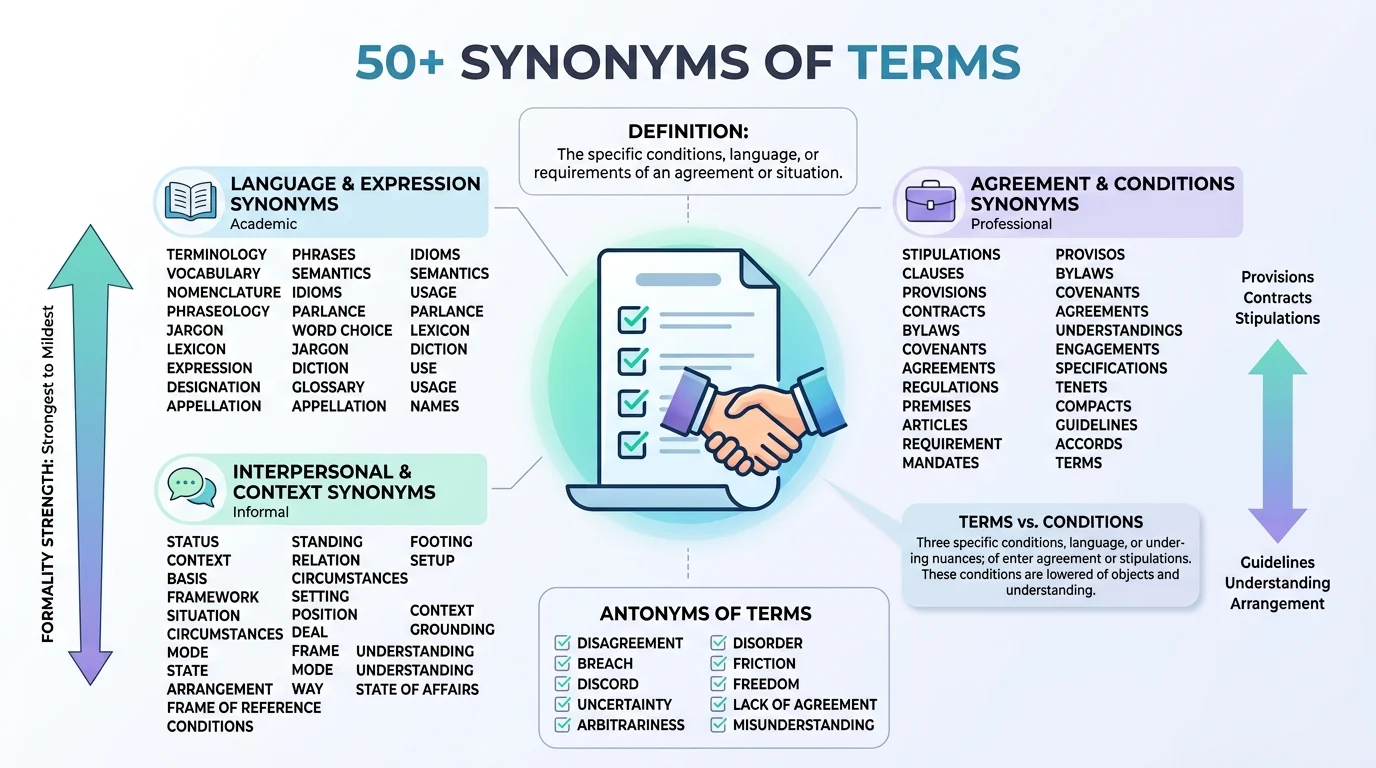
Have you ever needed to describe the specific language used in a conversation or the conditions of an agreement but felt that “words” or “conditions” did not fully capture the nuance? You want to highlight precise vocabulary or contractual details, and the word “terms” comes to mind. But is it the best fit for your audience? Choosing the right synonym for “terms” can transform a general reference into a precise description of language, conditions, or relationships. This guide explores the best synonyms of terms, explaining exactly which word to use and when.
Quick Ans: “Terms” can mean specific words or phrases, conditions of an agreement, or the state of a relationship. For language contexts, choose terminology or phraseology. For conditions, use conditions or provisions. For relationships, relations or footing are strong choices. For academic contexts, nomenclature works well. For professional writing, stipulations is a precise alternative.
Meaning, Tone, and Context
Understanding the core meaning of “terms” is the first step to using it effectively.
Simple Definition: Specific words or expressions used in a particular context. Also, conditions or provisions of an agreement. Also, the state of a relationship.
Part of Speech: Noun (plural, though singular “term” also exists).
Overall Tone: Neutral to formal. The word adapts to different contexts.
Formality Level: Neutral to formal. The word works in most contexts.
Common Uses: Native English speakers use it to describe specialized vocabulary (“medical terms”), conditions of agreements (“contract terms”), and relationships (“on good terms”). For example, “She explained the technical terms,” or “The terms of the contract were favorable.”
Word Forms: Related words include the singular term, the adjective terminological, and the adverb terminologically.
When and How to Use “Terms”
“Terms” is a versatile word that works in several distinct contexts. Here are seven realistic examples.
Professional: “The terms of the agreement were negotiated over several months.”
Academic: “The professor asked us to define key terms in our research papers.”
Workplace: “We need to clarify the terms of our partnership before proceeding.”
Personal: “We left the meeting on good terms despite our disagreements.”
Email: “Please review the attached terms and conditions carefully.”
Resume: “Negotiated favorable contract terms that reduced costs by 15%.”
Social Media: “In simple terms, this new policy is a game-changer.”
Best Synonyms of “Terms”
No synonym is identical in every situation. Here is your guide to the best replacement for “terms” based on your writing context.
Language Context: Terminology. It suggests the specialized vocabulary of a field. “The medical terminology confused the patient.”
Conditions Context: Conditions. A direct and widely understood alternative. “The conditions of the agreement were strict.”
Agreement Context: Provisions. This suggests specific clauses or stipulations. “The provisions of the contract protect both parties.”
Relationship Context: Relations. Use it when discussing how people interact. “We have always enjoyed cordial relations.”
Academic Context: Nomenclature. Use it for formal naming systems. “The nomenclature of chemical compounds is standardized.”
Legal Context: Stipulations. This suggests formal requirements or conditions. “The stipulations of the settlement were binding.”
Casual Context: Language. A simple word for the words used. “In plain language, the policy is flawed.”
When Not to Use “Terms”
Using “terms” can sound wrong or awkward in certain situations.
When It Sounds Too Vague: “Terms” can be unclear if you need specificity.
Better Choice: Stipulations or conditions. “The stipulations were clear.”
When You Mean a Single Word: “Terms” is plural. Use term for one word.
Better Choice: Term or word. “Define the term clearly.”
When Describing Charges: “Terms” can mean rates or fees.
Better Choice: Rates or charges. “The rates for the service were high.”
When It Sounds Too Formal: In casual conversation, “terms” can sound legalistic.
Better Choice: Conditions or rules. “The rules were fair.”
Words Commonly Confused With “Terms”
Several words are often mixed up with “terms.” Here is how to keep them straight.
Word: Terminology
Difference: Refers to the system of terms in a field. “Terms” is the individual words.
When to Use: Use it for the vocabulary of a profession.
Example: “The terminology of medicine is complex.”
Word: Conditions
Difference: Refers to requirements or circumstances. “Terms” is broader.
When to Use: Use this for requirements that must be met.
Example: “The conditions for approval were strict.”
Word: Provisions
Difference: Refers to specific legal clauses. “Terms” is more general.
When to Use: Use this for contractual clauses.
Example: “The provisions of the lease were clear.”
Word: Stipulations
Difference: Refers to formal requirements. “Terms” is broader.
When to Use: Use this for binding conditions.
Example: “The stipulations of the agreement were non-negotiable.”
Word: Nomenclature
Difference: Refers to a naming system. “Terms” is the names themselves.
When to Use: Use this for scientific naming systems.
Example: “The nomenclature of botany is precise.”
Word: Relations
Difference: Refers to interactions between people. “Terms” can also mean this.
When to Use: Use this for how people or groups relate.
Example: “We have maintained good relations.”
Best Synonyms of “Terms” by Context
| Context | Best Synonym | Why It Works | Example |
|---|---|---|---|
| Language context | Terminology | Precise for specialized vocabulary. | “The legal terminology was challenging.” |
| Conditions context | Conditions | Direct and widely understood. | “The conditions were acceptable.” |
| Legal context | Provisions | Precise for contractual clauses. | “The provisions of the contract were fair.” |
| Relationship context | Relations | Clear for interpersonal contexts. | “We have enjoyed cordial relations.” |
| Academic context | Nomenclature | Formal for naming systems. | “The nomenclature of biology is standardized.” |
| Professional context | Stipulations | Formal for binding requirements. | “The stipulations were agreed upon.” |
| Casual context | Language | Simple and accessible. | “In plain language, the policy needs work.” |
| Business context | Conditions | Practical and widely used. | “The business conditions were favorable.” |
| Negotiation context | Provisions | Suggests specific clauses. | “The provisions were negotiated carefully.” |
| Medical context | Terminology | Precise for medical vocabulary. | “The medical terminology was difficult.” |
How to Choose the Best Synonym of “Terms”
Choosing the right word is a simple decision. Answer these questions.
What is my context? Are you discussing language, conditions, or relationships? Choose the synonym that matches your context.
What is my audience? For a professor or CEO, terminology or provisions is appropriate. For a friend, conditions or language is more natural.
What is my purpose? Are you trying to inform, persuade, or describe? Use nomenclature for information, stipulations for persuasion, and conditions for description.
What is the formality level? Provisions and stipulations are more formal. Conditions and language are neutral. Pick the one that matches your message.
Real Life Examples of “Terms”
To truly master the word, it helps to see how it behaves in the wild and how a stronger synonym can elevate the sentence.
School: Basic: “The student learned the terms of grammar.” Improved: “The student learned the terminology of grammar.”
College: Basic: “The terms of the experiment were explained.” Improved: “The procedures of the experiment were explained.”
Workplace: Basic: “We agreed on the terms of the project.” Improved: “We agreed on the conditions of the project.”
Business: Basic: “The terms of the deal were signed.” Improved: “The provisions of the deal were signed.”
Email: Basic: “Please review the terms.” Improved: “Please review the stipulations carefully.”
Conversation: Basic: “They parted on bad terms.” Improved: “They parted on bad footing.”
Storytelling: Basic: “The terms of the kingdom were discussed.” Improved: “The conditions of the kingdom were discussed.”
Top 10 Synonyms of “Terms”
| Synonym | Simple Meaning | Best Used For | Example Sentence |
|---|---|---|---|
| Terminology | Specialized vocabulary of a field | Academic, medical, and professional contexts. | “The terminology of law is complex.” |
| Conditions | Requirements or circumstances | Business, contracts, and general contexts. | “The conditions were favorable.” |
| Provisions | Specific clauses in an agreement | Legal, contractual, and formal contexts. | “The provisions of the lease were clear.” |
| Stipulations | Formal requirements or conditions | Legal, professional, and negotiation contexts. | “The stipulations were binding.” |
| Nomenclature | A system of naming | Scientific, academic, and formal contexts. | “The nomenclature of chemistry is precise.” |
| Phraseology | The way words are arranged | Linguistic, literary, and academic contexts. | “The phraseology of the document was precise.” |
| Language | The words and expressions used | Casual, accessible, and general contexts. | “In simple language, the proposal works.” |
| Relations | The way people interact | Personal and professional relationship contexts. | “We have maintained good relations.” |
| Footing | The basis of a relationship | Relationship and social contexts. | “We started on equal footing.” |
| Rates | Prices or charges for services | Business, finance, and service contexts. | “The rates for the service were reasonable.” |
Synonyms of “Terms” by Usage
Professional vs. Personal Synonyms
In the workplace (professional), choose provisions, stipulations, or conditions to describe agreements. These words convey precision and professionalism. “The provisions of the contract were agreed upon” is more precise than “The terms of the contract were agreed upon.”
With friends (personal), conditions, language, or relations keep the tone relaxed and relatable. These alternatives sound natural in everyday conversation.
Formal vs. Conversational Synonyms
For formal writing (reports, essays, professional documents), use nomenclature, phraseology, or stipulations. These choices maintain the sophisticated tone expected in professional documents.
For casual conversations and texting, use language, conditions, or rules. These options sound more natural and less pretentious.
Academic Synonyms
For research and essays, choose precise, authoritative words. Terminology is great for vocabulary, nomenclature for naming systems, and phraseology for expression. These words sound considered and scholarly.
Using precise academic vocabulary demonstrates expertise and careful thinking. Professors and reviewers expect this level of precision.
Professional and Business Synonyms
For maximum impact in professional writing, choose provisions for contracts, stipulations for requirements, and conditions for agreements. These words demonstrate confidence and professional awareness.
Business leaders respond to language that conveys clarity and precision. These synonyms project authority.
Creative and Literary Synonyms
To add emotion and imagery to your writing, choose phraseology or language. These words create atmosphere and literary quality.
Literary writers use these alternatives to build voice and style. They transform ordinary descriptions into evocative prose.
Slang or Modern Synonyms
In modern American slang, deal or setup can sometimes be used for terms of an agreement. For example, “What’s the deal?” or “What’s the setup?” These are acceptable in casual, friendly contexts. Avoid them in professional or academic writing.
Strongest to Mildest Synonyms
Mild: language, conditions, rules
Moderate: terms, terminology, phraseology
Strong: provisions, stipulations, nomenclature
Very Strong: requirements, prerequisites, obligations
Emotional vs. Neutral Synonyms
Emotional Synonyms: Phraseology, language, relations. These words often hint at nuance, tone, or feeling. Use them when you want to evoke emotion.
Neutral Synonyms: Conditions, provisions, requirements. These words simply communicate factual information. Use them when you want to inform without emotional coloring.
Antonyms of “Terms”
Here are 15 genuine opposites of “terms” in various senses.
| Antonym | Meaning | Example Sentence |
|---|---|---|
| Exemption | Freedom from requirements | “The exemption from the rule was granted.” |
| Deregulation | Removal of restrictions | “The deregulation of the industry was controversial.” |
| Freedom | Lack of constraints | “The freedom from conditions was liberating.” |
| Waiver | Giving up a requirement | “The waiver of the terms was accepted.” |
| Exception | A case that does not follow the rule | “The exception to the condition was noted.” |
| Noncompliance | Failure to meet requirements | “The noncompliance was reported.” |
| Rejection | Refusal to accept conditions | “The rejection of the terms ended the negotiation.” |
| Hostility | Bad relations | “The hostility between the parties was clear.” |
| Estrangement | Separation in a relationship | “The estrangement was painful.” |
| Disagreement | Lack of accord | “The disagreement about the terms was unresolved.” |
| Disharmony | Lack of harmony | “The disharmony in the partnership was evident.” |
| Conflict | A clash or opposition | “The conflict about the terms was intense.” |
| Severance | The ending of a relationship | “The severance was amicable.” |
| Nullification | Making invalid | “The nullification of the contract was requested.” |
| Revocation | Taking back | “The revocation of the offer was disappointing.” |
Comparison: “Terms” vs Similar Words
Terms vs. Terminology
Main Difference: Terms are individual words. Terminology is the entire vocabulary of a field.
Which Is Stronger? Terminology is more comprehensive.
Which Is More Formal? Terminology is more formal.
When to Use Each: Use terms for individual words. Use terminology for the full vocabulary.
Examples:
Terms: “Define these terms.”
Terminology: “The terminology of medicine is complex.”
Terms vs. Conditions
Main Difference: Terms is broader. Conditions specifically means requirements.
Which Is Stronger? Conditions is more specific.
Which Is More Formal? Both are formal.
When to Use Each: Use terms for general language or agreement. Use conditions for specific requirements.
Examples:
Terms: “The terms of the deal were agreed.”
Conditions: “The conditions must be met.”
Terms vs. Provisions
Main Difference: Terms is general. Provisions means specific clauses.
Which Is Stronger? Provisions is more precise.
Which Is More Formal? Provisions is more legal.
When to Use Each: Use terms for general agreements. Use provisions for contractual clauses.
Examples:
Terms: “The terms of the contract were fair.”
Provisions: “The provisions of the contract were binding.”
Terms vs. Stipulations
Main Difference: Terms is broad. Stipulations means formal requirements.
Which Is Stronger? Stipulations is more binding.
Which Is More Formal? Stipulations is highly formal.
When to Use Each: Use terms for general references. Use stipulations for formal requirements.
Examples:
Terms: “The terms were acceptable.”
Stipulations: “The stipulations were non-negotiable.”
Terms vs. Relations
Main Difference: Terms can mean relationship status. Relations specifically means interactions.
Which Is Stronger? They are similar. Relations is more direct.
Which Is More Formal? Both are formal.
When to Use Each: Use terms for a general sense. Use relations for the interactions themselves.
Examples:
Terms: “They parted on good terms.”
Relations: “They have maintained cordial relations.”
Terms vs. Phraseology
Main Difference: Terms are words. Phraseology is the arrangement of words.
Which Is Stronger? Phraseology suggests style.
Which Is More Formal? Phraseology is more formal and literary.
When to Use Each: Use terms for individual words. Use phraseology for how words are expressed.
Examples:
Terms: “The terms were simple.”
Phraseology: “The phraseology of the document was complex.”
Common Phrases and Expressions with “Terms”
Phrase: In simple terms
Meaning: Explained in an easy way.
Example Sentence: “In simple terms, the policy is a disaster.”
Phrase: On good terms
Meaning: In a positive relationship.
Example Sentence: “They remained on good terms after the breakup.”
Phrase: Terms and conditions
Meaning: The rules and requirements of an agreement.
Example Sentence: “Please read the terms and conditions carefully.”
Phrase: Come to terms
Meaning: To reach an agreement.
Example Sentence: “They finally came to terms after months of negotiation.”
Phrase: In no uncertain terms
Meaning: Clearly and directly.
Example Sentence: “She told him in no uncertain terms to leave.”
Phrase: Set terms
Meaning: To establish conditions.
Example Sentence: “The employer set the terms of employment.”
Common Mistakes to Avoid
Mistake 1: Using “terms” when you mean “terminology”.
Incorrect: “The legal terms of the profession are complex.”
Better: “The legal terminology of the profession is complex.”
Why: Terminology is the whole vocabulary. Terms are individual words.
Mistake 2: Using “terms” when you mean “conditions”.
Incorrect: “The terms for approval were strict.”
Better: “The conditions for approval were strict.”
Why: Conditions are requirements. Terms is broader.
Mistake 3: Confusing “terms” with “relations”.
Incorrect: “They parted on good terms.”
Better: “They parted on good footing.”
Why: “On good terms” is actually correct. The confusion is with using “terms” for relationship status vs. language.
Mistake 4: Using “terms” when you mean “rates”.
Incorrect: “The terms for the service were high.”
Better: “The rates for the service were high.”
Why: Rates are charges. Terms are conditions.
Mistake 5: Overusing “terms” in academic writing.
Incorrect: “The terms of the theory are important.”
Better: “The concepts of the theory are important.”
Why: Concepts is more precise in academic contexts.
Frequently Asked Questions
1. What are the best synonyms of “terms”?
The best synonyms depend on your context. For language, choose terminology or phraseology. And for conditions, use conditions or provisions. For relationships, relations or footing are ideal choices.
2. What are the best formal synonyms of “terms”?
The best formal synonyms are stipulations, provisions, and nomenclature. These words are suitable for academic papers, professional reports, and legal documents.
3. What are common informal synonyms of “terms”?
For informal settings, use conditions, language, or rules. These alternatives sound more natural in everyday conversation.
4. What is another word for “terms” in professional writing?
In professional writing, provisions is an excellent choice for contractual contexts. Conditions is also strong for general agreements.
5. What is the difference between “terms” and “conditions”?
While both indicate requirements, terms is broader. Conditions specifically means requirements that must be met. Use terms for general references and conditions for specific requirements.
6. What is the opposite of “terms”?
The most direct opposites (antonyms) of terms in the sense of conditions are exemption, waiver, and freedom. These words describe the absence of restrictions.
Conclusion
“Terms” is a versatile and essential word that adapts to multiple contexts, including language, conditions, and relationships. The term is neutral and widely understood, yet it can sound vague or formal in certain situations. The best choice among the synonyms of terms depends entirely on your audience, tone, and purpose. Remember, no single synonym works perfectly in every situation. Your goal is to choose the word that communicates your message with the most clarity and impact. A practical tip for your vocabulary growth is to pay attention to the different contexts where “terms” appears and practice using its synonyms appropriately.
Discover More:
- 50+ Synonyms of Example: Meanings, Uses, Examples, and Best Alternatives
- 50+ Synonyms of Learn: Meanings, Uses, Examples, and Best Alternatives 2026

Ella Parker is a professional content writer with a passion for creating clear, engaging, and well-researched articles. She focuses on delivering valuable insights and practical information across business, technology, and lifestyle topics.
1 thought on “50+ Synonyms of Terms: Meanings, Uses, Examples, and Best Alternatives 2026”