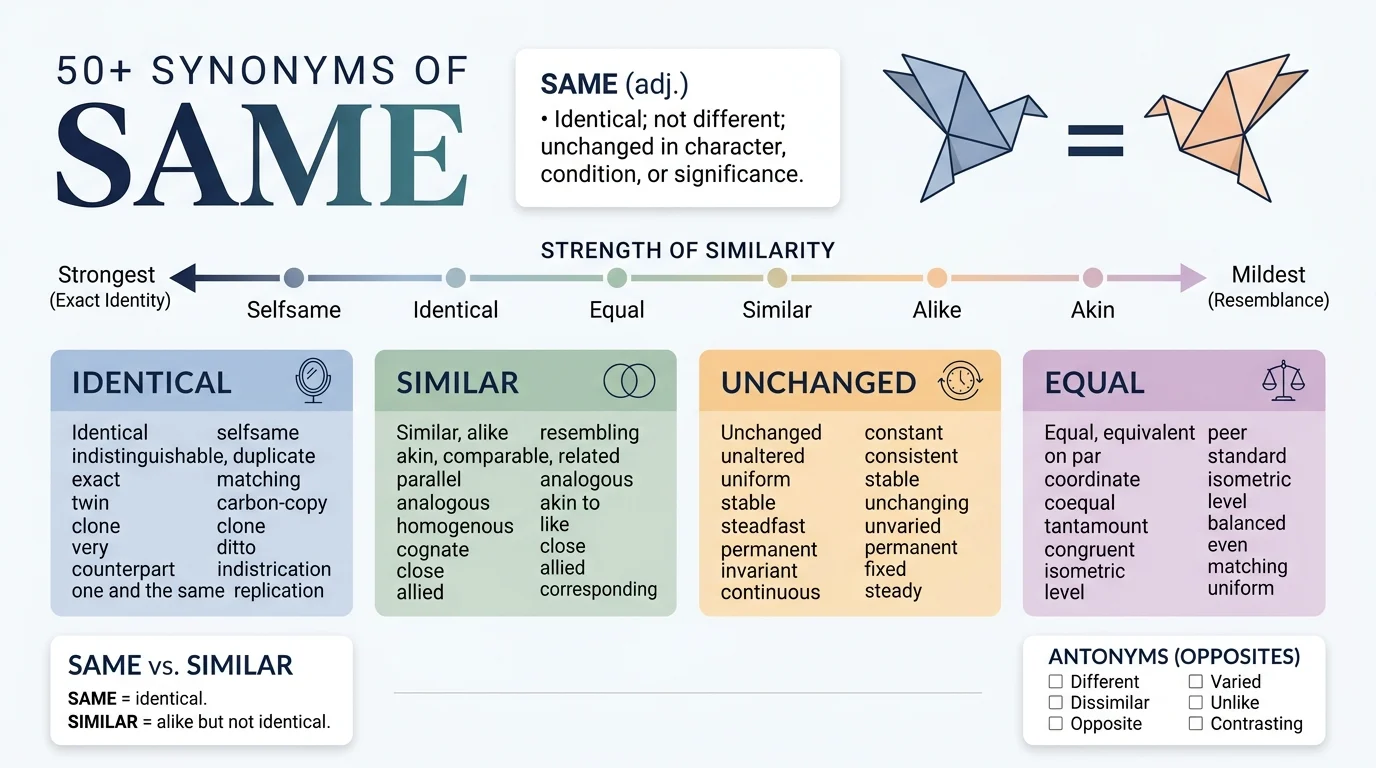
Have you ever needed to describe two things that are identical, alike, or unchanged but felt that “same” was too simple or repetitive? You want to capture the specific nature of similarity, equality, or lack of change, and the word “same” comes to mind. Choosing the right synonym for “same” can transform a basic statement into a precise expression of similarity, consistency, or equivalence. This guide explores the best synonyms of same, explaining exactly which word to use and when.
Quick Ans: “Same” means identical, alike, or unchanged. For formal writing, choose identical, equivalent, or uniform. For casual conversation, use alike, matching, or equal. For describing consistency, use consistent, unchanged, or constant. For describing similarity, use similar, comparable, or analogous.
Meaning, Tone, and Context
Understanding the core meaning of “same” is the first step to using it effectively.
Simple Definition: Not different; identical; alike in kind, quality, or amount; unchanged.
Part of Speech: Adjective, pronoun, and adverb.
Overall Tone: Neutral. It is a fundamental word used across all contexts.
Formality Level: Neutral. The word works in casual and formal contexts, though more specific alternatives exist.
Common Uses: Native English speakers use it to describe identical objects (“the same car”), unchanged conditions (“the same as before”), and equal treatment (“the same rights”).
Word Forms: Related words include the noun sameness and the adjective samey (informal).
When and How to Use “Same”
“Same” is the perfect choice when you want to describe identical, alike, or unchanged things. Here are seven realistic examples.
Identical: “We have the same phone.”
Unchanged: “The situation is the same as yesterday.”
Equal: “Everyone deserves the same opportunities.”
Similar: “They have the same taste in music.”
Consistent: “He maintains the same routine every day.”
Simultaneous: “We arrived at the same time.”
Agreement: “We are on the same page.”
Best Synonyms of “Same”
No synonym is identical in every situation. Here is your guide to the best replacement for “same” based on your writing context.
For Identical and Exactly Alike
Most Direct: Identical means exactly the same. “The twins wore identical outfits.”
Equivalent: Equivalent means equal in value or meaning. “The two terms are equivalent.”
Indistinguishable: Indistinguishable means impossible to tell apart. “The copies were indistinguishable.”
Duplicate: Duplicate means an exact copy. “This is a duplicate key.”
For Similar and Comparable
Similar: Similar means resembling without being identical. “We have similar interests.”
Comparable: Comparable means able to be compared. “The results are comparable.”
Analogous: Analogous means similar in some ways. “The two systems are analogous.”
Alike: Alike means similar in appearance or nature. “They look very much alike.”
For Unchanged and Consistent
Unchanged: Unchanged means not changed. “The policy remains unchanged.”
Consistent: Consistent means unchanging over time. “Her performance is consistent.”
Constant: Constant means unchanging. “The temperature remained constant.”
Uniform: Uniform means not varying. “The rules are uniform across all departments.”
For Equal and Matching
Equal: Equal means the same in quantity or value. “They received equal pay.”
Matching: Matching means corresponding. “They wore matching shirts.”
Corresponding: Corresponding means equivalent or matching. “The corresponding parts fit together.”
Like: Like means similar. “She has a like-minded friend.”
When Not to Use “Same”
Using “same” can sound wrong or awkward in certain situations.
When You Mean “Similar”: “Same” implies identical. “Similar” implies resemblance.
Better Choice: Similar or alike. “We have similar views.”
When You Mean “Equal”: “Same” is about identity. “Equal” is about value.
Better Choice: Equal or equivalent. “They received equal treatment.”
When It Sounds Too Simple: In formal writing, “same” can sound basic.
Better Choice: Identical or uniform. “The results were identical.”
Words Commonly Confused With “Same”
| Word | Difference | When to Use | Example |
|---|---|---|---|
| Similar | Resembling without being identical | Comparison | “Similar interests.” |
| Identical | Exactly the same | Exact matches | “Identical twins.” |
| Equal | Same in value | Quantities and rights | “Equal pay.” |
| Equivalent | Equal in meaning | Formal and technical | “Equivalent terms.” |
| Alike | Similar in appearance | Appearance and nature | “They look alike.” |
| Uniform | Not varying | Consistency | “Uniform rules.” |
Best Synonyms of “Same” by Context
| Context | Best Synonym | Why It Works | Example |
|---|---|---|---|
| Formal writing | Identical | Formal and precise | “The documents are identical.” |
| Academic writing | Equivalent | Standard in research | “The two groups are equivalent.” |
| Professional | Consistent | Professional and clear | “The results are consistent.” |
| Business | Uniform | Business and policy | “The policy is uniform.” |
| Casual conversation | Alike | Simple and natural | “They look alike.” |
| Comparison | Similar | General comparison | “We have similar tastes.” |
| Emphasis | Indistinguishable | Strong and precise | “The copies are indistinguishable.” |
How to Choose the Best Synonym of “Same”
Choosing the right word is a simple decision. Answer these questions.
What type of sameness am I describing? For identical, use identical or indistinguishable. And For similar, use similar or alike. For unchanged, use unchanged or consistent. For equal, use equal or equivalent.
What is my audience? For a formal report, use identical or equivalent. For a friend, use alike or same.
What is my purpose? Are you comparing, equating, or describing consistency? The correct synonym depends entirely on this.
What is the emotional strength? Indistinguishable is strong. Like is mild. Pick the one that matches your message.
Real Life Examples of “Same”
School: Basic: “The answers are the same.” Improved: “The answers are identical.”
College: Basic: “The two theories are the same.” Improved: “The two theories are equivalent.”
Workplace: Basic: “We have the same policy.” Improved: “We have a uniform policy.”
Business: Basic: “The results are the same.” Improved: “The results are consistent.”
Email: Basic: “The same applies to you.” Improved: “The same applies to you.” (No change needed)
Conversation: Basic: “They are the same.” Improved: “They are alike.”
Storytelling: Basic: “The two paths were the same.” Improved: “The two paths were indistinguishable.”
Top 10 Synonyms of “Same”
| Synonym | Simple Meaning | Best Used For | Example Sentence |
|---|---|---|---|
| Identical | Exactly the same | Formal and exact matches | “The twins are identical.” |
| Equivalent | Equal in value or meaning | Formal and academic | “The terms are equivalent.” |
| Similar | Resembling without being identical | General comparison | “We have similar interests.” |
| Alike | Similar in appearance | Casual and appearance | “They look alike.” |
| Equal | Same in quantity or value | Rights and quantities | “They received equal pay.” |
| Consistent | Unchanging over time | Performance and behavior | “Her work is consistent.” |
| Uniform | Not varying | Rules and policies | “The rules are uniform.” |
| Unchanged | Not changed | Conditions and situations | “The policy is unchanged.” |
| Indistinguishable | Impossible to tell apart | Strong and precise | “The copies are indistinguishable.” |
| Comparable | Able to be compared | Formal and analysis | “The results are comparable.” |
Synonyms of “Same” by Usage
Professional vs. Personal Synonyms
In the workplace, choose consistent, uniform, or equivalent. With friends, use alike, same, or similar.
Formal vs. Conversational Synonyms
For formal writing, use identical, equivalent, or uniform. For casual conversations, use alike, same, or similar.
Academic Synonyms
For research and essays, choose equivalent for comparison, identical for exact matches, and consistent for reliability.
Professional and Business Synonyms
For maximum impact, choose uniform for policies, consistent for results, and equal for treatment.
Creative and Literary Synonyms
To add emotion and imagery, choose indistinguishable, alike, or kindred. These words create atmosphere.
Slang or Modern Synonyms
In modern American slang, same, same here, or ditto are common. For example, “Same here.” These are casual and should be avoided in formal writing.
Strongest to Mildest Synonyms
Mild: like, similar, same
Moderate: alike, equal, comparable
Strong: identical, equivalent, consistent
Very Strong: indistinguishable, uniform, duplicate
Emotional vs. Neutral Synonyms
Emotional Synonyms: Kindred, alike. These words hint at connection. Use them when you want to evoke feeling.
Neutral Synonyms: Same, identical, equal. These words communicate factual information.
Antonyms of “Same”
| Antonym | Meaning | Example Sentence |
|---|---|---|
| Different | Not the same | “The two are different.” |
| Dissimilar | Not alike | “Their views are dissimilar.” |
| Unlike | Not similar | “Unlike his brother, he is tall.” |
| Distinct | Clearly different | “The two species are distinct.” |
| Various | Of different kinds | “The options are various.” |
| Diverse | Showing variety | “The team is diverse.” |
| Opposite | Completely different | “They have opposite opinions.” |
| Contrasting | Differing | “The colors are contrasting.” |
| Unique | One of a kind | “Each snowflake is unique.” |
| Individual | Distinct | “Each has an individual style.” |
| Separate | Not together | “They are separate entities.” |
| Changed | Not the same as before | “The situation has changed.” |
| Varying | Changing | “The results are varying.” |
| Inconsistent | Not consistent | “His work is inconsistent.” |
| Unequal | Not equal | “The distribution is unequal.” |
Comparison: “Same” vs Similar Words
Same vs. Similar
Main Difference: “Same” is identical. “Similar” is resembling.
Which Is Stronger? “Same” is stronger for identity.
Which Is More Formal? Both are neutral.
When to Use Each: Use “same” for identical things. Use “similar” for resembling things.
Examples:
Same: “We have the same car.”
Similar: “We have similar cars.”
Same vs. Identical
Main Difference: “Identical” is more formal and precise. “Same” is general.
Which Is Stronger? “Identical” is stronger for exactness.
Which Is More Formal? “Identical” is more formal.
When to Use Each: Use “identical” in formal writing. Use “same” in general contexts.
Examples:
Same: “They are the same.”
Identical: “They are identical.”
Same vs. Equal
Main Difference: “Equal” is about value. “Same” is about identity.
Which Is Stronger? “Equal” is stronger for value.
Which Is More Formal? Both are formal.
When to Use Each: Use “equal” for rights and quantities. Use “same” for identity.
Examples:
Same: “We have the same car.”
Equal: “We have equal rights.”
Same vs. Alike
Main Difference: “Alike” is similar in appearance. “Same” is identical.
Which Is Stronger? “Same” is stronger.
Which Is More Formal? Both are neutral.
When to Use Each: Use “alike” for appearance. Use “same” for identity.
Examples:
Same: “They wear the same clothes.”
Alike: “They look alike.”
Same vs. Uniform
Main Difference: “Uniform” is not varying. “Same” is identical.
Which Is Stronger? “Uniform” is stronger for consistency.
Which Is More Formal? “Uniform” is more formal.
When to Use Each: Use “uniform” for rules. Use “same” for general contexts.
Examples:
Same: “The rules are the same.”
Uniform: “The rules are uniform.”
Same vs. Consistent
Main Difference: “Consistent” is unchanging over time. “Same” is identical.
Which Is Stronger? “Consistent” is stronger for reliability.
Which Is More Formal? Both are formal.
When to Use Each: Use “consistent” for performance. Use “same” for general contexts.
Examples:
Same: “The results are the same.”
Consistent: “The results are consistent.”
Common Phrases and Expressions with “Same”
Phrase: Same here
Meaning: I agree or me too.
Example Sentence: “Same here, I love pizza.”
Phrase: All the same
Meaning: Nevertheless.
Example Sentence: “All the same, we should try.”
Phrase: Same old
Meaning: Unchanged and familiar.
Example Sentence: “It is the same old story.”
Phrase: On the same page
Meaning: In agreement.
Example Sentence: “We are on the same page.”
Phrase: Same difference
Meaning: No real difference.
Example Sentence: “It is the same difference.”
Phrase: Same time
Meaning: At the same time.
Example Sentence: “See you at the same time.”
Common Mistakes to Avoid
Mistake 1: Using “same” when you mean “similar”.
Incorrect: “We have the same views.”
Better: “We have similar views.”
Why: “Same” implies identical.
Mistake 2: Using “same” when you mean “equal”.
Incorrect: “They received the same pay.”
Better: “They received equal pay.”
Why: “Equal” is for value.
Mistake 3: Overusing “same” in writing.
Incorrect: “The same thing happened the same way.”
Better: “The identical thing happened similarly.”
Why: Variety improves writing.
Mistake 4: Using “same” when you mean “consistent”.
Incorrect: “His performance is the same.”
Better: “His performance is consistent.”
Why: “Consistent” is for reliability.
Mistake 5: Using “same” when you mean “uniform”.
Incorrect: “The rules are the same.”
Better: “The rules are uniform.”
Why: “Uniform” is for policies.
Frequently Asked Questions
1. What are the best synonyms of “same”?
The best synonyms depend on your context. For identical, choose identical or indistinguishable. And For similar, use similar or alike. For unchanged, use unchanged or consistent. For equal, use equal or equivalent.
2. What are the best formal synonyms of “same”?
The best formal synonyms are identical, equivalent, and uniform. These words are suitable for academic papers, professional reports, and business communications.
3. What are common informal synonyms of “same”?
For informal settings, use alike, same, or similar. These alternatives sound more natural in everyday conversation.
4. What is another word for “same” in professional writing?
In professional writing, consistent is an excellent choice. It conveys reliability. Uniform is also strong for policies.
5. What is the difference between “same” and “similar”?
“Same” means identical. “Similar” means resembling. Use “same” for exact matches and “similar” for likeness.
6. What is the opposite of “same”?
The most direct opposites (antonyms) of same are different, dissimilar, and unlike. These words describe things that are not identical.
Conclusion
“Same” is a fundamental and versatile word for describing identity, similarity, and consistency. The term is neutral and widely accepted in all contexts, yet it can sound too simple for formal writing or too vague for specific descriptions. The best choice among the synonyms of same depends entirely on your audience, tone, and purpose. Remember, no single synonym works perfectly in every situation. Your goal is to choose the word that communicates your message with the most clarity and impact. A practical tip for your vocabulary growth is to pay attention to how writers describe similarity and identity and practice using different synonyms in your writing.










1 thought on “50+ Synonyms of Same: Meanings, Uses, Examples, and Best Alternatives 2026”