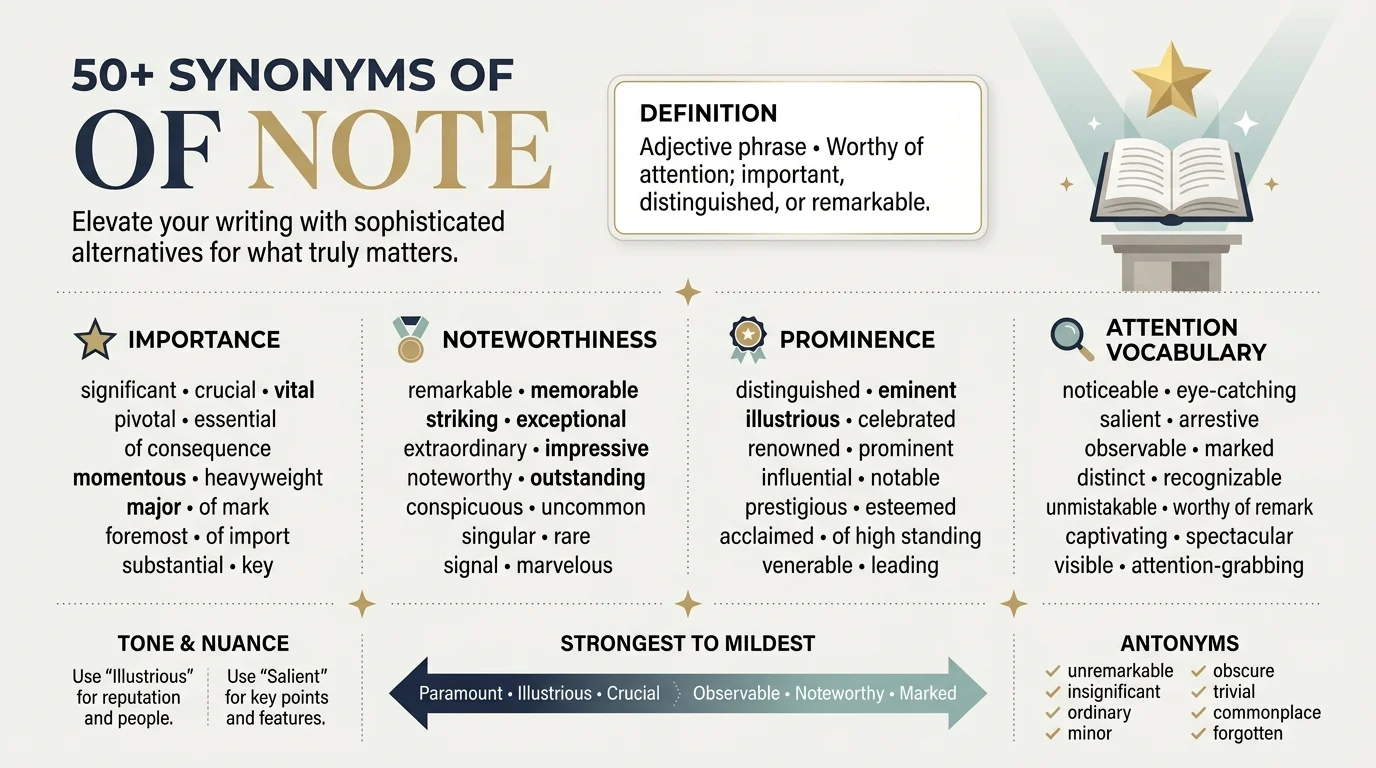
Have you ever needed to point out that something deserves attention but felt that “important” or “notable” was too plain? You want to highlight significance, distinction, or worthiness of notice, and the phrase “of note” comes to mind. Choosing the right synonym for “of note” can transform a casual mention into a precise statement of importance. This guide explores the best synonyms of note, explaining exactly which word to use and when.
Quick Ans: “Of note” means important, noteworthy, or deserving attention. For formal writing, choose noteworthy or significant. For academic contexts, use notable or distinguished. For professional settings, use prominent or notable. For casual conversation, use worth mentioning or important.
Meaning, Tone, and Context
Understanding the core meaning of “of note” is the first step to using it effectively.
Simple Definition: Important, noteworthy, or deserving of attention; distinguished.
Part of Speech: Prepositional phrase functioning as an adjective.
Overall Tone: Neutral to positive. It indicates importance without exaggeration.
Formality Level: Formal to neutral. The phrase is appropriate in professional, academic, and formal writing.
Common Uses: Native English speakers use it in reports (“several findings are of note”), introductions (“nothing of note happened”), and formal descriptions (“a scientist of note”).
Word Forms: Related words include the noun note, the adjective notable, and the adverb notably.
When and How to Use “Of Note”
“Of note” is the perfect choice when you want to highlight importance or distinction. Here are seven realistic examples.
Professional: “Several trends in the data are of note.”
Academic: “The research is of note for its innovative methodology.”
Workplace: “Nothing of note occurred during the meeting.”
Personal: “Her achievements are of note in the community.”
Email: “The following points are of note for your review.”
Resume: “Delivered results of note in a competitive market.”
Social Media: “A performance of note from the young athlete.”
Best Synonyms of “Of Note”
No synonym is identical in every situation. Here is your guide to the best replacement for “of note” based on your writing context.
For Importance and Significance
Most Formal: Significant means important and meaningful. “The discovery was significant.”
Important: Important means of great value. “This is an important issue.”
Consequential: Consequential means important or significant. “The decision was consequential.”
Momentous: Momentous means very important. “The momentous occasion was celebrated.”
For Noteworthiness and Distinction
Noteworthy: Noteworthy means deserving attention. “The achievement is noteworthy.”
Notable: Notable means worthy of attention. “A notable exception exists.”
Distinguished: Distinguished means respected and eminent. “She is a distinguished scholar.”
Remarkable: Remarkable means worthy of attention. “The recovery was remarkable.”
For Prominence and Recognition
Prominent: Prominent means important and well-known. “He is a prominent figure.”
Eminent: Eminent means famous and respected. “The eminent scientist spoke.”
Renowned: Renowned means famous and celebrated. “The renowned artist exhibited.”
Celebrated: Celebrated means famous and praised. “The celebrated author won awards.”
For Worthiness of Attention
Worth mentioning: Worth mentioning means deserving to be mentioned. “One point is worth mentioning.”
Worth noting: Worth noting means deserving attention. “It is worth noting that sales increased.”
Deserving attention: Deserving attention means meriting notice. “The issue is deserving attention.”
Memorable: Memorable means worth remembering. “The event was memorable.”
When Not to Use “Of Note”
Using “of note” can sound wrong or awkward in certain situations.
When You Mean “Famous”: “Of note” is about importance. “Famous” is about fame.
Better Choice: Famous or well-known. “She is a famous actress.”
When You Mean “Interesting”: “Of note” is about significance. “Interesting” is about curiosity.
Better Choice: Interesting or intriguing. “The lecture was interesting.”
When It Sounds Too Formal: In casual conversation, “of note” can sound stiff.
Better Choice: Important or worth mentioning. “That is important.”
Words Commonly Confused With “Of Note”
| Word | Difference | When to Use | Example |
|---|---|---|---|
| Notable | Worthy of attention | General and formal | “A notable achievement.” |
| Noteworthy | Deserving attention | Formal and academic | “A noteworthy contribution.” |
| Significant | Important and meaningful | Formal and statistical | “A significant finding.” |
| Prominent | Important and well-known | Professional and social | “A prominent leader.” |
| Remarkable | Worthy of attention | General and emphatic | “A remarkable recovery.” |
| Distinguished | Respected and eminent | Academic and formal | “A distinguished professor.” |
Best Synonyms of “Of Note” by Context
| Context | Best Synonym | Why It Works | Example |
|---|---|---|---|
| Formal writing | Significant | Formal and precise | “A significant development.” |
| Academic writing | Noteworthy | Standard in research | “A noteworthy finding.” |
| Professional | Notable | Professional and clear | “A notable improvement.” |
| Business | Prominent | Business and influence | “A prominent investor.” |
| Casual conversation | Important | Simple and direct | “That is important.” |
| Emphatic | Remarkable | Strong and positive | “A remarkable achievement.” |
| Recognition | Distinguished | Respect and honor | “A distinguished career.” |
How to Choose the Best Synonym of “Of Note”
Choosing the right word is a simple decision. Answer these questions.
What type of importance am I describing? For significance, use significant or important.And For noteworthiness, use noteworthy or notable. For prominence, use prominent or distinguished. And For attention, use worth mentioning.
What is my audience? For a formal report, use significant or noteworthy. For a friend, use important or worth mentioning.
What is my purpose? Are you highlighting importance, distinction, or recognition? The correct synonym depends entirely on this.
What is the emotional strength? Momentous and remarkable are stronger. Worth mentioning is milder. Pick the one that matches your message.
Real Life Examples of “Of Note”
School: Basic: “The student’s work is of note.” Improved: “The student’s work is noteworthy.”
College: Basic: “The research is of note.” Improved: “The research is significant.”
Workplace: Basic: “Nothing of note happened.” Improved: “Nothing important happened.”
Business: Basic: “The investor is of note.” Improved: “The investor is prominent.”
Email: Basic: “The following points are of note.” Improved: “The following points are worth noting.”
Conversation: Basic: “That is of note.” Improved: “That is important.”
Storytelling: Basic: “The achievement was of note.” Improved: “The achievement was remarkable.”
Top 10 Synonyms of “Of Note”
| Synonym | Simple Meaning | Best Used For | Example Sentence |
|---|---|---|---|
| Significant | Important and meaningful | Formal and statistical | “A significant finding.” |
| Noteworthy | Deserving attention | Academic and formal | “A noteworthy contribution.” |
| Notable | Worthy of attention | Professional and general | “A notable exception.” |
| Prominent | Important and well-known | Professional and social | “A prominent figure.” |
| Distinguished | Respected and eminent | Academic and formal | “A distinguished scholar.” |
| Remarkable | Worthy of attention | General and emphatic | “A remarkable recovery.” |
| Important | Of great value | General and casual | “An important issue.” |
| Eminent | Famous and respected | Formal and academic | “An eminent scientist.” |
| Momentous | Very important | Formal and dramatic | “A momentous occasion.” |
| Memorable | Worth remembering | General and emotional | “A memorable event.” |
Synonyms of “Of Note” by Usage
Professional vs. Personal Synonyms
In the workplace, choose significant, notable, or prominent. With friends, use important or worth mentioning.
Formal vs. Conversational Synonyms
For formal writing, use significant, noteworthy, or distinguished. For casual conversations, use important or worth mentioning.
Academic Synonyms
For research and essays, choose noteworthy for contributions, significant for findings, and distinguished for scholars.
Professional and Business Synonyms
For maximum impact, choose prominent for figures, significant for results, and notable for exceptions.
Creative and Literary Synonyms
To add emotion and imagery, choose remarkable, momentous, or memorable. These words create atmosphere.
Slang or Modern Synonyms
In modern American slang, big deal, notable, or important are common. For example, “That is a big deal.” These are casual and should be avoided in formal writing.
Strongest to Mildest Synonyms
Mild: worth mentioning, important
Moderate: of note, notable, noteworthy
Strong: significant, prominent, remarkable
Very Strong: distinguished, eminent, momentous
Emotional vs. Neutral Synonyms
Emotional Synonyms: Remarkable, momentous, memorable. These words hint at strong positive emotion. Use them when you want to evoke feeling.
Neutral Synonyms: Of note, significant, notable. These words communicate factual information.
Antonyms of “Of Note”
| Antonym | Meaning | Example Sentence |
|---|---|---|
| Unimportant | Not significant | “The detail is unimportant.” |
| Insignificant | Lacking importance | “The change was insignificant.” |
| Trivial | Of little value | “The matter is trivial.” |
| Negligible | Too small to matter | “The difference is negligible.” |
| Minor | Lesser in importance | “A minor issue.” |
| Ordinary | Normal and unremarkable | “An ordinary day.” |
| Commonplace | Not unusual | “A commonplace event.” |
| Unremarkable | Not worthy of attention | “An unremarkable performance.” |
| Mundane | Dull and ordinary | “A mundane task.” |
| Forgettable | Not memorable | “A forgettable film.” |
| Inconsequential | Not important | “An inconsequential remark.” |
| Petty | Of little importance | “A petty concern.” |
| Unnoteworthy | Not deserving attention | “An unnoteworthy result.” |
| Standard | Usual and expected | “A standard procedure.” |
| Routine | Regular and habitual | “A routine check.” |
Comparison: “Of Note” vs Similar Words
Of Note vs. Notable
Main Difference: “Of note” is a phrase. “Notable” is an adjective.
Which Is Stronger? They are similar.
Which Is More Formal? Both are formal.
When to Use Each: Use “of note” in formal writing. Use “notable” in general contexts.
Examples:
Of note: “Several findings are of note.”
Notable: “A notable achievement.”
Of Note vs. Noteworthy
Main Difference: “Of note” is a phrase. “Noteworthy” is an adjective.
Which Is Stronger? They are similar.
Which Is More Formal? Both are formal.
When to Use Each: Use “of note” in formal writing. Use “noteworthy” in academic contexts.
Examples:
Of note: “The contribution is of note.”
Noteworthy: “A noteworthy contribution.”
Of Note vs. Significant
Main Difference: “Of note” is about attention. “Significant” is about importance.
Which Is Stronger? “Significant” is stronger for importance.
Which Is More Formal? Both are formal.
When to Use Each: Use “significant” for importance. Use “of note” for attention.
Examples:
Of note: “The trend is of note.”
Significant: “A significant trend.”
Of Note vs. Prominent
Main Difference: “Of note” is about importance. “Prominent” is about being well-known.
Which Is Stronger? “Prominent” is stronger for recognition.
Which Is More Formal? Both are formal.
When to Use Each: Use “prominent” for people. Use “of note” for general contexts.
Examples:
Of note: “The scientist is of note.”
Prominent: “A prominent scientist.”
Of Note vs. Remarkable
Main Difference: “Of note” is about importance. “Remarkable” is about wonder.
Which Is Stronger? “Remarkable” is stronger for surprise.
Which Is More Formal? Both are formal.
When to Use Each: Use “remarkable” for achievements. Use “of note” for general contexts.
Examples:
Of note: “The achievement is of note.”
Remarkable: “A remarkable achievement.”
Of Note vs. Distinguished
Main Difference: “Of note” is about importance. “Distinguished” is about respect.
Which Is Stronger? “Distinguished” is stronger for honor.
Which Is More Formal? Both are formal.
When to Use Each: Use “distinguished” for careers. Use “of note” for general contexts.
Examples:
Of note: “The career is of note.”
Distinguished: “A distinguished career.”
Common Phrases and Expressions with “Of Note”
Phrase: Nothing of note
Meaning: Nothing important happened.
Example Sentence: “Nothing of note occurred during the meeting.”
Phrase: Several points of note
Meaning: Several important points.
Example Sentence: “Several points of note emerged from the discussion.”
Phrase: A person of note
Meaning: An important person.
Example Sentence: “She is a person of note in the industry.”
Phrase: A development of note
Meaning: An important development.
Example Sentence: “A development of note was announced.”
Phrase: An achievement of note
Meaning: An important achievement.
Example Sentence: “An achievement of note was celebrated.”
Common Mistakes to Avoid
Mistake 1: Using “of note” when you mean “famous”.
Incorrect: “She is an actress of note.”
Better: “She is a famous actress.”
Why: “Of note” is about importance, not fame.
Mistake 2: Using “of note” when you mean “interesting”.
Incorrect: “The lecture was of note.”
Better: “The lecture was interesting.”
Why: “Of note” is about significance.
Mistake 3: Overusing “of note” in conversation.
Incorrect: “That is of note.”
Better: “That is important.”
Why: “Important” sounds more natural.
Mistake 4: Using “of note” when you mean “notable”.
Incorrect: “A notable exception is of note.”
Better: “A notable exception exists.”
Why: “Notable” is more concise.
Mistake 5: Using “of note” when you mean “significant”.
Incorrect: “The results are of note.”
Better: “The results are significant.”
Why: “Significant” is stronger for importance.
Frequently Asked Questions
1. What are the best synonyms of “of note”?
The best synonyms depend on your context. For formal writing, choose significant or noteworthy. And For academic contexts, use notable or distinguished. For professional settings, use prominent or notable. For casual conversation, use important or worth mentioning.
2. What are the best formal synonyms of “of note”?
The best formal synonyms are significant, noteworthy, and distinguished. These words are suitable for academic papers, professional reports, and business communications.
3. What are common informal synonyms of “of note”?
For informal settings, use important, worth mentioning, or big deal. These alternatives sound more natural in everyday conversation.
4. What is another word for “of note” in professional writing?
In professional writing, significant is an excellent choice. It conveys importance. Notable is also strong for exceptions.
5. What is the difference between “of note” and “notable”?
“Of note” is a phrase. “Notable” is an adjective. They are similar in meaning. Use “notable” for conciseness and “of note” for formal emphasis.
6. What is the opposite of “of note”?
The most direct opposites (antonyms) of of note are unimportant, insignificant, and trivial. These words describe things that lack importance.
Conclusion
“Of note” is a formal and useful phrase for highlighting importance, distinction, and attention. The phrase is widely accepted in professional, academic, and formal contexts, yet it can sound too stiff for casual conversation or too vague for specific descriptions. The best choice among the synonyms of note depends entirely on your audience, tone, and purpose. Remember, no single synonym works perfectly in every situation. Your goal is to choose the word that communicates your message with the most clarity and impact. A practical tip for your vocabulary growth is to pay attention to how writers highlight importance and practice using different synonyms in your writing.









