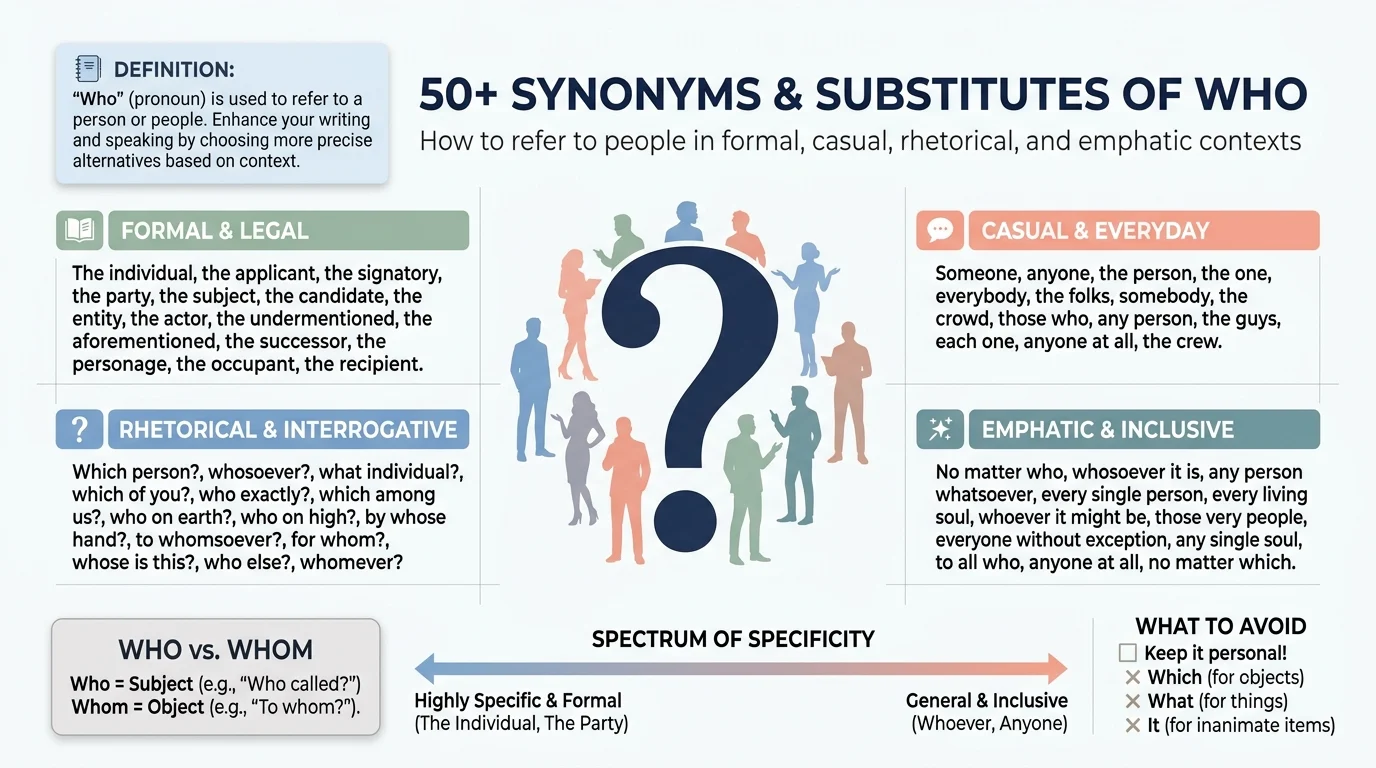
Have you ever needed to refer to a person or people in a sentence but felt that “who” was too simple or repetitive? You want to capture the specific identity, role, or characteristic of the person being mentioned, and the word “who” comes to mind. Choosing the right synonym or alternative for “who” can transform a basic sentence into a precise, engaging statement. This guide explores the best synonyms and alternatives for who, explaining exactly which word to use and when.
Quick Ans: “Who” is a pronoun used to refer to a person or people. For formal writing, choose whom, that, or which (for groups). For casual conversation, use that or omit the pronoun entirely. For rhetorical questions, use whoever or whomever. For emphasis, use the person who or the one who.
Meaning, Tone, and Context
Understanding the core meaning of “who” is the first step to using it effectively.
Simple Definition: A pronoun used in questions to ask about a person or people; a relative pronoun used to introduce a clause about a person.
Part of Speech: Pronoun.
Overall Tone: Neutral. It is a functional word with no emotional coloring.
Formality Level: Neutral. The word works in casual and formal contexts.
Common Uses: Native English speakers use it in questions (“Who is that?”), relative clauses (“The woman who called”), and rhetorical questions (“Who knows?”).
Word Forms: Related words include whom (object form), whose (possessive), and whoever (indefinite).
When and How to Use “Who”
“Who” is the perfect choice when you want to refer to a person or people. Here are seven realistic examples.
Question: “Who is coming to the party?”
Relative Clause: “The doctor who treated me was excellent.”
Rhetorical: “Who cares about that anyway?”
Emphasis: “She is the one who made it happen.”
Formal Writing: “The candidate who meets the requirements will be hired.”
Casual Conversation: “Who was that on the phone?”
Social Media: “Who else is excited for the weekend?”
Best Synonyms and Alternatives of “Who”
No synonym is identical in every situation. Here is your guide to the best replacement or alternative for “who” based on your writing context.
For Formal and Academic Writing
Most Formal: Whom is the object form of who. “The person whom you met is my brother.”
Relative Pronoun: That can replace who in restrictive clauses. “The woman that called was my aunt.”
Group Reference: Which is used for groups or organizations. “The committee, which met yesterday, decided to postpone.”
Indefinite: Whoever means any person who. “Whoever arrives first gets the best seat.”
For Casual and Conversational Contexts
Omission: In casual speech, the pronoun is often omitted. “The man I saw was tall.”
That: That is common in casual speech. “The guy that fixed my car was nice.”
The one who: The one who adds emphasis. “She is the one who helped me.”
For Rhetorical and Emphatic Contexts
Whoever: Whoever means any person. “Whoever did this will be caught.”
Whomever: Whomever is the object form. “Give it to whomever you trust.”
The person who: The person who is explicit. “The person who stole it will be punished.”
When Not to Use “Who”
Using “who” can sound wrong or awkward in certain situations.
When You Mean “That”: In restrictive clauses, “that” is often preferred. “The book that I read was good.”
Better Choice: That. “The book that I read was good.”
When You Mean “Which”: For things, use “which.” “The car which is red is mine.”
Better Choice: Which. “The car which is red is mine.”
When You Should Use “Whom”: In formal writing, “whom” is correct for objects. “To whom should I address the letter?”
Better Choice: Whom. “Whom did you see?”
Words Commonly Confused With “Who”
| Word | Difference | When to Use | Example |
|---|---|---|---|
| Whom | Object form of who | Formal and objects | “Whom did you call?” |
| Whose | Possessive form | Possession | “Whose book is this?” |
| Which | For things and groups | Things and clauses | “The book which is red.” |
| That | For things and people | Restrictive clauses | “The car that I bought.” |
| Whoever | Any person who | Indefinite | “Whoever comes is welcome.” |
| Whomever | Object form of whoever | Formal and objects | “Give it to whomever.” |
Best Synonyms and Alternatives of “Who” by Context
| Context | Best Alternative | Why It Works | Example |
|---|---|---|---|
| Formal writing | Whom | Formal and correct | “The person whom I met.” |
| Academic writing | That | Standard in restrictive clauses | “The author that wrote the book.” |
| Professional | The person who | Explicit and clear | “The person who called.” |
| Casual conversation | Omission | Natural and simple | “The man I saw.” |
| Rhetorical | Whoever | Indefinite and emphatic | “Whoever did this.” |
| Emphatic | The one who | Adds emphasis | “She is the one who.” |
| Group reference | Which | For groups | “The team which won.” |
How to Choose the Best Synonym or Alternative of “Who”
Choosing the right word is a simple decision. Answer these questions.
What type of sentence am I writing? For formal writing, use whom or that. And For casual conversation, use omission or that. For rhetorical questions, use whoever.
What is my audience? For a formal report, use whom or that. For a friend, use omission or that.
What is my purpose? Are you asking a question, adding information, or emphasizing? The correct alternative depends entirely on this.
What is the grammatical case? For subjects, use who. For objects, use whom.
Real Life Examples of “Who”
School: Basic: “The student who won is here.” Improved: “The student that won is here.”
College: Basic: “The professor who taught me retired.” Improved: “The professor whom I admired retired.”
Workplace: Basic: “The employee who called is waiting.” Improved: “The employee that called is waiting.”
Business: Basic: “The client who complained was upset.” Improved: “The client that complained was upset.”
Email: Basic: “Who should I contact?” Improved: “Whom should I contact?”
Conversation: Basic: “Who was that?” Improved: “Who was that?” (No change needed)
Storytelling: Basic: “The hero who saved us is here.” Improved: “The hero that saved us is here.”
Top 10 Synonyms and Alternatives of “Who”
| Alternative | Simple Meaning | Best Used For | Example Sentence |
|---|---|---|---|
| Whom | Object form of who | Formal and objects | “Whom did you see?” |
| That | Relative pronoun for people or things | Restrictive clauses | “The person that called.” |
| Which | Relative pronoun for things | Things and groups | “The team which won.” |
| Whoever | Any person who | Indefinite and rhetorical | “Whoever comes is welcome.” |
| Whomever | Object form of whoever | Formal and objects | “Give it to whomever.” |
| The person who | Explicit reference | Emphasis and clarity | “The person who did it.” |
| The one who | Emphatic reference | Emphasis | “She is the one who.” |
| Omission | Leaving out the pronoun | Casual conversation | “The man I saw.” |
| Whose | Possessive form | Possession | “Whose book is this?” |
| They who | Formal and poetic | Literary and formal | “They who dare, win.” |
Synonyms of “Who” by Usage
Professional vs. Personal Alternatives
In the workplace, choose whom, that, or the person who. With friends, use omission or that.
Formal vs. Conversational Alternatives
For formal writing, use whom, that, or which. For casual conversations, use omission or that.
Academic Alternatives
For research and essays, choose whom for objects, that for restrictive clauses, and which for non-restrictive clauses.
Professional and Business Alternatives
For maximum impact, choose whom for formal correspondence, that for clarity, and the person who for emphasis.
Creative and Literary Alternatives
To add emotion and imagery, choose whoever, whomever, or they who. These words create atmosphere.
Slang or Modern Alternatives
In modern American slang, that or omission are common. For example, “The guy I met.” These are casual and should be avoided in formal writing.
Strongest to Mildest Alternatives
Mild: omission, that
Moderate: who, which
Strong: whom, whoever
Very Strong: the person who, the one who, they who
Emotional vs. Neutral Alternatives
Emotional Alternatives: Whoever, the one who. These words hint at emphasis. Use them when you want to evoke feeling.
Neutral Alternatives: Who, that, which. These words communicate factual information.
Antonyms of “Who”
| Antonym | Meaning | Example Sentence |
|---|---|---|
| What | Refers to things | “What is that?” |
| Which | Refers to things or groups | “Which one do you want?” |
| That | Refers to things or people | “That is the one.” |
| It | Refers to a thing | “It is here.” |
| They | Refers to people or things | “They are coming.” |
| Nobody | No person | “Nobody knows.” |
| No one | No person | “No one called.” |
| None | Not any | “None of them came.” |
| Something | An unspecified thing | “Something happened.” |
| Anything | Any thing | “Anything is possible.” |
| Nothing | No thing | “Nothing matters.” |
| Everyone | Every person | “Everyone is here.” |
| Everybody | Every person | “Everybody knows.” |
| Someone | An unspecified person | “Someone called.” |
| Somebody | An unspecified person | “Somebody left a message.” |
Comparison: “Who” vs Similar Words
Who vs. Whom
Main Difference: “Who” is the subject. “Whom” is the object.
Which Is Stronger? “Whom” is more formal.
Which Is More Formal? “Whom” is more formal.
When to Use Each: Use “who” for subjects. Use “whom” for objects.
Examples:
Who: “Who called?”
Whom: “Whom did you call?”
Who vs. That
Main Difference: “Who” is for people. “That” is for people and things.
Which Is Stronger? “Who” is more specific to people.
Which Is More Formal? Both are neutral.
When to Use Each: Use “who” in non-restrictive clauses. Use “that” in restrictive clauses.
Examples:
Who: “My brother, who is a doctor, lives here.”
That: “The man that called is here.”
Who vs. Which
Main Difference: “Who” is for people. “Which” is for things and groups.
Which Is Stronger? They are different.
Which Is More Formal? Both are neutral.
When to Use Each: Use “who” for people. Use “which” for things.
Examples:
Who: “The woman who called.”
Which: “The book which is red.”
Who vs. Whoever
Main Difference: “Who” is specific. “Whoever” is indefinite.
Which Is Stronger? “Whoever” is more emphatic.
Which Is More Formal? Both are neutral.
When to Use Each: Use “who” for known people. Use “whoever” for any person.
Examples:
Who: “Who did this?”
Whoever: “Whoever did this will pay.”
Who vs. The person who
Main Difference: “The person who” is more explicit. “Who” is simpler.
Which Is Stronger? “The person who” is more emphatic.
Which Is More Formal? Both are neutral.
When to Use Each: Use “who” in general contexts. Use “the person who” for emphasis.
Examples:
Who: “Who called?”
The person who: “The person who called is waiting.”
Who vs. Whose
Main Difference: “Who” is subject. “Whose” is possessive.
Which Is Stronger? They are different.
Which Is More Formal? Both are neutral.
When to Use Each: Use “who” for subjects. Use “whose” for possession.
Examples:
Who: “Who is that?”
Whose: “Whose book is this?”
Common Phrases and Expressions with “Who”
Phrase: Who knows
Meaning: Nobody knows.
Example Sentence: “Who knows what will happen.”
Phrase: Who’s who
Meaning: A list of important people.
Example Sentence: “The party was a who’s who of celebrities.”
Phrase: Who cares
Meaning: It does not matter.
Example Sentence: “Who cares about that anyway?”
Phrase: Who’s there
Meaning: Asking who is present.
Example Sentence: “Who’s there?”
Phrase: Who done it
Meaning: A mystery story.
Example Sentence: “It was a classic who done it.”
Common Mistakes to Avoid
Mistake 1: Using “who” when you mean “whom”.
Incorrect: “Who did you call?”
Better: “Whom did you call?”
Why: “Whom” is the object form.
Mistake 2: Using “who” when you mean “that”.
Incorrect: “The book who I read was good.”
Better: “The book that I read was good.”
Why: “That” is for things.
Mistake 3: Using “who” when you mean “which”.
Incorrect: “The car who is red.”
Better: “The car which is red.”
Why: “Which” is for things.
Mistake 4: Overusing “who” in writing.
Incorrect: “The man who called who was nice.”
Better: “The man that called was nice.”
Why: “That” adds variety.
Mistake 5: Using “who” when you mean “whoever”.
Incorrect: “Who comes is welcome.”
Better: “Whoever comes is welcome.”
Why: “Whoever” is for any person.
Frequently Asked Questions
1. What are the best synonyms of “who”?
The best alternatives depend on your context. For formal writing, choose whom or that. And For casual conversation, use that or omit the pronoun. For rhetorical questions, use whoever.
2. What are the best formal alternatives of “who”?
The best formal alternatives are whom, that, and which. These words are suitable for academic papers, professional reports, and business communications.
3. What are common informal alternatives of “who”?
For informal settings, use that or omit the pronoun. These alternatives sound more natural in everyday conversation.
4. What is another word for “who” in professional writing?
In professional writing, whom is an excellent choice for objects. That is also strong for restrictive clauses.
5. What is the difference between “who” and “whom”?
“Who” is the subject form. “Whom” is the object form. Use “who” for subjects and “whom” for objects.
6. What is the opposite of “who”?
The most direct opposites of who are what, which, and that. These words refer to things rather than people.
Conclusion
“Who” is a fundamental and versatile pronoun for referring to people in questions, relative clauses, and rhetorical statements. The word is neutral and widely accepted in all contexts, yet it can sound repetitive or informal in certain situations. The best choice among the alternatives for who depends entirely on your audience, tone, and purpose. Remember, no single alternative works perfectly in every situation. Your goal is to choose the word that communicates your message with the most clarity and impact. A practical tip for your vocabulary growth is to pay attention to how writers refer to people and practice using different alternatives in your writing.










1 thought on “50+ Synonyms of Who: Meanings, Uses, Examples, and Best Alternatives 2026”