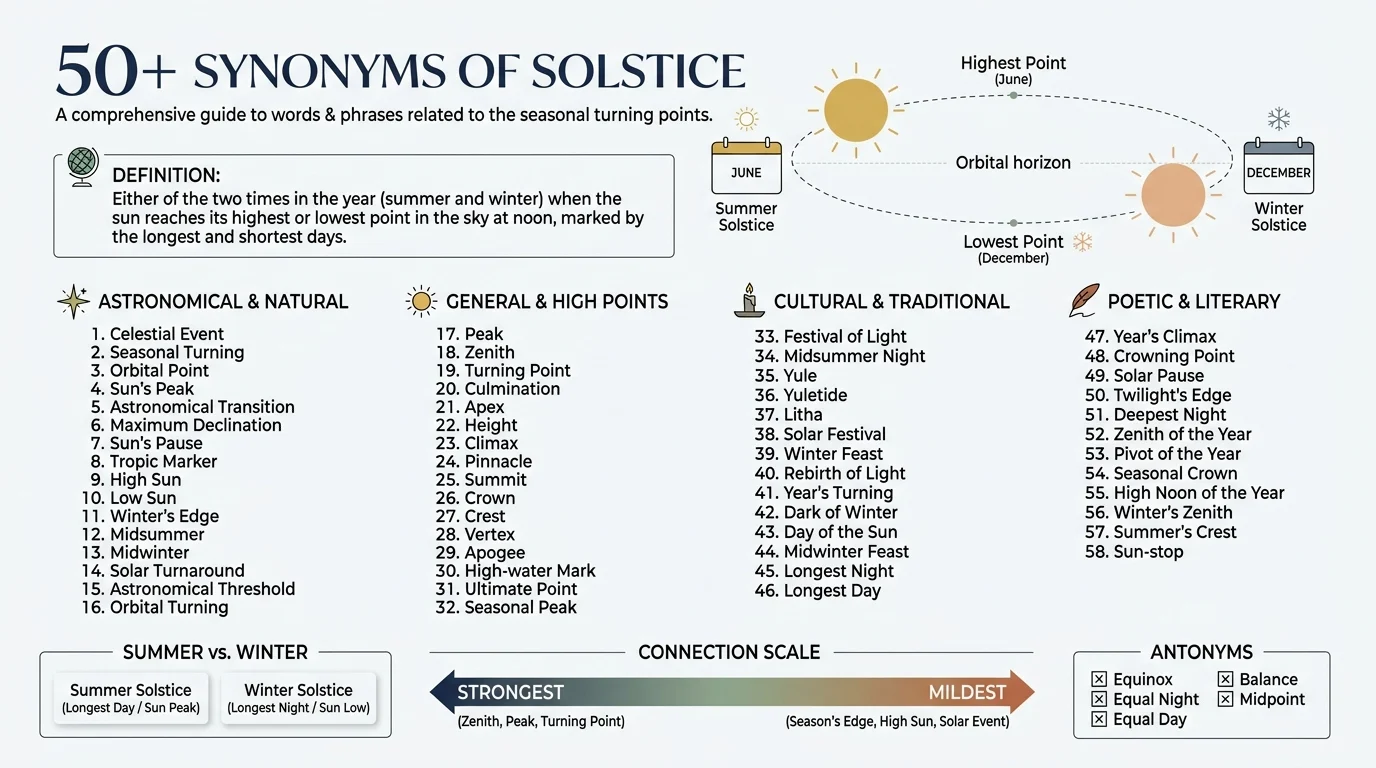
Have you ever needed to describe the longest or shortest day of the year but felt that “solstice” was too technical or unfamiliar? You want to capture the significance of this astronomical event, and the word “solstice” comes to mind. Choosing the right synonym or related term for “solstice” can transform a simple reference into a precise description of seasonal turning points. This guide explores the best synonyms of solstice, explaining exactly which word to use and when.
Quick Ans: “Solstice” means either of the two times of the year when the sun is at its greatest distance from the celestial equator. For general use, choose midsummer or midwinter. For astronomical contexts, use solstitial point or solar standstill. For cultural celebrations, use summer solstice or winter solstice. For poetic effect, use sun’s turning or sunstead.
Meaning, Tone, and Context
Understanding the core meaning of “solstice” is the first step to using it effectively.
Simple Definition: Either of the two times of the year when the sun reaches its highest or lowest point in the sky at noon, marking the longest and shortest days.
Part of Speech: Noun.
Overall Tone: Neutral. It is a scientific and cultural term with no emotional coloring.
Formality Level: Formal to neutral. The word is appropriate in scientific, academic, and cultural contexts.
Common Uses: Native English speakers use it in astronomy (“the summer solstice”), cultural celebrations (“winter solstice festival”), and seasonal references (“the solstice marks the start of summer”).
Word Forms: Related words include the adjective solstitial and the adverb solstitially.
When and How to Use “Solstice”
“Solstice” is the perfect choice when you want to describe the astronomical event marking the longest or shortest day. Here are seven realistic examples.
Astronomical: “The summer solstice occurs around June 21 in the Northern Hemisphere.”
Cultural: “Many cultures celebrate the winter solstice with festivals of light.”
Academic: “The study examined ancient monuments aligned with the solstice.”
Personal: “We gathered to watch the sunrise on the summer solstice.”
Historical: “The solstice was a significant event in many ancient calendars.”
Travel: “Tourists flock to Stonehenge for the summer solstice.”
Social Media: “Happy solstice! Here comes the longest day of the year.”
Best Synonyms and Related Terms of “Solstice”
No synonym is identical in every situation. Here is your guide to the best replacement or related term for “solstice” based on your writing context.
For General and Cultural Contexts
Most Common: Midsummer refers to the summer solstice or the period around it. “Midsummer celebrations are common in Scandinavia.”
Midwinter: Midwinter refers to the winter solstice or the period around it. “The midwinter festival brought light to the dark days.”
Summer solstice: Summer solstice is the specific term for the longest day. “The summer solstice marks the official start of summer.”
Winter solstice: Winter solstice is the specific term for the shortest day. “The winter solstice is celebrated in many cultures.”
For Astronomical and Technical Contexts
Solstitial point: Solstitial point is the astronomical term for the point where the solstice occurs. “The solstitial point marks the sun’s extreme position.”
Solar standstill: Solar standstill describes the apparent pause of the sun’s movement. “The solar standstill occurs at the solstice.”
Sunstead: Sunstead is an archaic term for solstice. “The ancient sunstead was marked by stone monuments.”
Solstice point: Solstice point is a general astronomical term. “The solstice point is calculated precisely.”
For Poetic and Literary Contexts
Sun’s turning: Sun’s turning is a poetic description of the solstice. “The sun’s turning brought longer days.”
Sun’s peak: Sun’s peak describes the highest point of the sun. “At the sun’s peak, the day was longest.”
Sun’s rest: Sun’s rest is a poetic term for the winter solstice. “The sun’s rest marked the year’s darkest day.”
Year’s hinge: Year’s hinge is a literary description of the solstice. “The year’s hinge turned toward the light.”
For Related Astronomical Events
Equinox: Equinox is when day and night are equal. “The equinox occurs in spring and autumn.”
Perihelion: Perihelion is when Earth is closest to the sun. “The perihelion occurs in early January.”
Aphelion: Aphelion is when Earth is farthest from the sun. “The aphelion occurs in early July.”
When Not to Use “Solstice”
Using “solstice” can sound wrong or awkward in certain situations.
When You Mean “Equinox”: “Solstice” is about the longest and shortest days. “Equinox” is about equal days and nights.
Better Choice: Equinox. “The equinox marks the start of spring.”
When You Mean “Season”: “Solstice” is a specific day. “Season” is a period.
Better Choice: Season. “Summer is my favorite season.”
When It Sounds Too Technical: In casual conversation, “solstice” can sound scientific.
Better Choice: Longest day or shortest day. “It is the longest day of the year.”
Words Commonly Confused With “Solstice”
| Word | Difference | When to Use | Example |
|---|---|---|---|
| Equinox | Equal day and night | Spring and autumn | “The spring equinox.” |
| Midsummer | Summer solstice period | Cultural celebrations | “Midsummer festival.” |
| Midwinter | Winter solstice period | Cultural celebrations | “Midwinter feast.” |
| Perihelion | Closest to the sun | Astronomical | “The perihelion occurs in January.” |
| Aphelion | Farthest from the sun | Astronomical | “The aphelion occurs in July.” |
| Zenith | Highest point | General and astronomical | “The sun reached its zenith.” |
Best Synonyms of “Solstice” by Context
| Context | Best Synonym | Why It Works | Example |
|---|---|---|---|
| General use | Midsummer | Common and cultural | “Midsummer celebrations.” |
| General use | Midwinter | Common and cultural | “Midwinter festival.” |
| Astronomical | Solstitial point | Technical and precise | “The solstitial point.” |
| Astronomical | Solar standstill | Descriptive and technical | “The solar standstill.” |
| Poetic | Sun’s turning | Evocative and literary | “The sun’s turning.” |
| Cultural | Summer solstice | Specific and celebratory | “Summer solstice festival.” |
| Cultural | Winter solstice | Specific and celebratory | “Winter solstice ritual.” |
How to Choose the Best Synonym of “Solstice”
Choosing the right word is a simple decision. Answer these questions.
What type of solstice am I describing? For summer, use summer solstice or midsummer. And For winter, use winter solstice or midwinter. For astronomical, use solstitial point or solar standstill.
What is my audience? For a formal report, use solstitial point or summer solstice. For a friend, use longest day or midsummer.
What is my purpose? Are you describing an astronomical event, a cultural celebration, or a poetic image? The correct synonym depends entirely on this.
What is the emotional strength? Sun’s turning is poetic. Solstitial point is technical. Pick the one that matches your message.
Real Life Examples of “Solstice”
School: Basic: “The solstice is in June.” Improved: “The summer solstice occurs in June.”
College: Basic: “The study examined solstice alignments.” Improved: “The study examined solstitial alignments in ancient structures.”
Workplace: Basic: “The solstice is a holiday.” Improved: “The winter solstice is celebrated as a holiday.”
Business: Basic: “The solstice affects daylight.” Improved: “The summer solstice provides the most daylight.”
Email: Basic: “Happy solstice.” Improved: “Happy midsummer.”
Conversation: Basic: “The solstice is coming.” Improved: “The longest day is coming.”
Storytelling: Basic: “The solstice was sacred.” Improved: “The sun’s turning was sacred to the ancients.”
Top 10 Synonyms and Related Terms of “Solstice”
| Term | Simple Meaning | Best Used For | Example Sentence |
|---|---|---|---|
| Midsummer | Summer solstice period | Cultural and general | “Midsummer celebrations are common.” |
| Midwinter | Winter solstice period | Cultural and general | “The midwinter feast was joyful.” |
| Summer solstice | Longest day of the year | Specific and cultural | “The summer solstice is in June.” |
| Winter solstice | Shortest day of the year | Specific and cultural | “The winter solstice is in December.” |
| Solstitial point | Astronomical point of solstice | Technical and scientific | “The solstitial point was calculated.” |
| Solar standstill | Apparent pause of the sun | Technical and descriptive | “The solar standstill occurs at solstice.” |
| Sunstead | Archaic term for solstice | Literary and historical | “The ancient sunstead was marked.” |
| Sun’s turning | Poetic description | Poetic and literary | “The sun’s turning brought longer days.” |
| Equinox | Equal day and night | Related astronomical event | “The equinox occurs in spring.” |
| Year’s hinge | Literary description | Literary and poetic | “The year’s hinge turned toward light.” |
Synonyms of “Solstice” by Usage
Professional vs. Personal Synonyms
In professional contexts, choose summer solstice, winter solstice, or solstitial point. With friends, use midsummer, midwinter, or longest day.
Formal vs. Conversational Synonyms
For formal writing, use solstitial point, summer solstice, or winter solstice. For casual conversations, use midsummer, midwinter, or longest day.
Academic Synonyms
For research and essays, choose solstitial point for astronomy, solstice alignment for archaeology, and solar standstill for physics.
Professional and Business Synonyms
For maximum impact, choose summer solstice for events, winter solstice for holidays, and solstitial point for technical reports.
Creative and Literary Synonyms
To add emotion and imagery, choose sun’s turning, year’s hinge, or sunstead. These words create atmosphere.
Slang or Modern Synonyms
There is no direct slang synonym for “solstice.” In modern usage, longest day or shortest day are the most common alternatives.
Strongest to Mildest Synonyms
Mild: longest day, shortest day
Moderate: solstice, midsummer, midwinter
Strong: summer solstice, winter solstice
Very Strong: solstitial point, solar standstill, sunstead
Emotional vs. Neutral Synonyms
Emotional Synonyms: Sun’s turning, year’s hinge. These words hint at poetic and spiritual significance. Use them when you want to evoke feeling.
Neutral Synonyms: Solstice, summer solstice, winter solstice. These words communicate factual information.
Antonyms of “Solstice”
| Antonym | Meaning | Example Sentence |
|---|---|---|
| Equinox | Equal day and night | “The equinox occurs in spring.” |
| Aphelion | Farthest from the sun | “The aphelion occurs in July.” |
| Perihelion | Closest to the sun | “The perihelion occurs in January.” |
| Zenith | Highest point | “The sun reached its zenith.” |
| Nadir | Lowest point | “The sun reached its nadir.” |
| Midnight sun | Sun visible at midnight | “The midnight sun occurs in the Arctic.” |
| Polar night | Darkness at noon | “The polar night lasts for months.” |
| Darkness | Absence of light | “The darkness covered the land.” |
| Winter | Coldest season | “Winter brings short days.” |
| Summer | Warmest season | “Summer brings long days.” |
| Autumn | Season of transition | “Autumn marks the equinox.” |
| Spring | Season of renewal | “Spring marks the equinox.” |
| Noon | Middle of the day | “The sun is highest at noon.” |
| Midnight | Middle of the night | “The sun is lowest at midnight.” |
| Twilight | Dim light after sunset | “The twilight was beautiful.” |
Comparison: “Solstice” vs Similar Words
Solstice vs. Equinox
Main Difference: “Solstice” is the longest or shortest day. “Equinox” is equal day and night.
Which Is Stronger? They are different events.
Which Is More Formal? Both are formal.
When to Use Each: Use “solstice” for longest/shortest days. Use “equinox” for equal days.
Examples:
Solstice: “The summer solstice is in June.”
Equinox: “The spring equinox is in March.”
Solstice vs. Midsummer
Main Difference: “Midsummer” is the period around the summer solstice. “Solstice” is the specific day.
Which Is Stronger? “Solstice” is more precise.
Which Is More Formal? Both are neutral.
When to Use Each: Use “midsummer” for celebrations. Use “solstice” for astronomy.
Examples:
Solstice: “The summer solstice occurs in June.”
Midsummer: “Midsummer celebrations are common.”
Solstice vs. Midwinter
Main Difference: “Midwinter” is the period around the winter solstice. “Solstice” is the specific day.
Which Is Stronger? “Solstice” is more precise.
Which Is More Formal? Both are neutral.
When to Use Each: Use “midwinter” for celebrations. Use “solstice” for astronomy.
Examples:
Solstice: “The winter solstice is in December.”
Midwinter: “The midwinter feast was joyful.”
Solstice vs. Solstitial Point
Main Difference: “Solstitial point” is the astronomical point. “Solstice” is the event.
Which Is Stronger? “Solstitial point” is more technical.
Which Is More Formal? Both are formal.
When to Use Each: Use “solstitial point” for technical writing. Use “solstice” for general contexts.
Examples:
Solstice: “The solstice marks the longest day.”
Solstitial point: “The solstitial point was calculated.”
Solstice vs. Solar Standstill
Main Difference: “Solar standstill” describes the sun’s apparent pause. “Solstice” is the event.
Which Is Stronger? “Solar standstill” is more descriptive.
Which Is More Formal? Both are formal.
When to Use Each: Use “solar standstill” for descriptive writing. Use “solstice” for general contexts.
Examples:
Solstice: “The solstice occurs twice a year.”
Solar standstill: “The solar standstill occurs at the solstice.”
Solstice vs. Sunstead
Main Difference: “Sunstead” is archaic. “Solstice” is modern.
Which Is Stronger? “Sunstead” is more literary.
Which Is More Formal? Both are formal.
When to Use Each: Use “sunstead” in historical writing. Use “solstice” in general contexts.
Examples:
Solstice: “The solstice was celebrated.”
Sunstead: “The ancient sunstead was marked.”
Common Phrases and Expressions with “Solstice”
Phrase: Summer solstice
Meaning: The longest day of the year.
Example Sentence: “The summer solstice is celebrated worldwide.”
Phrase: Winter solstice
Meaning: The shortest day of the year.
Example Sentence: “The winter solstice marks the return of light.”
Phrase: Solstice celebration
Meaning: A festival marking the solstice.
Example Sentence: “The solstice celebration lasted all night.”
Phrase: Solstice sunrise
Meaning: The sunrise on the solstice.
Example Sentence: “We watched the solstice sunrise at Stonehenge.”
Phrase: Solstice alignment
Meaning: The alignment of structures with the solstice sun.
Example Sentence: “The solstice alignment was intentional.”
Phrase: Solstice point
Meaning: The astronomical point of the solstice.
Example Sentence: “The solstice point is marked on the map.”
Common Mistakes to Avoid
Mistake 1: Using “solstice” when you mean “equinox”.
Incorrect: “The solstice marks equal day and night.”
Better: “The equinox marks equal day and night.”
Why: “Equinox” is for equal days.
Mistake 2: Using “solstice” when you mean “season”.
Incorrect: “Summer solstice is my favorite season.”
Better: “Summer is my favorite season.”
Why: “Season” is a period.
Mistake 3: Overusing “solstice” in casual conversation.
Incorrect: “The solstice is coming.”
Better: “The longest day is coming.”
Why: “Longest day” sounds more natural.
Mistake 4: Using “solstice” when you mean “midsummer”.
Incorrect: “The solstice festival was fun.”
Better: “The midsummer festival was fun.”
Why: “Midsummer” is for celebrations.
Mistake 5: Using “solstice” when you mean “solstitial point”.
Incorrect: “The solstice was calculated precisely.”
Better: “The solstitial point was calculated precisely.”
Why: “Solstitial point” is technical.
Frequently Asked Questions
1. What are the best synonyms of “solstice”?
The best synonyms depend on your context. For general use, choose midsummer or midwinter. And For astronomical contexts, use solstitial point or solar standstill. For cultural celebrations, use summer solstice or winter solstice.
2. What are the best formal synonyms of “solstice”?
The best formal synonyms are solstitial point, solar standstill, and summer solstice. These words are suitable for academic papers, professional reports, and scientific communications.
3. What are common informal synonyms of “solstice”?
For informal settings, use midsummer, midwinter, or longest day. These alternatives sound more natural in everyday conversation.
4. What is another word for “solstice” in professional writing?
In professional writing, solstitial point is an excellent choice. It conveys astronomical precision. Summer solstice is also strong for cultural contexts.
5. What is the difference between “solstice” and “equinox”?
“Solstice” is the longest or shortest day. “Equinox” is when day and night are equal. They are different astronomical events.
6. What is the opposite of “solstice”?
The most direct opposite of “solstice” is equinox. Other related terms include perihelion and aphelion.
Conclusion
“Solstice” is a precise and evocative word for describing the astronomical events that mark the longest and shortest days of the year. The term is neutral and widely accepted in scientific, cultural, and academic contexts, yet it can sound too technical for casual conversation. The best choice among the synonyms of solstice depends entirely on your audience, tone, and purpose. Remember, no single synonym works perfectly in every situation. Your goal is to choose the word that communicates your message with the most clarity and impact. A practical tip for your vocabulary growth is to pay attention to how writers describe astronomical events and practice using different synonyms in your writing.









