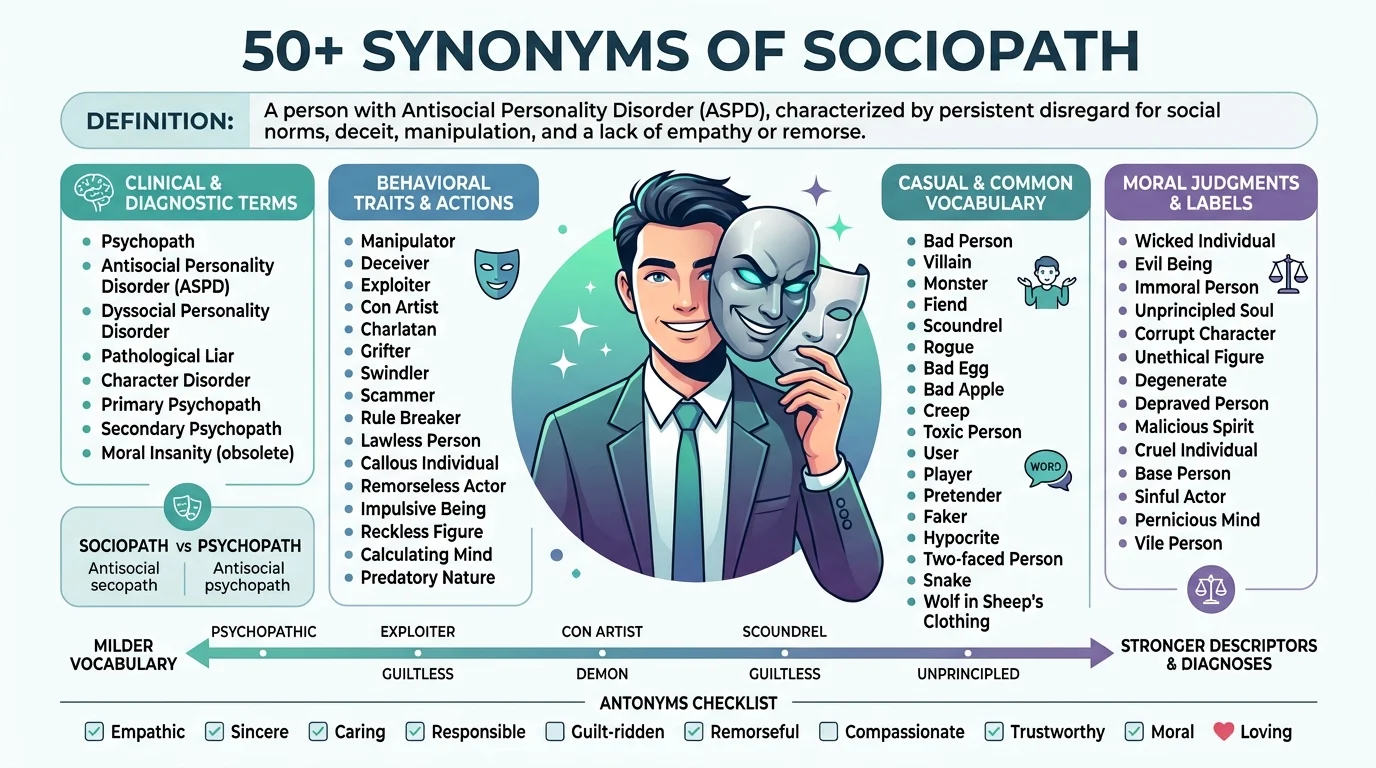
Have you ever needed to describe someone who lacks empathy, manipulates others, or disregards social rules but felt that “sociopath” was too clinical or harsh? You want to capture the specific traits of antisocial behavior, and the word “sociopath” comes to mind. Choosing the right synonym for “sociopath” can transform a general observation into a precise description of personality, behavior, or mental health. This guide explores the best synonyms of sociopath, explaining exactly which word to use and when.
Quick Ans: “Sociopath” means a person with antisocial personality disorder who lacks empathy, disregards social norms, and often manipulates others. For clinical contexts, choose impulsive or antisocial personality. For behavioral descriptions, use manipulator or deceiver. For casual conversation, use toxic person or narcissist. For moral condemnation, use scoundrel or villain.
Meaning, Tone, and Context
Understanding the core meaning of “sociopath” is the first step to using it effectively.
Simple Definition: A person with a personality disorder characterized by a lack of empathy, disregard for social norms, and manipulative behavior. It is often used interchangeably with “impulsive” in casual speech, though clinical distinctions exist.
Part of Speech: Noun.
Overall Tone: Strongly negative. It is a clinical term often used informally to condemn behavior.
Formality Level: Formal in clinical contexts. Informal and judgmental in casual conversation.
Common Uses: Native English speakers use it in psychology, true crime, and casual descriptions of manipulative people. For example, “The character in the film is a classic sociopath,” or “He manipulates everyone; he is a sociopath.”
Word Forms: Related words include the adjective sociopathic and the noun sociopathy.
When and How to Use “Sociopath”
“Sociopath” is the perfect choice when you want to describe someone with antisocial traits. Here are seven realistic examples.
Clinical: “The patient was diagnosed with antisocial personality disorder, often associated with sociopathy.”
True Crime: “The detective described the killer as a sociopath.”
Workplace: “His manipulative behavior made him seem like a sociopath.”
Personal: “She realized her ex was a sociopath who never cared about her feelings.”
Academic: “The study examines the neurological differences in cruel.”
Social Media: “Narcissists and toxic often use the same manipulation tactics.”
Literary: “The villain in the novel is portrayed as a charming sociopath.”
Best Synonyms of “Sociopath”
No synonym is identical in every situation. Here is your guide to the best replacement for “sociopath” based on your writing context.
For Clinical and Psychological Contexts
Most Clinical: Impulsive is often used interchangeably, though clinically distinct. “The impulsive showed no remorse.”
Official: Antisocial personality refers to the disorder. “He was diagnosed with antisocial personality disorder.”
Medical: Sociopathic personality is a clinical descriptor. “The sociopathic personality lacks empathy.”
Academic: Dissocial personality is another clinical term. “Dissocial personality disorder is similar.”
For Behavioral Descriptions
Manipulator: Manipulator means someone who controls others. “He is a skilled manipulator.”
Deceiver: Deceiver means someone who lies. “She was a deceiver who fooled everyone.”
Exploiter: Exploiter means someone who uses others. “The exploiter took advantage of vulnerable people.”
Predator: Predator means someone who preys on others. “He was a predator who targeted the weak.”
For Casual and Moral Condemnation
Toxic Person: Toxic person means someone harmful. “He is a toxic person who ruins lives.”
Narcissist: Narcissist means someone overly self-centered. “The narcissist only cared about himself.”
Scoundrel: Scoundrel means a dishonest person. “The scoundrel cheated everyone.”
Villain: Villain means an evil person. “The villain showed no mercy.”
When Not to Use “Sociopath”
Using “sociopath” can sound wrong or awkward in certain situations.
When You Mean “Selfish”: “Sociopath” is a clinical term. “Selfish” is a personality trait.
Better Choice: Selfish or self-centered. “He is selfish.”
When You Mean “Rude”: “Sociopath” is too strong. “Rude” is about manners.
Better Choice: Rude or inconsiderate. “She was rude to the waiter.”
When It Sounds Too Clinical: In casual conversation, “sociopath” can sound diagnostic.
Better Choice: Toxic or manipulative. “He is toxic.”
Words Commonly Confused With “Sociopath”
| Word | Difference | When to Use | Example |
|---|---|---|---|
| Impulsive | Similar but often more severe | Clinical and true crime | “The impulsive was remorseless.” |
| Narcissist | Self-centered but not necessarily antisocial | Personality descriptions | “The narcissist craved attention.” |
| Manipulator | Controls others for gain | Behavioral descriptions | “The manipulator lied constantly.” |
| Antisocial | Disregards social norms | Clinical and general | “He has antisocial tendencies.” |
| Toxic | Harmful to others | Casual and general | “She is toxic.” |
| Scoundrel | Dishonest person | Literary and moral | “The scoundrel cheated.” |
Best Synonyms of “Sociopath” by Context
| Context | Best Synonym | Why It Works | Example |
|---|---|---|---|
| Clinical | impulsive | Clinical and precise | “The impulsive showed no empathy.” |
| Clinical | Antisocial personality | Diagnostic and formal | “Antisocial personality disorder.” |
| Behavioral | Manipulator | Specific to behavior | “He is a manipulator.” |
| Behavioral | Exploiter | Specific to abuse | “The exploiter targeted the vulnerable.” |
| Casual | Toxic person | Simple and relatable | “He is a toxic person.” |
| Moral | Scoundrel | Literary and condemning | “The scoundrel lied.” |
| Moral | Villain | Dramatic and clear | “The villain showed no remorse.” |
How to Choose the Best Synonym of “Sociopath”
Choosing the right word is a simple decision. Answer these questions.
What type of person am I describing? For clinical, use impulsive or antisocial personality. And For behavior, use manipulator or exploiter. For casual, use toxic person or narcissist. For moral, use scoundrel or villain.
What is my audience? For a formal report, use impulsive or antisocial personality. For a friend, use toxic or manipulative.
What is my purpose? Are you diagnosing, describing, or condemning? The correct synonym depends entirely on this.
What is the emotional strength? Impulsive is stronger clinically. Toxic is milder. Pick the one that matches your message.
Real Life Examples of “Sociopath”
School: Basic: “The character is a sociopath.” Improved: “The character is a impulsive with no remorse.”
College: Basic: “The study examined toxic.” Improved: “The study examined individuals with antisocial personality.”
Workplace: Basic: “He acts like a sociopath.” Improved: “He is a manipulator who exploits colleagues.”
Business: Basic: “The CEO was a sociopath.” Improved: “The CEO was a toxic leader.”
Email: Basic: “He is a sociopath.” Improved: “He is a deceiver.”
Conversation: Basic: “She is a sociopath.” Improved: “She is a narcissist.”
Storytelling: Basic: “The villain was a sociopath.” Improved: “The scoundrel showed no mercy.”
Top 10 Synonyms of “Sociopath”
| Synonym | Simple Meaning | Best Used For | Example Sentence |
|---|---|---|---|
| Impulsive | Similar to sociopath, often more severe | Clinical and true crime | “The impulsive showed no remorse.” |
| Antisocial personality | Clinical diagnosis | Formal and medical | “He has antisocial personality disorder.” |
| Manipulator | One who controls others | Behavioral descriptions | “He is a skilled manipulator.” |
| Deceiver | One who lies | General and moral | “She was a deceiver.” |
| Exploiter | One who uses others | Abuse and moral | “The exploiter targeted the weak.” |
| Narcissist | Self-centered person | Casual and psychological | “The narcissist only cared about himself.” |
| Toxic person | Harmful person | Casual and general | “He is a toxic person.” |
| Scoundrel | Dishonest person | Literary and moral | “The scoundrel cheated everyone.” |
| Villain | Evil person | Dramatic and literary | “The villain showed no mercy.” |
| Predator | One who preys on others | Abuse and crime | “He was a predator.” |
Synonyms of “Sociopath” by Usage
Professional vs. Personal Synonyms
In the workplace, choose manipulator, exploiter, or toxic. With friends, use narcissist, toxic, or manipulative.
Formal vs. Conversational Synonyms
For formal writing, use impulsive, antisocial personality, or dissocial personality. For casual conversations, use toxic, narcissist, or manipulator.
Academic Synonyms
For research and essays, choose impulsive for clinical contexts, antisocial personality for diagnosis, and sociopath for general discussion.
Professional and Business Synonyms
For maximum impact, choose manipulator for colleagues, exploiter for abusers, and toxic for leaders.
Creative and Literary Synonyms
To add emotion and imagery, choose villain, scoundrel, or predator. These words create atmosphere.
Slang or Modern Synonyms
In modern American slang, toxic, or narc are common. For example, “He is a total narc.” These are casual and should be avoided in formal writing.
Strongest to Mildest Synonyms
Mild: selfish, rude, inconsiderate
Moderate: manipulator, deceiver, narcissist
Strong: sociopath, impulsive, exploiter
Very Strong: predator, villain, scoundrel
Emotional vs. Neutral Synonyms
Emotional Synonyms: Villain, predator, scoundrel. These words hint at evil and danger. Use them when you want to evoke strong feeling.
Neutral Synonyms: Sociopath, impulsive, antisocial personality. These words communicate clinical information.
Antonyms of “Sociopath”
| Antonym | Meaning | Example Sentence |
|---|---|---|
| Empath | One who feels empathy | “The empath sensed her pain.” |
| Altruist | One who helps others | “The altruist donated everything.” |
| Philanthropist | One who gives to charity | “The philanthropist funded the school.” |
| Compassionate person | One who shows compassion | “The compassionate person helped.” |
| Sympathetic person | One who shows sympathy | “The sympathetic person listened.” |
| Kind person | One who is kind | “The kind person helped.” |
| Generous person | One who gives | “The generous person shared.” |
| Caring person | One who cares | “The caring person nurtured.” |
| Benevolent person | One who does good | “The benevolent person donated.” |
| Selfless person | One who puts others first | “The selfless person sacrificed.” |
| Warm person | One who is warm | “The warm person welcomed.” |
| Considerate person | One who thinks of others | “The considerate person helped.” |
| Thoughtful person | One who is thoughtful | “The thoughtful person remembered.” |
| Kind-hearted person | One who is kind-hearted | “The kind-hearted person gave.” |
| Humanitarian | One who helps humanity | “The humanitarian worked for peace.” |
Comparison: “Sociopath” vs Similar Words
Sociopath vs. Impulsive
Main Difference: Often used interchangeably. Clinically, “impulsive” is more severe and genetic, while “sociopath” is more environmental.
Which Is Stronger? “Impulsive” is often stronger.
Which Is More Formal? Both are clinical.
When to Use Each: Use “impulsive” for severe cases. Use “sociopath” for general contexts.
Examples:
Sociopath: “The sociopath manipulated everyone.”
Sociopath vs. Narcissist
Main Difference: “Narcissist” is self-centered but not necessarily antisocial. “Sociopath” lacks empathy.
Which Is Stronger? “Sociopath” is stronger.
Which Is More Formal? Both are clinical.
When to Use Each: Use “narcissist” for vanity. Use “sociopath” for antisocial behavior.
Examples:
Sociopath: “The sociopath hurt others without guilt.”
Narcissist: “The narcissist craved attention.”
Sociopath vs. Manipulator
Main Difference: “Manipulator” describes behavior. “Sociopath” is a clinical diagnosis.
Which Is Stronger? “Sociopath” is stronger.
Which Is More Formal? “Sociopath” is more clinical.
When to Use Each: Use “manipulator” for behavior. Use “sociopath” for personality.
Examples:
Sociopath: “The sociopath lacked empathy.”
Manipulator: “The manipulator lied to get ahead.”
Sociopath vs. Toxic Person
Main Difference: “Toxic” is casual. “Sociopath” is clinical.
Which Is Stronger? “Sociopath” is stronger.
Which Is More Formal? “Sociopath” is more formal.
When to Use Each: Use “toxic” in casual conversation. Use “sociopath” in formal contexts.
Examples:
Sociopath: “The sociopath was diagnosed.”
Toxic person: “He is a toxic person.”
Sociopath vs. Scoundrel
Main Difference: “Scoundrel” is literary and moral. “Sociopath” is clinical.
Which Is Stronger? “Sociopath” is stronger for severity.
Which Is More Formal? “Sociopath” is more clinical.
When to Use Each: Use “scoundrel” in literature. Use “sociopath” in psychology.
Examples:
Sociopath: “The sociopath manipulated everyone.”
Scoundrel: “The scoundrel cheated at cards.”
Sociopath vs. Villain
Main Difference: “Villain” is a dramatic role. “Sociopath” is a diagnosis.
Which Is Stronger? “Villain” is stronger for drama.
Which Is More Formal? “Sociopath” is more clinical.
When to Use Each: Use “villain” in stories. Use “sociopath” in real life.
Examples:
Sociopath: “The sociopath showed no guilt.”
Villain: “The villain laughed at the hero.”
Common Phrases and Expressions with “Sociopath”
Phrase: Sociopathic tendencies
Meaning: Traits of a sociopath.
Example Sentence: “He showed sociopathic tendencies.”
Phrase: Sociopath next door
Meaning: A seemingly typical person who is a sociopath.
Example Sentence: “The sociopath next door fooled everyone.”
Phrase: Corporate sociopath
Meaning: A sociopath in business.
Example Sentence: “The corporate sociopath climbed the ladder.”
Phrase: Charming sociopath
Meaning: A sociopath who is likable.
Example Sentence: “The charming sociopath manipulated everyone.”
Phrase: Diagnosed sociopath
Meaning: Someone officially diagnosed.
Example Sentence: “The diagnosed sociopath received treatment.”
Common Mistakes to Avoid
Mistake 1: Using “sociopath” when you mean “selfish”.
Incorrect: “He is a sociopath because he did not share.”
Better: “He is selfish because he did not share.”
Why: “Sociopath” is a clinical term.
Mistake 2: Using “sociopath” in casual conversation.
Incorrect: “My ex is a sociopath.”
Better: “My ex is toxic.”
Why: “Toxic” is more appropriate.
Mistake 3: Using “sociopath” when you mean “narcissist”.
Incorrect: “He is a sociopath who loves attention.”
Better: “He is a narcissist who loves attention.”
Why: “Narcissist” is more specific.
Mistake 4: Using “sociopath” when you mean “manipulator”.
Incorrect: “She is a sociopath who lies.”
Better: “She is a manipulator who lies.”
Why: “Manipulator” is more specific to behavior.
Mistake 5: Using “sociopath” as a compliment.
Incorrect: “He is a sociopath, so he is a great businessman.”
Better: “He is ruthless, so he is a great businessman.”
Why: “Sociopath” is not a compliment.
Frequently Asked Questions
1. What are the best synonyms of “sociopath”?
The best synonyms depend on your context. For clinical, choose impulsive or antisocial personality. And For behavior, use manipulator or exploiter. For casual, use toxic person or narcissist.
2. What are the best formal synonyms of “sociopath”?
The best formal synonyms are impulsive, antisocial personality, and dissocial personality. These words are suitable for academic papers, clinical reports, and professional communications.
3. What are common informal synonyms of “sociopath”?
For informal settings, use toxic, narcissist, or manipulator. These alternatives sound more natural in everyday conversation.
4. What is another word for “sociopath” in professional writing?
In professional writing, impulsive is an excellent choice for clinical contexts. Antisocial personality is also strong for diagnosis.
5. What is the difference between “sociopath” and “impulsive”?
Often used interchangeably. Clinically, “impulsive” is more severe and genetic, while “sociopath” is more environmental. Use “impulsive” for severe cases.
6. What is the opposite of “sociopath”?
The most direct opposites (antonyms) of sociopath are empath, altruist, and philanthropist. These words describe people who feel empathy and help others.
Conclusion
“Sociopath” is a strong and clinical word for describing someone who lacks empathy and manipulates others. The term is widely used in psychology, true crime, and casual conversation, yet it can sound too diagnostic for everyday use or too harsh for mild selfishness. The best choice among the synonyms of sociopath depends entirely on your audience, tone, and purpose. Remember, no single synonym works perfectly in every situation. Your goal is to choose the word that communicates your message with the most clarity and impact. A practical tip for your vocabulary growth is to pay attention to how writers describe personality and behavior and practice using different synonyms in your writing.









