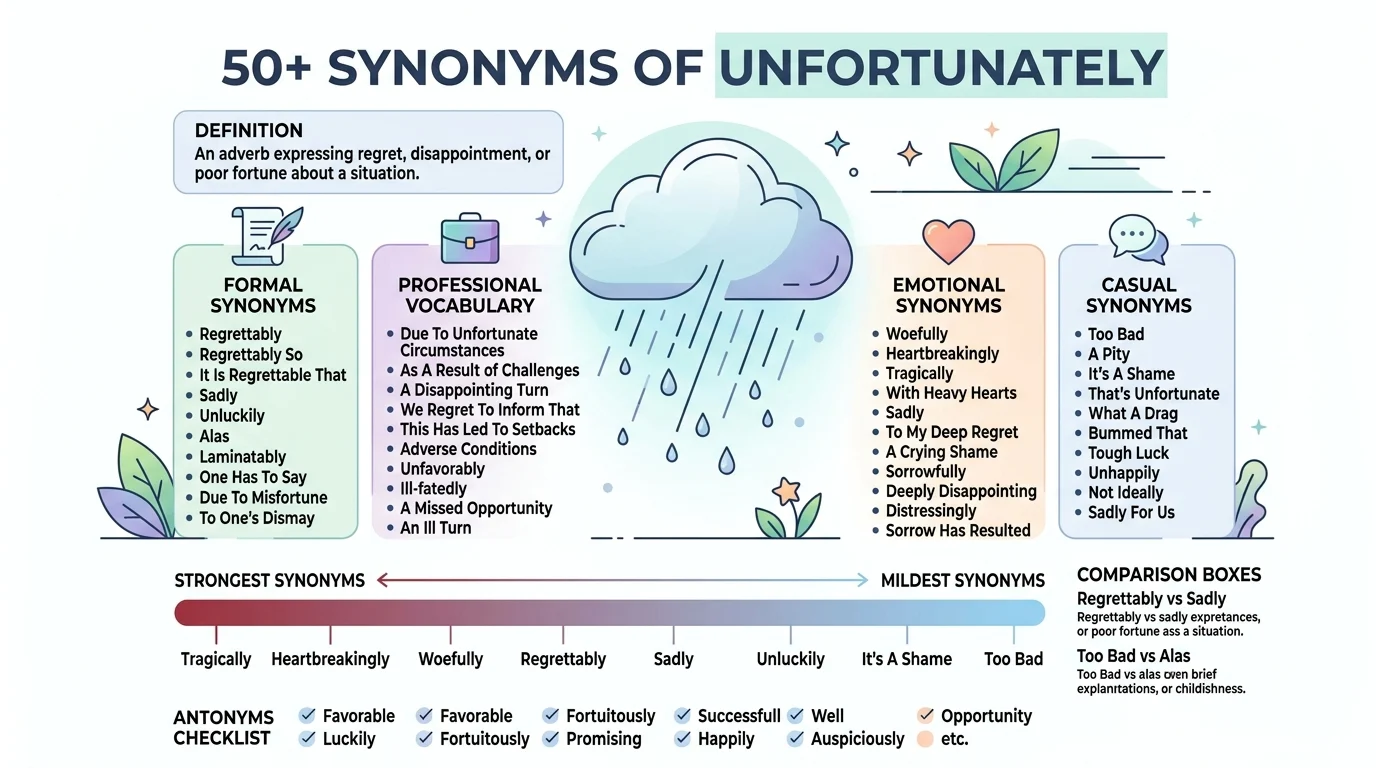
Have you ever needed to deliver bad news, express regret, or soften a disappointing statement but felt that “unfortunately” was too repetitive? You want to convey sympathy, disappointment, or simply acknowledge an unlucky situation, and the word “unfortunately” comes to mind. Choosing the right synonym for “unfortunately” can transform a blunt statement into a diplomatic, empathetic, or professional message. This guide explores the best synonyms of unfortunately, explaining exactly which word to use and when.
Quick Ans: “Unfortunately” means it is sad, unlucky, or regrettable that something is the case. For formal writing, choose regrettably or alas. For professional communication, use sadly or disappointingly. For casual conversation, use unluckily or too bad. For softening bad news, use I’m afraid or sad to say.
Meaning, Tone, and Context
Understanding the core meaning of “unfortunately” is the first step to using it effectively.
Simple Definition: Used to say that something is sad, disappointing, or unlucky; it is regrettable that something is the case.
Part of Speech: Adverb.
Overall Tone: Negative and empathetic. It expresses regret, sympathy, or disappointment.
Formality Level: Neutral to formal. The word is appropriate in most contexts.
Common Uses: Native English speakers use it to deliver bad news, express regret, or soften disappointing information. For example, “Unfortunately, the event has been canceled,” or “Unfortunately, I cannot attend.”
Word Forms: Related words include the adjective unfortunate and the noun unfortunateness.
When and How to Use “Unfortunately”
“Unfortunately” is the perfect choice when you want to express regret or deliver disappointing news. Here are seven realistic examples.
Professional: “Unfortunately, we are unable to meet your deadline.”
Academic: “Unfortunately, the data was incomplete.”
Workplace: “Unfortunately, the position has been filled.”
Personal: “Unfortunately, I cannot make it to the party.”
Email: “Unfortunately, the shipment has been delayed.”
Resume: (Avoid in resumes) Use positive framing instead.
Social Media: “Unfortunately, the concert was canceled due to rain.”
Best Synonyms of “Unfortunately”
No synonym is identical in every situation. Here is your guide to the best replacement for “unfortunately” based on your writing context.
For Formal and Professional Contexts
Most Formal: Regrettably is the most formal synonym. “Regrettably, we must decline your offer.”
Literary: Alas is an archaic but expressive synonym. “Alas, the plan failed.”
Disappointing: Disappointingly means in a disappointing manner. “Disappointingly, the results were poor.”
Sadly: Sadly means in a sad manner. “Sadly, the event was canceled.”
For Casual and Conversational Contexts
Unluckily: Unluckily means by bad luck. “Unluckily, I missed the bus.”
Too bad: Too bad is an informal expression of regret. “Too bad you cannot come.”
Sad to say: Sad to say means regrettably. “Sad to say, the deal fell through.”
I’m afraid: I’m afraid is a polite way to deliver bad news. “I’m afraid the tickets are sold out.”
For Softening Bad News
Unfortunately for: Unfortunately for means to someone’s disadvantage. “Unfortunately for us, the weather turned bad.”
As luck would have it: As luck would have it means by chance, often ironically. “As luck would have it, the train was late.”
By misfortune: By misfortune means due to bad luck. “By misfortune, the funds were lost.”
For Expressing Sympathy
Sorry to say: Sorry to say means with regret. “Sorry to say, the answer is no.”
With regret: With regret means with a feeling of sadness. “With regret, I must resign.”
It is a pity: It is a pity means it is regrettable. “It is a pity you cannot join us.”
When Not to Use “Unfortunately”
Using “unfortunately” can sound wrong or awkward in certain situations.
When You Mean “However”: “Unfortunately” is about regret. “However” is about contrast.
Better Choice: However or nevertheless. “However, the results were positive.”
When It Sounds Too Negative: “Unfortunately” can sound pessimistic.
Better Choice: Interestingly or notably. “Interestingly, the results differed.”
When It Sounds Too Informal: In very formal writing, “unfortunately” can sound casual.
Better Choice: Regrettably or with regret. “Regrettably, we must decline.”
Words Commonly Confused With “Unfortunately”
| Word | Difference | When to Use | Example |
|---|---|---|---|
| Regrettably | Formal expression of regret | Formal and professional | “Regrettably, we must decline.” |
| Sadly | Expresses sadness | General and emotional | “Sadly, the event was canceled.” |
| Unluckily | By bad luck | Casual and general | “Unluckily, I missed the bus.” |
| Alas | Archaic expression of regret | Literary and dramatic | “Alas, the plan failed.” |
| Disappointingly | In a disappointing manner | General and formal | “Disappointingly, the results were poor.” |
| I’m afraid | Polite way to deliver bad news | Professional and polite | “I’m afraid the tickets are sold out.” |
Best Synonyms of “Unfortunately” by Context
| Context | Best Synonym | Why It Works | Example |
|---|---|---|---|
| Formal writing | Regrettably | Formal and precise | “Regrettably, we must decline.” |
| Professional | I’m afraid | Polite and professional | “I’m afraid the position is filled.” |
| Academic | Disappointingly | Measured and formal | “Disappointingly, the data was incomplete.” |
| Casual conversation | Too bad | Simple and natural | “Too bad you cannot come.” |
| Emotional | Sadly | Expresses sadness | “Sadly, the event was canceled.” |
| Literary | Alas | Dramatic and expressive | “Alas, the plan failed.” |
| Sympathy | With regret | Formal and empathetic | “With regret, I must resign.” |
How to Choose the Best Synonym of “Unfortunately”
Choosing the right word is a simple decision. Answer these questions.
What is the context? For formal writing, use regrettably or with regret. And For casual conversation, use too bad or unluckily. For professional, use I’m afraid or sadly.
What is my audience? For a formal report, use regrettably. For a friend, use too bad or sadly.
What is my purpose? Are you delivering bad news, expressing sympathy, or softening a statement? The correct synonym depends entirely on this.
What is the emotional strength? Alas is dramatic. I’m afraid is polite. Pick the one that matches your message.
Real Life Examples of “Unfortunately”
School: Basic: “Unfortunately, the test was hard.” Improved: “Regrettably, the test was difficult.”
College: Basic: “Unfortunately, the data was incomplete.” Improved: “Disappointingly, the data was incomplete.”
Workplace: Basic: “Unfortunately, the position is filled.” Improved: “I’m afraid the position has been filled.”
Business: Basic: “Unfortunately, the shipment is delayed.” Improved: “Regrettably, the shipment has been delayed.”
Email: Basic: “Unfortunately, I cannot attend.” Improved: “Sadly, I cannot attend.”
Conversation: Basic: “Unfortunately, I missed the bus.” Improved: “Unluckily, I missed the bus.”
Storytelling: Basic: “Unfortunately, the plan failed.” Improved: “Alas, the plan failed.”
Top 10 Synonyms of “Unfortunately”
| Synonym | Simple Meaning | Best Used For | Example Sentence |
|---|---|---|---|
| Regrettably | In a regrettable manner | Formal and professional | “Regrettably, we must decline.” |
| Sadly | In a sad manner | General and emotional | “Sadly, the event was canceled.” |
| Unluckily | By bad luck | Casual and general | “Unluckily, I missed the bus.” |
| Disappointingly | In a disappointing manner | Academic and formal | “Disappointingly, the results were poor.” |
| Alas | Archaic expression of regret | Literary and dramatic | “Alas, the plan failed.” |
| Too bad | Informal expression of regret | Casual and conversational | “Too bad you cannot come.” |
| I’m afraid | Polite way to deliver bad news | Professional and polite | “I’m afraid the tickets are sold out.” |
| Sad to say | Regrettably | General and emotional | “Sad to say, the deal fell through.” |
| With regret | With a feeling of sadness | Formal and empathetic | “With regret, I must resign.” |
| It is a pity | It is regrettable | General and sympathetic | “It is a pity you cannot join us.” |
Synonyms of “Unfortunately” by Usage
Professional vs. Personal Synonyms
In the workplace, choose regrettably, I’m afraid, or with regret. With friends, use too bad, sadly, or unluckily.
Formal vs. Conversational Synonyms
For formal writing, use regrettably, disappointingly, or with regret. For casual conversations, use too bad, unluckily, or sadly.
Academic Synonyms
For research and essays, choose disappointingly for results, regrettably for limitations, and sadly for general contexts.
Professional and Business Synonyms
For maximum impact, choose regrettably for formal announcements, I’m afraid for customer service, and with regret for resignations.
Creative and Literary Synonyms
To add emotion and imagery, choose alas or sadly. These words create atmosphere.
Slang or Modern Synonyms
In modern American slang, too bad, bummer, or sucks are common. For example, “That sucks.” These are casual and should be avoided in formal writing.
Strongest to Mildest Synonyms
Mild: too bad, sadly, unluckily
Moderate: unfortunately, disappointingly, I’m afraid
Strong: regrettably, with regret, sad to say
Very Strong: alas, it is a pity, by misfortune
Emotional vs. Neutral Synonyms
Emotional Synonyms: Sadly, alas, it is a pity. These words hint at sadness and regret. Use them when you want to evoke feeling.
Neutral Synonyms: Regrettably, disappointingly, unluckily. These words communicate factual information about regret.
Antonyms of “Unfortunately”
| Antonym | Meaning | Example Sentence |
|---|---|---|
| Fortunately | By good luck | “Fortunately, we arrived on time.” |
| Luckily | By good luck | “Luckily, the weather was nice.” |
| Thankfully | In a grateful manner | “Thankfully, no one was hurt.” |
| Happily | In a happy manner | “Happily, the event was a success.” |
| Conveniently | In a convenient manner | “Conveniently, the store was open.” |
| Idealistically | In an ideal manner | “Idealistically, everyone agreed.” |
| Auspiciously | In a favorable manner | “Auspiciously, the project launched well.” |
| Prophetically | In a prophetic manner | “Prophetically, the warning came true.” |
| Opportunely | At a favorable time | “Opportunely, the rain stopped.” |
| Favorably | In a favorable manner | “Favorably, the reviews were positive.” |
| Blessedly | In a blessed manner | “Blessedly, the power came back.” |
| Mercifully | In a merciful manner | “Mercifully, the pain ended.” |
| Thankfully | In a grateful manner | “Thankfully, the crisis was averted.” |
| Joyfully | In a joyful manner | “Joyfully, the reunion was a success.” |
| Cheerfully | In a cheerful manner | “Cheerfully, the team celebrated.” |
Comparison: “Unfortunately” vs Similar Words
Unfortunately vs. Regrettably
Main Difference: “Regrettably” is more formal. “Unfortunately” is more general.
Which Is Stronger? “Regrettably” is more formal.
Which Is More Formal? “Regrettably” is more formal.
When to Use Each: Use “regrettably” in formal writing. Use “unfortunately” in general contexts.
Examples:
Unfortunately: “Unfortunately, I cannot attend.”
Regrettably: “Regrettably, we must decline.”
Unfortunately vs. Sadly
Main Difference: “Sadly” expresses sadness. “Unfortunately” expresses regret.
Which Is Stronger? “Sadly” is more emotional.
Which Is More Formal? Both are neutral.
When to Use Each: Use “sadly” for emotional contexts. Use “unfortunately” for general contexts.
Examples:
Unfortunately: “Unfortunately, the event was canceled.”
Sadly: “Sadly, the event was canceled.”
Unfortunately vs. Unluckily
Main Difference: “Unluckily” is casual. “Unfortunately” is more formal.
Which Is Stronger? “Unluckily” is more casual.
Which Is More Formal? “Unfortunately” is more formal.
When to Use Each: Use “unluckily” in casual conversation. Use “unfortunately” in formal writing.
Examples:
Unfortunately: “Unfortunately, I missed the bus.”
Unluckily: “Unluckily, I missed the bus.”
Unfortunately vs. Alas
Main Difference: “Alas” is archaic and dramatic. “Unfortunately” is neutral.
Which Is Stronger? “Alas” is stronger for drama.
Which Is More Formal? “Alas” is literary.
When to Use Each: Use “alas” in creative writing. Use “unfortunately” in general contexts.
Examples:
Unfortunately: “Unfortunately, the plan failed.”
Alas: “Alas, the plan failed.”
Unfortunately vs. I’m Afraid
Main Difference: “I’m afraid” is polite and personal. “Unfortunately” is more formal.
Which Is Stronger? “I’m afraid” is more personal.
Which Is More Formal? Both are neutral.
When to Use Each: Use “I’m afraid” in customer service. Use “unfortunately” in formal writing.
Examples:
Unfortunately: “Unfortunately, the position is filled.”
I’m afraid: “I’m afraid the position is filled.”
Unfortunately vs. Too Bad
Main Difference: “Too bad” is casual. “Unfortunately” is more formal.
Which Is Stronger? “Too bad” is more casual.
Which Is More Formal? “Unfortunately” is more formal.
When to Use Each: Use “too bad” in casual conversation. Use “unfortunately” in formal writing.
Examples:
Unfortunately: “Unfortunately, you cannot come.”
Too bad: “Too bad you cannot come.”
Common Phrases and Expressions with “Unfortunately”
Phrase: Unfortunately for
Meaning: To someone’s disadvantage.
Example Sentence: “Unfortunately for us, the weather turned bad.”
Phrase: Unfortunately not
Meaning: Regrettably not the case.
Example Sentence: “Unfortunately not, the tickets are sold out.”
Phrase: Unfortunately, yes
Meaning: Regrettably affirmative.
Example Sentence: “Unfortunately, yes, the price has increased.”
Phrase: Most unfortunately
Meaning: Very regrettably.
Example Sentence: “Most unfortunately, the event was canceled.”
Common Mistakes to Avoid
Mistake 1: Using “unfortunately” when you mean “however”.
Incorrect: “Unfortunately, the results were good.”
Better: “However, the results were good.”
Why: “Unfortunately” is for regret, not contrast.
Mistake 2: Overusing “unfortunately” in conversation.
Incorrect: “Unfortunately, I missed the bus.”
Better: “Unluckily, I missed the bus.”
Why: “Unluckily” adds variety.
Mistake 3: Using “unfortunately” in formal writing.
Incorrect: “Unfortunately, we must decline.”
Better: “Regrettably, we must decline.”
Why: “Regrettably” is more formal.
Mistake 4: Using “unfortunately” when you mean “sadly”.
Incorrect: “Unfortunately, the funeral was sad.”
Better: “Sadly, the funeral was sad.”
Why: “Sadly” is more emotional.
Mistake 5: Using “unfortunately” when you mean “alas”.
Incorrect: “Unfortunately, the plan failed.”
Better: “Alas, the plan failed.”
Why: “Alas” is more dramatic.
Frequently Asked Questions
1. What are the best synonyms of “unfortunately”?
The best synonyms depend on your context. For formal writing, choose regrettably or with regret.And For casual conversation, use too bad or unluckily. For professional, use I’m afraid or sadly.
2. What are the best formal synonyms of “unfortunately”?
The best formal synonyms are regrettably, disappointingly, and with regret. These words are suitable for academic papers, professional reports, and business communications.
3. What are common informal synonyms of “unfortunately”?
For informal settings, use too bad, unluckily, or sadly. These alternatives sound more natural in everyday conversation.
4. What is another word for “unfortunately” in professional writing?
In professional writing, regrettably is an excellent choice. It conveys formal regret. I’m afraid is also strong for customer service.
5. What is the difference between “unfortunately” and “regrettably”?
“Unfortunately” is general. “Regrettably” is more formal. Use “regrettably” in formal writing and “unfortunately” in general contexts.
6. What is the opposite of “unfortunately”?
The most direct opposites (antonyms) of unfortunately are fortunately, luckily, and thankfully. These words describe good fortune.
Conclusion
“Unfortunately” is a versatile and essential word for delivering bad news, expressing regret, and softening disappointing statements. The term is neutral and widely accepted in most contexts, yet it can sound too casual for formal writing or too repetitive in conversation. The best choice among the synonyms of unfortunately depends entirely on your audience, tone, and purpose. Remember, no single synonym works perfectly in every situation. Your goal is to choose the word that communicates your message with the most clarity and impact. A practical tip for your vocabulary growth is to pay attention to how writers deliver bad news and practice using different synonyms in your writing.









