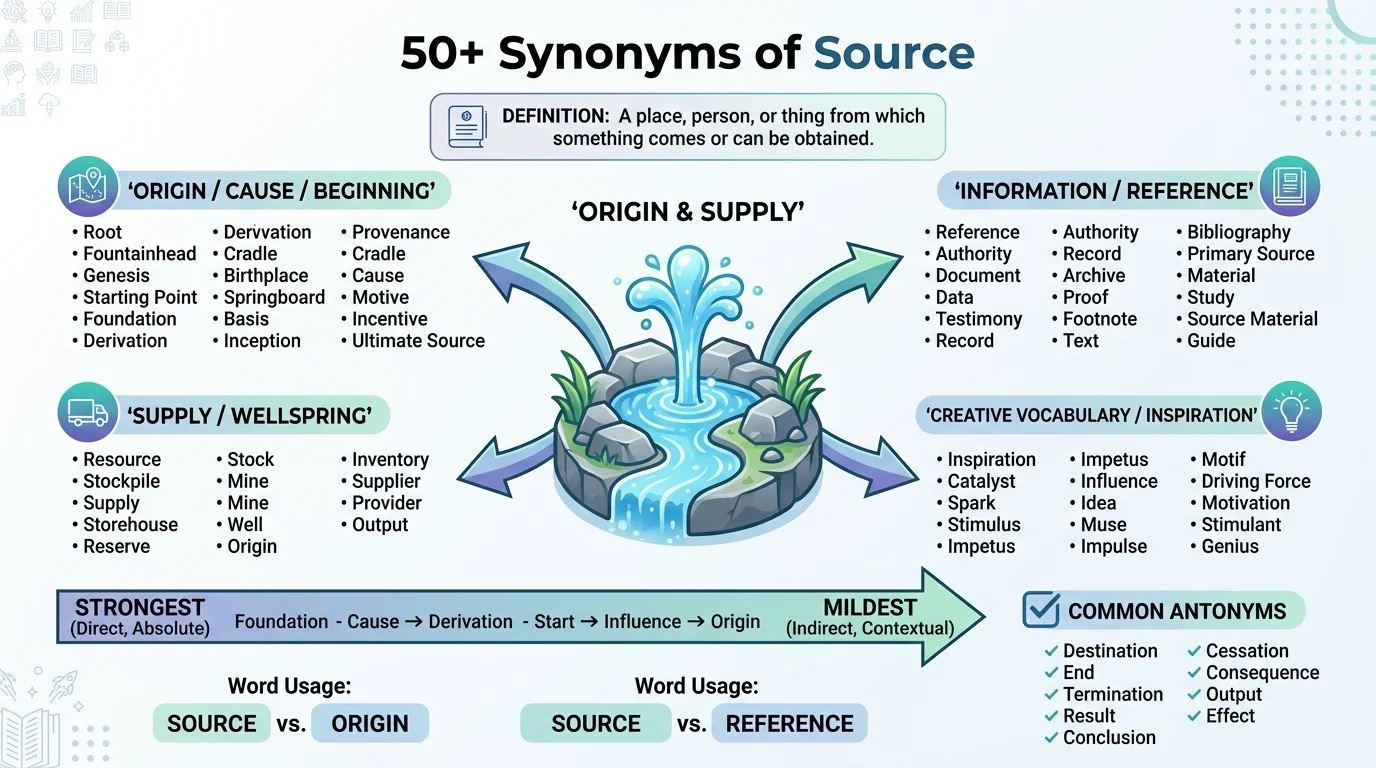
Have you ever needed to describe where something comes from, who provided information, or what caused an event but felt that “source” was too vague or repetitive? You want to capture the specific origin, provider, or cause, and the word “source” comes to mind. Choosing the right synonym for “source” can transform a general statement into a precise description of origin, supply, or reference. This guide explores the best synonyms of source, explaining exactly which word to use and when.
Quick Ans: “Source” means the origin or point of origin of something, a person or document that provides information, or a supply of something. For origin contexts, choose origin, root, or beginning. For information providers, use reference, authority, or informant. For supply contexts, use supplier, provider, or reservoir.
Meaning, Tone, and Context
Understanding the core meaning of “source” is the first step to using it effectively.
Simple Definition: A place, person, or thing from which something comes or can be obtained; the point of origin; a person or document that provides information.
Part of Speech: Noun.
Overall Tone: Neutral. It is a functional word used across all contexts.
Formality Level: Neutral to formal. The word is appropriate in most contexts.
Common Uses: Native English speakers use it in journalism (“anonymous source”), research (“primary source”), business (“supply source”), and general contexts (“source of inspiration”).
Word Forms: Related words include the verb source and the noun sourcing.
When and How to Use “Source”
“Source” is the perfect choice when you want to describe origin, supply, or information. Here are seven realistic examples.
Journalism: “The reporter refused to reveal her source.”
Academic: “The study cites several primary sources.”
Business: “We need to find a reliable source for raw materials.”
Personal: “Music is a source of comfort for me.”
Technology: “The open-source software is free to use.”
Environmental: “Solar energy is a renewable source of power.”
Social Media: “According to a trusted source, the event is canceled.”
Best Synonyms of “Source”
No synonym is identical in every situation. Here is your guide to the best replacement for “source” based on your writing context.
For Origin and Beginning
Most Direct: Origin means the point where something begins. “The origin of the universe is a mystery.”
Root: Root means the basic cause or origin. “The root of the problem is poor communication.”
Beginning: Beginning means the start. “The beginning of the story was exciting.”
Fountainhead: Fountainhead means an original source. “He is the fountainhead of the movement.”
Wellspring: Wellspring means an abundant source. “She is a wellspring of creativity.”
For Information Providers
Reference: Reference means a source of information. “The encyclopedia is a good reference.”
Authority: Authority means an expert or official source. “She is an authority on climate change.”
Informant: Informant means a person who provides information. “The informant gave crucial details.”
Citation: Citation means a reference to a source. “Include a citation for each quote.”
Document: Document means a written source. “The document provided the evidence.”
For Supply and Provision
Supplier: Supplier means a company or person that provides goods. “The supplier delivers on time.”
Provider: Provider means a person or organization that supplies. “The internet provider offers fast speeds.”
Reservoir: Reservoir means a large supply. “The library is a reservoir of knowledge.”
Supply: Supply means a stock or amount available. “The supply of water is limited.”
When Not to Use “Source”
Using “source” can sound wrong or awkward in certain situations.
When You Mean “Cause”: “Source” is about origin. “Cause” is about effect.
Better Choice: Cause or reason. “The cause of the fire was faulty wiring.”
When You Mean “Resource”: “Source” is where something comes from. “Resource” is something you use.
Better Choice: Resource or asset. “The library is a valuable resource.”
When It Sounds Too Vague: “Source” can be unclear.
Better Choice: Supplier or origin. “The supplier is reliable.”
Words Commonly Confused With “Source”
| Word | Difference | When to Use | Example |
|---|---|---|---|
| Origin | The point of beginning | General and formal | “The origin of the word is Latin.” |
| Cause | Something that produces an effect | Causation | “The cause was clear.” |
| Resource | Something available for use | General and business | “Water is a vital resource.” |
| Reference | A source of information | Academic and formal | “The reference is cited.” |
| Supplier | One who provides goods | Business and commerce | “The supplier is reliable.” |
| Root | The basic cause | Problem-solving | “Find the root of the issue.” |
Best Synonyms of “Source” by Context
| Context | Best Synonym | Why It Works | Example |
|---|---|---|---|
| Formal writing | Origin | Formal and precise | “The origin of the custom is unknown.” |
| Academic writing | Reference | Standard in research | “The reference is listed.” |
| Journalism | Informant | Specific to news | “The informant remained anonymous.” |
| Business | Supplier | Commercial context | “The supplier signed the contract.” |
| Problem-solving | Root | Causal and direct | “The root of the problem.” |
| Creative writing | Wellspring | Evocative and literary | “She is a wellspring of ideas.” |
| Technology | Provider | Technical and specific | “The provider offers cloud services.” |
How to Choose the Best Synonym of “Source”
Choosing the right word is a simple decision. Answer these questions.
What type of source am I describing? For origin, use origin or root. And For information, use reference or authority. For supply, use supplier or provider.
What is my audience? For a formal report, use origin or reference. For a friend, use supplier or root.
What is my purpose? Are you describing origin, information, or supply? The correct synonym depends entirely on this.
What is the emotional strength? Wellspring is evocative. Supplier is neutral. Pick the one that matches your message.
Real Life Examples of “Source”
School: Basic: “The source of the river is in the mountains.” Improved: “The origin of the river is in the mountains.”
College: Basic: “The source of the data is reliable.” Improved: “The reference for the data is reliable.”
Workplace: Basic: “We need a new source.” Improved: “We need a new supplier.”
Business: Basic: “The source of the problem is unclear.” Improved: “The root of the problem is unclear.”
Email: Basic: “According to a source, the deal is off.” Improved: “According to an informant, the deal is off.”
Conversation: Basic: “What is the source of this?” Improved: “What is the origin of this?”
Storytelling: Basic: “She was a source of inspiration.” Improved: “She was a wellspring of inspiration.”
Top 10 Synonyms of “Source”
| Synonym | Simple Meaning | Best Used For | Example Sentence |
|---|---|---|---|
| Origin | The point of beginning | General and formal | “The origin of the word is Latin.” |
| Root | The basic cause or origin | Problem-solving | “Find the root of the issue.” |
| Reference | A source of information | Academic and formal | “The reference is cited.” |
| Supplier | One who provides goods | Business and commerce | “The supplier is reliable.” |
| Provider | One who supplies | Business and technology | “The provider offers services.” |
| Authority | An expert or official source | Formal and academic | “She is an authority on the subject.” |
| Informant | A person who provides information | Journalism and law | “The informant gave details.” |
| Wellspring | An abundant source | Literary and creative | “She is a wellspring of ideas.” |
| Reservoir | A large supply | Formal and descriptive | “The library is a reservoir of knowledge.” |
| Supply | A stock or amount available | Business and general | “The supply is limited.” |
Synonyms of “Source” by Usage
Professional vs. Personal Synonyms
In the workplace, choose supplier, provider, or reference. With friends, use origin, root, or supplier.
Formal vs. Conversational Synonyms
For formal writing, use origin, reference, or authority. For casual conversations, use supplier, root, or origin.
Academic Synonyms
For research and essays, choose reference for citations, authority for experts, and origin for historical contexts.
Professional and Business Synonyms
For maximum impact, choose supplier for goods, provider for services, and reservoir for knowledge.
Creative and Literary Synonyms
To add emotion and imagery, choose wellspring, fountainhead, or reservoir. These words create atmosphere.
Slang or Modern Synonyms
In modern American slang, source or hookup are common. For example, “I have a hookup for tickets.” These are casual and should be avoided in formal writing.
Strongest to Mildest Synonyms
Mild: supply, provider, supplier
Moderate: source, origin, reference
Strong: root, authority, informant
Very Strong: wellspring, fountainhead, reservoir
Emotional vs. Neutral Synonyms
Emotional Synonyms: Wellspring, fountainhead. These words hint at abundance and creativity. Use them when you want to evoke feeling.
Neutral Synonyms: Source, origin, supplier. These words communicate factual information.
Antonyms of “Source”
| Antonym | Meaning | Example Sentence |
|---|---|---|
| Destination | The place something is going to | “The destination is unknown.” |
| End | The final point | “The end is near.” |
| Outcome | The result | “The outcome was positive.” |
| Result | The effect | “The result was unexpected.” |
| Conclusion | The final part | “The conclusion was clear.” |
| Sink | A place where something is absorbed | “The sink absorbed the water.” |
| Mouth | The place a river meets the sea | “The river mouth was wide.” |
| Termination | The end point | “The termination of the contract.” |
| Consumption | The using up of resources | “Consumption is increasing.” |
| Use | The act of using | “The use of resources is high.” |
| Expenditure | The spending of resources | “Expenditure was reduced.” |
| Output | What is produced | “The output increased.” |
| Product | What is made | “The product is new.” |
| Effect | A result | “The effect was immediate.” |
| Consequence | A result of an action | “The consequence was severe.” |
Comparison: “Source” vs Similar Words
Source vs. Origin
Main Difference: “Source” is where something comes from. “Origin” is the point of beginning.
Which Is Stronger? They are similar.
Which Is More Formal? Both are formal.
When to Use Each: Use “source” for supply and information. Use “origin” for beginnings.
Examples:
Source: “The source of the river.”
Origin: “The origin of the species.”
Source vs. Cause
Main Difference: “Source” is the origin. “Cause” is what produces an effect.
Which Is Stronger? “Cause” is more specific to effects.
Which Is More Formal? Both are formal.
When to Use Each: Use “cause” for effects. Use “source” for origins.
Examples:
Source: “The source of the problem.”
Cause: “The cause of the fire.”
Source vs. Reference
Main Difference: “Reference” is a source of information. “Source” is broader.
Which Is Stronger? “Reference” is more specific.
Which Is More Formal? Both are formal.
When to Use Each: Use “reference” for citations. Use “source” for general contexts.
Examples:
Source: “The source of the data.”
Reference: “The reference is cited.”
Source vs. Supplier
Main Difference: “Supplier” is a business provider. “Source” is broader.
Which Is Stronger? “Supplier” is more specific.
Which Is More Formal? Both are formal.
When to Use Each: Use “supplier” for business. Use “source” for general contexts.
Examples:
Source: “The source of materials.”
Supplier: “The supplier delivered.”
Source vs. Root
Main Difference: “Root” is the basic cause. “Source” is the origin.
Which Is Stronger? “Root” is more specific to causes.
Which Is More Formal? Both are formal.
When to Use Each: Use “root” for problems. Use “source” for general contexts.
Examples:
Source: “The source of the issue.”
Root: “The root of the problem.”
Source vs. Wellspring
Main Difference: “Wellspring” is literary and abundant. “Source” is neutral.
Which Is Stronger? “Wellspring” is more evocative.
Which Is More Formal? Both are formal.
When to Use Each: Use “wellspring” in creative writing. Use “source” in general contexts.
Examples:
Source: “The source of inspiration.”
Wellspring: “She is a wellspring of ideas.”
Common Phrases and Expressions with “Source”
Phrase: Primary source
Meaning: An original document or firsthand account.
Example Sentence: “The historian used primary sources.”
Phrase: Reliable source
Meaning: A trustworthy provider of information.
Example Sentence: “According to a reliable source.”
Phrase: Open source
Meaning: Software with publicly available code.
Example Sentence: “The open source project has many contributors.”
Phrase: Source of inspiration
Meaning: Something that inspires.
Example Sentence: “Nature is a source of inspiration.”
Phrase: Source of income
Meaning: Where money comes from.
Example Sentence: “Her main source of income is freelancing.”
Phrase: Source code
Meaning: The underlying code of software.
Example Sentence: “The source code was leaked.”
Common Mistakes to Avoid
Mistake 1: Using “source” when you mean “cause”.
Incorrect: “The source of the accident was ice.”
Better: “The cause of the accident was ice.”
Why: “Cause” is for effects.
Mistake 2: Using “source” when you mean “resource”.
Incorrect: “Water is a vital source.”
Better: “Water is a vital resource.”
Why: “Resource” is for things used.
Mistake 3: Overusing “source” in conversation.
Incorrect: “The source of the river is north.”
Better: “The origin of the river is north.”
Why: “Origin” sounds more natural.
Mistake 4: Using “source” when you mean “supplier”.
Incorrect: “We need a new source.”
Better: “We need a new supplier.”
Why: “Supplier” is more specific.
Mistake 5: Using “source” when you mean “reference”.
Incorrect: “The source is listed at the end.”
Better: “The reference is listed at the end.”
Why: “Reference” is for citations.
Frequently Asked Questions
1. What are the best synonyms of “source”?
The best synonyms depend on your context. For origin, choose origin or root. And For information, use reference or authority. For supply, use supplier or provider.
2. What are the best formal synonyms of “source”?
The best formal synonyms are origin, reference, and authority. These words are suitable for academic papers, professional reports, and business communications.
3. What are common informal synonyms of “source”?
For informal settings, use supplier, root, or origin. These alternatives sound more natural in everyday conversation.
4. What is another word for “source” in professional writing?
In professional writing, supplier is an excellent choice for business. Reference is also strong for research.
5. What is the difference between “source” and “origin”?
“Source” is where something comes from. “Origin” is the point of beginning. Use “source” for supply and “origin” for beginnings.
6. What is the opposite of “source”?
The most direct opposites (antonyms) of source are destination, end, and outcome. These words describe the endpoint rather than the beginning.
Conclusion
“Source” is a versatile and essential word for describing origin, supply, and information. The term is neutral and widely accepted in most contexts, yet it can sound too vague for specific descriptions or too formal for casual conversation. The best choice among the synonyms of source depends entirely on your audience, tone, and purpose. Remember, no single synonym works perfectly in every situation. Your goal is to choose the word that communicates your message with the most clarity and impact. A practical tip for your vocabulary growth is to pay attention to how writers describe origins and supplies and practice using different synonyms in your writing.










1 thought on “50+ Synonyms of Source: Meanings, Uses, Examples, and Best Alternatives 2026”