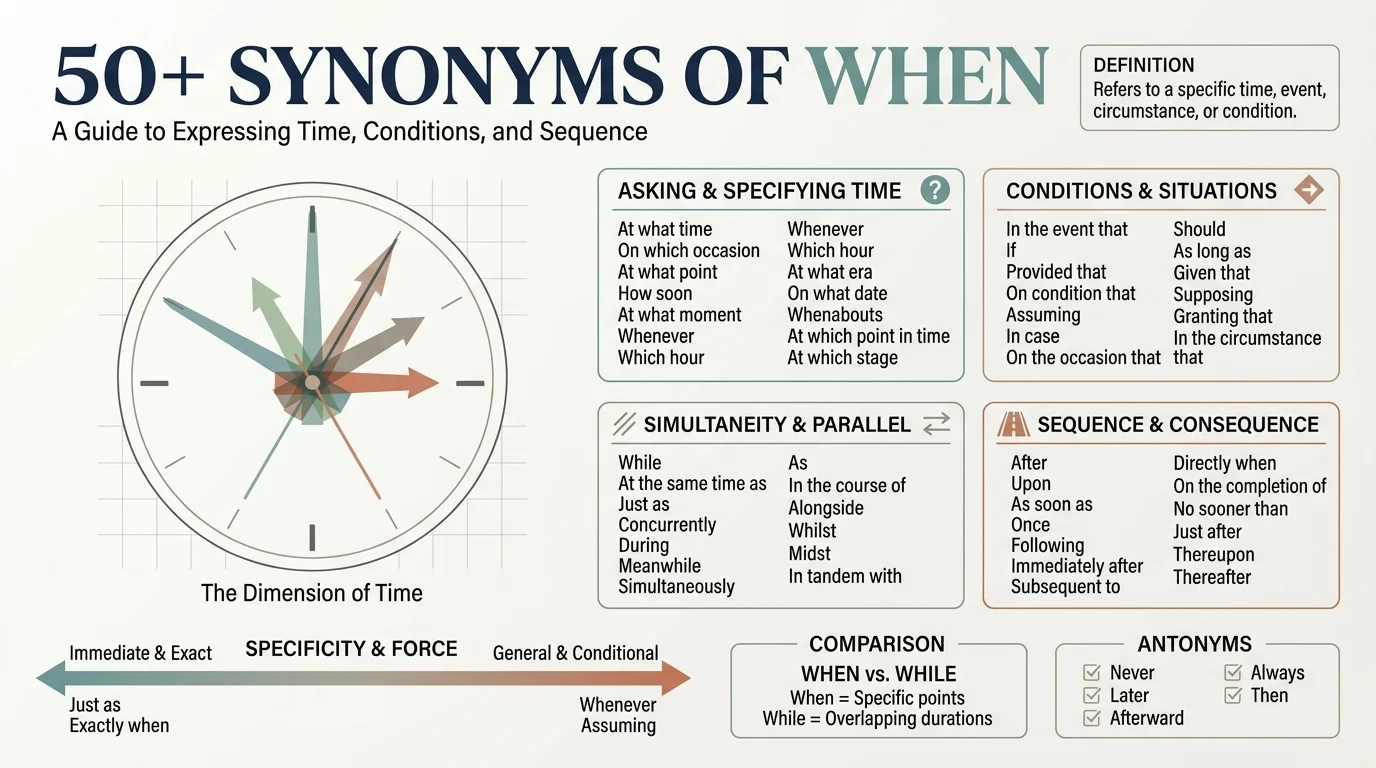
Have you ever found yourself starting sentence after sentence with the same word, or struggled to vary your writing when talking about time? You want to describe the moment something happens, and the word “when” comes to mind. Choosing the right synonym for “when” can transform repetitive writing into smooth, precise prose. This guide explores the best synonyms of when, explaining exactly which word to use and when.
Quick Ans: “When” is an adverb and conjunction used to ask about or refer to time, or to introduce a condition. For asking about time, use at what time or what time. For introducing a condition, use if or whenever. For expressing simultaneity, use while or as. For expressing sequence, use after or once.
Meaning, Tone, and Context
Understanding the core meaning of “when” is the first step to using it effectively.
Simple Definition: At what time; at or during which time; in the event that; considering that.
Part of Speech: Adverb and conjunction.
Overall Tone: Neutral. It is a basic function word used in all contexts.
Formality Level: Neutral. The word is appropriate in every context, from casual to formal.
Common Uses: Native English speakers use “when” to ask questions (“When does the meeting start?”), to introduce clauses (“I was sleeping when you called”), and to express conditions (“When it rains, the roads flood”).
Word Forms: Related words include whenever, whence, and whereas.
When and How to Use “When”
“When” is the perfect choice when you want to refer to time or introduce a condition. Here are seven realistic examples.
Asking About Time: “When does the conference begin?”
Introducing a Time Clause: “I will call you when I arrive at the airport.”
Expressing a Condition: “When you exercise regularly, you feel better.”
Expressing Simultaneity: “She was reading when the phone rang.”
Expressing Sequence: “When the rain stopped, we went outside.”
Academic: “The reaction occurs when the temperature exceeds 100 degrees.”
Professional: “When the client approves the proposal, we will begin work.”
Best Synonyms of “When”
No synonym is identical in every situation. Here is your guide to the best replacement for “when” based on your writing context.
For Asking About Time
Formal: At what time is a formal way to ask about time. “At what time does the ceremony commence?”
Informal: What time is the common casual alternative. “What time should we meet?”
For Introducing a Condition
Conditional: If is the closest synonym for conditional “when.” “If it rains, we will stay inside.”
Every Time: Whenever means every time that. “Whenever I visit, she bakes cookies.”
For Expressing Simultaneity
Simultaneous: While indicates during the time that. “While I was cooking, he set the table.”
At the Same Time: As indicates two actions happening together. “As she spoke, the audience listened.”
For Expressing Sequence
Sequence: After indicates following in time. “After the meeting ended, we went to lunch.”
Once: Once means as soon as. “Once you finish, let me know.”
The Moment: The moment emphasizes immediacy. “The moment I saw her, I knew.”
When Not to Use “When”
Using “when” can sound wrong or awkward in certain situations.
When You Mean “If”: “When” implies certainty. “If” implies possibility.
Better Choice: If. “If I win the lottery, I will travel.”
When You Mean “While”: “When” can be ambiguous for simultaneous actions.
Better Choice: While. “While I was sleeping, the storm raged.”
When You Mean “Because”: “When” can sometimes imply causation but is not precise.
Better Choice: Because or since. “Because it was raining, we stayed inside.”
Words Commonly Confused With “When”
Word: While
Difference: “While” emphasizes duration. “When” emphasizes a point in time.
When to Use: Use it for actions happening at the same time.
Example: “While I was cooking, he cleaned.”
Word: As
Difference: “As” indicates simultaneity. “When” can indicate sequence.
When to Use: Use it for simultaneous actions.
Example: “As I was leaving, the phone rang.”
Word: Whenever
Difference: “Whenever” means every time. “When” refers to a specific time.
When to Use: Use it for repeated events.
Example: “Whenever it rains, the basement floods.”
Word: If
Difference: “If” indicates possibility. “When” indicates certainty.
When to Use: Use it for uncertain conditions.
Example: “If it snows, school will be canceled.”
Word: Once
Difference: “Once” means as soon as. “When” is more general.
When to Use: Use it for immediate sequence.
Example: “Once you arrive, call me.”
Best Synonyms of “When” by Context
| Context | Best Synonym | Why It Works | Example |
|---|---|---|---|
| Formal question | At what time | Polite and formal | “At what time does the event begin?” |
| Casual question | What time | Simple and direct | “What time is dinner?” |
| Conditional | If | Indicates possibility | “If you need help, ask.” |
| Repeated events | Whenever | Every time that | “Whenever she visits, she brings gifts.” |
| Simultaneity | While | During the time that | “While I studied, he watched TV.” |
| Simultaneity | As | At the same time | “As he spoke, the crowd cheered.” |
| Sequence | After | Following in time | “After the show, we went home.” |
| Immediate sequence | Once | As soon as | “Once you finish, we can leave.” |
| Dramatic immediacy | The moment | Emphasizes exact time | “The moment I saw her, I smiled.” |
How to Choose the Best Synonym of “When”
Choosing the right word is a simple decision. Answer these questions.
Am I asking a question? For formal questions, use at what time. For casual questions, use what time.
Am I introducing a condition? For certain conditions, use when. For possible conditions, use if.
Am I expressing simultaneity? For simultaneous actions, use while or as.
Am I expressing sequence? For sequence, use after or once.
Real Life Examples of “When”
To truly master the word, it helps to see how it behaves in the wild and how a stronger synonym can elevate the sentence.
School: Basic: “When does class start?” Improved: “At what time does class commence?”
College: Basic: “When I graduate, I will travel.” Improved: “Once I graduate, I will travel.”
Workplace: Basic: “When the meeting ends, we can talk.” Improved: “After the meeting ends, we can talk.”
Business: Basic: “When profits rise, we will expand.” Improved: “If profits rise, we will expand.”
Email: Basic: “When you receive this, please reply.” Improved: “Once you receive this, please reply.”
Conversation: Basic: “When are you coming?” Improved: “What time are you coming?”
Storytelling: Basic: “When she arrived, the party started.” Improved: “The moment she arrived, the party started.”
Top 10 Synonyms of “When”
| Synonym | Simple Meaning | Best Used For | Example Sentence |
|---|---|---|---|
| At what time | Formal inquiry about time | Formal questions | “At what time does the flight depart?” |
| What time | Casual inquiry about time | Casual questions | “What time does the movie start?” |
| If | Condition of possibility | Conditional statements | “If it rains, we will cancel.” |
| Whenever | Every time that | Repeated events | “Whenever I call, she answers.” |
| While | During the time that | Simultaneous actions | “While I cooked, he cleaned.” |
| As | At the same time | Simultaneous actions | “As she sang, he played piano.” |
| After | Following in time | Sequence | “After the storm, the sun appeared.” |
| Once | As soon as | Immediate sequence | “Once you finish, let me know.” |
| The moment | At the exact time | Dramatic immediacy | “The moment he left, I cried.” |
| Since | From the time that | Starting point | “Since you arrived, things improved.” |
Synonyms of “When” by Usage
Professional vs. Personal Synonyms
In the workplace (professional), choose at what time, once, or after for clarity. These words convey professionalism. “Once the client approves, we will proceed” is more precise than “When the client approves.”
With friends (personal), what time, if, or the moment keep the tone relaxed and relatable.
Formal vs. Conversational Synonyms
For formal writing (reports, essays, professional emails), use at what time, once, or after. These choices maintain the sophisticated tone expected in professional documents.
For casual conversations and texting, use what time, if, or the moment. These options sound more natural.
Academic Synonyms
For research and essays, choose precise, authoritative words. If is great for conditional hypotheses, once for sequential steps, and whenever for recurring phenomena.
Professional and Business Synonyms
For maximum impact in business writing, choose once for conditions, after for sequence, and at what time for scheduling. These words demonstrate confidence and professional awareness.
Creative and Literary Synonyms
To add drama and immediacy to your writing, choose the moment or as. These words create atmosphere.
Strongest to Mildest Synonyms
Mild: when, if, what time
Moderate: while, after, whenever
Strong: once, as, the moment
Very Strong: at what time, the instant
Emotional vs. Neutral Synonyms
Emotional Synonyms: The moment, as. These words hint at drama and immediacy. Use them when you want to evoke feeling.
Neutral Synonyms: When, if, after. These words simply communicate factual information.
Antonyms of “When”
| Antonym | Meaning | Example Sentence |
|---|---|---|
| Never | At no time | “He never arrives on time.” |
| Always | At all times | “She always brings snacks.” |
| Now | At the present moment | “We need to act now.” |
| Then | At that time | “We were younger then.” |
| Later | At a future time | “We will discuss it later.” |
| Before | At an earlier time | “Before the storm, we prepared.” |
Common Phrases and Expressions with “When”
Phrase: When in Rome
Meaning: Adapt to local customs.
Example Sentence: “When in Rome, do as the Romans do.”
Phrase: When it rains, it pours
Meaning: Problems come in groups.
Example Sentence: “First the car broke down, then the pipes burst. When it rains, it pours.”
Phrase: When pigs fly
Meaning: Something that will never happen.
Example Sentence: “He will apologize when pigs fly.”
Phrase: When all is said and done
Meaning: After everything is considered.
Example Sentence: “When all is said and done, family matters most.”
Phrase: When the time comes
Meaning: At the appropriate moment.
Example Sentence: “When the time comes, you will know what to do.”
Common Mistakes to Avoid
Mistake 1: Confusing “when” and “if”.
Incorrect: “When I win the lottery, I will buy a house.” (implies certainty)
Better: “If I win the lottery, I will buy a house.”
Why: “If” is for possibilities. “When” is for certainties.
Mistake 2: Using “when” instead of “while”.
Incorrect: “When I was sleeping, the phone rang.”
Better: “While I was sleeping, the phone rang.”
Why: “While” emphasizes duration.
Mistake 3: Using “when” instead of “that”.
Incorrect: “The day when I graduated was memorable.”
Better: “The day that I graduated was memorable.”
Why: “That” is more natural in this context.
Mistake 4: Overusing “when”.
Incorrect: “When I woke up, when I ate breakfast, when I left…”
Better: “After I woke up, once I ate breakfast, as I left…”
Why: Variety improves writing.
Frequently Asked Questions
1. What are the best synonyms of “when”?
For questions, use at what time or what time. For conditions, use if. For simultaneity, use while or as.
2. What are the best formal synonyms of “when”?
The best formal synonyms are at what time, once, and after. These words are suitable for professional writing.
3. What are common informal synonyms of “when”?
For informal settings, use what time, if, or the moment. These alternatives sound more natural.
4. What is another word for “when” in professional writing?
In professional writing, once or after is an excellent choice for sequence. At what time is strong for scheduling.
5. What is the difference between “when” and “while”?
“When” indicates a point in time. “While” indicates duration. Use “while” for simultaneous ongoing actions.
6. What is the opposite of “when”?
The most direct opposites are never, always, and now.
Conclusion
“When” is a fundamental and versatile word for discussing time, conditions, and sequence. The best choice among the synonyms of when depends entirely on your audience, tone, and purpose. For formal questions, use at what time. For conditions, use if. For simultaneity, use while or as. For sequence, use after or once. Remember, no single synonym works perfectly in every situation. Your goal is to choose the word that communicates your message with the most clarity and impact. A practical tip for your vocabulary growth is to vary your sentence starters and practice using different time-related synonyms in your writing.










2 thoughts on “50+ Synonyms of When: Meanings, Uses, Examples, and Best Alternatives 2026”