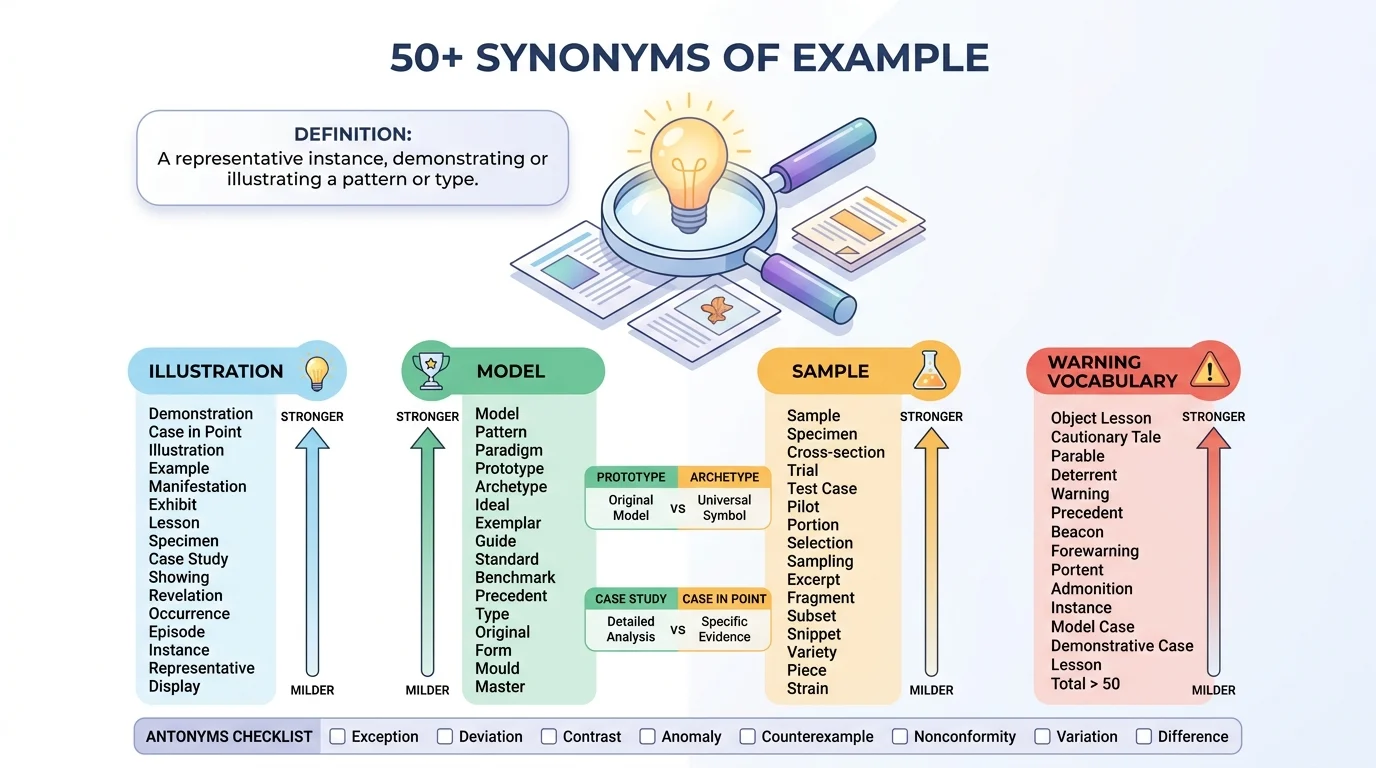
Have you ever needed to illustrate a point, cite a model to follow, or provide a sample but felt that repeating “example” made your writing feel flat? You want to clarify, persuade, or demonstrate, and the word “example” comes to mind again and again. Choosing the right synonym for “example” can transform a repetitive sentence into a precise illustration, a clear model, or a compelling case. This guide explores the best synonyms of example, explaining exactly which word to use and when.
Quick Ans: “Example” means a specific instance, a model to follow, or a sample that illustrates a larger idea. For formal writing, choose illustration or exemplar. For casual conversation, use instance or case. In academic contexts, specimen and paradigm are strong choices. For a model to imitate, select model or template. For a warning, use cautionary tale or warning.
Meaning, Tone, and Context
Understanding the core meaning of “example” is the first step to using it effectively.
Simple Definition: A person or thing regarded as a representative or typical case; a model to be imitated; a sample.
Part of Speech: Noun.
Overall Tone: Neutral. It is a versatile word used across all contexts.
Formality Level: Neutral. The word works in casual and formal writing.
Common Uses: Native English speakers use it to illustrate points, cite precedents, and set standards. For example, “For example, oranges are rich in vitamin C,” or “She set a good example for her younger siblings.”
Word Forms: Related words include the verb exemplify, the adjective exemplary, and the noun exemplification.
When and How to Use “Example”
“Example” is the perfect choice when you want to illustrate, model, or sample something. Here are seven realistic examples.
Illustrating a Point: “For example, many birds migrate south for the winter.”
Setting a Standard: “She set an example for the entire team with her work ethic.”
Citing a Precedent: “The court’s decision set a legal example for future cases.”
Providing a Sample: “This painting is a fine example of the Impressionist style.”
Warning: “The failed project serves as an example of poor planning.”
Academic: “The study provides an example of how climate change affects migration.”
Social Media: “This before-and-after photo is a perfect example of what consistency can achieve.”
Best Synonyms of “Example”
No synonym is identical in every situation. Here is your guide to the best replacement for “example” based on your writing context.
For Illustrating a Point
Most Direct: Instance refers to a specific occurrence. “There was one instance where the rule was broken.”
Formal: Illustration emphasizes a vivid demonstration. “The chart is an illustration of the trend.”
Academic: Case refers to a specific situation. “Let us examine a case where this failed.”
Concrete: Sample refers to a physical or data example. “We tested a sample of the product.”
For Setting a Standard
Strongest: Exemplar means a perfect model. “She is an exemplar of professional integrity.”
Formal: Model means a standard to imitate. “His leadership is a model for others.”
Literary: Paragon means a perfect example of a quality. “He is a paragon of virtue.”
Emotional: Embodiment means a perfect representation. “She is the embodiment of grace.”
For Providing a Sample
Scientific: Specimen means a single sample for examination. “The lab tested the specimen.”
Prototype: Prototype means a first model. “The team built a prototype of the device.”
For Warning
Cautionary: Cautionary tale means a warning example. “The company’s collapse is a cautionary tale.”
Warning: Warning means a signal of danger. “The incident serves as a warning.”
When Not to Use “Example”
Using “example” can sound wrong or awkward in certain situations.
When It Sounds Too Vague: “Example” can be too general.
Better Choice: Instance or case. “In this case, the rule does not apply.”
When You Mean a Model to Follow: “Example” is weak. Model or exemplar is stronger.
Better Choice: Model. “She is a model for young professionals.”
When It Sounds Repetitive: Overusing “example” makes writing flat.
Better Choice: Illustration or instance. “Here is an illustration of the concept.”
Words Commonly Confused With “Example”
Several words are often mixed up with “example.” Here is how to keep them straight.
Word: Instance
Difference: A specific occurrence. “Example” can be a model or illustration.
When to Use: Use it for a single event.
Example: “There was one instance of fraud.”
Word: Sample
Difference: A physical or data piece. “Example” is broader.
When to Use: Use it for products or data.
Example: “We tested a sample of the fabric.”
Word: Illustration
Difference: Emphasizes clarification. “Example” is more general.
When to Use: Use it to clarify a concept.
Example: “The story is an illustration of courage.”
Word: Model
Difference: A standard to imitate. “Example” can be neutral.
When to Use: Use it for behavior or systems to replicate.
Example: “Her work is a model of efficiency.”
Word: Paradigm
Difference: A broad framework. “Example” is a single case.
When to Use: Use it for theories and frameworks.
Example: “The discovery created a new paradigm.”
Word: Exemplar
Difference: A perfect example. “Example” does not imply perfection.
When to Use: Use it for the best of a class.
Example: “The museum displays an exemplar of Roman art.”
Best Synonyms of “Example” by Context
| Context | Best Synonym | Why It Works | Example |
|---|---|---|---|
| Formal writing | Illustration | Clarifies and demonstrates | “The graph is an illustration of the data.” |
| Academic writing | Case | Specific and analytical | “Let us examine a case of market failure.” |
| Professional communication | Instance | Specific and precise | “There was one instance of non-compliance.” |
| Casual conversation | Example | Natural and direct | “For example, I love pizza.” |
| Setting a standard | Model | Implies imitation | “She is a model for new employees.” |
| Perfect example | Exemplar | Implies perfection | “He is an exemplar of leadership.” |
| Physical sample | Specimen | Scientific and precise | “The lab analyzed the specimen.” |
| Warning | Cautionary tale | Warns and instructs | “The collapse is a cautionary tale.” |
How to Choose the Best Synonym of “Example”
Choosing the right word is a simple decision. Answer these questions.
What type of example am I giving? For illustrating, use instance or illustration. And For setting a standard, use model or exemplar. For warning, use cautionary tale.
What is my audience? For a professor, use exemplar or paradigm. For a friend, use instance or case.
What is my purpose? Are you clarifying, modeling, or warning? The correct synonym depends entirely on this.
What is the emotional strength? Paragon and embodiment are stronger. Instance and case are milder.
Real Life Examples of “Example”
To truly master the word, it helps to see how it behaves in the wild and how a stronger synonym can elevate the sentence.
School: Basic: “The teacher gave an example.” Improved: “The teacher provided an illustration of the concept.”
College: Basic: “This is an example of the theory.” Improved: “This is a case that demonstrates the theory.”
Workplace: Basic: “She is an example for the team.” Improved: “She is a model for the entire team.”
Business: Basic: “The product is an example of innovation.” Improved: “The product is an exemplar of innovation.”
Email: Basic: “Here is an example of the format.” Improved: “Here is a sample of the format.”
Conversation: Basic: “Give me an example.” Improved: “Give me an instance.”
Storytelling: Basic: “He was an example of courage.” Improved: “He was the embodiment of courage.”
Top 10 Synonyms of “Example”
| Synonym | Simple Meaning | Best Used For | Example Sentence |
|---|---|---|---|
| Instance | A specific occurrence | Casual and specific contexts | “There was one instance of error.” |
| Illustration | A clarifying demonstration | Formal and educational contexts | “The diagram is an illustration of the process.” |
| Case | A specific situation | Academic and analytical contexts | “Let us examine a case of success.” |
| Sample | A physical or data piece | Scientific and product contexts | “We tested a sample of the new material.” |
| Model | A standard to imitate | Professional and behavioral contexts | “His work is a model of excellence.” |
| Exemplar | A perfect example | Formal and academic contexts | “She is an exemplar of professionalism.” |
| Paragon | A perfect model of a quality | Literary and emotional contexts | “He is a paragon of honesty.” |
| Embodiment | A perfect representation | Emotional and descriptive contexts | “She is the embodiment of kindness.” |
| Specimen | A sample for examination | Scientific and medical contexts | “The specimen was analyzed in the lab.” |
| Cautionary tale | A warning example | Narrative and warning contexts | “The failure is a cautionary tale.” |
Synonyms of “Example” by Usage
Professional vs. Personal Synonyms
In the workplace (professional), choose model, instance, or illustration. With friends (personal), use example, case, or instance.
Formal vs. Conversational Synonyms
For formal writing, use illustration, exemplar, or paradigm. For casual conversation, use example, instance, or case.
Academic Synonyms
For research and essays, choose case, specimen, paradigm, or exemplar. These words sound scholarly.
Professional and Business Synonyms
For maximum impact, choose model, prototype, or illustration. These words demonstrate authority.
Creative and Literary Synonyms
To add emotion, choose paragon, embodiment, or cautionary tale. These words create depth.
Strongest to Mildest Synonyms
Mild: example, instance, case
Moderate: illustration, sample, model
Strong: exemplar, prototype, specimen
Very Strong: paragon, embodiment, paradigm
Emotional vs. Neutral Synonyms
Emotional Synonyms: Paragon, embodiment, cautionary tale. These evoke feeling.
Neutral Synonyms: Example, instance, case. These inform without emotion.
Antonyms of “Example”
| Antonym | Meaning | Example Sentence |
|---|---|---|
| Anomaly | Something that deviates from the norm | “The result was an anomaly.” |
| Exception | A case that does not follow the rule | “This is the exception, not the rule.” |
| Aberration | A departure from normal | “The violence was an aberration.” |
| Outlier | A data point far from others | “The outlier skewed the results.” |
| Deviation | A departure from standard | “Any deviation is unacceptable.” |
| Irregularity | Something not normal | “The auditor found an irregularity.” |
| Uniqueness | The quality of being one of a kind | “The uniqueness of the artifact is notable.” |
| Rarity | Something uncommon | “The rarity of the gem is remarkable.” |
| Abnormality | A feature that is not typical | “The doctor noted an abnormality.” |
| Nonconformity | Failure to match the standard | “His nonconformity set him apart.” |
| Contradiction | A case that opposes the principle | “His actions were a contradiction.” |
| Unconventional | Not based on what is usual | “Her unconventional approach worked.” |
| Atypical | Not representative of the type | “The weather was atypical.” |
| Singularity | A unique point | “The singularity of the event was noted.” |
| Original | The first version | “The original is in the museum.” |
Comparison: “Example” vs Similar Words
Example vs. Instance
Main Difference: “Example” can be a model. “Instance” is a specific occurrence.
Which Is Stronger? “Example” is more versatile.
Which Is More Formal? Both are neutral.
When to Use Each: Use “example” for models. Use “instance” for single events.
Examples:
Example: “This painting is an example of Impressionism.”
Instance: “There was one instance of theft.”
Example vs. Sample
Main Difference: “Example” is abstract. “Sample” is physical.
Which Is Stronger? “Sample” is more concrete.
Which Is More Formal? Both are neutral.
When to Use Each: Use “example” for ideas. Use “sample” for products or data.
Examples:
Example: “This is an example of good writing.”
Sample: “We tested a sample of the product.”
Example vs. Illustration
Main Difference: “Illustration” emphasizes clarification. “Example” is general.
Which Is Stronger? “Illustration” is stronger for clarity.
Which Is More Formal? Both are formal.
When to Use Each: Use “illustration” to clarify. Use “example” for general reference.
Examples:
Example: “Here is an example of the rule.”
Illustration: “The story is an illustration of courage.”
Example vs. Model
Main Difference: “Model” implies a standard to imitate. “Example” is neutral.
Which Is Stronger? “Model” is stronger for imitation.
Which Is More Formal? Both are formal.
When to Use Each: Use “model” for behavior to follow. Use “example” for general reference.
Examples:
Example: “This is an example of a compound sentence.”
Model: “She is a model for new employees.”
Example vs. Exemplar
Main Difference: “Exemplar” implies perfection. “Example” is neutral.
Which Is Stronger? “Exemplar” is much stronger.
Which Is More Formal? “Exemplar” is very formal.
When to Use Each: Use “exemplar” for perfect examples. Use “example” for general cases.
Examples:
Example: “This is an example of Renaissance art.”
Exemplar: “The Sistine Chapel is an exemplar of Renaissance art.”
Example vs. Paradigm
Main Difference: “Paradigm” is a broad framework. “Example” is a single case.
Which Is Stronger? “Paradigm” is stronger and more conceptual.
Which Is More Formal? “Paradigm” is far more formal.
When to Use Each: Use “paradigm” for theories. Use “example” for illustrations.
Examples:
Example: “This is an example of good leadership.”
Paradigm: “The shift changed the paradigm of the industry.”
Common Phrases and Expressions with “Example”
Phrase: For example
Meaning: Used to introduce an illustration.
Example Sentence: “Many fruits are healthy. For example, apples are rich in fiber.”
Phrase: Set an example
Meaning: To behave in a way others should follow.
Example Sentence: “The manager set an example by arriving early.”
Phrase: Prime example
Meaning: A perfect or most typical example.
Example Sentence: “The city is a prime example of urban planning.”
Phrase: Case in point
Meaning: A specific example that proves a statement.
Example Sentence: “His tardiness is a case in point.”
Phrase: Lead by example
Meaning: To guide others by showing how.
Example Sentence: “She leads by example, always working hard.”
Phrase: Make an example of
Meaning: To punish as a warning.
Example Sentence: “The principal made an example of the student.”
Common Mistakes to Avoid
Mistake 1: Using “example” when you mean “sample”.
Incorrect: “The lab tested the example of tissue.”
Better: “The lab tested the sample of tissue.”
Why: “Sample” is a physical piece. “Example” is an illustration.
Mistake 2: Using “example” when you mean “model”.
Incorrect: “Her performance is an example to follow.”
Better: “Her performance is a model to follow.”
Why: “Model” is a standard to imitate.
Mistake 3: Overusing “example” in formal writing.
Incorrect: “This is an example. That is another example.”
Better: “This is one illustration. That is another case.”
Why: Variation in vocabulary demonstrates sophistication.
Mistake 4: Using “instance” when you mean “model”.
Incorrect: “She is an instance of a good leader.”
Better: “She is a model of a good leader.”
Why: “Instance” is a single occurrence.
Mistake 5: Using “paradigm” when you mean a simple example.
Incorrect: “The broken printer is a paradigm of our problems.”
Better: “The broken printer is an illustration of our problems.”
Why: “Paradigm” is a grand theoretical pattern.
Frequently Asked Questions
1. What are the best synonyms of “example”?
The best synonyms depend on your context. For formal writing, choose illustration or exemplar. And For casual conversation, instance or case are ideal. For physical items, use sample or specimen.
2. What are the best formal synonyms of “example”?
The best formal synonyms are exemplar, illustration, and paradigm. These words are suitable for academic papers and professional reports.
3. What are common informal synonyms of “example”?
For informal settings, use instance, case, or simply example. These alternatives sound natural in everyday conversation.
4. What is another word for “example” in professional writing?
In professional writing, illustration is an excellent choice. It conveys a clear demonstration. Model is also strong for processes to be replicated.
5. What is the difference between “example” and “exemplar”?
“Exemplar” implies a perfect or ideal example. “Example” is neutral and does not imply perfection. Use “exemplar” when something is the best of its kind.
6. What is the opposite of “example”?
The most direct opposites (antonyms) of example are anomaly, exception, and aberration. These words describe things that deviate from the norm.
Conclusion
“Example” is a versatile and essential word for explaining concepts and providing models. The term is neutral and widely understood, yet it can sound vague or ordinary in certain contexts. The best choice among the synonyms of example depends entirely on your audience, tone, and purpose. Remember, no single synonym works perfectly in every situation. Your goal is to choose the word that communicates your message with the most clarity and impact. A practical tip for your vocabulary growth is to keep a thesaurus handy and challenge yourself to use one new synonym in your writing each week.










2 thoughts on “50+ Synonyms of Example: Meanings, Uses, Examples, and Best Alternatives 2026”