Quick Ans: In anatomy, lateral means away from the body’s midline or toward the outer side of the body. It is an anatomical directional term used by doctors, nurses, students, and healthcare professionals to describe the location of organs, bones, muscles, nerves, and other body structures.
If you’re studying anatomy or reading a medical report, you’ve probably encountered the term lateral. Anatomical directional terms help healthcare professionals describe the precise location of body structures, making communication accurate and consistent.
Among these directional terms, lateral is one of the most commonly used. Whether discussing bones, muscles, organs, blood vessels, or injuries, understanding what lateral means can help you interpret anatomy textbooks, medical imaging, and healthcare discussions with confidence.
This guide explains what lateral means in anatomy, how it differs from related terms like medial, real-world examples, clinical applications, common mistakes, and frequently asked questions.
Quick Answer Box
| Topic | Answer |
|---|---|
| Definition | Away from the body’s midline |
| Opposite Term | Medial |
| Used In | Anatomy, medicine, nursing, radiology, physical therapy |
| Applies To | Bones, muscles, organs, joints, nerves, blood vessels |
| Example | The ears are lateral to the nose. |
What Does Lateral Mean in Anatomy?
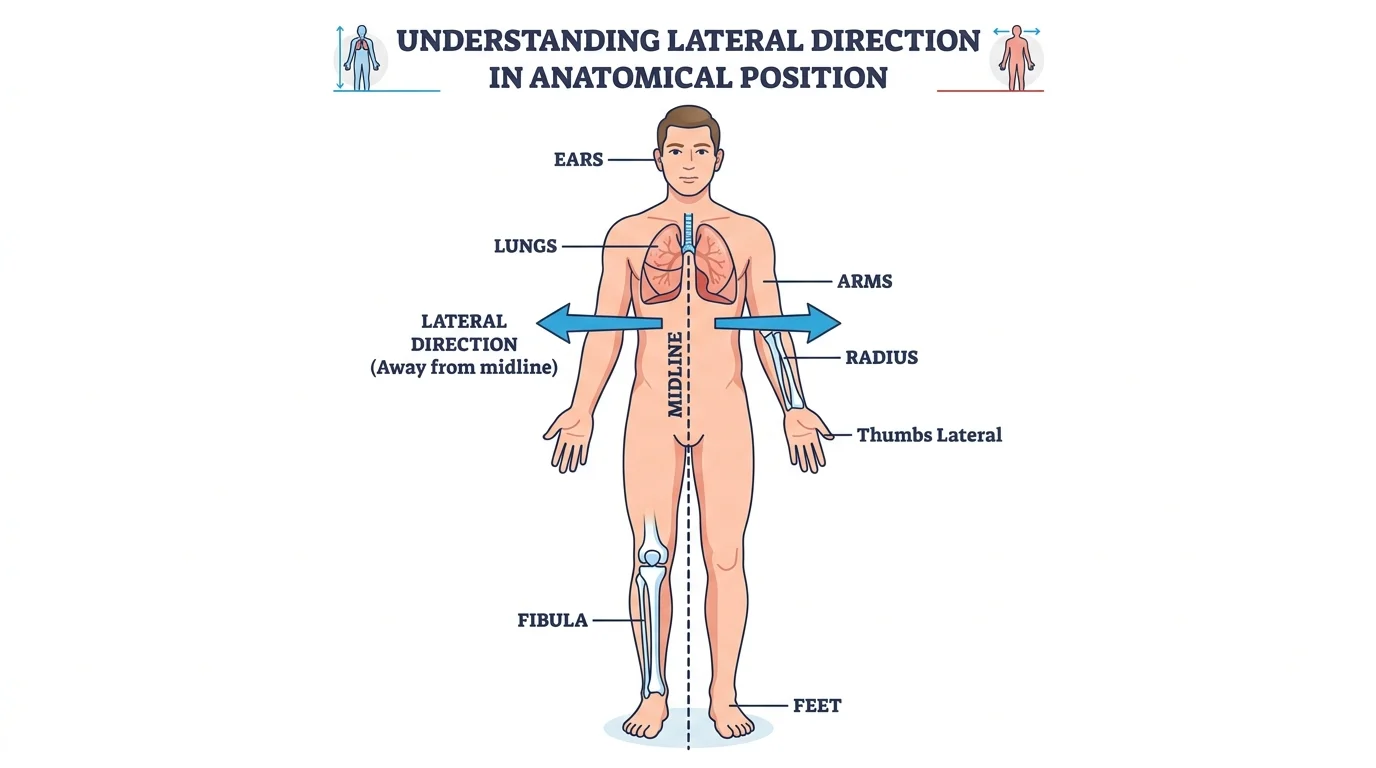
In anatomy, lateral describes a structure that is farther away from the body’s midline.
The body’s midline is an imaginary vertical line dividing the body into equal right and left halves.
If a body part is positioned farther from this center line, it is considered lateral.
For example:
- The ears are lateral to the eyes.
- The arms are lateral to the chest.
- The lungs are lateral to the heart.
- The thumbs are lateral when standing in the standard anatomical position.
Simply put:
Closer to the sides = Lateral
Full Definition
Lateral is one of the standard anatomical directional terms used worldwide in medicine.
It helps describe where one structure is located relative to another.
Healthcare professionals rely on this terminology because words like “left,” “right,” or “beside” may not always provide enough precision.
For example:
“The fibula is lateral to the tibia.”
This statement clearly identifies the fibula’s position on the outer side of the lower leg.
Understanding the Anatomical Position
All anatomical directional terms are based on the standard anatomical position, where a person stands:
- Upright
- Facing forward
- Arms at the sides
- Palms facing forward
- Feet pointing forward
Using this standard position ensures everyone interprets directional terms consistently.
Lateral vs. Medial
The easiest way to understand lateral is to compare it with medial.
| Lateral | Medial |
|---|---|
| Away from the body’s center | Toward the body’s center |
| Outer side | Inner side |
| Farther from the midline | Closer to the midline |
Examples:
- The little finger is medial to the thumb.
- The thumb is lateral to the little finger.
- The lungs are lateral to the heart.
- The nose is medial to the eyes.
Remember:
Lateral = Outside
Medial = Middle
Real-Life Anatomy Examples
Example 1: Eyes and Ears
The ears are lateral to the eyes because they are farther from the body’s midline.
Example 2: Arms
The shoulders are medial to the arms, while the arms are lateral to the chest.
Example 3: Legs
The fibula lies lateral to the tibia.
This is one of the most common anatomy examples taught in medical school.
Example 4: Lungs
Each lung is positioned lateral to the heart.
Example 5: Brain
The left and right cerebral hemispheres contain lateral surfaces that face the outer sides of the skull.
Medical Uses of Lateral
Physical Examination
Doctors use lateral when describing:
- Pain location
- Swelling
- Injuries
- Skin conditions
- Joint movement
Example:
“The patient reports pain along the lateral aspect of the knee.”
Radiology
Radiologists frequently use lateral when interpreting:
- X-rays
- CT scans
- MRI scans
- Ultrasound reports
Example:
“A fracture is present on the lateral side of the ankle.”
Orthopedic Surgery
Orthopedic surgeons often describe:
- Lateral ligaments
- Lateral fractures
- Lateral meniscus injuries
- Lateral epicondylitis (tennis elbow)
Physical Therapy
Therapists evaluate lateral movement, lateral stability, and lateral muscle strength during rehabilitation.
Lateral in Different Body Regions
Head
- Ears are lateral to the nose.
- Temples are lateral to the eyes.
Chest
- Lungs are lateral to the heart.
- Ribs extend laterally around the chest.
Abdomen
Certain abdominal muscles extend toward the lateral abdominal wall.
Upper Limb
- Thumb is lateral in anatomical position.
- Radius is lateral to the ulna.
Lower Limb
- Fibula is lateral to the tibia.
- The outer ankle is on the lateral side of the foot.
Related Anatomical Terms
Lateral is often studied alongside other directional terms.
Medial
Toward the body’s midline.
Superior
Toward the head.
Inferior
Toward the feet.
Anterior
Toward the front of the body.
Posterior
Toward the back.
Proximal
Closer to the trunk or point of origin.
Distal
Farther from the trunk or point of origin.
Learning these terms together makes understanding anatomy much easier.
Common Misunderstandings
Students often confuse lateral with left or right.
However, lateral does not always mean left or right.
Instead, it describes position relative to the body’s midline.
Another misconception is believing lateral always refers to movement.
Although exercises like lateral raises use the word lateral, in anatomy it primarily describes location.
When Is the Term Lateral Used?
Healthcare professionals use lateral every day in:
- Medical school
- Nursing education
- Anatomy classes
- Surgical reports
- Diagnostic imaging
- Physical therapy
- Sports medicine
- Emergency medicine
Using standardized terminology helps prevent misunderstandings during patient care.
Study Tips for Remembering Lateral
Here are a few easy ways to remember the term:
- Think of the sides of your body.
- Remember that lateral = away from the center.
- Compare it with medial whenever you study anatomy.
- Practice identifying lateral structures on anatomy diagrams.
- Use real-life examples like the ears, lungs, and fibula.
Frequently Asked Questions
What does lateral mean in anatomy?
Lateral means away from the body’s midline or toward the outer side of the body.
What is the opposite of lateral?
The opposite anatomical term is medial, which means toward the body’s midline.
Are the ears lateral to the nose?
Yes. The ears are farther from the body’s center than the nose.
Is the thumb lateral?
Yes. In the standard anatomical position, the thumb is lateral to the other fingers.
Is the fibula lateral to the tibia?
Yes. The fibula is located on the outer side of the lower leg.
Is the heart lateral to the lungs?
No. The lungs are lateral to the heart.
Why do doctors use the word lateral?
It provides a precise way to describe body locations regardless of a patient’s position.
Does lateral mean left?
No. It simply means farther from the body’s midline.
Is lateral an anatomical directional term?
Yes. It is one of the primary directional terms used in anatomy and medicine.
Why is learning lateral important?
Understanding lateral improves communication in anatomy, healthcare, radiology, and clinical practice.
Conclusion
Understanding what lateral means in anatomy is essential for anyone studying medicine, nursing, biology, physical therapy, or other health sciences. The term lateral simply means away from the body’s midline, making it one of the most fundamental directional terms in anatomy.
From describing the position of the lungs relative to the heart to identifying the fibula as lateral to the tibia, this terminology allows healthcare professionals to communicate accurately and consistently. By learning lateral alongside related terms such as medial, superior, inferior, anterior, posterior, proximal, and distal, you’ll build a strong foundation for understanding anatomical relationships and interpreting medical information with confidence.
Discover More:-
- STD Meaning in Text: What It Means, How to Use It, Examples & More 2026
- Awe Meaning in Text: Definition, Uses, Examples & Social Media Guide 2026

Ella Parker is a professional content writer with a passion for creating clear, engaging, and well-researched articles. She focuses on delivering valuable insights and practical information across business, technology, and lifestyle topics.