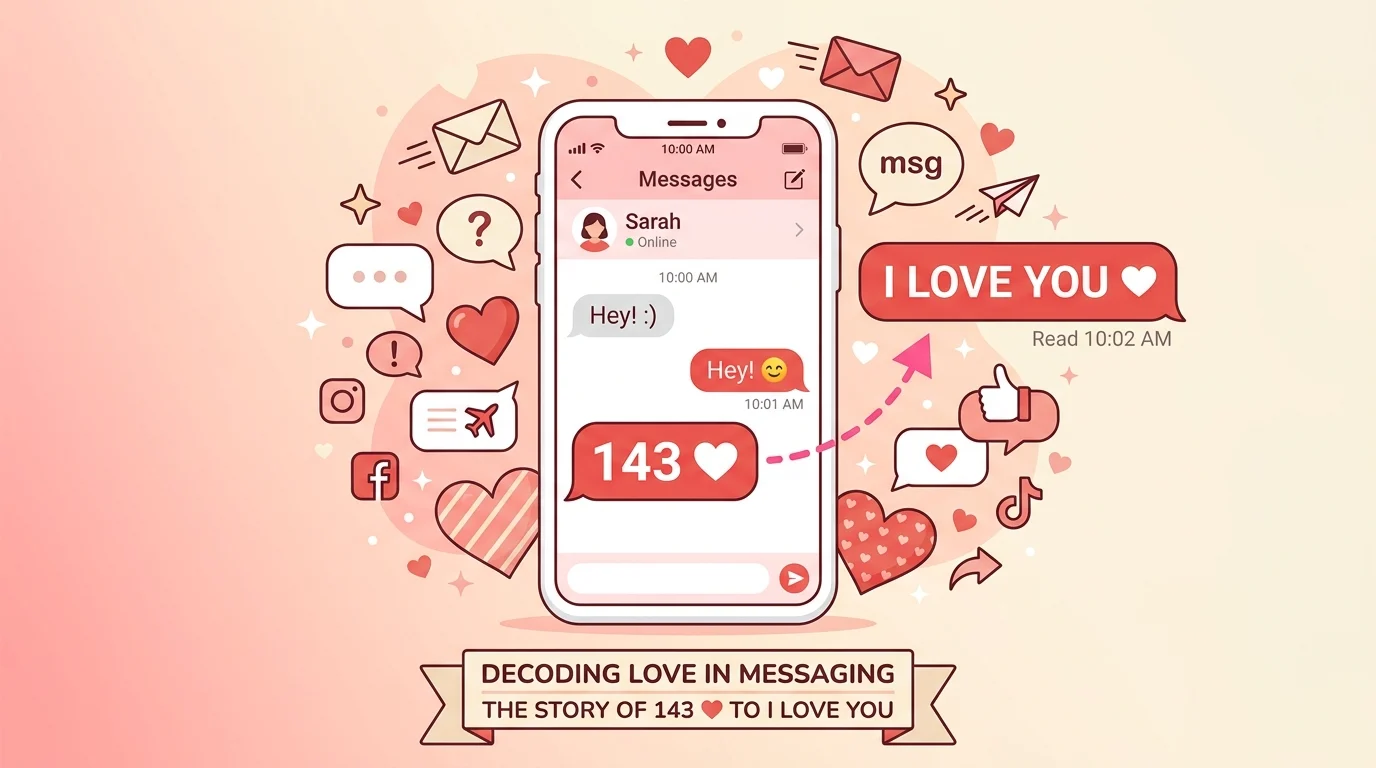
Quick Ans: 143 in text means “I Love You.” The number represents the number of letters in each word: 1 = I, 4 = Love, 3 = You. It is commonly used in text messages, social media, online chats, and messaging apps as a short, affectionate way to express love.
If you’ve received the number 143 in a text message, Snapchat, Instagram DM, or another social media platform, you may be wondering what it means. Unlike many internet abbreviations that use letters, 143 is a numeric code with a heartfelt meaning.
For decades, 143 has been one of the most recognizable love codes in digital communication. It offers a quick, simple, and meaningful way to tell someone “I love you” without typing the full phrase. Whether it’s sent between romantic partners, close friends, or family members, the message usually expresses affection and care.
In this guide, you’ll learn everything about the 143 meaning in text, including its definition, history, conversation examples, platform-specific usage, alternative meanings, reply suggestions, common misunderstandings, and frequently asked questions.
Quick Answer Box
| Topic | Answer |
|---|---|
| Most Common Meaning | I Love You |
| Type | Numeric text code |
| Used On | Text messages, Snapchat, Instagram, WhatsApp, TikTok, Facebook, Messenger |
| Tone | Loving, caring, affectionate |
| Number Breakdown | 1 = I, 4 = Love, 3 = You |
| Example | “143 ❤️” |
What Does 143 Mean in Text?
In texting, 143 means:
I Love You
The meaning comes from counting the letters in each word:
- 1 = I
- 4 = Love
- 3 = You
Instead of typing the complete sentence, people simply send 143 as a sweet and recognizable shortcut.
Although modern emojis have become popular, 143 remains one of the most iconic numeric expressions of love.
Full Definition
The number 143 is a numerical code that symbolizes the phrase “I Love You.”
People use it because it is:
- Short and easy to type
- Romantic
- Universally recognized
- Perfect for casual conversations
- A nostalgic texting code
Unlike many slang abbreviations, 143 carries genuine emotional meaning and is typically used to express affection.
Context and Usage
The meaning of 143 depends on the relationship between the people involved, but it almost always expresses love or deep appreciation.
Romantic Relationships
Couples often send:
“143 ❤️”
instead of typing:
“I love you.”
Family Conversations
Parents and children sometimes use 143 as a quick reminder of their love.
Example:
“Goodnight! 143.”
Friendships
Close friends occasionally send 143 to show appreciation or emotional support.
Example:
“Thanks for always being there. 143!”
Long-Distance Relationships
People in long-distance relationships often use 143 throughout the day because it’s short, meaningful, and easy to send.
Real-Life Conversation Examples
Conversation Example 1
Emma: I finally made it home safely.
Ryan: Good! Get some rest.
Emma: 143 ❤️
Ryan: Love you too!
Conversation Example 2
Mom: Have a great day at school.
Son: Thanks!
Mom: 143
Son: ❤️
Conversation Example 3
Jake: Thanks for always supporting me.
Sarah: Always.
Jake: 143.
Sarah: Same here.
Conversation Example 4
Olivia: I miss you already.
Lucas: I’ll see you this weekend.
Olivia: 143 ❤️
Lucas: Can’t wait.
Conversation Example 5
Sophia: Goodnight!
Noah: Sweet dreams.
Sophia: 143
Noah: Love you too.
Platform-Specific Meaning
Text Messages
In regular SMS conversations, 143 almost always means “I Love You.”
Snapchat
Snapchat users often send:
- 143 ❤️
- 143🥰
- 143 Always
to express affection.
On Instagram, you’ll find 143 in:
- Captions
- Comments
- Direct Messages
- Story replies
Example:
“143 forever ❤️”
TikTok
TikTok creators use 143 in romantic videos, relationship edits, and nostalgic content.
Friends, couples, and family members commonly use 143 during private chats.
Facebook Messenger
Messenger conversations frequently include 143 as a sweet and simple expression of love.
The History Behind 143
Long before smartphones and social media, 143 became popular through pagers and early text messaging.
Since messages were often limited in length, people created number codes to communicate quickly.
Because:
- “I” has 1 letter
- “Love” has 4 letters
- “You” has 3 letters
the number 143 naturally became a shorthand for I Love You.
It has remained popular for decades and continues to appear across modern messaging apps.
Alternative Meanings of 143
Although I Love You is by far the most common meaning, there are situations where 143 may represent something else.
Examples include:
- A room number
- A house address
- A bus route
- A product model
- A sports jersey number
- A page number
However, in texting and social media, 143 almost always refers to I Love You.
Related Numeric Text Codes
Several other number codes are commonly used alongside 143.
Examples include:
- 831 = I Love You (8 letters, 3 words, 1 meaning)
- 459 = I Love You (phone keypad code)
- ILY = I Love You
- ILYSM = I Love You So Much
- 1437 = I Love You Forever
- 520 = I Love You (popular in Chinese internet culture)
Learning these codes can help you better understand online conversations.
How to Respond to 143
If someone sends you 143, your response depends on your relationship.
Common replies include:
- 143 ❤️
- I love you too.
- Love you!
- Always ❤️
- Me too!
- You mean the world to me.
- Aww, 143!
- Forever ❤️
- Same here.
- Sending hugs!
If you’re unsure why someone sent it, you can simply ask:
“Does 143 mean I love you?”
Common Misinterpretations
Although 143 is well known, misunderstandings can still happen.
Some people assume it’s:
- A random number
- A password
- A code with no meaning
- A reference to something technical
In most casual conversations, however, 143 simply means “I Love You.”
When Not to Use 143
While 143 is sweet and meaningful, it isn’t appropriate in every situation.
Avoid using it in:
- Professional emails
- Business communication
- Academic assignments
- Legal documents
- Formal workplace conversations
Instead, use clear language that matches the setting.
Usage Tips
To use 143 naturally:
- Use it with people who understand internet culture.
- Pair it with emojis for extra warmth.
- Don’t assume everyone recognizes the number.
- Reserve it for personal conversations.
- Consider the relationship before sending it.
Simple, thoughtful communication is always more meaningful than overusing abbreviations.
Frequently Asked Questions
What does 143 mean in text?
It means “I Love You.”
Why does 143 mean I love you?
The numbers represent the number of letters in each word: 1, 4, and 3.
Is 143 romantic?
Usually yes, although family members and close friends also use it.
Is 143 still popular?
Yes. While emojis are more common today, many people still use 143 as a classic expression of love.
Can friends say 143?
Yes. Some close friends use it to show appreciation and care.
Does 143 mean the same thing on every platform?
Yes. Across most messaging apps and social media platforms, it means “I Love You.”
What should I reply to 143?
You can respond with “143,” “Love you too,” or another affectionate message.
Is 143 internet slang?
It’s better described as a numeric text code rather than traditional slang.
Can 143 have other meanings?
Yes, but outside texting those meanings are uncommon.
Is 143 appropriate for business messages?
No. It should be reserved for personal conversations.
Conclusion
The 143 meaning in text is one of the oldest and most recognizable expressions of affection in digital communication. By representing the phrase “I Love You” through the number of letters in each word, 143 provides a quick yet meaningful way to express love and appreciation.
Whether you receive it in a text message, Snapchat chat, Instagram DM, WhatsApp conversation, or Facebook Messenger, the meaning is almost always the same: someone is expressing care, affection, or love. Understanding this classic number code helps you communicate more naturally and appreciate one of the internet’s most enduring symbols of affection.
Discover More:-
- BY Meaning in Text Slang: What It Means, How to Use It, Examples & More 2026
- What Does EPO Mean in Health Insurance? Complete Guide 2026

Amelia Brooks is a professional content writer and digital publishing specialist with a passion for creating clear, engaging, and informative content. She has extensive experience writing about technology, business, lifestyle, and online services.