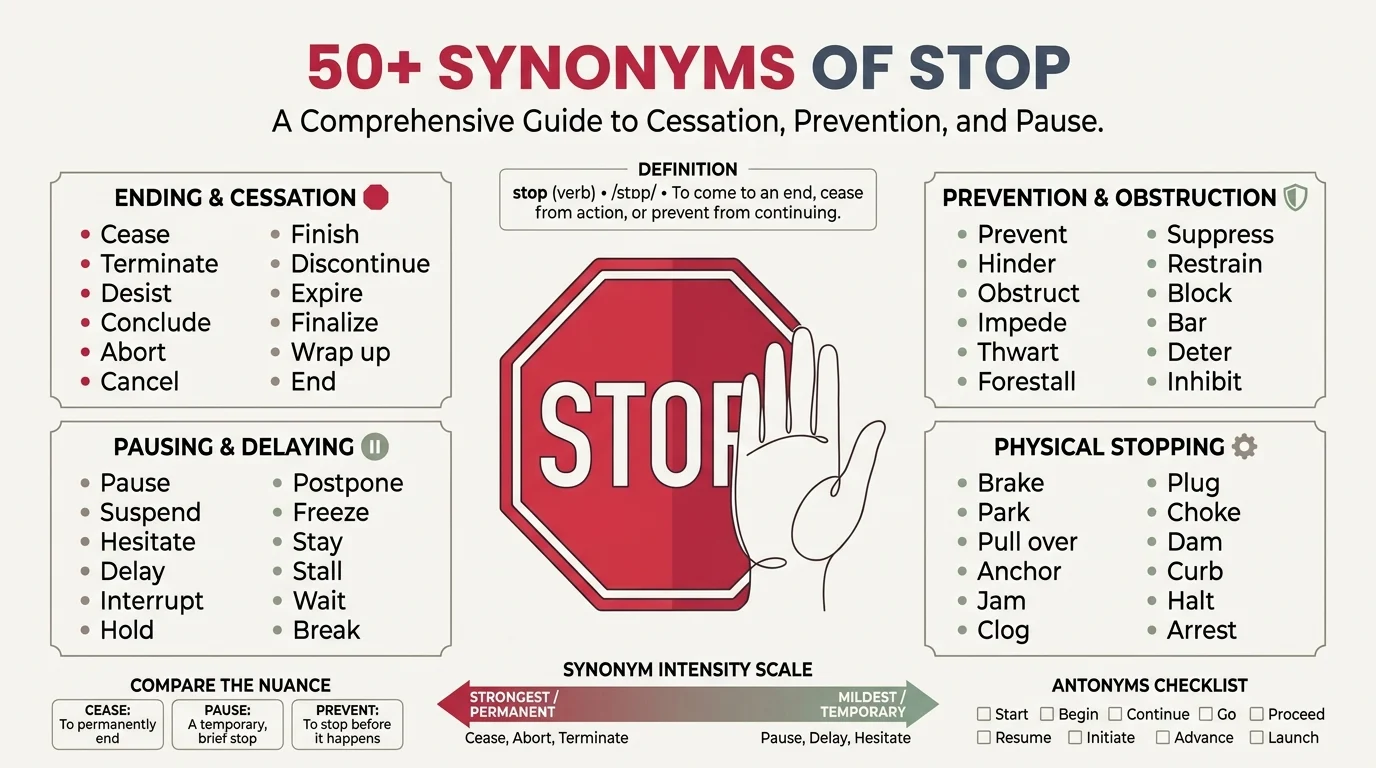
Have you ever needed to describe ending an action, halting movement, or preventing something from continuing but felt that “stop” was too simple or repetitive? You want to capture the specific type of cessation, whether it is a temporary pause, a permanent end, or a forceful halt, and the word “stop” comes to mind. Choosing the right synonym for “stop” can transform a basic statement into a precise expression of cessation, prevention, or interruption. This guide explores the best synonyms of stop, explaining exactly which word to use and when.
Quick Ans: “Stop” means to cease movement or action, to bring something to an end, or to prevent something from happening. For ending an action, choose cease, halt, or discontinue. For preventing, use prevent, block, or obstruct. For pausing, use pause, interrupt, or suspend. For physical stopping, use brake, arrest, or check.
Meaning, Tone, and Context
Understanding the core meaning of “stop” is the first step to using it effectively.
Simple Definition: To cease moving or acting; to bring something to an end; to prevent something from happening or continuing.
Part of Speech: Verb and noun.
Overall Tone: Neutral. It can indicate control, prevention, or completion.
Formality Level: Neutral. The word works in most contexts.
Common Uses: Native English speakers use it in traffic (“stop the car”), business (“stop production”), personal (“stop talking”), and general contexts (“stop the bleeding”).
Word Forms: Related words include the noun stop, the adjective stoppable, and the noun stoppage.
When and How to Use “Stop”
“Stop” is the perfect choice when you want to describe ending, halting, or preventing. Here are seven realistic examples.
Physical: “The driver stopped the car at the red light.”
Action: “Please stop talking during the movie.”
Business: “The company stopped production due to supply issues.”
Prevention: “The medicine stops the infection from spreading.”
Personal: “I need to stop procrastinating.”
Professional: “We must stop the leak immediately.”
Social Media: “Stop scrolling and look at this.”
Best Synonyms of “Stop”
No synonym is identical in every situation. Here is your guide to the best replacement for “stop” based on your writing context.
For Ending an Action
Most Direct: Cease means to bring to an end. “The company ceased operations.”
Halt: Halt means to stop suddenly. “The train halted at the station.”
Discontinue: Discontinue means to stop doing or making. “The product was discontinued.”
Terminate: Terminate means to bring to an end. “The contract was terminated.”
For Preventing and Blocking
Prevent: Prevent means to stop from happening. “Vaccines prevent disease.”
Block: Block means to obstruct. “The road was blocked by snow.”
Obstruct: Obstruct means to block or hinder. “The crowd obstructed the exit.”
Hinder: Hinder means to make difficult. “The rain hindered progress.”
For Pausing and Interrupting
Pause: Pause means to stop temporarily. “She paused before answering.”
Interrupt: Interrupt means to break the continuity. “Do not interrupt me.”
Suspend: Suspend means to stop temporarily. “The service was suspended.”
Break: Break means to interrupt. “Let us break for lunch.”
For Physical Stopping
Brake: Brake means to slow or stop a vehicle. “He braked suddenly.”
Arrest: Arrest means to bring to a stop. “The arrest of the bleeding was urgent.”
Check: Check means to slow or stop. “The advance was checked.”
Restrain: Restrain means to hold back. “He restrained his anger.”
When Not to Use “Stop”
Using “stop” can sound wrong or awkward in certain situations.
When You Mean “Pause”: “Stop” is stronger. “Pause” is temporary.
Better Choice: Pause. “Pause for a moment.”
When You Mean “Prevent”: “Stop” is general. “Prevent” is specific.
Better Choice: Prevent. “Prevent the spread of disease.”
When It Sounds Too Simple: In formal writing, “stop” can sound basic.
Better Choice: Cease or terminate. “Cease operations.”
Words Commonly Confused With “Stop”
| Word | Difference | When to Use | Example |
|---|---|---|---|
| Cease | Formal stop | Formal and business | “Cease operations.” |
| Halt | Sudden stop | Movement and progress | “Halt the advance.” |
| Prevent | Stop from happening | Prevention and safety | “Prevent accidents.” |
| Pause | Temporary stop | Conversation and action | “Pause for a moment.” |
| End | Final stop | General and formal | “End the meeting.” |
| Quit | Stop doing | Personal habits | “Quit smoking.” |
Best Synonyms of “Stop” by Context
| Context | Best Synonym | Why It Works | Example |
|---|---|---|---|
| Formal writing | Cease | Formal and precise | “The company ceased operations.” |
| Academic writing | Terminate | Standard in research | “The study was terminated early.” |
| Professional | Halt | Professional and strong | “The project was halted.” |
| Business | Discontinue | Business and products | “The product was discontinued.” |
| Safety | Prevent | Prevention and safety | “Prevent the spread of fire.” |
| Casual | Quit | Simple and natural | “Quit complaining.” |
| Physical | Brake | Vehicles and movement | “He braked suddenly.” |
How to Choose the Best Synonym of “Stop”
Choosing the right word is a simple decision. Answer these questions.
What type of stop am I describing? For ending, use cease or halt. And For preventing, use prevent or block. For pausing, use pause or interrupt. For physical stopping, use brake or arrest.
What is my audience? For a formal report, use cease or terminate. For a friend, use quit or pause.
What is my purpose? Are you ending, preventing, or pausing? The correct synonym depends entirely on this.
What is the emotional strength? Terminate and halt are stronger. Pause is milder. Pick the one that matches your message.
Real Life Examples of “Stop”
School: Basic: “Stop running in the hall.” Improved: “Cease running in the hall.”
College: Basic: “The study was stopped.” Improved: “The study was terminated.”
Workplace: Basic: “Stop the machine.” Improved: “Halt the machine.”
Business: Basic: “They stopped the product.” Improved: “They discontinued the product.”
Email: Basic: “Please stop sending emails.” Improved: “Please cease sending emails.”
Conversation: Basic: “Stop it!” Improved: “Quit it!”
Storytelling: Basic: “The car stopped suddenly.” Improved: “The car braked suddenly.”
Top 10 Synonyms of “Stop”
| Synonym | Simple Meaning | Best Used For | Example Sentence |
|---|---|---|---|
| Cease | To bring to an end | Formal and business | “The company ceased operations.” |
| Halt | To stop suddenly | Movement and progress | “The train halted at the station.” |
| Discontinue | To stop making or doing | Products and services | “The product was discontinued.” |
| Terminate | To bring to an end | Contracts and formal | “The contract was terminated.” |
| Prevent | To stop from happening | Prevention and safety | “Vaccines prevent disease.” |
| Pause | To stop temporarily | Conversation and action | “She paused before answering.” |
| Interrupt | To break the continuity | Conversation and events | “Do not interrupt me.” |
| Suspend | To stop temporarily | Services and activities | “The service was suspended.” |
| Quit | To stop doing | Personal habits | “He quit smoking.” |
| Brake | To slow or stop a vehicle | Vehicles and movement | “He braked suddenly.” |
Synonyms of “Stop” by Usage
Professional vs. Personal Synonyms
In the workplace, choose cease, halt, or discontinue. With friends, use quit, pause, or cut it out.
Formal vs. Conversational Synonyms
For formal writing, use cease, terminate, or suspend. For casual conversations, use quit, pause, or stop.
Academic Synonyms
For research and essays, choose terminate for studies, prevent for outcomes, and cease for actions.
Professional and Business Synonyms
For maximum impact, choose halt for production, discontinue for products, and terminate for contracts.
Creative and Literary Synonyms
To add emotion and imagery, choose arrest, check, or restrain. These words create atmosphere.
Slang or Modern Synonyms
In modern American slang, quit, cut it out, or knock it off are common. For example, “Knock it off!” These are casual and should be avoided in formal writing.
Strongest to Mildest Synonyms
Mild: pause, break, quit
Moderate: stop, halt, cease
Strong: terminate, discontinue, prevent
Very Strong: arrest, obstruct, restrain
Emotional vs. Neutral Synonyms
Emotional Synonyms: Restrain, arrest, check. These words hint at control and force. Use them when you want to evoke feeling.
Neutral Synonyms: Stop, cease, halt. These words communicate factual information.
Antonyms of “Stop”
| Antonym | Meaning | Example Sentence |
|---|---|---|
| Start | To begin | “Start the engine.” |
| Begin | To commence | “The meeting began.” |
| Continue | To keep going | “Continue reading.” |
| Proceed | To move forward | “Proceed with caution.” |
| Resume | To begin again | “Resume the work.” |
| Go | To move | “Go forward.” |
| Advance | To move forward | “Advance to the next level.” |
| Persist | To continue | “Persist in your efforts.” |
| Carry on | To continue | “Carry on with the plan.” |
| Accelerate | To speed up | “Accelerate the process.” |
| Maintain | To keep up | “Maintain the speed.” |
| Initiate | To start | “Initiate the program.” |
| Launch | To start | “Launch the product.” |
| Commence | To begin | “Commence the ceremony.” |
| Activate | To start | “Activate the system.” |
Comparison: “Stop” vs Similar Words
Stop vs. Cease
Main Difference: “Stop” is general. “Cease” is formal.
Which Is Stronger? “Cease” is more formal.
Which Is More Formal? “Cease” is more formal.
When to Use Each: Use “cease” in formal writing. Use “stop” in general contexts.
Examples:
Stop: “Stop the car.”
Cease: “Cease operations.”
Stop vs. Halt
Main Difference: “Stop” is general. “Halt” is sudden.
Which Is Stronger? “Halt” is stronger.
Which Is More Formal? Both are formal.
When to Use Each: Use “halt” for movement. Use “stop” for general contexts.
Examples:
Stop: “Stop the machine.”
Halt: “Halt the advance.”
Stop vs. Prevent
Main Difference: “Stop” is about ending. “Prevent” is about stopping before it starts.
Which Is Stronger? “Prevent” is more specific.
Which Is More Formal? Both are formal.
When to Use Each: Use “prevent” for safety. Use “stop” for general contexts.
Examples:
Stop: “Stop the bleeding.”
Prevent: “Prevent the disease.”
Stop vs. Pause
Main Difference: “Stop” can be permanent. “Pause” is temporary.
Which Is Stronger? “Stop” is stronger.
Which Is More Formal? Both are neutral.
When to Use Each: Use “pause” for temporary breaks. Use “stop” for general contexts.
Examples:
Stop: “Stop the car.”
Pause: “Pause for a moment.”
Stop vs. Terminate
Main Difference: “Stop” is general. “Terminate” is formal.
Which Is Stronger? “Terminate” is stronger.
Which Is More Formal? “Terminate” is more formal.
When to Use Each: Use “terminate” for contracts. Use “stop” for general contexts.
Examples:
Stop: “Stop the project.”
Terminate: “Terminate the contract.”
Stop vs. Quit
Main Difference: “Stop” is general. “Quit” is personal.
Which Is Stronger? “Quit” is more personal.
Which Is More Formal? “Stop” is more formal.
When to Use Each: Use “quit” for habits. Use “stop” for general contexts.
Examples:
Stop: “Stop talking.”
Quit: “Quit smoking.”
Common Phrases and Expressions with “Stop”
Phrase: Stop by
Meaning: Visit briefly.
Example Sentence: “Stop by my office later.”
Phrase: Stop at nothing
Meaning: Do anything to achieve a goal.
Example Sentence: “She will stop at nothing to succeed.”
Phrase: Stop short
Meaning: Stop suddenly.
Example Sentence: “He stopped short when he saw the sign.”
Phrase: Put a stop to
Meaning: End something.
Example Sentence: “We must put a stop to this behavior.”
Phrase: Stop over
Meaning: Break a journey.
Example Sentence: “We stopped over in Paris.”
Phrase: Full stop
Meaning: A period in punctuation.
Example Sentence: “End the sentence with a full stop.”
Common Mistakes to Avoid
Mistake 1: Using “stop” when you mean “prevent”.
Incorrect: “Stop the disease from spreading.”
Better: “Prevent the disease from spreading.”
Why: “Prevent” is more specific.
Mistake 2: Using “stop” when you mean “cease”.
Incorrect: “Stop operations immediately.”
Better: “Cease operations immediately.”
Why: “Cease” is more formal.
Mistake 3: Overusing “stop” in conversation.
Incorrect: “Stop it!”
Better: “Quit it!”
Why: “Quit” sounds more natural.
Mistake 4: Using “stop” when you mean “pause”.
Incorrect: “Stop for a moment.”
Better: “Pause for a moment.”
Why: “Pause” is temporary.
Mistake 5: Using “stop” when you mean “terminate”.
Incorrect: “Stop the contract.”
Better: “Terminate the contract.”
Why: “Terminate” is for contracts.
Frequently Asked Questions
1. What are the best synonyms of “stop”?
The best synonyms depend on your context. For ending, choose cease or halt. And For preventing, use prevent or block. For pausing, use pause or interrupt.
2. What are the best formal synonyms of “stop”?
The best formal synonyms are cease, terminate, and suspend. These words are suitable for academic papers, professional reports, and business communications.
3. What are common informal synonyms of “stop”?
For informal settings, use quit, pause, or cut it out. These alternatives sound more natural in everyday conversation.
4. What is another word for “stop” in professional writing?
In professional writing, halt is an excellent choice. It conveys a strong stop. Discontinue is also strong for products.
5. What is the difference between “stop” and “cease”?
“Stop” is general. “Cease” is formal. Use “cease” in formal writing and “stop” in general contexts.
6. What is the opposite of “stop”?
The most direct opposites (antonyms) of stop are start, begin, and continue. These words describe the beginning or continuation of an action.
Conclusion
“Stop” is a fundamental and versatile word for describing the end of an action, the prevention of something, or a temporary pause. The term is neutral and widely accepted in all contexts, yet it can sound too simple for formal writing or too broad for specific descriptions. The best choice among the synonyms of stop depends entirely on your audience, tone, and purpose. Remember, no single synonym works perfectly in every situation. Your goal is to choose the word that communicates your message with the most clarity and impact. A practical tip for your vocabulary growth is to pay attention to how writers describe endings and prevention and practice using different synonyms in your writing.









