Have you ever needed to describe the process of breaking something down to understand it better but felt that “analysis” sounded too technical or academic? You want to highlight careful examination, systematic study, or detailed evaluation, and the word “analysis” comes to mind. But is it the best fit for your audience? Choosing the right synonym for “analysis” can transform a general statement into a precise description of investigation, evaluation, or interpretation. This guide explores the best synonyms of analysis, explaining exactly which word to use and when.
Quick Ans: “Analysis” means the detailed examination or study of something to understand its nature or determine its essential features . It is a neutral, formal noun. For business writing, choose evaluation or assessment . For scientific contexts, use examination or investigation . In academic settings, study and scrutiny are strong choices . For a more dramatic, detailed effect, select dissection or deconstruction .
Meaning, Tone, and Context
Understanding the core meaning of “analysis” is the first step to using it effectively .
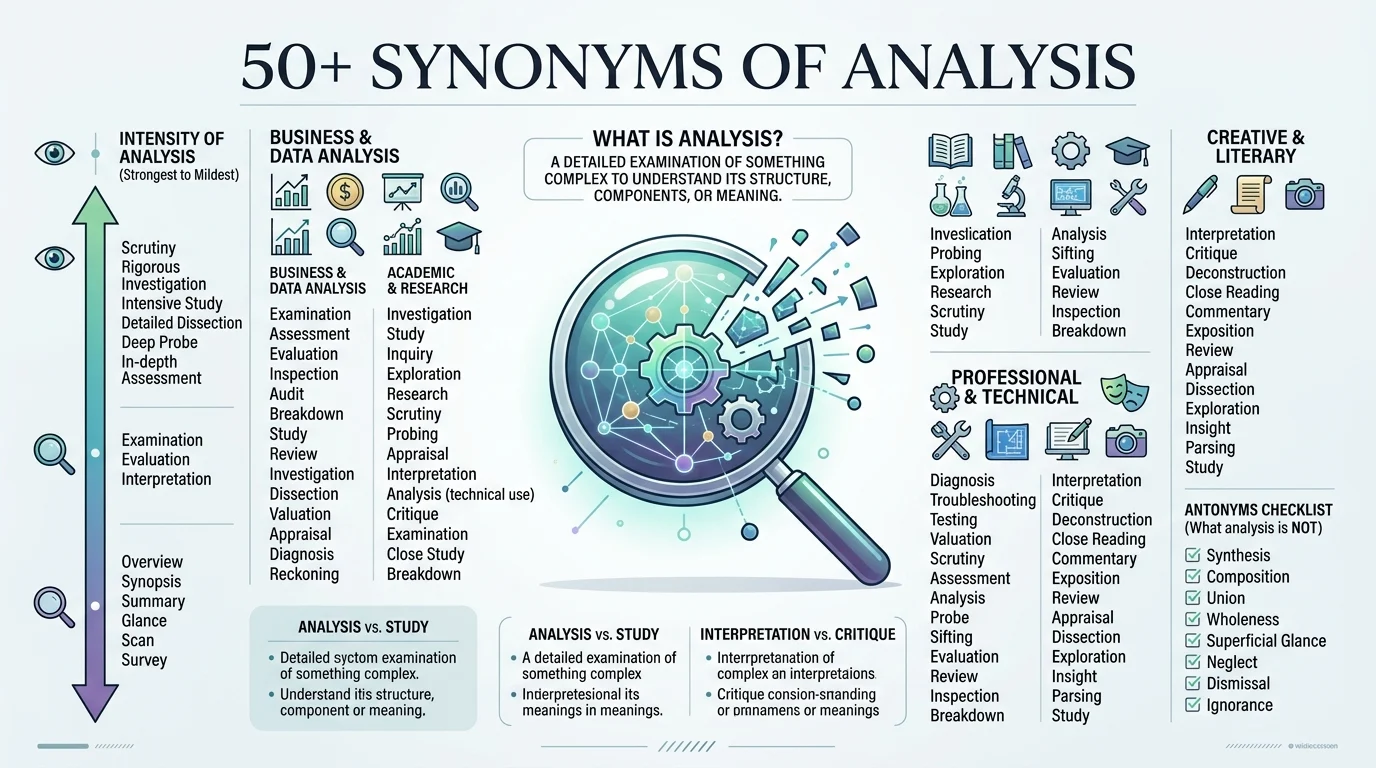
Simple Definition: The process of breaking a complex topic or substance into smaller parts to understand it better. A detailed examination of something .
Part of Speech: Noun.
Overall Tone: Neutral and formal. It describes a systematic process of investigation.
Formality Level: Formal to neutral. The word is appropriate in professional, academic, and scientific contexts .
Common Uses: Native English speakers use it to describe data examination, problem-solving, and literary criticism. For example, “The data analysis revealed significant trends,” or “Her analysis of the poem was insightful” .
Word Forms: Related words include the verb analyze, the adjective analytical, and the adverb analytically .
When and How to Use “Analysis”
“Analysis” is the perfect choice when you want to emphasize a systematic and detailed examination . Here are seven realistic examples.
Professional: “The market analysis showed a growing demand for sustainable products.”
Academic: “The student’s analysis of the text demonstrated a deep understanding of the themes.”
Workplace: “We need a thorough analysis of the project’s risks before proceeding.”
Personal: “His analysis of the situation was surprisingly accurate.”
Email: “Please attach your analysis of the quarterly sales data.”
Resume: “Conducted a detailed analysis of customer feedback, leading to a 15% increase in satisfaction.”
Social Media: “Book analysis: this novel explores themes of identity and belonging.”
Best Synonyms of “Analysis”
No synonym is identical in every situation. Here is your guide to the best replacement for “analysis” based on your writing context .
Business Writing: Evaluation. It suggests a judgment of value or quality. “The project evaluation determined its viability” .
Scientific Writing: Examination. This focuses on a careful, detailed look . “The examination of the sample revealed contamination.”
Academic Writing: Study. It emphasizes a systematic investigation . “The study explored the effects of climate change.”
Professional Communication: Assessment. A practical choice for estimating or judging. “The risk assessment was completed on time” .
Casual Conversation: Review. It tones down the formality and sounds natural. “I did a quick review of the document.”
Emotional Writing: Dissection. This word carries weight, suggesting a thorough and sometimes painful breakdown. “The dissection of their relationship was difficult but necessary” .
Resume Writing: Investigation. Use it to describe systematic research. “Led the investigation into process inefficiencies” .
When Not to Use “Analysis”
Using “analysis” can sound wrong or awkward in certain situations.
When It Sounds Too Technical: In casual conversation, “analysis” can sound overly academic .
Better Choice: Look or review. “Let me take a look at it.”
When You Mean a Summary: “Analysis” is about breaking down, not summarizing.
Better Choice: Summary or synopsis . “Here is a summary of the main points.”
When You Mean a Simple Check: “Analysis” implies depth, not a quick check.
Better Choice: Check or inspection . “The equipment passed inspection.”
When It Sounds Too Impersonal: “Analysis” can sound cold and detached.
Better Choice: Interpretation or opinion . “My interpretation of the data is different.”
Words Commonly Confused With “Analysis”
Several words are often mixed up with “analysis.” Here is how to keep them straight .
Word: Evaluation
Difference: Focuses on judging value or quality. “Analysis” focuses on understanding structure.
When to Use: Use it when you need to make a judgment.
Example: “The project evaluation rated it as successful.”
Word: Assessment
Difference: Similar to evaluation, often used for estimating .
When to Use: Use this for estimating or appraising.
Example: “The risk assessment was thorough.”
Word: Examination
Difference: A careful, detailed look. “Analysis” is the systematic breakdown .
When to Use: Use this for physical or close inspection.
Example: “The medical examination was thorough.”
Word: Interpretation
Difference: Explaining the meaning of something .
When to Use: Use this for texts, dreams, and data.
Example: “His interpretation of the poem was unique.”
Word: Study
Difference: A systematic investigation. “Analysis” is part of a study .
When to Use: Use this for research and academic work.
Example: “The study lasted five years.”
Word: Review
Difference: A general survey or summary .
When to Use: Use this for a less detailed look.
Example: “The literature review was comprehensive.”
Best Synonyms of “Analysis” by Context
| Context | Best Synonym | Why It Works | Example |
|---|---|---|---|
| Business writing | Evaluation | Emphasizes judgment of value. | “The product evaluation was positive.” |
| Scientific writing | Examination | Focuses on careful observation. | “The examination of the specimen began.” |
| Academic writing | Study | Emphasizes systematic investigation. | “The study of linguistics is complex.” |
| Professional communication | Assessment | Practical for estimating or judging. | “The assessment of the damage was severe.” |
| Business emails | Review | Professional and accessible. | “Please complete the review of the document.” |
| Resume writing | Investigation | Highlights systematic research. | “Led the investigation of the incident.” |
| Workplace communication | Analysis | The standard, expected term. | “We need an analysis of the problem.” |
| Creative writing | Dissection | Evokes a thorough, sometimes painful breakdown. | “The dissection of his motives was cruel.” |
| Emotional writing | Deconstruction | Suggests breaking down assumptions. | “The deconstruction of her identity was liberating.” |
| Strong emphasis | Scrutiny | Suggests intense, critical examination. | “The plan came under media scrutiny” . |
| Mild tone | Look | Simple and unassuming. | “Take a look at these figures.” |
| Social media captions | Breakdown | Casual and widely understood. | “Here is my breakdown of the movie.” |
How to Choose the Best Synonym of “Analysis”
Choosing the right word is a simple decision. Answer these questions.
What is my audience? For a professor or CEO, evaluation or study is powerful. For a friend, review or look is more natural.
What is my purpose? Are you judging, understanding, or investigating? Use evaluation for judging, study for understanding, and investigation for investigating .
Am I describing a physical or abstract process? For physical things, examination is good. For abstract ideas, interpretation or deconstruction are better.
What is the emotional strength? Dissection and scrutiny are stronger. Review and look are mild. Pick the one that matches your message.
Real Life Examples of “Analysis”
To truly master the word, it helps to see how it behaves in the wild and how a stronger synonym can elevate the sentence .
School: Basic: “The student completed an analysis of the poem.” Improved: “The student completed a critical interpretation of the poem.”
College: Basic: “The analysis of the data was complex.” Improved: “The statistical evaluation of the data was complex.”
Workplace: Basic: “We need an analysis of the market.” Improved: “We need a comprehensive market assessment.”
Business: Basic: “The analysis showed good results.” Improved: “The performance evaluation showed strong results.”
Email: Basic: “Please find the analysis attached.” Improved: “Please find the financial review attached.”
Conversation: Basic: “My analysis is that we should wait.” Improved: “My assessment is that we should wait.”
Storytelling: Basic: “Her analysis of the situation was cold.” Improved: “Her cold dissection of the situation was brutal.”
Top 10 Synonyms of “Analysis”
| Synonym | Simple Meaning | Best Used For | Example Sentence |
|---|---|---|---|
| Evaluation | A judgment of value or quality | Business, performance, and products. | “The program evaluation was positive.” |
| Examination | A careful, detailed look | Scientific, medical, and physical contexts. | “The doctor conducted a thorough examination.” |
| Assessment | An estimate or appraisal | Risk, damage, and professional judgments. | “The damage assessment was severe.” |
| Study | A systematic investigation | Academic, research, and detailed projects. | “The study was published in a journal.” |
| Scrutiny | Intense, critical examination | Media, public, and high-stakes contexts. | “The policy came under intense scrutiny.” |
| Dissection | A detailed separation of parts | Literary, emotional, and thorough analysis. | “Her dissection of the issue was thorough.” |
| Investigation | A systematic search for facts | Police, scientific, and research contexts. | “The investigation uncovered new evidence.” |
| Interpretation | An explanation of meaning | Texts, data, and artistic works. | “His interpretation of the painting was unique.” |
| Breakdown | A division into parts | Costs, budgets, and casual contexts. | “Here is a breakdown of the costs.” |
| Review | A general survey or report | Literature, documents, and summaries. | “Please complete a review of the article.” |
Synonyms of “Analysis” by Usage
Professional vs. Personal Synonyms
In the workplace (professional), choose evaluation, assessment, or investigation to describe processes and outcomes . These words convey professionalism and precision. “The project evaluation was thorough” is more precise than “The project analysis was thorough.”
With friends (personal), review, look, or breakdown keep the tone relaxed and relatable. These alternatives sound natural in everyday conversation.
Formal vs. Conversational Synonyms
For formal writing (reports, essays, professional emails), use examination, scrutiny, or evaluation . These choices maintain the sophisticated tone expected in professional documents.
For casual conversations and texting, use breakdown, look, or once-over. These options sound more natural and less pretentious .
Academic Synonyms
For research and essays, choose precise, authoritative words. Study is great for research, interpretation for texts, and investigation for systematic inquiry . These words sound considered and scholarly.
Using precise academic vocabulary demonstrates expertise and careful thinking. Professors and reviewers expect this level of precision.
Professional and Business Synonyms
For maximum impact in business writing, choose assessment for evaluations, review for reports, and evaluation for judgments . These words demonstrate confidence and professional awareness.
Business leaders respond to language that conveys clarity and practicality. These synonyms project authority.
Creative and Literary Synonyms
To add emotion and imagery to your writing, choose dissection, deconstruction, or autopsy (figuratively) . These words create atmosphere and evoke depth.
Literary writers use these alternatives to build tension and insight. They transform ordinary descriptions into evocative prose.
Slang or Modern Synonyms
In modern American slang, deep dive or breakdown are commonly used alternatives . For example, “Let’s do a deep dive into the data,” or “Here is the breakdown.” These are acceptable in casual, friendly contexts. Avoid them in professional or academic writing.
Strongest to Mildest Synonyms
Mild: look, review, breakdown
Moderate: examination, study, assessment
Strong: evaluation, investigation, interpretation
Very Strong: dissection, scrutiny, deconstruction
Emotional vs. Neutral Synonyms
Emotional Synonyms: Dissection, deconstruction, autopsy. These words often hint at intensity, pain, or deep insight. Use them when you want to evoke feeling.
Neutral Synonyms: Study, examination, assessment. These words simply communicate factual information. Use them when you want to inform without emotional coloring .
Antonyms of “Analysis”
Here are 15 genuine opposites of “analysis” .
| Antonym | Meaning | Example Sentence |
|---|---|---|
| Synthesis | Combining parts into a whole | “Synthesis of the ideas created a new theory.” |
| Summary | A brief statement of main points | “The summary was clear and concise.” |
| Aggregation | A collection of things | “The aggregation of data was complete.” |
| Amalgamation | A mixture of different things | “The amalgamation of styles was unique.” |
| Combination | Joining together | “The combination of factors caused the problem.” |
| Compilation | A collection from various sources | “The compilation took months.” |
| Conclusion | The final judgment or decision | “The conclusion was reached after a long debate.” |
| Disregard | Lack of attention | “His disregard for the details was costly.” |
| Guess | An estimate without analysis | “Her guess was surprisingly accurate.” |
| Ignorance | Lack of knowledge | “His ignorance of the issue was a problem.” |
| Intuition | Understanding without reasoning | “Her intuition guided her decision.” |
| Neglect | Failure to care for something | “The neglect of the data led to errors.” |
| Omission | Leaving something out | “The omission of key facts was a mistake.” |
| Guesswork | The process of guessing | “The guesswork led to incorrect results.” |
| Simplification | Making something simpler | “The simplification of the problem was helpful.” |
Comparison: “Analysis” vs Similar Words
Analysis vs. Evaluation
Main Difference: Analysis is about understanding structure. Evaluation is about judging value.
Which Is Stronger? They are different. Evaluation implies a judgment.
Which Is More Formal? Both are formal.
When to Use Each: Use analysis to understand. Use evaluation to judge.
Examples:
Analysis: “The analysis of the data showed patterns.”
Evaluation: “The evaluation rated the project as successful.”
Analysis vs. Assessment
Main Difference: Analysis is about breaking down . Assessment is about estimating .
Which Is Stronger? Assessment often implies a practical judgment.
Which Is More Formal? Both are formal.
When to Use Each: Use analysis for detailed breakdown. Use assessment for estimation.
Examples:
Analysis: “The analysis of the chemical was complex.”
Assessment: “The risk assessment was critical.”
Analysis vs. Examination
Main Difference: Analysis is about breaking down . Examination is about looking closely .
Which Is Stronger? Analysis implies deeper processing.
Which Is More Formal? Both are formal.
When to Use Each: Use analysis for conceptual breakdown. Use examination for physical or close inspection .
Examples:
Analysis: “The analysis of the theory was thorough.”
Examination: “The medical examination was routine.”
Analysis vs. Interpretation
Main Difference: Analysis is about breaking down . Interpretation is about explaining meaning .
Which Is Stronger? Interpretation requires more subjectivity.
Which Is More Formal? Both are formal.
When to Use Each: Use analysis for factual breakdown. Use interpretation for explaining meaning.
Examples:
Analysis: “The analysis of the data was objective.”
Interpretation: “Her interpretation of the painting was profound.”
Analysis vs. Study
Main Difference: Study is a general investigation . Analysis is the detailed breakdown.
Which Is Stronger? Analysis is more specific about the process.
Which Is More Formal? Both are formal.
When to Use Each: Use study for the whole research effort. Use analysis for the specific breakdown.
Examples:
Analysis: “His analysis of the data was the key finding.”
Study: “The study lasted three years.”
Analysis vs. Scrutiny
Main Difference: Analysis is about breaking down . Scrutiny is about intense, critical observation .
Which Is Stronger? Scrutiny implies more intense and critical attention.
Which Is More Formal? Both are formal.
When to Use Each: Use analysis for a systematic breakdown. Use scrutiny for intense criticism.
Examples:
Analysis: “The analysis was systematic.”
Scrutiny: “His private life came under scrutiny” .
Common Phrases and Expressions with “Analysis”
Phrase: Data analysis
Meaning: The process of examining data.
Example Sentence: “Data analysis revealed significant trends.”
Phrase: Cost-benefit analysis
Meaning: Comparing costs and benefits.
Example Sentence: “The cost-benefit analysis supported the investment.”
Phrase: Risk analysis
Meaning: The assessment of potential risks.
Example Sentence: “Risk analysis is a crucial step in planning.”
Phrase: Critical analysis
Meaning: A detailed, critical evaluation.
Example Sentence: “The critical analysis of the text was insightful.”
Phrase: In-depth analysis
Meaning: A very thorough analysis.
Example Sentence: “The report provides an in-depth analysis of the market.”
Phrase: Market analysis
Meaning: The study of market conditions.
Example Sentence: “The market analysis showed growing demand.”
Common Mistakes to Avoid
Mistake 1: Using “analysis” when you mean “summary”.
Incorrect: “Please provide an analysis of the main points.”
Better: “Please provide a summary of the main points.”
Why: Analysis is a breakdown, not a summary .
Mistake 2: Using “analysis” when you mean “evaluation”.
Incorrect: “My analysis is that the project is good.”
Better: “My evaluation is that the project is good.”
Why: Evaluation implies a judgment. Analysis implies a breakdown.
Mistake 3: Overusing “analysis” in casual conversation.
Incorrect: “Let me do an analysis of this problem.”
Better: “Let me take a look at this problem.”
Why: Analysis sounds too formal for everyday situations.
Mistake 4: Using “analysis” when you mean “interpretation”.
Incorrect: “My analysis of the poem is that it is about loss.”
Better: “My interpretation of the poem is that it is about loss.”
Why: Interpretation explains meaning. Analysis breaks down structure .
Mistake 5: Using “dissection” when you mean a simple analysis.
Incorrect: “A quick dissection of the issue showed the cause.”
Better: “A quick review of the issue showed the cause.”
Why: Dissection implies a very thorough and sometimes painful breakdown.
Frequently Asked Questions
1. What are the best synonyms of “analysis”?
The best synonyms depend on your context. For business writing, choose evaluation or assessment. And for scientific contexts, use examination or investigation . For academic settings, study or scrutiny are ideal choices .
2. What are the best formal synonyms of “analysis”?
The best formal synonyms are examination, investigation, and scrutiny . These words are suitable for academic papers, professional reports, and business communications.
3. What are common informal synonyms of “analysis”?
For informal settings, use breakdown, review, or look. These alternatives sound more natural in everyday conversation .
4. What is another word for “analysis” in professional writing?
In professional writing, assessment is an excellent choice . It conveys practical judgment. Evaluation is also strong for determining value.
5. What is the difference between “analysis” and “evaluation”?
While both are forms of examination, analysis is about breaking down to understand . Evaluation is about judging value or quality . Use analysis for understanding and evaluation for judgment.
6. What is the opposite of “analysis”?
The most direct opposite (antonym) of analysis is synthesis . Synthesis is the process of combining parts into a whole, while analysis separates them.
Conclusion
“Analysis” is a fundamental and versatile word for describing the process of breaking down complex topics to understand them. The term is formal and widely accepted in most professional and academic contexts, yet it can sound too technical for casual conversation. The best choice among the synonyms of analysis depends entirely on your audience, tone, and purpose. Remember, no single synonym works perfectly in every situation. Your goal is to choose the word that communicates your message with the most clarity and impact. A practical tip for your vocabulary growth is to practice using different synonyms in your writing and notice how they change the tone and precision of your communication.
Discover More:
- 50+ Synonyms of Ubiquitous: Meanings, Uses, Examples, and Best Alternatives
- 50+ Synonyms of Algorithm: Meanings, Uses, Examples, and Best Alternatives 2026

Alexander Cole is a professional content writer and researcher who specializes in creating informative, reader-friendly, and well-researched articles. He is committed to publishing accurate, valuable, and engaging content that helps readers stay informed and make smarter decisions.