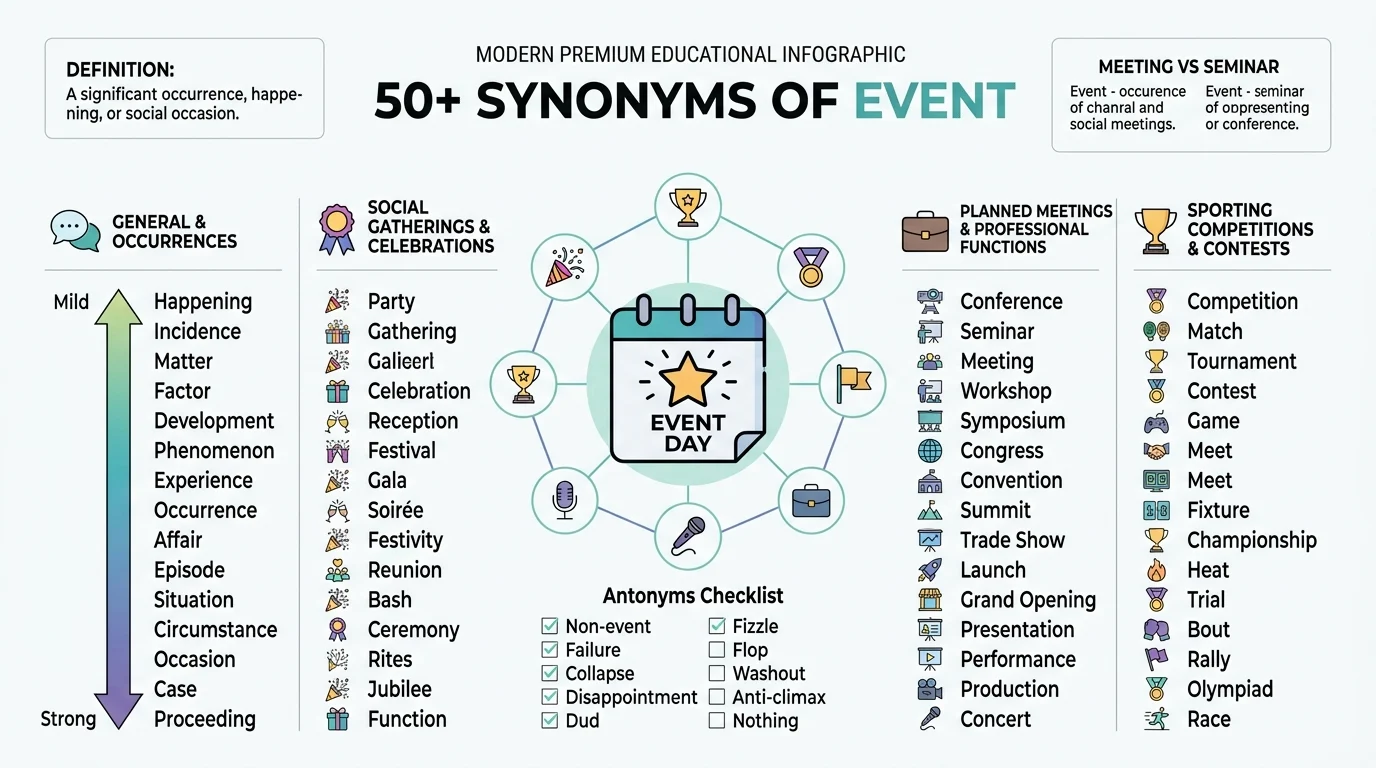
Have you ever struggled to find the perfect word for something that happened, a gathering you attended, or a milestone you achieved? You want to describe a specific happening accurately, and the word “event” comes to mind. But is it the best fit for your audience? Choosing the right synonym for “event” can transform a vague description into a precise and powerful statement. This guide explores the best synonyms of event, explaining exactly which word to use and when.
Quick Ans: “Event” means a happening or occurrence, especially one of some importance or significance . It can also refer to a planned social gathering, a sports competition, or a significant moment . For formal or general writing, choose occurrence or happening . For a social gathering, use function, affair, or occasion . For a significant moment, use milestone or landmark . For an organized contest, use competition or tournament .
Meaning, Tone, and Context
Understanding the core meaning of “event” is the first step to using it effectively.
Simple Definition: Something that happens, especially something important or notable . It can also be a planned public or social occasion .
Part of Speech: Noun .
Overall Tone: Neutral. It describes anything that takes place, from a small incident to a major occasion .
Formality Level: Neutral to formal. The word works in almost any context, from casual conversation to formal academic writing .
Common Uses: Native English speakers use it to describe historical moments, social gatherings, competitions, and even natural phenomena. For example, “The moon landing was a historic event” , or “We are planning a corporate event.”
Word Forms: Related words include the adjective eventful, the adverb eventfully, and the noun eventfulness .
When and How to Use “Event”
“Event” is the perfect choice when you want to describe a notable happening or a planned occasion. Here are seven realistic examples.
Historical: “The signing of the declaration was a pivotal event in the nation’s history.”
Academic: “The conference was a significant event for researchers in the field.”
Workplace: “The company’s annual charity event was a huge success.”
Personal: “Graduation was a major event for the entire family.”
Email: “We are looking forward to the networking event next week.”
Sports: “The championship event will be held at the national stadium.”
Social Media: “What a spectacular event! The fireworks display was incredible.”
Best Synonyms of “Event”
No synonym is identical in every situation . Here is your guide to the best replacement for “event” based on your writing context.
Formal/General Writing: Occurrence . This implies a more casual or less planned aspect than “event” . “Traffic jams are now a daily occurrence.”
Social Gatherings: Affair . This often implies a more personal or private nature, sometimes with a hint of secrecy . “The political scandal became a very public affair.”
Planned Occasions: Function . This emphasizes the organized aspect . “The company hosted a formal function.”
Significant Moments: Milestone . This specifically refers to an important point in a process . “Graduating college is a major milestone in life.”
Unplanned Happenings: Incident . This implies an event of usually minor importance, sometimes unexpected . “An amusing incident in a play.”
Sports Contexts: Competition or Tournament . These are appropriate for a specific contest in a series of contests . “He won the tournament.”
When Not to Use “Event”
Using “event” can sound wrong or awkward in certain situations.
When It Sounds Too General: “Event” can be vague if you need to be specific.
Better Choice: Incident or occurrence . “The incident in the parking lot was caught on camera.”
When You Mean a Social Gathering: “Event” is a bit formal for a casual get-together.
Better Choice: Get-together or party. “We are having a small get-together on Saturday.”
When You Mean a Formal Occasion: “Event” can be too broad.
Better Choice: Ceremony or festivity. “The wedding ceremony was beautiful.”
Words Commonly Confused With “Event”
Several words are often mixed up with “event.” Here is how to keep them straight .
Word: Incident
Difference: An incident is often an event of minor importance, sometimes unexpected .
When to Use: Use it for a specific, often minor, happening.
Example: “There was an unfortunate incident at the restaurant.”
Word: Occurrence
Difference: An occurrence is something that happens, often by surprise .
When to Use: Use this for spontaneous or natural happenings .
Example: “His arrival was an unexpected occurrence.”
Word: Episode
Difference: An episode is one of a series of happenings in a narrative or a person’s life .
When to Use: Use this for a distinct event in a sequence.
Example: “That was a difficult episode in my life.”
Word: Occasion
Difference: An occasion is a special or significant event often marked by festivities .
When to Use: Use this for a special or formal time.
Example: “The anniversary was a joyous occasion.”
Word: Affair
Difference: An affair often carries a connotation of a more personal or private nature, sometimes with scandal .
When to Use: Use this for an event that has some intrigue or is more personal.
Example: “The government has mishandled the whole affair.”
Best Synonyms of “Event” by Context
| Context | Best Synonym | Why It Works | Example |
|---|---|---|---|
| General happening | Occurrence | Neutral, factual, and implies spontaneity . | “The eclipse was a rare natural occurrence.” |
| Unplanned happening | Incident | Often used for unexpected or minor events . | “The incident with the car was quickly resolved.” |
| Series of events | Episode | Describes a distinct part of a larger narrative . | “This is a sad episode in the country’s history.” |
| Special occasion | Occasion | Implies celebration or formality . | “Her birthday was a special occasion.” |
| Social gathering | Affair | Suggests a social event, often with a personal or formal tone . | “The gala was a glamorous affair.” |
| Organized function | Function | Professional and formal for scheduled activities. | “The networking function was held downtown.” |
| Sports contest | Competition | Refers to a specific contest in a program . | “He won first place in the swimming competition.” |
| Significant moment | Milestone | Highlights an important achievement or turning point . | “The project reached a major milestone.” |
How to Choose the Best Synonym of “Event”
Choosing the right word is a simple decision. Answer these questions.
What is the nature of the event? Is it planned or unplanned? Is it important or minor? Use function for planned, occurrence for unplanned, milestone for important.
What is my audience? For a professor or CEO, occurrence or function is powerful. For a friend, happening or get-together is more natural.
What is my purpose? Are you describing a historical moment, a social gathering, or a sports contest? The correct synonym depends entirely on this.
What is the emotional strength? Milestone is stronger and implies success. Incident can be neutral or negative. Pick the one that matches your message.
Real Life Examples of “Event”
To truly master the word, it helps to see how it behaves in the wild.
School: Basic: “The school held an event.” Improved: “The school held a fundraising event for the new library.”
College: Basic: “The lecture was a major event.” Improved: “The lecture was a landmark event in the academic calendar.”
Workplace: Basic: “We organized an event.” Improved: “We organized a team-building function for the staff.”
Business: Basic: “The conference was a big event.” Improved: “The conference was a significant industry affair.”
Sports: Basic: “The event was postponed.” Improved: “The athletic tournament was postponed due to weather.”
Conversation: Basic: “That was a chaotic event.” Improved: “That was a bizarre incident.”
Storytelling: Basic: “The event changed history.” Improved: “The historic happening changed the course of history.”
Top 10 Synonyms of “Event”
| Synonym | Simple Meaning | Best Used For | Example Sentence |
|---|---|---|---|
| Occurrence | Something that happens, often naturally | General, casual, or spontaneous happenings . | “The eclipse was a rare occurrence.” |
| Happening | An event that is unplanned or unusual | Casual conversation, describing current things. | “The concert was the biggest happening in town this year.” |
| Incident | An event of usually minor importance | Accidents, disputes, or specific moments. | “The incident was quickly forgotten.” |
| Affair | A private, personal, or often scandalous event | Social gatherings, controversies, or formal occasions. | “The gala was a glamorous affair.” |
| Function | A formal social gathering or ceremony | Professional, business, or formal events. | “The company hosted a formal function.” |
| Occasion | A special or significant event | Celebrations, milestones, and ceremonies. | “The anniversary was a joyous occasion.” |
| Episode | A specific incident within a larger series | Narratives, TV shows, or periods of life. | “It was a painful episode in his life.” |
| Milestone | An important event or achievement | Achievements, turning points, and progress. | “The product launch was a major milestone.” |
| Competition | A specific contest in a series | Sports, debates, and tournaments. | “He won the national competition.” |
| Tournament | A series of contests | Organized sports events. | “The chess tournament attracted players from around the world.” |
Synonyms of “Event” by Usage
Professional vs. Personal Synonyms
In the workplace (professional), choose function, milestone, or competition to describe business activities . These words convey professionalism and precision. “We are hosting a networking function” is more precise than “We are hosting an event.”
With friends (personal), happening, get-together, or thing keep the tone relaxed and relatable.
Formal vs. Conversational Synonyms
For formal writing (reports, essays, professional emails), use occurrence, milestone, or affair. These choices maintain the sophisticated tone expected in professional documents.
For casual conversations and texting, use happening, get-together, or bash. These options sound more natural.
Academic Synonyms
For research and essays, choose precise words. Incident is great for specific case studies, occurrence for natural phenomena, and episode for historical or narrative sequences .
Professional and Business Synonyms
For maximum impact in business writing, choose function for organized events , milestone for achievements , and occurrence for general happenings. These words demonstrate confidence and professional awareness.
Creative and Literary Synonyms
To add emotion and imagery to your writing, choose affair or episode. These words create atmosphere and show narrative depth .
Slang or Modern Synonyms
In modern American slang, bash, shindig, or do can be used for casual social events . For example, “We are throwing a bash on Saturday.” These are acceptable in casual contexts but should be avoided in professional or academic writing.
Strongest to Mildest Synonyms
Mild: thing, happening, occurrence
Moderate: event, incident, function
Strong: episode, affair, milestone
Very Strong: landmark, turning point, phenomenon
Emotional vs. Neutral Synonyms
Emotional Synonyms: Milestone, landmark, episode. These words often hint at significance or narrative importance.
Neutral Synonyms: Occurrence, happening, incident. These words simply communicate factual information.
Antonyms of “Event”
Here are genuine opposites or contrasts of “event” .
| Antonym | Meaning | Example Sentence |
|---|---|---|
| Non-event | An uninteresting or unimportant event | “The party was a complete non-event.” |
| Inaction | Lack of action, nothing happening | “The period of inaction was followed by a flurry of activity.” |
| Stasis | A state of stability or inaction | “The region has been in a state of stasis for years.” |
| Inactivity | The state of being inactive | “The team’s inactivity allowed the competitors to get ahead.” |
Comparison: “Event” vs Similar Words
Event vs. Incident
Main Difference: “Incident” is usually an event of minor or secondary importance, while “event” is a broader term .
Which Is Stronger? “Event” is more neutral and general. “Incident” is more specific and often implies a problem or minor occurrence.
Which Is More Formal? Both are formal.
When to Use Each: Use “incident” for a specific, often minor happening. Use “event” for a notable or planned occasion.
Examples:
Event: “The charity event was a huge success.”
Incident: “There was an amusing incident in the play.”
Event vs. Occasion
Main Difference: “Occasion” is a special or significant event often marked by festivities .
Which Is Stronger? “Occasion” is stronger in terms of emotion and celebration. “Event” is more objective.
Which Is More Formal? Both are formal.
When to Use Each: Use “occasion” for special celebrations. Use “event” for any happening.
Examples:
Event: “The book fair is an event that brings people together.”
Occasion: “The 50th anniversary was a joyous occasion.”
Event vs. Occurrence
Main Difference: “Occurrence” often implies a more casual or spontaneous aspect than “event” .
Which Is Stronger? “Event” is more significant. “Occurrence” is more neutral.
Which Is More Formal? Both are formal.
When to Use Each: Use “occurrence” for everyday, natural, or unexpected happenings. Use “event” for planned or important happenings.
Examples:
Event: “The company’s annual meeting was a significant event.”
Occurrence: “Traffic jams are now a daily occurrence.”
Event vs. Episode
Main Difference: “Episode” is a specific incident within a larger series or sequence .
Which Is Stronger? “Episode” implies a narrative context. “Event” is more general.
Which Is More Formal? Both are formal.
When to Use Each: Use “episode” for a distinct part of a story or life. Use “event” for any happening.
Examples:
Event: “The election was a major event.”
Episode: “The accident was a frightening episode.”
Common Phrases and Expressions with “Event”
Phrase: Current events
Meaning: Important happenings in the news.
Example Sentence: “She follows current events closely.”
Phrase: Charity event
Meaning: A gathering held to raise money for a cause.
Example Sentence: “The charity event raised millions of dollars.”
Phrase: Networking event
Meaning: A gathering for professionals to connect .
Example Sentence: “The networking event was well-attended.”
Phrase: Annual event
Meaning: A gathering that happens every year .
Example Sentence: “The annual event is a highlight of the year.”
Phrase: In the event of
Meaning: Used to say what to do if something happens.
Example Sentence: “In the event of a fire, use the nearest exit.”
Common Mistakes to Avoid
Mistake 1: Using “event” when you mean “incident”.
Incorrect: “The event at the party was embarrassing.”
Better: “The incident at the party was embarrassing.”
Why: “Incident” is a more appropriate word for a specific, often minor, occurrence.
Mistake 2: Using “event” when you mean “occasion”.
Incorrect: “The holiday is a happy event.”
Better: “The holiday is a happy occasion.”
Why: “Occasion” emphasizes celebration.
Mistake 3: Overusing “event” in a single paragraph.
Incorrect: “The event was large. The event was also loud.”
Better: “The function was large. The gathering was also loud.”
Why: Variation in vocabulary demonstrates writing sophistication.
Mistake 4: Using “event” when you mean “episode”.
Incorrect: “The event in the TV show was exciting.”
Better: “The episode of the TV show was exciting.”
Why: “Episode” is the standard term for a television segment.
Frequently Asked Questions
1. What are the best synonyms of “event”?
The best synonyms depend on your context. For a general happening, choose occurrence or happening . And for a social gathering, use affair or function . For a significant moment, use milestone . For a sports contest, use competition or tournament .
2. What are the best formal synonyms of “event”?
The best formal synonyms are occurrence, affair, and function . These words are suitable for academic papers, professional reports, and business communications.
3. What are common informal synonyms of “event”?
For informal settings, use happening, get-together, or bash. These alternatives sound more natural in everyday conversation.
4. What is another word for “event” in professional writing?
In professional writing, function is an excellent choice for a business gathering . Milestone is also strong for achievements .
5. What is the difference between “event” and “incident”?
“Event” is a broad term for any happening of some significance. “Incident” is usually an event of minor importance, often unexpected .
6. What is the opposite of “event”?
The most direct opposite (antonym) of an event is a non-event, which is an uninteresting or unimportant occurrence .
Conclusion
“Event” is a versatile and essential word for describing any happening or planned occasion. The term is neutral and widely accepted in most contexts. However, the best choice among the synonyms of event depends entirely on your audience, tone, and purpose. Remember, no single synonym works perfectly in every situation. Your goal is to choose the word that communicates your message with the most clarity and impact. A practical tip for your vocabulary growth is to pay attention to how you use “event” and challenge yourself to use one of these specific alternatives in your writing today.










1 thought on “50+ Synonyms of Event: Meanings, Uses, Examples, and Best Alternatives 2026”