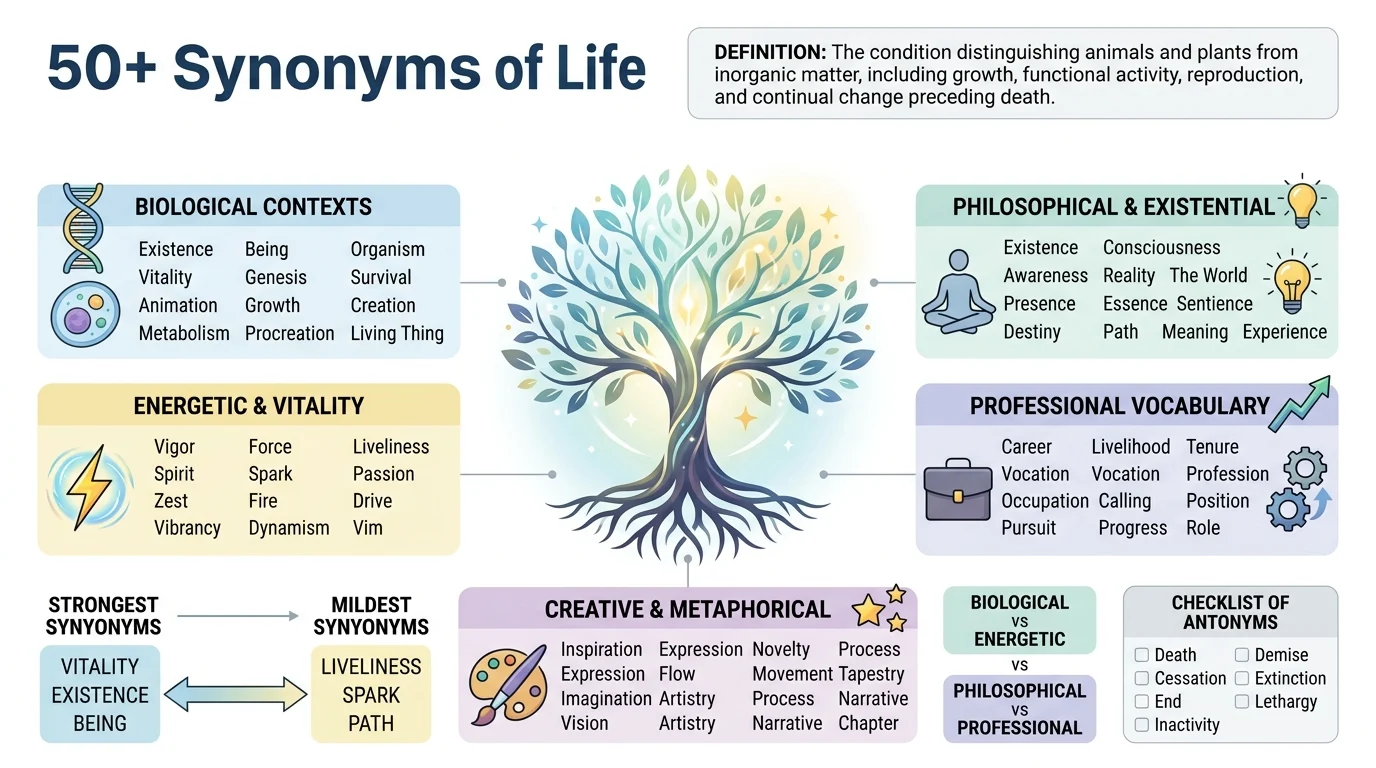
Have you ever needed to describe existence, vitality, or the human experience but felt that “life” did not quite capture the specific nuance you intended? You want to highlight energy, duration, or a way of living, and the word “life” comes to mind. But is it the best fit for your audience? Choosing the right synonym for “life” can transform a simple statement into a precise description of energy, existence, or experience. This guide explores the best synonyms of life, explaining exactly which word to use and when.
Quick Ans: “Life” means the state of being alive, the period of existence, or the vitality that characterizes living things . It is a neutral, versatile noun. For describing energy, choose vitality or animation. For duration, use lifetime or lifespan. In philosophical contexts, existence or being are strong choices. For a person’s experiences, select biography or life story. For a way of living, choose lifestyle or conduct.
Meaning, Tone, and Context
Understanding the core meaning of “life” is the first step to using it effectively.
Simple Definition: The state of being alive. The period during which something exists. The quality that distinguishes living organisms from dead organisms or inanimate matter .
Part of Speech: Noun.
Overall Tone: Neutral to positive. It can describe biological existence, energy, experience, or duration.
Formality Level: Neutral. The word works in almost any context, from casual conversation to formal academic writing.
Common Uses: Native English speakers use it to describe biological existence, a person’s experiences, energy and vitality, or the duration of something. For example, “The life of the battery was short,” or “She is full of life,” or “He wrote a life of the president.”
Word Forms: Related words include the adjective lively, the verb live, and the adverb lifelong .
When and How to Use “Life”
“Life” is the most common and versatile word in its category. Here are seven realistic examples.
Biological/Existence: “Life depends on water and oxygen.”
Energy/Vitality: “The children are always full of life and energy.”
Experience: “Her life has been full of adventure and travel.”
Duration: “The life of the product is approximately five years.”
Person: “He saved a life during the accident.”
Way of Living: “City life can be fast-paced and exciting.”
Academic/Philosophical: “The philosopher wrote extensively about the meaning of life.”
Best Synonyms of “Life”
No synonym is identical in every situation. Here is your guide to the best replacement for “life” based on your writing context.
Professional/Business: Lifespan or longevity. These suggest the duration of usefulness. “The expected lifespan of the equipment is ten years.”
Academic/Philosophical: Existence or being. These describe the state of living. “The philosopher questioned the nature of existence.”
Creative/Emotional: Vitality or animation. These suggest energy and spirit. “The vitality of the city was contagious.”
Describing Energy: Liveliness. It implies excitement and activity. “The liveliness of the party kept everyone awake.”
Describing a Person’s Story: Biography or life story. These describe the account of a person’s life. “The biography was a bestseller.”
Casual Conversation: Being alive. It is a simple phrase for the state of living. “I am grateful to be alive.”
When Not to Use “Life”
Using “life” can sound too vague or inaccurate in certain situations.
When You Need Specific Duration: “Life” is general. Lifetime or lifespan is more precise.
Better Choice: Lifetime. “The guarantee covers the product for its lifetime.”
When You Mean Energy: “Life” can mean energy, but vitality is more specific.
Better Choice: Vitality. “She showed great vitality in her work.”
When You Mean a Way of Living: “Life” is broad. Lifestyle is more specific.
Better Choice: Lifestyle. “His healthy lifestyle made a difference.”
When It Sounds Too Abstract: “Life” can be abstract. Experience is more concrete.
Better Choice: Experience. “Her experience in the field was invaluable.”
Words Commonly Confused With “Life”
Several words are often mixed up with “life.” Here is how to keep them straight.
Word: Existence
Difference: Refers to the state of being, often in a philosophical or abstract sense. “Life” is more concrete and biological.
When to Use: Use it for abstract or philosophical contexts.
Example: “The theory questions the existence of a higher power.”
Word: Vitality
Difference: Refers to energy and liveliness. “Life” is broader.
When to Use: Use this for describing energy and spirit.
Example: “Her vitality is an inspiration to others.”
Word: Biography
Difference: Refers to an account of a person’s life. “Life” is the subject.
When to Use: Use this for written accounts .
Example: “I am reading a biography of the president.”
Word: Lifetime
Difference: Refers to the duration of a life. “Life” is broader.
When to Use: Use this for time periods.
Example: “The award was a once-in-a-lifetime opportunity.”
Word: Liveliness
Difference: Refers to energy and activity. “Life” can be more passive.
When to Use: Use this for describing animated situations.
Example: “The liveliness of the city is famous.”
Word: Lifestyle
Difference: Refers to a way of living. “Life” is more general.
When to Use: Use this for habits and values.
Example: “A healthy lifestyle can prevent disease.”
Best Synonyms of “Life” by Context
| Context | Best Synonym | Why It Works | Example |
|---|---|---|---|
| Biological/Existence | Existence | Precise for the state of being. | “The existence of the species is threatened.” |
| Duration | Lifespan | Specific for how long something lasts. | “The lifespan of the product is five years.” |
| Energy/Vitality | Vitality | Highlights energy and strength. | “He is known for his vitality and vigor.” |
| Experience | Journey | Metaphorical and evocative. | “Her journey through life has been inspiring.” |
| Way of Living | Lifestyle | Specific to habits and choices. | “The coastal lifestyle is relaxing.” |
| Account of a Life | Biography | The standard term for written accounts. | “The biography was published posthumously.” |
| Creative/Descriptive | Spirit | Suggests essence and energy. | “The spirit of the city is vibrant.” |
How to Choose the Best Synonym of “Life”
Choosing the right word is a simple decision. Answer these questions.
What is my audience? For a professor or CEO, existence or viability is powerful. For a friend, energy or being alive is more natural.
What is my purpose? Are you describing duration, energy, or experience? Use lifespan for duration, vitality for energy, and biography for experience.
Am I describing a physical or abstract quality? For physical things, lifespan or duration are good. For abstract ideas, existence or essence are better.
What is the emotional strength? Vitality and spirit are stronger. Existence and being are mild. Pick the one that matches your message.
Real Life Examples of “Life”
To truly master the word, it helps to see how it behaves in the wild and how a stronger synonym can elevate the sentence.
School: Basic: “The science book describes plant life.” Improved: “The science book describes the biology of plants.”
College: Basic: “He studied life in ancient Rome.” Improved: “He studied the civilization and culture of ancient Rome.”
Workplace: Basic: “The product has a long life.” Improved: “The product has a long lifespan.”
Business: Basic: “The merger changed company life.” Improved: “The merger changed the culture and lifestyle of the company.”
Email: Basic: “I appreciate your life advice.” Improved: “I appreciate your wise counsel based on your experience.”
Conversation: Basic: “That party was full of life.” Improved: “That party was full of energy and liveliness.”
Storytelling: Basic: “She lived a life of adventure.” Improved: “She led a life of adventure, traveling to peculiar places.”
Top 10 Synonyms of “Life”
| Synonym | Simple Meaning | Best Used For | Example Sentence |
|---|---|---|---|
| Existence | The state of being | Philosophical, abstract, and academic contexts. | “The existence of the species is threatened.” |
| Vitality | Energy and liveliness | Creative, emotional, and descriptive contexts. | “Her vitality is an inspiration to others.” |
| Lifespan | The duration of life | Technical, product, and biological contexts. | “The lifespan of the device is 10 years.” |
| Lifetime | The period of a life | Duration, legal, and personal contexts. | “The award was a once-in-a-lifetime opportunity.” |
| Biography | An account of a life | Literary, historical, and academic contexts. | “The biography was published posthumously.” |
| Lifestyle | A way of living | Health, business, and personal contexts. | “A healthy lifestyle can prevent disease.” |
| Spirit | The essential nature | Creative, emotional, and descriptive contexts. | “The spirit of the city is vibrant.” |
| Liveliness | Energy and activity | Casual, social, and descriptive contexts. | “The liveliness of the party was contagious.” |
| Being | The nature of existence | Philosophical, spiritual, and literary contexts. | “The meaning of being is a question of the ages.” |
| Vivacity | High-spirited energy | Creative, emotional, and descriptive contexts. | “She danced with vivacity and charm.” |
Synonyms of “Life” by Usage
Professional vs. Personal Synonyms
In the workplace (professional), choose viability, lifespan, or sustainability to describe systems and products. These words convey professionalism and precision. “The longevity of the project was assessed” is more precise than “The life of the project was assessed.”
With friends (personal), energy, spirit, or being keep the tone relaxed and relatable. These alternatives sound natural in everyday conversation.
Formal vs. Conversational Synonyms
For formal writing (reports, essays, professional emails), use existence, viability, or longevity. These choices maintain the sophisticated tone expected in professional documents.
For casual conversations and texting, use energy, spirit, or being alive. These options sound more natural and less pretentious.
Academic Synonyms
For research and essays, choose precise, authoritative words. Existence is great for philosophical contexts, viability for biological or economic contexts, and duration for time periods . These words sound considered and scholarly.
Using precise academic vocabulary demonstrates expertise and careful thinking. Professors and reviewers expect this level of precision.
Professional and Business Synonyms
For maximum impact in business writing, choose viability for practical success, longevity for duration, and sustainability for systems. These words demonstrate confidence and professional awareness.
Business leaders respond to language that conveys clarity and practicality. These synonyms project authority.
Creative and Literary Synonyms
To add emotion and imagery to your writing, choose vitality, spirit, or vivacity. These words create atmosphere and evoke energy .
Literary writers use these alternatives to build character and theme. They transform ordinary descriptions into evocative prose.
Slang or Modern Synonyms
In modern American slang, vibe or energy are sometimes used as informal alternatives. For example, “That party had good vibes,” or “His energy is amazing.” These are acceptable in casual, friendly contexts. Avoid them in professional or academic writing.
Strongest to Mildest Synonyms
Mild: being, existence, duration
Moderate: life, lifetime, lifespan
Strong: vitality, vivacity, liveliness
Very Strong: spirit, essence, passion
Emotional vs. Neutral Synonyms
Emotional Synonyms: Vitality, spirit, passion, vivacity. These words often hint at energy, enthusiasm, or emotional intensity. Use them when you want to evoke feeling.
Neutral Synonyms: Existence, duration, being. These words simply communicate factual information. Use them when you want to inform without emotional coloring.
Antonyms of “Life”
Here are 15 genuine opposites of “life.”
| Antonym | Meaning | Example Sentence |
|---|---|---|
| Death | The end of life | “Death is an unavoidable part of existence.” |
| Non-existence | The state of not existing | “The non-existence of the species is a tragedy.” |
| Inanimateness | The state of being inanimate | “The inanimateness of the object was evident.” |
| Lifelessness | The absence of life | “The lifelessness of the desert was stark.” |
| Stillness | The absence of movement | “The stillness of the forest was broken by a bird.” |
| Coma | A state of deep unconsciousness | “The coma was a state of suspended life.” |
| Sluggishness | The quality of being slow and lazy | “The sluggishness of the economy was a concern.” |
| Leadenness | A dull and heavy quality | “The leadenness of the atmosphere was oppressive.” |
| Spiritlessness | The absence of energy or spirit | “The spiritlessness of the crowd was noted.” |
| Apathy | A lack of interest or emotion | “The apathy of the public was a concern.” |
| Boredom | The state of being uninterested | “The boredom of the routine was draining.” |
| Stagnation | A state of inactivity | “The stagnation of the project was a problem.” |
| Paralysis | A loss of movement | “The paralysis of the system was a crisis.” |
| Inactivity | The state of being idle | “The inactivity of the team was frustrating.” |
| Decomposition | The process of decaying | “The decomposition of the organic matter was observed.” |
Comparison: “Life” vs Similar Words
Life vs. Existence
Main Difference: Life is more concrete and biological. Existence is more abstract and philosophical.
Which Is Stronger? They are different. Existence is more formal and abstract.
Which Is More Formal? Existence is more formal and philosophical.
When to Use Each: Use life for biological contexts. Use existence for abstract or philosophical contexts.
Examples:
Life: “Life on earth depends on water.”
Existence: “The existence of God is a philosophical question.”
Life vs. Vitality
Main Difference: Life is the state of being. Vitality is the energy of being .
Which Is Stronger? Vitality suggests energy and liveliness.
Which Is More Formal? Both are formal, but vitality is more descriptive.
When to Use Each: Use life for existence. Use vitality for energy.
Examples:
Life: “There is no life on the moon.”
Vitality: “Her vitality was contagious.”
Life vs. Lifespan
Main Difference: Life is broader. Lifespan is specific to duration .
Which Is Stronger? Lifespan is more precise for time periods.
Which Is More Formal? Both are formal.
When to Use Each: Use life for general contexts. Use lifespan for duration.
Examples:
Life: “The life of the battery is short.”
Lifespan: “The average human lifespan is 80 years.”
Life vs. Lifestyle
Main Difference: Life is the state. Lifestyle is the way of living .
Which Is Stronger? Lifestyle is more specific to habits.
Which Is More Formal? Both are formal.
When to Use Each: Use life for existence. Use lifestyle for choices.
Examples:
Life: “Life in the city is exciting.”
Lifestyle: “A healthy lifestyle prevents disease.”
Life vs. Biography
Main Difference: Life is the subject. Biography is the account .
Which Is Stronger? Biography is more specific to literary context.
Which Is More Formal? Both are formal.
When to Use Each: Use life for the actual experience. Use biography for written accounts.
Examples:
Life: “His life was full of adventure.”
Biography: “I read a biography of Mandela.”
Common Phrases and Expressions with “Life”
Phrase: Life is a journey
Meaning: Life is a process of growth and change.
Example Sentence: “She believes that life is a journey, not a destination.”
Phrase: Full of life
Meaning: Energetic and lively .
Example Sentence: “The children are always full of life.”
Phrase: The life of the party
Meaning: The most energetic and entertaining person at a social event.
Example Sentence: “He is always the life of the party.”
Phrase: New lease on life
Meaning: A new opportunity to live or improve one’s life.
Example Sentence: “After the surgery, she had a new lease on life.”
Phrase: Life and death
Meaning: Extremely serious and important.
Example Sentence: “The decision was a matter of life and death.”
Phrase: Way of life
Meaning: A person’s or group’s customs and habits .
Example Sentence: “Farming is their traditional way of life.”
Phrase: Life story
Meaning: The account of a person’s experiences .
Example Sentence: “He wrote his life story.”
Common Mistakes to Avoid
Mistake 1: Using “life” when you mean “lifespan”.
Incorrect: “The life of the product is five years.”
Better: “The lifespan of the product is five years.”
Why: Lifespan is more specific to duration.
Mistake 2: Using “life” when you mean “vitality”.
Incorrect: “She has a lot of life.”
Better: “She has a lot of energy and vitality.”
Why: Vitality is more specific to energy.
Mistake 3: Overusing “life” in casual conversation.
Incorrect: “I love life in the city.”
Better: “I love living in the city.”
Why: Living sounds more natural.
Mistake 4: Using “life” when you mean “biography”.
Incorrect: “He wrote a life of Lincoln.”
Better: “He wrote a biography of Lincoln.”
Why: Biography is the standard term for a written account.
Mistake 5: Using “life” when you mean “lifestyle”.
Incorrect: “His life is very healthy.”
Better: “His lifestyle is very healthy.”
Why: Lifestyle is specific to habits and choices.
Frequently Asked Questions
1. What are the best synonyms of “life”?
The best synonyms depend on your context. For energy, choose vitality or animation and duration, use lifespan or lifetime. For philosophical contexts, existence or being are ideal choices. And for a person’s story, use biography.
2. What are the best formal synonyms of “life”?
The best formal synonyms are existence, viability, and longevity. These words are suitable for academic papers, professional reports, and business communications.
3. What are common informal synonyms of “life”?
For informal settings, use energy, spirit, or being alive. These alternatives sound more natural in everyday conversation.
4. What is another word for “life” in professional writing?
In professional writing, viability is an excellent choice. It conveys practical success and endurance. Lifespan is also strong for duration.
5. What is the difference between “life” and “existence”?
While both refer to the state of being, life is more concrete and biological. Existence is more abstract and philosophical. Use life for biological contexts and existence for philosophical ones.
6. What is the opposite of “life”?
The most direct opposites (antonyms) of life are death and non-existence. These words describe the end or absence of life.
Conclusion
“Life” is a versatile and essential word for describing existence, energy, duration, and experience. The term is neutral and widely understood, yet it can sound vague or imprecise in certain contexts. The best choice among the synonyms of life depends entirely on your audience, tone, and purpose. Remember, no single synonym works perfectly in every situation. Your goal is to choose the word that communicates your message with the most clarity and impact. A practical tip for your vocabulary growth is to pay attention to how writers describe energy and existence and practice using different synonyms in your writing.
Discover More:
- 50+ Synonyms of Algorithm: Meanings, Uses, Examples, and Best Alternatives 2026
- 50+ Synonyms of Summary: Meanings, Uses, Examples, and Best Alternatives 2026

Amelia Brooks is a professional content writer and digital publishing specialist with a passion for creating clear, engaging, and informative content. She has extensive experience writing about technology, business, lifestyle, and online services.
1 thought on “50+ Synonyms of Life: Meanings, Uses, Examples, and Best Alternatives 2026”