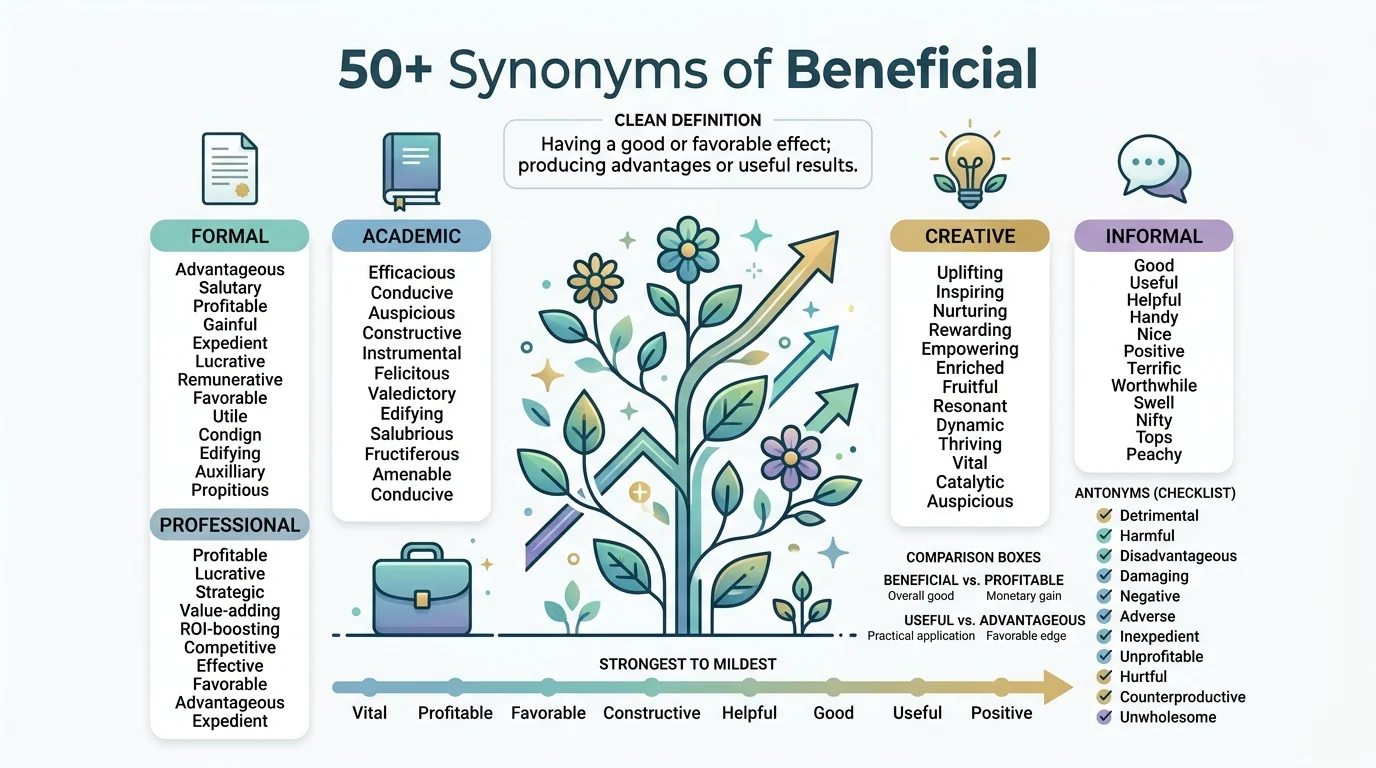
Have you ever needed to describe something that helps or improves a situation but felt that “good” did not fully capture its value? You want to highlight positive effects and advantages, and the word “beneficial” comes to mind. But is it the best fit for your audience? Choosing the right synonym for “beneficial” can transform a basic compliment into a precise assessment of value and impact. This guide explores the best synonyms of beneficial, explaining exactly which word to use and when.
Quick Ans: “Beneficial” means producing good results or helpful effects. It is a positive, formal adjective. For professional writing, choose advantageous or favorable. For casual conversation, use helpful or good for. In academic contexts, conducive and salutary are strong choices. For a stronger, more dramatic impact, select instrumental or pivotal.
Meaning, Tone, and Context
Understanding the core meaning of “beneficial” is the first step to using it effectively.
Simple Definition: Producing a good or helpful effect. Giving an advantage.
Part of Speech: Adjective.
Overall Tone: Positive and constructive. It indicates value and usefulness.
Formality Level: Formal. The word is appropriate in professional and academic settings.
Common Uses: Native English speakers use it to describe actions, policies, relationships, and habits that produce positive outcomes. For example, “Regular exercise is beneficial,” or “The new policy was beneficial to employees.”
Word Forms: Related words include the noun benefit and the adverb beneficially.
When and How to Use “Beneficial”
“Beneficial” is the perfect choice when you want to emphasize positive effects and value. Here are seven realistic examples.
Professional: “The new software upgrade will be beneficial for productivity.”
Academic: “The study demonstrates that group study is beneficial for retention.”
Workplace: “Her feedback was beneficial to the team’s development.”
Personal: “Yoga has been beneficial for my mental health.”
Email: “We believe this partnership will be mutually beneficial.”
Resume: “Implemented initiatives beneficial to company growth and employee satisfaction.”
Social Media: “So many things I thought were beneficial turned out to be stress-inducing.”
Best Synonyms of “Beneficial”
No synonym is identical in every situation. Here is your guide to the best replacement for “beneficial” based on your writing context.
Professional Writing: Advantageous. It suggests a strategic benefit. “The merger was advantageous for both companies.”
Academic Writing: Salutary. This is ideal when discussing health or moral improvement. “The experience had a salutary effect on his character.”
Business Communication: Favorable. A practical choice for describing conditions or outcomes. “We received a favorable response to the proposal.”
Casual Conversation: Helpful. It tones down the formality and sounds natural. “The map was helpful for finding the restaurant.”
Emotional Writing: Enriching. This word carries weight, suggesting deep personal value. “The travel experience was enriching.”
Creative Writing: Pivotal. It implies being central to a positive outcome. “Her pivotal role in the project ensured success.”
Resume Writing: Beneficial. This is the standard and expected term for resumes. It communicates value and contribution.
When Not to Use “Beneficial”
Using “beneficial” can sound wrong or inadequate in certain situations.
When It Sounds Too Vague: “Beneficial” can be too general. You might need a word that conveys more specificity.
Better Choice: Effective or efficient. “The new system proved efficient.”
When You Mean “Essential”: “Beneficial” suggests helpful, but not necessary.
Better Choice: Essential or critical. “Regular communication is essential.”
When It Sounds Too Formal: In casual conversation, “beneficial” sounds stiff.
Better Choice: Good for or helpful. “Reading is good for you.”
When You Mean “Profitable”: “Beneficial” can be about non-financial gains.
Better Choice: Profitable or lucrative. “The investment proved lucrative.”
Words Commonly Confused With “Beneficial”
Several words are often mixed up with “beneficial.” Here is how to keep them straight.
Word: Advantageous
Difference: Focuses on giving a strategic edge. “Beneficial” is about general good effects.
When to Use: Use it when discussing strategies, positions, or opportunities.
Example: “The location is advantageous for business.”
Word: Helpful
Difference: More casual and common. “Beneficial” is more formal.
When to Use: Use it in everyday situations.
Example: “The manual was helpful for assembly.”
Word: Favorable
Difference: Means positive or approving. “Beneficial” means producing good results.
When to Use: Use this for conditions, opinions, or circumstances.
Example: “The market conditions were favorable.”
Word: Salutary
Difference: Implies moral or health improvement. “Beneficial” is broader.
When to Use: Use it for experiences that teach a useful lesson.
Example: “The failure had a salutary effect on his work ethic.”
Word: Conducive
Difference: Means leading to a result. “Beneficial” means producing good results.
When to Use: Use this for conditions that enable something to happen.
Example: “A quiet environment is conducive to study.”
Word: Pivotal
Difference: Implies being crucial. “Beneficial” is about helpfulness.
When to Use: Use it for something central to success.
Example: “Her role was pivotal in the project.”
Best Synonyms of “Beneficial” by Context
| Context | Best Synonym | Why It Works | Example |
|---|---|---|---|
| Formal writing | Advantageous | Suggests strategic benefit. | “The agreement was advantageous to both parties.” |
| Academic writing | Salutary | Implies moral or health improvement. | “The lesson was salutary.” |
| Professional communication | Favorable | Indicates positive conditions. | “We received a favorable decision.” |
| Business emails | Helpful | Professional yet accessible. | “Your feedback is helpful.” |
| Resume writing | Beneficial | The standard, expected term. | “Beneficial to company growth.” |
| Workplace communication | Productive | Emphasizes outcomes. | “The meeting was productive.” |
| Casual conversation | Good for | Simple, natural, and conversational. | “Exercise is good for you.” |
| Creative writing | Pivotal | Evokes central importance. | “Her pivotal role saved the project.” |
| Emotional writing | Enriching | Suggests deep personal value. | “The experience was enriching.” |
| Strong emphasis | Instrumental | Implies key contribution. | “She was instrumental in the success.” |
| Mild tone | Useful | Simple and unassuming. | “This tool is useful.” |
| Social media captions | Helpful | Widely understood and relatable. | “This tip is helpful.” |
How to Choose the Best Synonym of “Beneficial”
Choosing the right word is a simple decision. Answer these questions.
What is my audience? For a professor or CEO, advantageous or salutary is powerful. For a friend, helpful or good for is more natural.
What is my purpose? Are you trying to praise, inform, or persuade? Use advantageous for persuasion, salutary for moral improvement, and helpful for information.
Am I describing a personal or strategic benefit? For personal benefits, enriching or helpful work well. For strategic benefits, advantageous or favorable are better.
What is the emotional strength? Instrumental and pivotal are stronger. Useful and helpful are mild. Pick the one that matches your message.
Real Life Examples of “Beneficial”
To truly master the word, it helps to see how it behaves in the wild and how a stronger synonym can elevate the sentence.
School: Basic: “Studying is beneficial for grades.” Improved: “Studying is conducive to better grades and deeper understanding.”
College: Basic: “The workshop was beneficial.” Improved: “The workshop was enriching and expanded our perspectives.”
Workplace: Basic: “Her advice was beneficial.” Improved: “Her advice was instrumental in turning the project around.”
Business: Basic: “The deal was beneficial.” Improved: “The deal was advantageous and strengthened our market position.”
Email: Basic: “This solution is beneficial.” Improved: “This solution is favorable for our long-term objectives.”
Conversation: Basic: “Drinking water is beneficial.” Improved: “Drinking water is good for you.”
Storytelling: Basic: “The experience was beneficial.” Improved: “The experience was salutary, teaching him a valuable lesson he never forgot.”
Top 10 Synonyms of “Beneficial”
| Synonym | Simple Meaning | Best Used For | Example Sentence |
|---|---|---|---|
| Advantageous | Giving a strategic benefit | Professional, business, and strategic contexts. | “The location is advantageous.” |
| Salutary | Producing health or moral improvement | Academic, health, and character contexts. | “The lesson was salutary.” |
| Favorable | Positive and approving | Business, conditions, and opinions. | “The response was favorable.” |
| Helpful | Providing assistance | Casual conversation and everyday contexts. | “The guide was helpful.” |
| Conducive | Leading to a result | Academic, environment, and enabling contexts. | “The setting is conducive to study.” |
| Enriching | Adding value and meaning | Emotional, personal, and creative contexts. | “The trip was enriching.” |
| Instrumental | Essential to achieving something | Professional, success, and achievement contexts. | “She was instrumental in the win.” |
| Pivotal | Central and crucial | Leadership, decisive, and critical contexts. | “His pivotal role was recognized.” |
| Productive | Producing positive results | Workplace, process, and outcome contexts. | “The meeting was productive.” |
| Useful | Practical and helpful | Everyday, practical, and tool contexts. | “The app is useful.” |
Synonyms of “Beneficial” by Usage
Professional vs. Personal Synonyms
In the workplace (professional), choose advantageous, instrumental, or favorable to describe outcomes and contributions. These words convey strategic value and precision. “The proposal was advantageous for the company” is more impactful than “The proposal was beneficial.”
With friends (personal), helpful, good for, or useful keep the tone relaxed and relatable. These alternatives sound natural in everyday conversation.
Formal vs. Conversational Synonyms
For formal writing (reports, essays, professional emails), use advantageous, salutary, or conducive. These choices maintain the sophisticated tone expected in professional documents.
For casual conversations and texting, use helpful, good for, or great for. These options sound more natural and less pretentious.
Academic Synonyms
For research and essays, choose precise, authoritative words. Salutary is great for moral or health improvement, conducive for enabling conditions, and advantageous for strategic benefits. These words sound considered and scholarly.
Using precise academic vocabulary demonstrates expertise and careful thinking. Professors and reviewers expect this level of precision.
Professional and Business Synonyms
For maximum impact in business writing, choose advantageous for strategies, favorable for outcomes, and instrumental for contributions. These words demonstrate confidence and professional awareness.
Business leaders respond to language that conveys value and strategic thinking. These synonyms project authority.
Creative and Literary Synonyms
To add emotion and imagery to your writing, choose enriching, salutary, or pivotal. These words create depth and demonstrate impact.
Literary writers use these alternatives to build character and theme. They transform ordinary descriptions into evocative prose.
Slang or Modern Synonyms
There is no direct slang synonym for “beneficial” in mainstream American English. In modern texting, people use helpful, good for, or simply great. This straightforward approach works best for casual digital communication.
Strongest to Mildest Synonyms
Mild: helpful, useful, good for
Moderate: beneficial, favorable, productive
Strong: advantageous, conducive, enriching
Very Strong: instrumental, pivotal, salutary
Emotional vs. Neutral Synonyms
Emotional Synonyms: Enriching, salutary, instrumental. These words often hint at admiration, inspiration, or deep value. Use them when you want to evoke feeling.
Neutral Synonyms: Helpful, useful, favorable. These words simply communicate factual information. Use them when you want to inform without emotional coloring.
Antonyms of “Beneficial”
Here are 15 genuine opposites of “beneficial.”
| Antonym | Meaning | Example Sentence |
|---|---|---|
| Harmful | Causing damage or injury | “Smoking is harmful to health.” |
| Detrimental | Causing damage or harm | “The policy was detrimental to morale.” |
| Damaging | Causing physical or other damage | “The storm was damaging.” |
| Injurious | Causing harm or injury | “The chemical was injurious.” |
| Adverse | Preventing success or development | “Adverse conditions stopped us.” |
| Disadvantageous | Involving disadvantage | “The location was disadvantageous.” |
| Counterproductive | Having the opposite effect | “The move was counterproductive.” |
| Ineffective | Not producing results | “The treatment was ineffective.” |
| Unhelpful | Not providing assistance | “His advice was unhelpful.” |
| Deleterious | Causing harm or damage | “The effect was deleterious.” |
| Unfavorable | Negative or disapproving | “The response was unfavorable.” |
| Dangerous | Likely to cause harm | “The situation was dangerous.” |
| Destructive | Causing great damage | “The hurricane was destructive.” |
| Negative | Bad or harmful | “The feedback was negative.” |
| Pernicious | Having a harmful effect | “The pernicious rumor spread.” |
Comparison: “Beneficial” vs Similar Words
Beneficial vs. Advantageous
Main Difference: Beneficial is about general good effects. Advantageous is about strategic benefits.
Which Is Stronger? Advantageous is stronger in business contexts.
Which Is More Formal? Both are formal, but advantageous is more precise.
When to Use Each: Use beneficial for general goodness. Use advantageous for strategic value.
Examples:
Beneficial: “Exercise is beneficial.”
Advantageous: “The location is advantageous for business.”
Beneficial vs. Salutary
Main Difference: Beneficial is general. Salutary is about health or moral improvement.
Which Is Stronger? Salutary is stronger and more specific.
Which Is More Formal? Salutary is more formal and academic.
When to Use Each: Use beneficial for general. Use salutary for moral or health lessons.
Examples:
Beneficial: “The policy was beneficial.”
Salutary: “The experience was salutary.”
Beneficial vs. Helpful
Main Difference: Beneficial is formal. Helpful is casual and common.
Which Is Stronger? They are similar in strength.
Which Is More Formal? Beneficial is formal. Helpful is neutral.
When to Use Each: Use beneficial in formal writing. Use helpful in conversation.
Examples:
Beneficial: “The study was beneficial.”
Helpful: “The tip was helpful.”
Beneficial vs. Favorable
Main Difference: Beneficial means good effects. Favorable means positive conditions.
Which Is Stronger? They are similar in strength.
Which Is More Formal? Both are formal.
When to Use Each: Use beneficial for outcomes. Use favorable for conditions.
Examples:
Beneficial: “The policy was beneficial.”
Favorable: “The conditions were favorable.”
Beneficial vs. Conducive
Main Difference: Beneficial means good effects. Conducive means leading to a result.
Which Is Stronger? They are similar.
Which Is More Formal? Both are formal.
When to Use Each: Use beneficial for outcomes. Use conducive for enabling environments.
Examples:
Beneficial: “The discussion was beneficial.”
Conducive: “The environment is conducive to study.”
Beneficial vs. Instrumental
Main Difference: Beneficial means helpful. Instrumental means essential to achievement.
Which Is Stronger? Instrumental is much stronger.
Which Is More Formal? Both are formal.
When to Use Each: Use beneficial for general help. Use instrumental for crucial contributions.
Examples:
Beneficial: “Her advice was beneficial.”
Instrumental: “She was instrumental in the win.”
Common Phrases and Expressions with “Beneficial”
Phrase: Mutually beneficial
Meaning: Beneficial to both parties involved.
Example Sentence: “The partnership was mutually beneficial for both companies.”
Phrase: Beneficial to
Meaning: Helping or improving someone or something.
Example Sentence: “The new policy is beneficial to employees.”
Phrase: Beneficial for
Meaning: Good for a particular purpose.
Example Sentence: “Exercise is beneficial for your health.”
Phrase: Highly beneficial
Meaning: Extremely useful or helpful.
Example Sentence: “The training program was highly beneficial.”
Phrase: Beneficial effect
Meaning: A positive result.
Example Sentence: “The medication had a beneficial effect on the patient.”
Common Mistakes to Avoid
Mistake 1: Using “beneficial” when you mean “essential”.
Incorrect: “Water is beneficial for survival.”
Better: “Water is essential for survival.”
Why: Beneficial suggests helpful, not necessary.
Mistake 2: Using “beneficial” when you mean “profitable”.
Incorrect: “The investment was beneficial.”
Better: “The investment was profitable.”
Why: Profitable specifies financial gain.
Mistake 3: Overusing “beneficial” in conversation.
Incorrect: “The movie was beneficial.”
Better: “The movie was enjoyable.”
Why: Beneficial is too formal for entertainment.
Mistake 4: Using “advantageous” when you mean “beneficial”.
Incorrect: “Yoga is advantageous.”
Better: “Yoga is beneficial.”
Why: Advantageous implies a strategic edge, not just general goodness.
Mistake 5: Using “conducive” incorrectly.
Incorrect: “The book was conducive.”
Better: “The book was useful.”
Why: Conducive is about enabling conditions, not about objects or actions themselves.
Frequently Asked Questions
1. What are the best synonyms of “beneficial”?
The best synonyms depend on your context. For professional writing, choose advantageous or favorable. And for casual conversation, helpful or good for are ideal choices. For academic contexts, use salutary or conducive.
2. What are the best formal synonyms of “beneficial”?
The best formal synonyms are advantageous, salutary, and conducive. These words are suitable for academic papers, professional reports, and business communications.
3. What are common informal synonyms of “beneficial”?
For informal settings, use helpful, good for, or useful. These alternatives sound more natural in everyday conversation.
4. What is another word for “beneficial” in professional writing?
In professional writing, advantageous is an excellent choice. It conveys strategic value. Favorable is also strong for positive outcomes.
5. What is the difference between “beneficial” and “advantageous”?
While both indicate positive effects, beneficial is about general good effects. Advantageous is about giving a strategic edge. Use beneficial for general and advantageous for strategy.
6. What is the opposite of “beneficial”?
The most direct opposites (antonyms) of beneficial are harmful, detrimental, and adverse. These words describe things that cause damage or negativity.
Conclusion
“Beneficial” is a valuable word for describing positive effects and helpful contributions. The term is formal and widely accepted in professional contexts, yet it can sound too vague or formal for extraordinary value. The best choice among the synonyms of beneficial depends entirely on your audience, tone, and purpose. Remember, no single synonym works perfectly in every situation. Your goal is to choose the word that communicates your message with the most clarity and impact. A practical tip for your vocabulary growth is to practice using different synonyms in your daily writing to develop confidence and precision.
Discover More:
- 50+ Synonyms of Effect: Meanings, Uses, Examples, and Best Alternatives 2026
- 50+ Synonyms of Developed: Meanings, Uses, Examples, and Best Alternatives 2026

Amelia Brooks is a professional content writer and digital publishing specialist with a passion for creating clear, engaging, and informative content. She has extensive experience writing about technology, business, lifestyle, and online services.