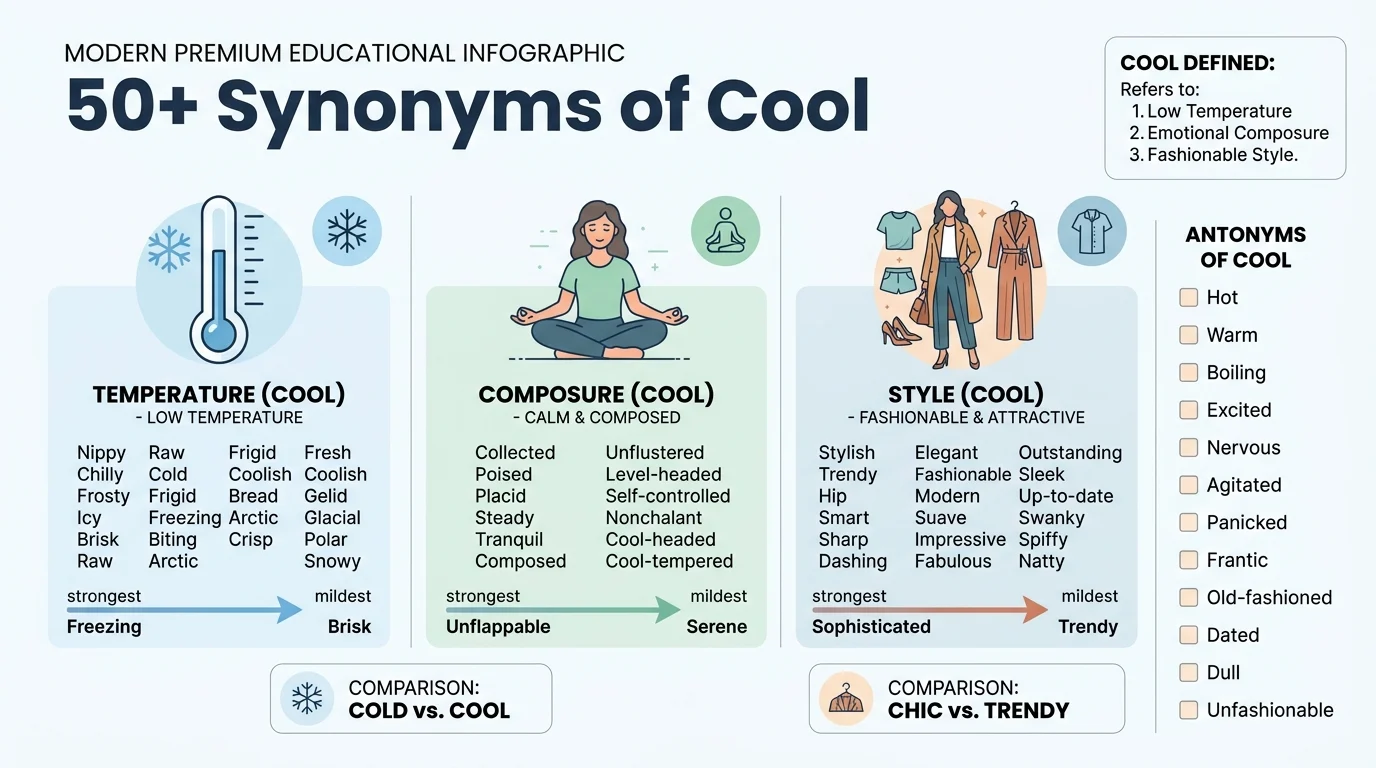
Have you ever needed to describe someone’s style, a moderate temperature, or a calm demeanor but felt that “cool” was too vague or overused? You want to capture the exact shade of meaning, and the word “cool” comes to mind. But is it the best fit for your audience? Choosing the right synonym for “cool” can transform a simple adjective into a precise description of temperature, attitude, or social appeal. This guide explores the best synonyms of cool, explaining exactly which word to use and when.
Quick Ans: “Cool” means moderately cold, calm and composed, or fashionable and impressive. It is a versatile, neutral-to-positive adjective. For describing temperature, choose chilly or refreshing. For describing composure, use composed or collected. For describing style and appeal, trendy or stylish are strong choices. For a stronger, more dramatic impact, select nonchalant or sophisticated.
Meaning, Tone, and Context
Understanding the core meaning of “cool” is the first step to using it effectively.
Simple Definition: Having a moderately low temperature. Also, being calm and not excited or anxious. Also, being fashionable and admired.
Part of Speech: Adjective (also used as a noun and verb).
Overall Tone: Highly context-dependent. It can be neutral (temperature), positive (composure), or approving (style).
Formality Level: Informal to neutral. “Cool” is widely used in casual conversation but is appropriate in many professional contexts depending on meaning.
Common Uses: Native English speakers use it constantly. For example, “The water is cool,” “Stay cool under pressure,” or “That jacket is so cool.”
Word Forms: Related words include the verb to cool, the noun coolness, and the adverb coolly.
When and How to Use “Cool”
“Cool” is a versatile word with multiple meanings. Here are seven realistic examples.
Temperature: “A cool breeze blew through the open window.”
Composure: “She remained cool during the stressful presentation.”
Fashion/Style: “His new sneakers are really cool.”
Approval: “Cool! I like that idea.”
Social/Acceptance: “He’s one of the cool kids in school.”
Professional (Composure): “The negotiator kept a cool head.”
Everyday Agreement: “Let’s meet at 3 PM. Cool.”
Best Synonyms of “Cool”
No synonym is identical in every situation. Here is your guide to the best replacement for “cool” based on your writing context.
Temperature Context: Chilly. It suggests a noticeably low temperature. “The chilly weather required a jacket.”
Temperature Context (Pleasant): Refreshing. It implies a pleasantly cool sensation. “A refreshing drink on a hot day.”
Composure Context: Composed. It suggests control and calmness. “She remained composed throughout the interview.”
Composure Context (Stronger): Collected. It implies being in full control of one’s emotions. “He was collected and ready to answer.”
Style/Appeal Context: Trendy. It means fashionable at the time. “She wears trendy clothes.”
Style/Appeal Context (Stronger): Sophisticated. It implies refined and cultured taste. “The restaurant has a sophisticated atmosphere.”
Casual Approval: Awesome or Great. “Awesome, I’ll see you there.”
When Not to Use “Cool”
Using “cool” can sound wrong or inadequate in certain situations.
When Describing Extreme Cold: “Cool” means moderately cold, not freezing.
Better Choice: Freezing or icy. “The freezing wind cut through his coat.”
When You Mean “Good” in a Professional Document: “Cool” is too informal for many professional contexts.
Better Choice: Acceptable or approved. “The proposal is acceptable.”
When Describing Technical Temperatures: “Cool” is vague. Cold, lukewarm, or tepid are more precise.
Better Choice: Tepid. “The tepid water was not hot enough for tea.”
When You Mean “Detached”: “Cool” can mean aloof, but uninterested or apathetic is clearer.
Better Choice: Apathetic. “His apathetic response frustrated the team.”
Words Commonly Confused With “Cool”
Several words are often mixed up with “cool.” Here is how to keep them straight.
Word: Chilly
Difference: More specific to temperature. “Cool” is more general.
When to Use: Use it when describing a noticeably low temperature.
Example: “The chilly morning air was invigorating.”
Word: Composed
Difference: Specific to emotional control. “Cool” can also mean temperature or style.
When to Use: Use it for someone who is calm and in control.
Example: “The composed speaker handled the tough questions well.”
Word: Trendy
Difference: Specific to current fashion. “Cool” can also mean temperature or composure.
When to Use: Use it for something fashionable at the moment.
Example: “The trendy restaurant was hard to book.”
Word: Nonchalant
Difference: Implies casual indifference. “Cool” implies calm composure.
When to Use: Use it for someone who seems unconcerned.
Example: “Her nonchalant attitude surprised everyone.”
Word: Aloof
Difference: Suggests emotional distance. “Cool” can mean calm but not detached.
When to Use: Use it for someone who seems distant or uninvolved.
Example: “His aloof personality made him hard to approach.”
Word: Refreshing
Difference: Specific to a pleasant, invigorating coolness. “Cool” is general.
When to Use: Use it for something that feels pleasantly cold.
Example: “The refreshing lemonade quenched her thirst.”
Best Synonyms of “Cool” by Context
| Context | Best Synonym | Why It Works | Example |
|---|---|---|---|
| Temperature (mild) | Chilly | Precise for noticeably low temperature. | “The chilly breeze made her shiver.” |
| Temperature (pleasant) | Refreshing | Evokes a pleasant, energizing sensation. | “The refreshing shower revived him.” |
| Composure | Composed | Precise for emotional control. | “She remained composed under pressure.” |
| Composure (stronger) | Collected | Implies full emotional control. | “He was collected and ready for the debate.” |
| Composure (indifferent) | Nonchalant | Suggests casual unconcern. | “His nonchalant shrug annoyed his boss.” |
| Style (current) | Trendy | Specific to current fashion. | “The trendy outfit turned heads.” |
| Style (classy) | Sophisticated | Implies refined and cultured taste. | “Her sophisticated style impressed everyone.” |
| Casual approval | Great | Simple and widely understood. | “Great, I’ll see you at noon.” |
| Casual approval | Awesome | More enthusiastic than “cool.” | “Awesome! That’s perfect!” |
| Creative/Emotional | Chic | Implies stylish elegance. | “Her chic appearance was noteworthy.” |
How to Choose the Best Synonym of “Cool”
Choosing the right word is a simple decision. Answer these questions.
What is my context? Are you describing temperature, composure, or style? Choose chilly for temperature, composed for composure, and trendy for style.
What is my audience? For a professor or CEO, sophisticated or composed is powerful. For a friend, great or awesome is more natural.
What is my purpose? Are you describing, praising, or agreeing? Use refreshing for description, chic for praise, and great for agreement.
What is the emotional strength? Awesome is more enthusiastic. Chilly is neutral. Pick the one that matches your message.
Real Life Examples of “Cool”
To truly master the word, it helps to see how it behaves in the wild and how a stronger synonym can elevate the sentence.
School: Basic: “The science lab is cool.” Improved: “The science lab is chilly in the morning.”
College: Basic: “She stayed cool during her presentation.” Improved: “She remained composed during her presentation.”
Workplace: Basic: “Her cool attitude helped resolve the conflict.” Improved: “Her collected attitude helped resolve the conflict.”
Business: Basic: “The new product is cool.” Improved: “The new product is trendy and appeals to younger consumers.”
Email: Basic: “Cool, I will get back to you.” Improved: “Great, I will get back to you.”
Conversation: Basic: “This drink is cool.” Improved: “This drink is refreshing.”
Storytelling: Basic: “He was the cool guy at the party.” Improved: “He was the charismatic guy at the party.”
Top 10 Synonyms of “Cool”
| Synonym | Simple Meaning | Best Used For | Example Sentence |
|---|---|---|---|
| Chilly | Noticeably cold | Temperature descriptions. | “The chilly weather required a jacket.” |
| Refreshing | Pleasantly cool | Invigorating experiences. | “The refreshing shower was welcome.” |
| Composed | Calm and in control | Emotional control and professionalism. | “She remained composed during the crisis.” |
| Collected | Fully in control of emotions | High-pressure situations. | “He was collected and confident.” |
| Nonchalant | Casually unconcerned | Describing indifference. | “Her nonchalant attitude was surprising.” |
| Trendy | Fashionable at the time | Style and fashion contexts. | “The trendy dress was popular.” |
| Sophisticated | Refined and cultured | Classy, elegant style. | “Her sophisticated style impressed everyone.” |
| Chic | Elegantly fashionable | Style and fashion contexts. | “The chic design was minimalist.” |
| Great | Excellent or good | Casual approval and agreement. | “Great! I’ll see you there.” |
| Awesome | Very impressive | Enthusiastic approval. | “Awesome! That is perfect.” |
Synonyms of “Cool” by Usage
Professional vs. Personal Synonyms
In the workplace (professional), choose composed for composure and sophisticated for style. These words convey professionalism and precision. “She remained composed” is more professional than “She stayed cool.”
With friends (personal), awesome, great, or chill keep the tone relaxed and relatable. These alternatives sound natural in everyday conversation.
Temperature Synonyms
For describing temperature, chilly, refreshing, crisp, brisk, and nippy are strong alternatives. Crisp suggests fresh and clean coolness. Brisk implies energetic coolness.
Composure Synonyms
For describing emotional control, composed, collected, unflappable, and nonchalant are excellent choices. Unflappable is the strongest term, meaning someone cannot be upset or panicked.
Style and Appeal Synonyms
For describing style, trendy, chic, sophisticated, hip, and voguish are strong alternatives. Hip is informal and suggests being modern and aware of trends.
Casual Approval Synonyms
For casual approval, great, awesome, fantastic, terrific, and excellent are widely understood alternatives. These are appropriate for informal written communication.
Slang or Modern Synonyms
Chill, dope, lit, and fire are modern slang alternatives. Chill means relaxed or okay. Dope and lit mean excellent or exciting. These are informal and should be avoided in professional writing.
Strongest to Mildest Synonyms
Mild: cool, okay, fine
Moderate: chilly, refreshing, composed, trendy
Strong: nonchalant, sophisticated, chic
Very Strong: unflappable, charismatic, elegant
Emotional vs. Neutral Synonyms
Emotional Synonyms: Awesome, fantastic, chic. These words often hint at admiration or enthusiasm. Use them when you want to evoke feeling.
Neutral Synonyms: Chilly, composed, great. These words simply communicate factual information. Use them when you want to inform without emotional coloring.
Antonyms of “Cool”
Here are 15 genuine opposites of “cool.”
| Antonym | Meaning | Example Sentence |
|---|---|---|
| Hot | Having a high temperature | “The hot sun beat down on the pavement.” |
| Warm | Moderately high temperature | “The warm drink was comforting.” |
| Boiling | Extremely hot | “The boiling water scalded her hand.” |
| Scorching | Very hot and burning | “The scorching sun was unbearable.” |
| Excited | Emotionally stirred up | “The excited crowd cheered loudly.” |
| Anxious | Feeling worried or nervous | “She felt anxious before the test.” |
| Agitated | Disturbed and upset | “The agitated customer demanded a refund.” |
| Panicked | Feeling sudden fear | “The panicked crowd ran for safety.” |
| Old-fashioned | Out of date in style | “His old-fashioned suit was out of place.” |
| Unfashionable | Not stylish | “The unfashionable clothes were rejected.” |
| Uncool | Not admired or fashionable | “His uncool attitude made him unpopular.” |
| Apathetic | Lacking interest or concern | “His apathetic response was disappointing.” |
| Unconcerned | Not worried or involved | “Her unconcerned attitude was frustrating.” |
| Tepid | Moderately warm | “The tepid water was lukewarm.” |
| Lukewarm | Neither hot nor cold | “The lukewarm tea was unpleasant.” |
Comparison: “Cool” vs Similar Words
Cool vs. Chilly
Main Difference: Cool is a general term. Chilly specifically means noticeably cold.
Which Is Stronger? Chilly is stronger in conveying coldness.
Which Is More Formal? Both are neutral, but chilly can sound more descriptive.
When to Use Each: Use cool for moderate temperature. Use chilly for a colder sensation.
Examples:
Cool: “The cool water felt good.”
Chilly: “The chilly air made her shiver.”
Cool vs. Composed
Main Difference: Cool has multiple meanings. Composed specifically refers to emotional control.
Which Is Stronger? Composed is more precise and formal.
Which Is More Formal? Composed is more formal and professional.
When to Use Each: Use cool for general composure. Use composed for formal situations.
Examples:
Cool: “She stayed cool during the interview.”
Composed: “She remained composed throughout the presentation.”
Cool vs. Trendy
Main Difference: Cool is general. Trendy is specifically about current fashion.
Which Is Stronger? Trendy is more precise but can be fleeting.
Which Is More Formal? Both are informal, but trendy is common in fashion writing.
When to Use Each: Use cool for general admiration. Use trendy for current fashion.
Examples:
Cool: “That jacket is cool.”
Trendy: “That jacket is very trendy this season.”
Cool vs. Nonchalant
Main Difference: Cool can imply calmness. Nonchalant implies casual indifference.
Which Is Stronger? Nonchalant is more specific and can imply a lack of care.
Which Is More Formal? Nonchalant is formal and descriptive.
When to Use Each: Use cool for positive composure. Use nonchalant for unconcern.
Examples:
Cool: “He remained cool under pressure.”
Nonchalant: “His nonchalant reply annoyed his boss.”
Cool vs. Sophisticated
Main Difference: Cool is general. Sophisticated implies refined and cultured taste.
Which Is Stronger? Sophisticated is more elevated and formal.
Which Is More Formal? Sophisticated is formal and classy.
When to Use Each: Use cool for general style. Use sophisticated for refined elegance.
Examples:
Cool: “Her outfit is cool.”
Sophisticated: “Her sophisticated style impressed everyone.”
Cool vs. Awesome
Main Difference: Cool can mean moderately good. Awesome means very impressive.
Which Is Stronger? Awesome is stronger and more enthusiastic.
Which Is More Formal? Both are informal, but awesome is more casual.
When to Use Each: Use cool for moderate approval. Use awesome for enthusiastic approval.
Examples:
Cool: “Cool, I’ll see you later.”
Awesome: “Awesome! That’s the best news.”
Common Phrases and Expressions with “Cool”
Phrase: Keep cool
Meaning: Remain calm and composed.
Example Sentence: “Keep cool and focus on the solution.”
Phrase: Cool as a cucumber
Meaning: Extremely calm and composed.
Example Sentence: “He remained as cool as a cucumber during the crisis.”
Phrase: Play it cool
Meaning: Act calm and not show strong emotions.
Example Sentence: “She decided to play it cool and not appear too eager.”
Phrase: Cool down
Meaning: Become less hot or less excited.
Example Sentence: “Take a moment to cool down before responding.”
Phrase: Cool off
Meaning: Become less warm or less angry.
Example Sentence: “Let’s take a break to cool off.”
Phrase: That’s cool
Meaning: That is acceptable or okay.
Example Sentence: “That’s cool, I understand completely.”
Common Mistakes to Avoid
Mistake 1: Using “cool” for extreme cold.
Incorrect: “The cool wind cut through his coat.” (If it was very cold)
Better: “The freezing wind cut through his coat.”
Why: Cool means moderately cold. Freezing means extremely cold.
Mistake 2: Using “cool” in formal professional writing.
Incorrect: “Your application is cool.”
Better: “Your application is approved.”
Why: Cool is too informal for many professional contexts.
Mistake 3: Using “cool” to describe something warm.
Incorrect: “The cool soup was barely warm.”
Better: “The lukewarm soup was barely warm.”
Why: Lukewarm is the correct word for something moderately warm.
Mistake 4: Overusing “cool” in conversation.
Incorrect: “Cool. Cool. That’s cool.”
Better: “Great. Awesome. That is excellent.”
Why: Variation in vocabulary demonstrates communication skills.
Mistake 5: Confusing “nonchalant” with positive composure.
Incorrect: “His nonchalant attitude was helpful.”
Better: “His composed attitude was helpful.”
Why: Nonchalant implies indifference, which is often negative.
Frequently Asked Questions
1. What are the best synonyms of “cool”?
The best synonyms depend on your context. For temperature, choose chilly or refreshing.And for composure, use composed or collected. For style, select trendy or sophisticated.
2. What are the best formal synonyms of “cool”?
The best formal synonyms are composed (for composure), sophisticated (for style), and moderately cold (for temperature). These are suitable for professional contexts.
3. What are common informal synonyms of “cool”?
For informal settings, use awesome, great, chill, or nice. These alternatives sound more natural in everyday conversation.
4. What is another word for “cool” in professional writing?
In professional writing, composed is an excellent choice for composure. Sophisticated is strong for style. For temperature, use chilly or crisp.
5. What is the difference between “cool” and “nonchalant”?
While both can describe calmness, cool often implies positive composure. Nonchalant implies casual indifference, which can be negative. Use nonchalant carefully.
6. What is the opposite of “cool”?
The most direct opposites (antonyms) of cool are hot (temperature), excited (emotional state), and unfashionable (style). These words describe the opposite qualities.
Conclusion
“Cool” is a remarkably versatile word with multiple meanings. The term is widely used and understood, yet it can be vague or informal in certain contexts. The best choice among the synonyms of cool depends entirely on your context, audience, tone, and purpose. Remember, no single synonym works perfectly in every situation. Your goal is to choose the word that communicates your message with the most clarity and impact. A practical tip for your vocabulary growth is to pause and consider whether “cool” is the most precise word for your situation. Challenge yourself to use one new synonym in your writing each week.
Discover More:
- 50+ Synonyms of Highlight: Meanings, Uses, Examples, and Best Alternatives 2026
- 50+ Synonyms of Required: Meanings, Uses, Examples, and Best Alternatives 2026

Ella Parker is a professional content writer with a passion for creating clear, engaging, and well-researched articles. She focuses on delivering valuable insights and practical information across business, technology, and lifestyle topics.