Have you ever needed to describe the result of an action but felt that “effect” or “impact” did not capture the full picture? You want to explain outcomes clearly, and the word “effect” comes to mind. But is it the best fit for your audience? Choosing the right synonym for “effect” can transform a vague statement into a precise description of consequences. This guide explores the best synonyms of effect, explaining exactly which word to use and when.
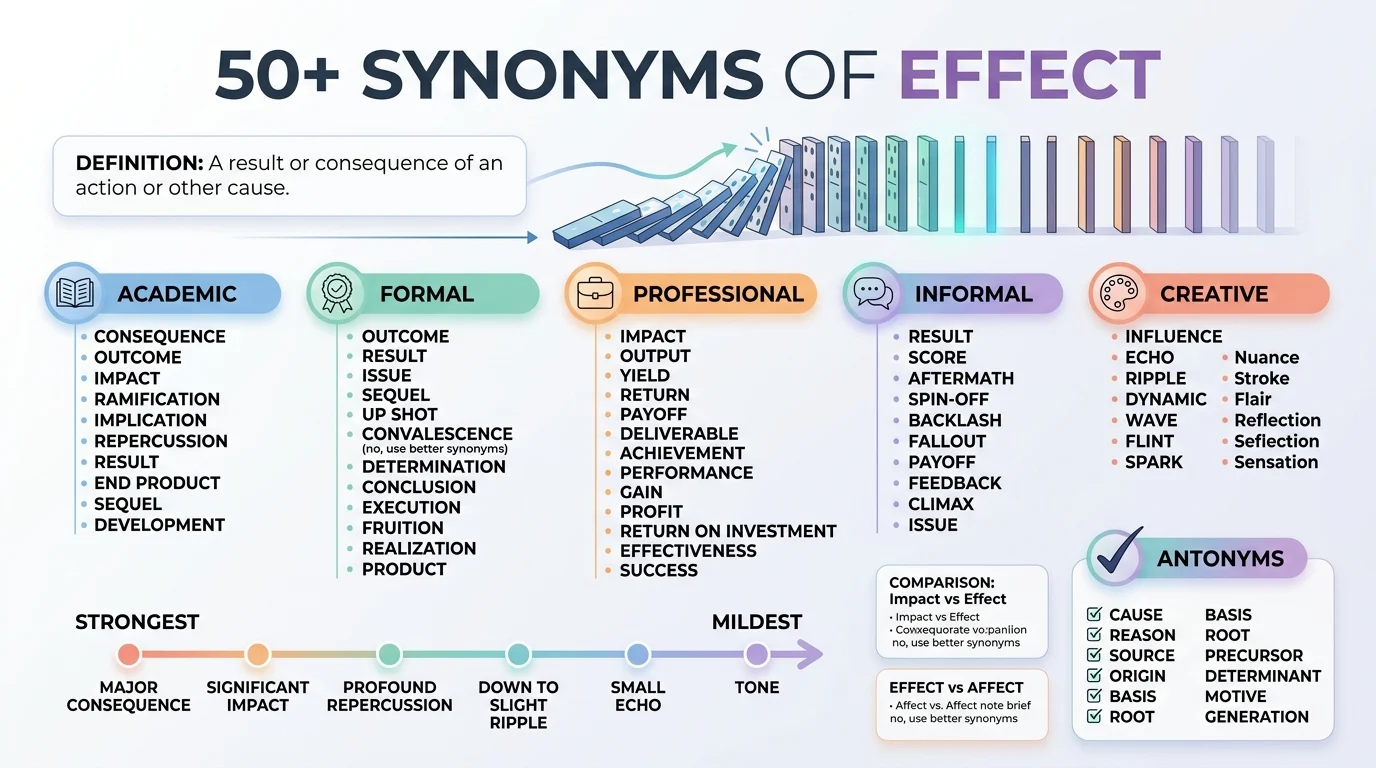
Quick Ans: “Effect” means a change that results from an action or cause. It is a neutral, versatile noun. For formal writing, choose consequence or outcome. For casual conversation, use result or aftermath. In academic contexts, repercussion and ramification are strong choices. For a stronger, more dramatic impact, select upshot or fruit.
Meaning, Tone, and Context
Understanding the core meaning of “effect” is the first step to using it effectively.
Simple Definition: A change produced by an action or cause. The result or consequence of something.
Part of Speech: Noun. (Note: “Effect” can also be a verb meaning to bring about, but this guide focuses on the noun form.)
Overall Tone: Neutral. It simply refers to outcomes without inherent emotion.
Formality Level: Neutral. The word works in almost any context, from casual conversation to formal academic writing.
Common Uses: Native English speakers use it constantly. For example, “The medicine had a positive effect,” or “The new policy had a significant effect on sales.”
Word Forms: Related words include the adjective effective, the adverb effectively, and the verb effectuate.
When and How to Use “Effect”
“Effect” is the most common and versatile word in its category. Here are seven realistic examples.
Professional: “The new strategy had a measurable effect on our quarterly revenue.”
Academic: “Researchers studied the effect of temperature on plant growth.”
Workplace: “The training program produced a noticeable effect on employee productivity.”
Personal: “The inspirational book had a profound effect on my outlook.”
Email: “Please review the attached report on the effect of the recent changes.”
Resume: “Implemented a system that had a direct effect on reducing costs by 15%.”
Social Media: “The challenge had a huge effect on our engagement numbers.”
Best Synonyms of “Effect”
No synonym is identical in every situation. Here is your guide to the best replacement for “effect” based on your writing context.
Professional Writing: Outcome. It suggests a clear, measurable result. “The outcome of the project exceeded expectations.”
Academic Writing: Consequence. This is ideal when discussing logical results or implications. “The study examined the consequences of climate change.”
Business Communication: Impact. A powerful choice for describing significant influence. “The new policy had a major impact on operations.”
Casual Conversation: Result. It tones down the formality, meaning a straightforward outcome. “The result was exactly what we expected.”
Emotional Writing: Aftermath. This word carries weight, suggesting the consequences of a significant event. “In the aftermath of the tragedy, the community came together.”
Creative Writing: Fruit. It implies the positive results of labor. “The fruit of her labor was a successful business.”
Resume Writing: Impact. Use it to describe significant contributions. “Had a direct impact on increasing customer satisfaction.”
When Not to Use “Effect”
Using “effect” can sound weak or imprecise in certain situations.
When It Sounds Too General: “Effect” can be vague. You might need a word that conveys more specificity.
Better Choice: Outcome. “The outcome of the negotiation was favorable.”
When You Need a Negative Result: “Effect” is neutral. For negative consequences, use a stronger word.
Better Choice: Repercussion. “His actions had serious repercussions.”
When Describing Long-Term Results: “Effect” might not imply duration.
Better Choice: Ramification. “We are still dealing with the ramifications of that decision.”
When It Sounds Too Ordinary: In creative or elevated writing, “effect” feels flat.
Better Choice: Upshot. “The upshot of the discussion was a new strategy.”
Words Commonly Confused With “Effect”
Several words are often mixed up with “effect.” Here is how to keep them straight.
Word: Affect
Difference: “Affect” is usually a verb meaning to influence. “Effect” is usually a noun meaning result.
When to Use: Use “affect” when something influences something else. Use “effect” for the result.
Example: “The weather affected the crops. The effect was lower yields.”
Word: Result
Difference: “Result” is a direct outcome. “Effect” is broader.
When to Use: Use “result” for immediate outcomes. Use “effect” for broader changes.
Example: “The result of the test was positive. The effect on the community was significant.”
Word: Impact
Difference: “Impact” suggests a strong, noticeable effect. “Effect” is more neutral.
When to Use: Use “impact” for significant influence. Use “effect” for general outcomes.
Example: “The new policy had a huge impact on the company.”
Word: Consequence
Difference: “Consequence” often implies a logical result. “Effect” is more general.
When to Use: Use “consequence” for results that logically follow.
Example: “The consequence of his actions was immediate.”
Word: Outcome
Difference: “Outcome” emphasizes the final result. “Effect” emphasizes the change produced.
When to Use: Use “outcome” for final results. Use “effect” for changes.
Example: “The outcome of the trial was favorable.”
Word: Repercussion
Difference: “Repercussion” implies negative, far-reaching effects. “Effect” is neutral.
When to Use: Use “repercussion” for negative consequences.
Example: “The scandal had political repercussions.”
Best Synonyms of “Effect” by Context
| Context | Best Synonym | Why It Works | Example |
|---|---|---|---|
| Formal writing | Consequence | Suggests a logical, reasoned outcome. | “The consequences of the decision were far-reaching.” |
| Academic writing | Ramification | Implies complex, branching results. | “The research explored the ramifications of the discovery.” |
| Professional communication | Outcome | Emphasizes measurable, clear results. | “The outcome of the project was successful.” |
| Business emails | Impact | Highlights significant influence. | “The change had a major impact on productivity.” |
| Resume writing | Impact | Demonstrates contribution and results. | “Drove impact through strategic initiatives.” |
| Workplace communication | Result | Simple and direct. | “The result of the meeting was a new plan.” |
| Casual conversation | Result | Natural and widely understood. | “What was the result of the game?” |
| Creative writing | Fruit | Evokes positive results of effort. | “The fruit of her labor was a masterpiece.” |
| Emotional writing | Aftermath | Suggests the wake of a significant event. | “In the aftermath of the storm, the community rebuilt.” |
| Strong emphasis | Implication | Suggests future consequences. | “The implications of the discovery are staggering.” |
| Mild tone | Result | Simple and unassuming. | “The result was predictable.” |
| Social media captions | Impact | Widely understood and relatable. | “This trend has had a huge impact on fashion.” |
How to Choose the Best Synonym of “Effect”
Choosing the right word is a simple decision. Answer these questions.
What is my audience? For a professor or CEO, consequence or ramification is powerful. For a friend, result or outcome is more natural.
What is my purpose? Are you trying to emphasize significance, describe a logical outcome, or explain a final result? Use impact for significance, consequence for logic, and outcome for finality.
Is the result positive, negative, or neutral? For negative results, repercussion is stronger.And for positive results, fruit or benefit are better. For neutral results, outcome or result work.
What is the emotional strength? Aftermath and ramification are stronger. Result is mild. Pick the one that matches your message.
Real Life Examples of “Effect”
To truly master the word, it helps to see how it behaves in the wild and how a stronger synonym can elevate the sentence.
School: Basic: “The new rule had an effect on students.” Improved: “The new rule had a significant impact on student behavior.”
College: Basic: “The study examined the effect of sleep on grades.” Improved: “The study examined the consequences of sleep deprivation on academic performance.”
Workplace: Basic: “The training had a positive effect.” Improved: “The training produced a positive outcome for the entire team.”
Business: Basic: “The marketing campaign had an effect on sales.” Improved: “The marketing campaign had a major impact on quarterly sales.”
Email: Basic: “Please review the effects of the changes.” Improved: “Please review the ramifications of the proposed changes.”
Conversation: Basic: “What was the effect of the news?” Improved: “What was the aftermath of the announcement?”
Storytelling: Basic: “The event had a lasting effect on her.” Improved: “The event had a profound aftermath that shaped her entire life.”
Top 10 Synonyms of “Effect”
| Synonym | Simple Meaning | Best Used For | Example Sentence |
|---|---|---|---|
| Consequence | A logical result following an action | Academic, formal, and logical contexts. | “The consequences of the decision were disastrous.” |
| Outcome | The final result of a process | Professional, business, and measurable contexts. | “The outcome of the negotiation was favorable.” |
| Impact | A strong, noticeable influence | Business, professional, and dramatic contexts. | “The policy had a significant impact on the economy.” |
| Result | Something produced by an action | Casual, everyday, and straightforward contexts. | “The result of the test was positive.” |
| Ramification | A complex, branching consequence | Academic, analytical, and formal contexts. | “The ramifications of the study are still being explored.” |
| Repercussion | A negative, far-reaching effect | Negative situations, scandals, and warnings. | “His actions had serious repercussions.” |
| Aftermath | The consequences of a significant event | Emotional, dramatic, and historical contexts. | “In the aftermath of the war, the country rebuilt.” |
| Upshot | The main point or final result | Informal, summarizing, and conversational contexts. | “The upshot of the discussion was a new plan.” |
| Fruit | Positive results of effort | Creative, literary, and inspirational contexts. | “The fruit of her labor was a successful business.” |
| Implication | A future consequence or suggestion | Academic, persuasive, and forward-looking contexts. | “The implications of the discovery are enormous.” |
Synonyms of “Effect” by Usage
Professional vs. Personal Synonyms
In the workplace (professional), choose outcome, impact, or result to describe effects. These words convey precision and significance. “The impact of the initiative was substantial” is more powerful than “The effect was good.”
With friends (personal), result, aftermath, or simply effect keep the tone relaxed and relatable. These alternatives sound natural in everyday conversation.
Formal vs. Conversational Synonyms
For formal writing (reports, essays, professional emails), use consequence, ramification, or implication. These choices maintain the sophisticated tone expected in professional documents.
For casual conversations and texting, use result, upshot, or aftermath (for dramatic events). These options sound more natural and less pretentious.
Academic Synonyms
For research and essays, choose precise, authoritative words. Consequence is great for logical results, ramification for complex outcomes, and implication for future effects. These words sound considered and scholarly.
Using precise academic vocabulary demonstrates expertise and careful thinking. Professors and reviewers expect this level of precision.
Professional and Business Synonyms
For maximum impact in business writing, choose outcome for measurable results, impact for significant influence, and result for straightforward effects. These words demonstrate confidence and professional awareness.
Business leaders respond to language that conveys clarity and certainty. These synonyms project authority.
Creative and Literary Synonyms
To add emotion and imagery to your writing, choose fruit, aftermath, or upshot. These words create atmosphere and drama.
Literary writers use these alternatives to build theme and mood. They transform ordinary descriptions into evocative prose.
Slang or Modern Synonyms
There is no direct slang synonym for “effect” in mainstream American English. The simplest alternative in modern texting is literally just result or impact. This straightforward approach works best for casual digital communication.
Strongest to Mildest Synonyms
Mild: result, outcome, fruit (positive)
Moderate: effect, consequence, upshot
Strong: impact, implication, ramification
Very Strong: repercussion, aftermath, consequence (negative)
Emotional vs. Neutral Synonyms
Emotional Synonyms: Aftermath, repercussion, fruit. These words often hint at drama, negativity, or admiration. Use them when you want to evoke feeling.
Neutral Synonyms: Result, outcome, consequence. These words simply communicate factual information. Use them when you want to inform without emotional coloring.
Antonyms of “Effect”
Here are 15 genuine opposites of “effect.”
| Antonym | Meaning | Example Sentence |
|---|---|---|
| Cause | Something that produces an effect | “The cause of the problem was identified.” |
| Origin | The beginning or source | “The origin of the tradition is ancient.” |
| Source | The place from which something comes | “The source of the funding was a grant.” |
| Root | The basic cause or basis | “The root of the issue was miscommunication.” |
| Foundation | The basis on which something stands | “The foundation of her argument was solid.” |
| Genesis | The beginning or origin | “The genesis of the idea was a casual conversation.” |
| Inception | The start or beginning | “The inception of the project was delayed.” |
| Catalyst | Something that causes change | “The catalyst for the reforms was public pressure.” |
| Stimulus | Something that provokes a response | “The stimulus for the research was a new theory.” |
| Motivation | The reason for an action | “Her motivation for volunteering was personal.” |
| Influence | The power to have an effect | “His influence on the committee was significant.” |
| Precursor | Something that comes before | “The precursor to the crisis was a series of warnings.” |
| Antecedent | Something that existed before | “The antecedent of the law was an older statute.” |
| Trigger | Something that initiates an effect | “The trigger for the reaction was a spark.” |
| Impetus | The force that makes something happen | “The impetus for the change was customer feedback.” |
Comparison: “Effect” vs Similar Words
Effect vs. Result
Main Difference: Effect emphasizes change produced. Result emphasizes the final outcome.
Which Is Stronger? Neither is inherently stronger. Result is more common. Effect is more formal.
Which Is More Formal? Effect is more formal. Result is neutral.
When to Use Each: Use effect for changes produced. Use result for final outcomes.
Examples:
Effect: “The medicine had a calming effect.”
Result: “The result of the test was positive.”
Effect vs. Impact
Main Difference: Effect is neutral. Impact implies a strong, noticeable influence.
Which Is Stronger? Impact is much stronger.
Which Is More Formal? Both are formal, but impact is preferred in business writing.
When to Use Each: Use effect for general outcomes. Use impact for significant influence.
Examples:
Effect: “The new rule had an effect on behavior.”
Impact: “The new policy had a huge impact on the company.”
Effect vs. Consequence
Main Difference: Effect is general. Consequence implies a logical result, often negative.
Which Is Stronger? Consequence is stronger and more precise.
Which Is More Formal? Consequence is more formal and academic.
When to Use Each: Use effect for general outcomes. Use consequence for logical results.
Examples:
Effect: “The effect of the change was immediate.”
Consequence: “The consequences of his actions were severe.”
Effect vs. Outcome
Main Difference: Effect emphasizes change. Outcome emphasizes the final result of a process.
Which Is Stronger? They are similar in strength. Outcome is more final.
Which Is More Formal? Both are formal and professional.
When to Use Each: Use effect for changes. Use outcome for final results.
Examples:
Effect: “The drug had a calming effect.”
Outcome: “The outcome of the trial was favorable.”
Effect vs. Ramification
Main Difference: Effect is simple. Ramification implies complex, branching consequences.
Which Is Stronger? Ramification is much stronger and more academic.
Which Is More Formal? Ramification is very formal.
When to Use Each: Use effect for simple outcomes. Use ramification for complex consequences.
Examples:
Effect: “The change had an effect on operations.”
Ramification: “The ramifications of the decision are still being felt.”
Effect vs. Aftermath
Main Difference: Effect is neutral. Aftermath implies the wake of a significant, often negative, event.
Which Is Stronger? Aftermath is stronger and more dramatic.
Which Is More Formal? Both are formal, but aftermath is more emotional.
When to Use Each: Use effect for everyday outcomes. Use aftermath for significant events.
Examples:
Effect: “The training had a positive effect.”
Aftermath: “In the aftermath of the fire, the community rallied.”
Common Phrases and Expressions with “Effect”
Phrase: Take effect
Meaning: To begin to produce results.
Example Sentence: “The new policy will take effect next month.”
Phrase: In effect
Meaning: In practice or operation.
Example Sentence: “The rule is still in effect.”
Phrase: Have an effect on
Meaning: To influence something.
Example Sentence: “The weather had a significant effect on the harvest.”
Phrase: Side effect
Meaning: An unintended consequence.
Example Sentence: “The medication had some unpleasant side effects.”
Phrase: Cause and effect
Meaning: The relationship between actions and results.
Example Sentence: “The law of cause and effect governs many systems.”
Phrase: With immediate effect
Meaning: Starting right now.
Example Sentence: “The changes apply with immediate effect.”
Phrase: To the effect that
Meaning: With the meaning that.
Example Sentence: “He made a statement to the effect that he was resigning.”
Common Mistakes to Avoid
Mistake 1: Confusing “effect” with “affect”.
Incorrect: “The weather will effect the crops.”
Better: “The weather will affect the crops.”
Why: “Affect” is usually a verb meaning to influence. “Effect” is usually a noun meaning result.
Mistake 2: Using “effect” when you mean “impact”.
Incorrect: “The effect of the new policy was huge.”
Better: “The impact of the new policy was huge.”
Why: “Impact” implies a stronger, more noticeable influence.
Mistake 3: Using “effect” when you mean “consequence”.
Incorrect: “The negative effects were severe.”
Better: “The negative consequences were severe.”
Why: “Consequence” is more precise for negative results.
Mistake 4: Overusing “effect” in formal writing.
Incorrect: “This is an effect. That is another effect.”
Better: “This is a consequence. That is a ramification.”
Why: Variation in vocabulary demonstrates writing sophistication.
Mistake 5: Using “effect” when you mean “outcome”.
Incorrect: “The final effect of the project was success.”
Better: “The final outcome of the project was success.”
Why: “Outcome” is the final result. “Effect” is a change produced.
Frequently Asked Questions
1. What are the best synonyms of “effect”?
The best synonyms depend on your context. For formal writing, choose consequence or outcome.And for casual conversation, result or upshot are ideal choices. For strong influence, use impact.
2. What are the best formal synonyms of “effect”?
The best formal synonyms are consequence, ramification, and implication. These words are suitable for academic papers, professional reports, and business communications.
3. What are common informal synonyms of “effect”?
For informal settings, use result, aftermath, or simply effect. These alternatives sound more natural in everyday conversation.
4. What is another word for “effect” in professional writing?
In professional writing, outcome is an excellent choice. It conveys a clear, measurable result. Impact is also strong for significant influence.
5. What is the difference between “effect” and “affect”?
“Affect” is usually a verb meaning to influence. “Effect” is usually a noun meaning result. For example, “The weather affected the crops” versus “The effect was lower yields.”
6. What is the opposite of “effect”?
The most direct opposites (antonyms) of effect are cause, origin, and source. These words describe what produces an effect.
Conclusion
“Effect” is a versatile and essential word for describing results and changes. The term is neutral and widely understood, yet it can sound vague or ordinary in certain contexts. The best choice among the synonyms of effect depends entirely on your audience, tone, and purpose.Remember, no single synonym works perfectly in every situation. Your goal is to choose the word that communicates your message with the most clarity and impact. A practical tip for your vocabulary growth is to keep a thesaurus handy and challenge yourself to use one new synonym in your writing each week.
Discover More:-
- 50+ Synonyms of Example: Meanings, Uses, Examples, and Best Alternatives
- 50+ Synonyms of Ubiquitous: Meanings, Uses, Examples, and Best Alternatives

Amelia Brooks is a professional content writer and digital publishing specialist with a passion for creating clear, engaging, and informative content. She has extensive experience writing about technology, business, lifestyle, and online services.