Have you ever needed to describe the act of examining something but felt that “check” did not fully capture the depth of your review? You want to convey thoroughness, verification, or restraint, and the word “check” comes to mind. But is it the best fit for your audience? Choosing the right synonym for “check” can transform a vague reference into a precise description of inspection, control, or limitation. This guide explores the best synonyms of check, explaining exactly which word to use and when.
Quick Ans: “Check” means to examine, verify, or restrain something. It is a versatile, neutral verb and noun. For professional writing, choose verify or inspect. For casual conversation, use look at or review. In academic contexts, examine and scrutinize are strong choices. For a stronger, more dramatic impact, select scrutinize or curb.
Meaning, Tone, and Context
Understanding the core meaning of “check” is the first step to using it effectively.
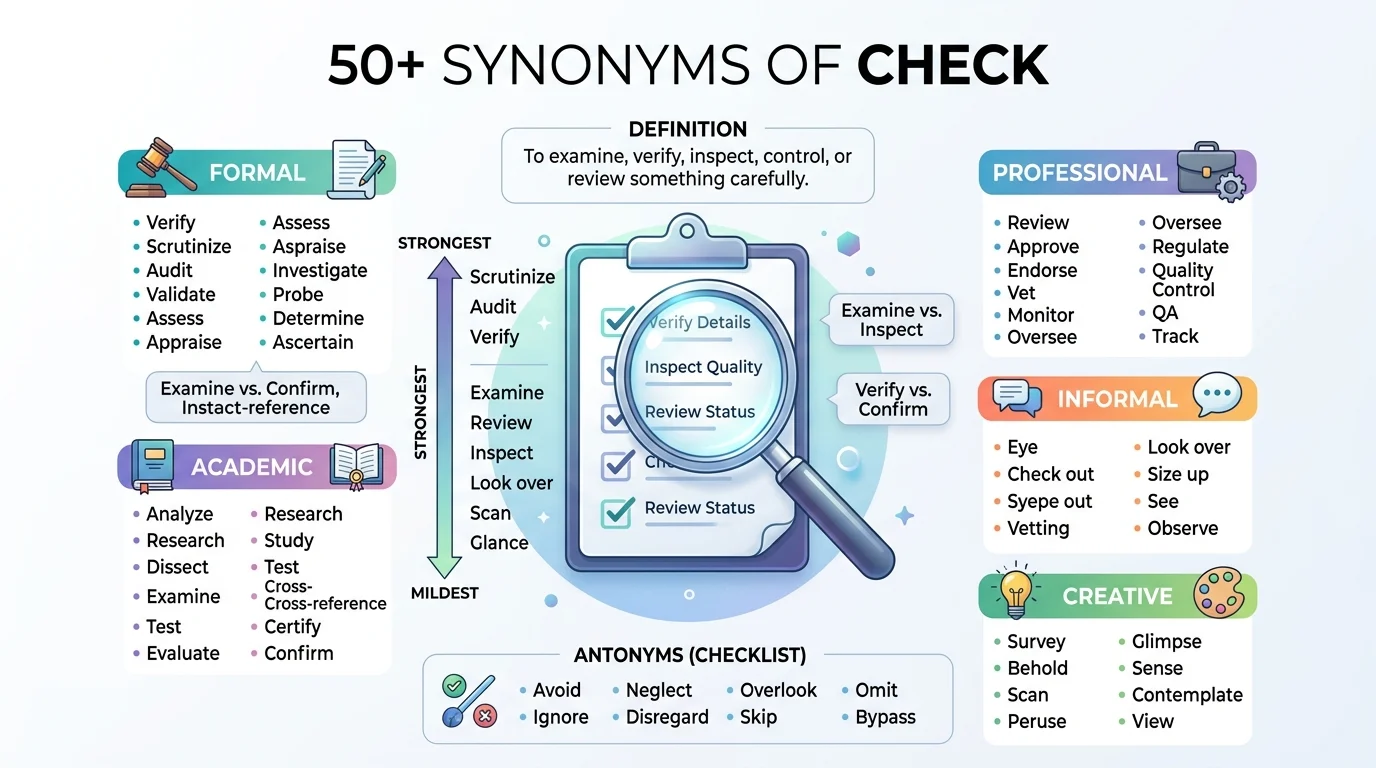
Simple Definition: To examine something to determine its accuracy, quality, or condition. To stop or slow down progress.
Part of Speech: Verb and noun.
Overall Tone: Neutral. It can describe a simple look or a thorough investigation.
Formality Level: Neutral. The word works in almost any context, from casual conversation to formal academic writing.
Common Uses: Native English speakers use it constantly. For example, “Check your work before submitting,” or “The government placed a check on spending.”
Word Forms: Related words include the noun checker, the adjective checkable, and the adverb checkingly.
When and How to Use “Check”
“Check” is the most common and versatile word in its category. Here are seven realistic examples.
Professional: “Please check the financial statements for any discrepancies.”
Academic: “Researchers must check their data against established benchmarks.”
Workplace: “The quality control team checks every product before shipment.”
Personal: “I need to check the weather before I leave for work.”
Email: “Could you check the attachment and confirm you received it?”
Resume: “Responsible for checking inventory levels and placing orders.”
Social Media: “Check out my new post about travel tips!”
Best Synonyms of “Check”
No synonym is identical in every situation. Here is your guide to the best replacement for “check” based on your writing context.
Professional Writing: Verify. It suggests confirming accuracy and truth. “The accountant verified all transaction records.”
Academic Writing: Examine. This is ideal when discussing careful analysis. “The researcher examined the results in detail.”
Business Communication: Review. A practical choice for assessing documents or situations. “Please review the proposal before the meeting.”
Casual Conversation: Look at. It tones down the formality and sounds natural. “Can you look at my essay before I submit it?”
Emotional Writing: Scrutinize. This word carries weight, suggesting intense, critical attention. “She scrutinized his face for any sign of deception.”
Creative Writing: Peruse. It implies a leisurely, thorough reading. “He perused the ancient manuscript with great interest.”
Resume Writing: Audit. Use it to describe formal examination of records. “Audited financial reports for accuracy and compliance.”
When Not to Use “Check”
Using “check” can sound weak or imprecise in certain situations.
When It Sounds Too Vague: “Check” can be too general. You might need a word that conveys more specificity.
Better Choice: Inspect or scrutinize. “The officer inspected the vehicle thoroughly.”
When You Need to Confirm Truth: “Check” works, but verify is more precise.
Better Choice: Verify. “Please verify the information before sharing it.”
When It Sounds Too Informal: In academic or legal writing, “check” feels casual.
Better Choice: Examine or audit. “The committee will examine all evidence.”
When Describing Control: “Check” can describe restraint, but curb or restrict is clearer.
Better Choice: Curb. “The policy curbs excessive spending.”
Words Commonly Confused With “Check”
Several words are often mixed up with “check.” Here is how to keep them straight.
Word: Verify
Difference: Means to confirm accuracy. “Check” is broader and can mean a simple look.
When to Use: Use it when you need to confirm that something is true.
Example: “Please verify the customer’s identity before proceeding.”
Word: Inspect
Difference: Means to examine closely, often for quality. “Check” is more general.
When to Use: Use this for physical examinations or quality control.
Example: “The health inspector inspected the kitchen for violations.”
Word: Review
Difference: Means to look over or assess. “Check” can be quicker and less formal.
When to Use: Use it for documents, proposals, or performance.
Example: “The manager reviewed the employee’s performance.”
Word: Examine
Difference: Means to inspect carefully and in detail. “Check” is less intensive.
When to Use: Use this for thorough analysis.
Example: “The doctor examined the patient for symptoms.”
Word: Scrutinize
Difference: Means to examine very critically. “Check” is much milder.
When to Use: Use it when someone is looking for flaws or deception.
Example: “The lawyer scrutinized the contract for loopholes.”
Word: Curb
Difference: Means to restrain or control. “Check” can mean control but is less specific.
When to Use: Use it for limiting behavior or spending.
Example: “We need to curb our spending this month.”
Best Synonyms of “Check” by Context
| Context | Best Synonym | Why It Works | Example |
|---|---|---|---|
| Formal writing | Verify | Emphasizes accuracy and confirmation. | “The committee verified the election results.” |
| Academic writing | Examine | Implies careful, detailed study. | “The scientist examined the data thoroughly.” |
| Professional communication | Review | Practical and widely understood. | “Please review the attached document.” |
| Business emails | Confirm | Clear and direct for verification. | “Please confirm your attendance by Friday.” |
| Resume writing | Audit | Highlights formal examination. | “Audited annual financial statements.” |
| Workplace communication | Inspect | Emphasizes quality control. | “The supervisor inspected the finished products.” |
| Casual conversation | Look at | Simple, direct, and conversational. | “Can you look at this for me?” |
| Creative writing | Peruse | Evokes a slow, careful reading. | “She perused the letter with great interest.” |
| Emotional writing | Scrutinize | Suggests intense, suspicious attention. | “He scrutinized her expression for any sign of guilt.” |
| Strong emphasis | Scrutinize | The most intense and critical term. | “The detective scrutinized every clue.” |
| Mild tone | Glance at | Simple and unassuming. Good for quick looks. | “She glanced at the clock and left.” |
| Social media captions | Check out | Casual, engaging, and widely used. | “Check out my new video!” |
How to Choose the Best Synonym of “Check”
Choosing the right word is a simple decision. Answer these questions.
What is my audience? For a professor or CEO, verify or examine is powerful. For a friend, look at or check out is more natural.
What is my purpose? Are you trying to confirm, inspect, or control? Use verify for confirmation, inspect for physical examination, and curb for restraint.
Am I describing a quick look or a thorough investigation? For quick looks, glance at or peek are good. For thorough investigation, scrutinize or examine are better.
What is the emotional strength? Scrutinize is the strongest. Look at is the mildest. Pick the one that matches your message.
Real Life Examples of “Check”
To truly master the word, it helps to see how it behaves in the wild and how a stronger synonym can elevate the sentence.
School: Basic: “The teacher checked the students’ homework.” Improved: “The teacher reviewed the students’ homework for completeness.”
College: Basic: “Check your essay for errors.” Improved: “Scrutinize your essay for grammatical and structural errors.”
Workplace: Basic: “The manager checked the reports.” Improved: “The manager reviewed the reports before the meeting.”
Business: Basic: “Check the financial records.” Improved: “Audit the financial records for compliance.”
Email: Basic: “Please check the attachment.” Improved: “Please review the attachment and provide feedback.”
Conversation: Basic: “Let me check my schedule.” Improved: “Let me look at my schedule and see if I am free.”
Storytelling: Basic: “He checked the document carefully.” Improved: “He scrutinized the document carefully, searching for any hidden errors.”
Top 10 Synonyms of “Check”
| Synonym | Simple Meaning | Best Used For | Example Sentence |
|---|---|---|---|
| Verify | Confirm the truth or accuracy | Professional, legal, and confirmation contexts. | “Please verify the customer’s address.” |
| Inspect | Examine closely for quality | Quality control, health, and safety contexts. | “The inspector inspected the building.” |
| Review | Look over and assess | Business, academic, and document contexts. | “The committee reviewed the proposal.” |
| Examine | Inspect carefully and in detail | Academic, medical, and research contexts. | “The doctor examined the patient.” |
| Scrutinize | Examine very critically | Intense investigation and suspicion contexts. | “The detective scrutinized the evidence.” |
| Audit | Formally examine records | Financial, business, and compliance contexts. | “The accountant audited the accounts.” |
| Confirm | Establish the truth or correctness | Verification and agreement contexts. | “Please confirm your reservation.” |
| Curb | Restrain or control | Policy, spending, and behavior contexts. | “The new law curbs excessive pollution.” |
| Monitor | Observe and check over time | Surveillance, health, and tracking contexts. | “The nurse monitored the patient’s condition.” |
| Peruse | Read thoroughly and carefully | Literary, academic, and detailed reading contexts. | “She perused the contract for hours.” |
Synonyms of “Check” by Usage
Professional vs. Personal Synonyms
In the workplace (professional), choose verify, review, or audit to describe examination or control. These words convey precision and responsibility. “The auditor verified all transactions” is more precise than “The auditor checked all transactions.”
With friends (personal), look at, glance at, or simply check keep the tone relaxed and relatable. These alternatives sound natural in everyday conversation.
Formal vs. Conversational Synonyms
For formal writing (reports, essays, professional emails), use verify, examine, or scrutinize. These choices maintain the sophisticated tone expected in professional documents.
For casual conversations and texting, use look at, check out, or peek at. These options sound more natural and less pretentious.
Academic Synonyms
For research and essays, choose precise, authoritative words. Examine is great for careful analysis, scrutinize for critical review, and verify for confirming findings. These words sound considered and scholarly.
Using precise academic vocabulary demonstrates expertise and careful thinking. Professors and reviewers expect this level of precision.
Professional and Business Synonyms
For maximum impact in business writing, choose verify for accuracy, review for documents, and audit for formal examinations. These words demonstrate confidence and professional awareness.
Business leaders respond to language that conveys precision and accountability. These synonyms project authority.
Creative and Literary Synonyms
To add emotion and imagery to your writing, choose scrutinize, peruse, or examine. These words create atmosphere and demonstrate character depth.
Literary writers use these alternatives to build tension and detail. They transform ordinary descriptions into evocative prose.
Slang or Modern Synonyms
In modern casual speech, people use check out to mean look at something interesting. For example, “Check out this cool video.” This phrase is widely accepted in informal contexts but should be avoided in professional writing.
Strongest to Mildest Synonyms
Mild: look at, glance at, peek at
Moderate: check, review, inspect
Strong: examine, verify, confirm
Very Strong: scrutinize, audit, probe
Emotional vs. Neutral Synonyms
Emotional Synonyms: Scrutinize, probe, interrogate. These words often hint at suspicion, intensity, or deep curiosity. Use them when you want to evoke feeling.
Neutral Synonyms: Check, review, inspect. These words simply communicate factual information. Use them when you want to inform without emotional coloring.
Antonyms of “Check”
Here are 15 genuine opposites of “check.”
| Antonym | Meaning | Example Sentence |
|---|---|---|
| Ignore | Pay no attention to | “He ignored the warning signs.” |
| Overlook | Fail to notice | “She overlooked the minor errors.” |
| Neglect | Fail to care for properly | “He neglected his responsibilities.” |
| Skip | Omit or pass over | “Skip the unnecessary details.” |
| Forget | Fail to remember | “She forgot to check the documents.” |
| Disregard | Pay no attention to | “They disregarded the safety rules.” |
| Miss | Fail to notice | “The inspector missed the defect.” |
| Omit | Leave out | “Please do not omit any information.” |
| Release | Set free from restraint | “The government released the funds.” |
| Free | Release from restrictions | “The new policy frees businesses.” |
| Allow | Permit without restraint | “The rules allow unlimited spending.” |
| Permit | Give authorization | “The law permits this activity.” |
| Encourage | Promote or support | “The program encourages innovation.” |
| Accelerate | Increase speed | “We need to accelerate the process.” |
| Expand | Increase in size or scope | “The company expanded its operations.” |
Comparison: “Check” vs Similar Words
Check vs. Verify
Main Difference: Check is a general look. Verify is confirming accuracy.
Which Is Stronger? Verify is stronger and more precise.
Which Is More Formal? Verify is more formal.
When to Use Each: Use check for quick looks. Use verify for confirming truth.
Examples:
Check: “Please check the spelling.”
Verify: “Please verify the customer’s identity.”
Check vs. Inspect
Main Difference: Check is general. Inspect implies a close, official examination.
Which Is Stronger? Inspect is stronger and more formal.
Which Is More Formal? Inspect is more formal.
When to Use Each: Use check for everyday tasks. Use inspect for quality control or official examinations.
Examples:
Check: “Check the tire pressure.”
Inspect: “The health inspector inspected the kitchen.”
Check vs. Review
Main Difference: Check can be quick. Review implies a thorough assessment.
Which Is Stronger? Review is more comprehensive.
Which Is More Formal? Both are formal, but review is often preferred in business.
When to Use Each: Use check for quick verification. Use review for detailed assessment.
Examples:
Check: “Check the numbers one more time.”
Review: “Review the proposal before the meeting.”
Check vs. Examine
Main Difference: Check is a simple look. Examine implies careful, detailed study.
Which Is Stronger? Examine is much stronger and more intensive.
Which Is More Formal? Examine is more formal and academic.
When to Use Each: Use check for simple tasks. Use examine for research or medical contexts.
Examples:
Check: “Check the temperature.”
Examine: “The doctor examined the patient.”
Check vs. Scrutinize
Main Difference: Check is simple. Scrutinize implies critical, suspicious examination.
Which Is Stronger? Scrutinize is the strongest of all these terms.
Which Is More Formal? Scrutinize is formal and often literary.
When to Use Each: Use check for routine tasks. Use scrutinize for intense investigation.
Examples:
Check: “Check the address.”
Scrutinize: “The detective scrutinized the suspect’s alibi.”
Check vs. Curb
Main Difference: Check can mean restrain, but curb is specifically about limiting.
Which Is Stronger? Curb is more specific and often used in policy contexts.
Which Is More Formal? Both are formal.
When to Use Each: Use check for general examination. Use curb for restraint and control.
Examples:
Check: “Check the growth of expenses.”
Curb: “We need to curb excessive spending.”
Common Phrases and Expressions with “Check”
Phrase: Check in
Meaning: To register or report arrival.
Example Sentence: “Please check in at the front desk when you arrive.”
Phrase: Check out
Meaning: To look at something interesting. To depart from a hotel.
Example Sentence: “Check out this amazing video.” or “We need to check out by 11:00 AM.”
Phrase: Check up on
Meaning: To monitor or investigate someone.
Example Sentence: “The manager checked up on the team’s progress.”
Phrase: Check off
Meaning: To mark something as completed.
Example Sentence: “Check off each task as you complete it.”
Phrase: Double-check
Meaning: To check again for accuracy.
Example Sentence: “Always double-check your work before submitting it.”
Phrase: Reality check
Meaning: An assessment of the true situation.
Example Sentence: “The financial report was a reality check for the company.”
Phrase: Check your attitude
Meaning: To control negative behavior or tone.
Example Sentence: “The manager told him to check his attitude.”
Common Mistakes to Avoid
Mistake 1: Using “check” when you mean “verify”.
Incorrect: “Please check the customer’s identity.”
Better: “Please verify the customer’s identity.”
Why: Verify means confirm accuracy. Check is too vague for identity verification.
Mistake 2: Using “check” when you mean “inspect”.
Incorrect: “The official checked the building for safety.”
Better: “The official inspected the building for safety.”
Why: Inspect implies a formal, close examination. Check sounds casual.
Mistake 3: Overusing “check” in formal writing.
Incorrect: “The committee checked the evidence.”
Better: “The committee examined the evidence.”
Why: Examine is more formal and precise for academic contexts.
Mistake 4: Using “check” when you mean “curb”.
Incorrect: “The policy checks spending.”
Better: “The policy curbs spending.”
Why: Curb is more specific for limiting or restraining.
Mistake 5: Using “scrutinize” for a simple task.
Incorrect: “She scrutinized the price tag.”
Better: “She looked at the price tag.”
Why: Scrutinize implies intense, suspicious examination. It sounds dramatic for routine tasks.
Frequently Asked Questions
1. What are the best synonyms of “check”?
The best synonyms depend on your context. For formal writing, choose verify or examine. And for casual conversation, look at or review are ideal choices. For intense investigation, use scrutinize or audit.
2. What are the best formal synonyms of “check”?
The best formal synonyms are verify, examine, and audit. These words are suitable for academic papers, professional reports, and business communications.
3. What are common informal synonyms of “check”?
For informal settings, use look at, check out, or glance at. These alternatives sound more natural in everyday conversation.
4. What is another word for “check” in professional writing?
In professional writing, verify is an excellent choice for confirming accuracy. Review is also strong for assessing documents. Audit works for formal examinations.
5. What is the difference between “check” and “verify”?
While both indicate examination, check is a general look. Verify means confirming truth or accuracy. Use check for simple tasks and verify for critical confirmation.
6. What is the opposite of “check”?
The most direct opposites (antonyms) of check are ignore, overlook, and neglect. These words describe failing to examine or control something.
Conclusion
“Check” is a versatile and essential word for describing examination, verification, and control. The term is neutral and widely understood, yet it can sound vague or informal in certain contexts. The best choice among the synonyms of check depends entirely on your audience, tone, and purpose. Remember, no single synonym works perfectly in every situation. Your goal is to choose the word that communicates your message with the most clarity and impact. A practical tip for your vocabulary growth is to practice replacing “check” with more specific synonyms in your daily writing to develop precision.
Discover More:
- 50+ Synonyms of Effect: Meanings, Uses, Examples, and Best Alternatives 2026
- 50+ Synonyms of Example: Meanings, Uses, Examples, and Best Alternatives

Ella Parker is a professional content writer with a passion for creating clear, engaging, and well-researched articles. She focuses on delivering valuable insights and practical information across business, technology, and lifestyle topics.