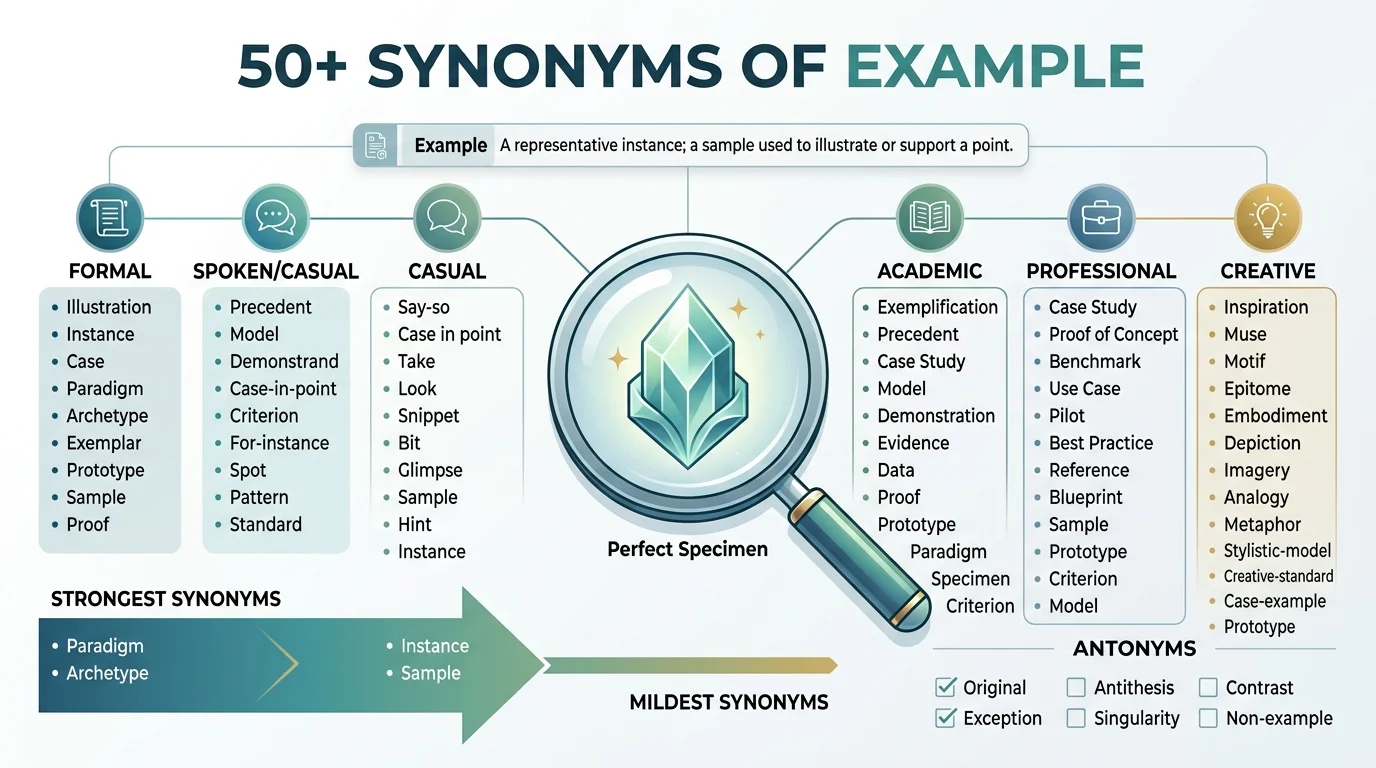
Have you ever struggled to find the right word when giving an illustration or a model for others to follow? You want to show someone how something works, and the word “example” comes to mind. But is it the best fit for your audience? Choosing the right synonym for “example” can transform a vague reference into a clear, compelling demonstration. This guide explores the best synonyms of example, explaining exactly which word to use and when.
Quick Ans: “Example” means a specific instance, model, or illustration that represents a broader category or explains a concept. It is a neutral, versatile noun. For formal writing, choose illustration or exemplar. For casual conversation, use instance or case. In academic contexts, specimen and prototype are strong choices. For a stronger, more dramatic impact, select paradigm or archetype.
Meaning, Tone, and Context
Understanding the core meaning of “example” is the first step to using it effectively.
Simple Definition: A particular instance or representation that shows what something is like. A model or pattern to be followed.
Part of Speech: Noun.
Overall Tone: Neutral. It simply refers to something that serves as a representative case.
Formality Level: Neutral. The word works in almost any context, from casual conversation to formal academic writing.
Common Uses: Native English speakers use it constantly. For example, “Give me an example of a good leader,” or “This painting is a perfect example of impressionism.”
Word Forms: Related words include the verb exemplify, the adjective exemplary, and the adverb exemplarily.
When and How to Use “Example”
“Example” is the most common and versatile word in its category. Here are seven realistic examples.
Professional: “Let me provide a concrete example of how this strategy increased revenue.”
Academic: “The researcher used the case study as an example of cognitive dissonance in action.”
Workplace: “This project serves as an example of what our team can achieve with collaboration.”
Personal: “My mother was always my example of strength and kindness.”
Email: “Attached is an example of the format we need for all future proposals.”
Resume: “Led a team that set an example for cross-departmental cooperation.”
Social Media: “This before-and-after photo is a great example of what consistent effort can do.”
Best Synonyms of “Example”
No synonym is identical in every situation. Here is your guide to the best replacement for “example” based on your writing context.
Professional Writing: Illustration. It suggests a clear, vivid demonstration. “The chart serves as an illustration of our quarterly growth.”
Academic Writing: Exemplar. This is ideal when discussing a model that perfectly represents a class. “The fossil is an exemplar of early mammalian evolution.”
Business Communication: Case. A practical choice for discussing specific situations. “Let’s examine a case where this approach failed.”
Casual Conversation: Instance. It tones down the formality, meaning a single occurrence. “I can think of one instance where that happened.”
Emotional Writing: Embodiment. This word carries weight, suggesting something is a perfect representation. “She was the embodiment of grace under pressure.”
Creative Writing: Paragon. It implies a perfect model of excellence. “He was a paragon of virtue in the community.”
Resume Writing: Prototype. Use it to describe creating a first model. “Developed a prototype that revolutionized the manufacturing process.”
When Not to Use “Example”
Using “example” can sound weak or imprecise in certain situations.
When It Sounds Too Vague: “Example” can be too general. You might need a word that conveys more specificity.
Better Choice: Specimen. “The lab tested the specimen for contamination.”
When You Need a Model to Follow: “Example” is fine, but model or template is stronger.
Better Choice: Template. “Use this template for all client proposals.”
When It Sounds Too Ordinary: In creative or elevated writing, “example” feels flat.
Better Choice: Archetype. “The character represents the archetype of the reluctant hero.”
When Describing a Sample: “Example” works, but sample is more precise.
Better Choice: Sample. “We received a sample of the new fabric.”
Words Commonly Confused With “Example”
Several words are often mixed up with “example.” Here is how to keep them straight.
Word: Instance
Difference: Refers to a specific occurrence or case. “Example” is broader and can be a model.
When to Use: Use it when talking about a single event or case.
Example: “There was only one instance of fraud in the entire company.”
Word: Sample
Difference: Suggests a physical part taken from a whole. “Example” is more abstract.
When to Use: Use this for physical pieces, data points, or product demonstrations.
Example: “The store offered a free sample of the new cheese.”
Word: Illustration
Difference: Focuses on visual or vivid explanation. “Example” is more general.
When to Use: Use it when you want to paint a picture or clarify with a story.
Example: “The anecdote served as a powerful illustration of the problem.”
Word: Model
Difference: Implies a standard or ideal to be imitated. “Example” is neutral.
When to Use: Use this for behavior, systems, or products meant to be reproduced.
Example: “She set a model for work-life balance that others followed.”
Word: Paradigm
Difference: Refers to a broader framework or pattern. “Example” is a single instance.
When to Use: Use it for overarching concepts or theoretical frameworks.
Example: “Copernicus shifted the paradigm of the entire scientific community.”
Word: Exemplar
Difference: Means a perfect or typical example. “Example” does not imply perfection.
When to Use: Use it to highlight something that perfectly represents its class.
Example: “The museum displayed an exemplar of Roman engineering.”
Best Synonyms of “Example” by Context
| Context | Best Synonym | Why It Works | Example |
|---|---|---|---|
| Formal writing | Exemplar | Suggests a perfect, ideal model. | “The treaty stands as an exemplar of international cooperation.” |
| Academic writing | Specimen | Implies a studied, examined object. | “The biologist examined the specimen under a microscope.” |
| Professional communication | Illustration | Emphasizes clarity and demonstration. | “The graph provides a clear illustration of market trends.” |
| Business emails | Case | Practical and concise for business situations. | “In this case, we need to reconsider our approach.” |
| Resume writing | Prototype | Highlights innovation and development. | “Built a prototype that secured funding for the project.” |
| Workplace communication | Model | Emphasizes something to be replicated. | “Her approach became the model for customer service.” |
| Casual conversation | Instance | Simple, direct, and conversational. | “I can think of one instance when that worked.” |
| Creative writing | Paragon | Evokes excellence and perfection. | “The knight was a paragon of chivalry.” |
| Emotional writing | Embodiment | Suggests something perfectly represents an abstract quality. | “He was the embodiment of all she admired.” |
| Strong emphasis | Archetype | Suggests a universal, fundamental pattern. | “The story follows the archetype of the hero’s journey.” |
| Mild tone | Case | Simple and unassuming. Good for everyday references. | “Here is a case where the policy worked well.” |
| Social media captions | Example | The most natural, widely understood choice. | “This is a perfect example of what I mean.” |
How to Choose the Best Synonym of “Example”
Choosing the right word is a simple decision. Answer these questions.
What is my audience? For a professor or CEO, exemplar or illustration is powerful. For a friend, instance or case is more natural.
What is my purpose? Are you trying to demonstrate, persuade, or inform? Use illustration for clarity, paradigm for persuasion, and sample for information.
Am I describing a physical thing or an abstract concept? For physical objects, specimen or sample are good. For abstract ideas, paradigm or archetype are better.
What is the emotional strength? Paragon and embodiment are stronger. Case and instance are mild. Pick the one that matches your message.
Real Life Examples of “Example”
To truly master the word, it helps to see how it behaves in the wild and how a stronger synonym can elevate the sentence.
School: Basic: “The teacher gave an example of a compound sentence.” Improved: “The teacher provided an illustration of a compound sentence on the board.”
College: Basic: “This theorem is an example of advanced calculus.” Improved: “This theorem serves as a paradigm of advanced calculus in practice.”
Workplace: Basic: “Her presentation was an example of great communication.” Improved: “Her presentation was a model of great workplace communication.”
Business: Basic: “Their marketing campaign is an example of success.” Improved: “Their marketing campaign is an exemplar of success in the industry.”
Email: Basic: “Please find an example of the report format.” Improved: “Please find a template of the report format for your reference.”
Conversation: Basic: “Give me an example of what you mean.” Improved: “Give me an instance of what you mean in practice.”
Storytelling: Basic: “She was an example of courage.” Improved: “She was the embodiment of courage in the face of danger.”
Top 10 Synonyms of “Example”
| Synonym | Simple Meaning | Best Used For | Example Sentence |
|---|---|---|---|
| Exemplar | A perfect or typical example | Formal, academic, and philosophical contexts. | “The building is an exemplar of modernist architecture.” |
| Illustration | A clear demonstration or explanation | Professional, educational, and visual contexts. | “The case study is an illustration of effective management.” |
| Instance | A specific occurrence or case | Casual conversation and everyday references. | “I recall one instance where the rule was broken.” |
| Specimen | A single sample taken for examination | Scientific, medical, and research contexts. | “The lab received the specimen for DNA testing.” |
| Model | A standard or ideal to be imitated | Workplace, business, and behavioral contexts. | “His work ethic is a model for younger employees.” |
| Paradigm | A broader framework or pattern | Academic, theoretical, and conceptual contexts. | “Einstein’s theory created a new paradigm in physics.” |
| Archetype | A universal, fundamental pattern | Creative writing, mythology, and psychology. | “The mentor character is an archetype in storytelling.” |
| Paragon | A perfect model of excellence | Literary, inspirational, and flattering contexts. | “The organization is a paragon of corporate responsibility.” |
| Embodiment | A perfect representation of a quality | Emotional, dramatic, and descriptive writing. | “She was the embodiment of kindness and generosity.” |
| Prototype | A first version created as a model | Business, tech, and product development contexts. | “The team built a prototype to test the new software.” |
Synonyms of “Example” by Usage
Professional vs. Personal Synonyms
In the workplace (professional), choose illustration, model, or prototype to demonstrate concepts or processes. These words convey seriousness and precision. “This report is an illustration of our commitment to accuracy” is more impactful than “This report is an example.”
With friends (personal), instance, case, or simply example keep the tone relaxed and relatable. These alternatives sound natural in everyday conversation.
Formal vs. Conversational Synonyms
For formal writing (reports, essays, professional emails), use exemplar, paradigm, or illustration. These choices maintain the sophisticated tone expected in professional documents.
For casual conversations and texting, use instance, case, or sample (when physical). These options sound more natural and less pretentious.
Academic Synonyms
For research and essays, choose precise, authoritative words. Specimen is great for scientific samples, exemplar for perfect representatives, and paradigm for theoretical frameworks. These words sound considered and scholarly.
Using precise academic vocabulary demonstrates expertise and careful thinking. Professors and reviewers expect this level of precision.
Professional and Business Synonyms
For maximum impact in business writing, choose prototype for innovation, model for processes, and illustration for explanations. These words demonstrate confidence and professional awareness.
Business leaders respond to language that conveys clarity and certainty. These synonyms project authority.
Creative and Literary Synonyms
To add emotion and imagery to your writing, choose paragon, embodiment, or archetype. These words create atmosphere and drama.
Literary writers use these alternatives to build character and theme. They transform ordinary descriptions into evocative prose.
Slang or Modern Synonyms
There is no direct slang synonym for “example” in mainstream American English. The simplest alternative in modern texting is literally just example or case. This straightforward approach works best for casual digital communication.
Strongest to Mildest Synonyms
Mild: example, case, instance
Moderate: sample, illustration, model
Strong: prototype, specimen, paradigm
Very Strong: exemplar, paragon, embodiment, archetype
Emotional vs. Neutral Synonyms
Emotional Synonyms: Paragon, embodiment, archetype. These words often hint at admiration, inspiration, or dramatic significance. Use them when you want to evoke feeling.
Neutral Synonyms: Example, instance, case, illustration. These words simply communicate factual information. Use them when you want to inform without emotional coloring.
Antonyms of “Example”
Here are 15 genuine opposites of “example.”
| Antonym | Meaning | Example Sentence |
|---|---|---|
| Anomaly | Something that deviates from the norm | “The positive test result was an anomaly in the data.” |
| Exception | A case that does not follow the rule | “This is the exception that proves the rule.” |
| Contradiction | A case that opposes the general principle | “His actions were a contradiction to his stated values.” |
| Atypical | Not representative of the type | “The weather was atypical for this time of year.” |
| Aberration | A departure from what is normal | “The violence was an aberration in an otherwise peaceful country.” |
| Deviation | A departure from the standard | “Any deviation from the protocol is unacceptable.” |
| Outlier | A data point far from others | “The statistical outlier skewed the entire analysis.” |
| Irregularity | Something not normal or usual | “The inspector found an irregularity in the financial records.” |
| Uniqueness | The quality of being one of a kind | “The uniqueness of the artifact made it priceless.” |
| Singularity | A point at which something is unique | “The singularity of the event made it historically significant.” |
| Original | The first version, not a copy | “The original is kept in a museum vault.” |
| Nonconformity | Failure to match the standard | “His nonconformity set him apart from his peers.” |
| Rarity | Something that is not common | “The rarity of the gem made it extraordinarily valuable.” |
| Unconventional | Not based on what is usual | “Her unconventional approach surprised everyone.” |
| Abnormality | A feature that is not typical | “The doctor noted an abnormality in the test results.” |
Comparison: “Example” vs Similar Words
Example vs. Instance
Main Difference: Example can be a model or representation. Instance is strictly a specific occurrence.
Which Is Stronger? Neither is inherently stronger. Example is more versatile. Instance is more precise.
Which Is More Formal? Both are neutral in formality.
When to Use Each: Use example when you want a model or illustration. Use instance when you refer to a single event.
Examples:
Example: “This painting is an example of impressionism.”
Instance: “There was one instance of theft last year.”
Example vs. Sample
Main Difference: Example is abstract and conceptual. Sample is physical and tangible.
Which Is Stronger? Sample is more concrete. Example is more flexible.
Which Is More Formal? Both are formal and informal depending on context.
When to Use Each: Use example for ideas and concepts. Use sample for physical products or data points.
Examples:
Example: “This is an example of good writing.”
Sample: “We tested a sample of the product.”
Example vs. Illustration
Main Difference: Example is general. Illustration emphasizes vivid explanation.
Which Is Stronger? Illustration is stronger for clarity and visualization.
Which Is More Formal? Both are formal, but illustration is often preferred in professional contexts.
When to Use Each: Use example for a simple reference. Use illustration for a detailed, clarifying demonstration.
Examples:
Example: “Here is an example of the rule.”
Illustration: “The anecdote served as a vivid illustration of the problem.”
Example vs. Model
Main Difference: Example is neutral. Model implies a standard to be imitated.
Which Is Stronger? Model carries more weight and implies excellence.
Which Is More Formal? Both are used in formal and informal contexts.
When to Use Each: Use example for simple reference. Use model when you want someone to follow or replicate something.
Examples:
Example: “This is an example of a compound sentence.”
Model: “Her behavior is a model for other employees.”
Example vs. Paradigm
Main Difference: Example is a single instance. Paradigm is a broader framework or pattern.
Which Is Stronger? Paradigm is much stronger and more conceptual.
Which Is More Formal? Paradigm is far more formal and academic.
When to Use Each: Use example for simple illustrations. Use paradigm for theoretical frameworks.
Examples:
Example: “This is an example of good leadership.”
Paradigm: “The shift to digital changed the paradigm of the entire industry.”
Example vs. Exemplar
Main Difference: Example is neutral. Exemplar implies perfection.
Which Is Stronger? Exemplar is much stronger and more laudatory.
Which Is More Formal? Exemplar is very formal and academic.
When to Use Each: Use example for simple reference. Use exemplar when something is the perfect representative of its class.
Examples:
Example: “This is an example of Renaissance art.”
Exemplar: “The Sistine Chapel is an exemplar of Renaissance art.”
Common Phrases and Expressions with “Example”
Phrase: For example
Meaning: Used to introduce an illustration or case.
Example Sentence: “Many foods contain vitamin C. For example, oranges and kiwis are excellent sources.”
Phrase: Set an example
Meaning: To behave in a way that others should follow.
Example Sentence: “The manager set an example by arriving early every day.”
Phrase: Prime example
Meaning: A perfect or most typical example.
Example Sentence: “The city of Venice is a prime example of urban engineering.”
Phrase: Case in point
Meaning: A specific example that proves a general statement.
Example Sentence: “His laziness is a case in point; he never completes anything on time.”
Phrase: Lead by example
Meaning: To guide others by showing how something is done.
Example Sentence: “She leads by example, always working harder than anyone else.”
Phrase: Make an example of
Meaning: To punish someone severely as a warning to others.
Example Sentence: “The principal made an example of the student to discourage cheating.”
Common Mistakes to Avoid
Mistake 1: Using “example” when you mean “sample”.
Incorrect: “The laboratory tested the example of tissue.”
Better: “The laboratory tested the sample of tissue.”
Why: A sample is a physical piece. An example is an illustration.
Mistake 2: Using “example” when you mean “model”.
Incorrect: “Her performance is an example to follow.”
Better: “Her performance is a model to follow.”
Why: A model is a standard to imitate. An example is just a case.
Mistake 3: Overusing “example” in formal writing.
Incorrect: “This is an example. That is another example.”
Better: “This is one illustration. That is another specimen.”
Why: Variation in vocabulary demonstrates writing sophistication.
Mistake 4: Using “instance” when you mean “model”.
Incorrect: “She is an instance of a good leader.”
Better: “She is a model of a good leader.”
Why: An instance is a single occurrence. A model is something to be followed.
Mistake 5: Using “paradigm” when you mean a simple example.
Incorrect: “The broken printer is a paradigm of our problems.”
Better: “The broken printer is an illustration of our problems.”
Why: Paradigm is a grand theoretical pattern. It sounds pretentious for small matters.
Frequently Asked Questions
1. What are the best synonyms of “example”?
The best synonyms depend on your context. For formal writing, choose exemplar or illustration. And for casual conversation, instance or case are ideal choices. Also for physical items, use sample or specimen.
2. What are the best formal synonyms of “example”?
The best formal synonyms are exemplar, illustration, and paradigm. These words are suitable for academic papers, professional reports, and business communications.
3. What are common informal synonyms of “example”?
For informal settings, use instance, case, or simply example. These alternatives sound more natural in everyday conversation.
4. What is another word for “example” in professional writing?
In professional writing, illustration is an excellent choice. It conveys a clear, vivid demonstration of a point. Model is also strong for processes to be replicated.
5. What is the difference between “example” and “exemplar”?
While both refer to a representative case, exemplar implies a perfect or ideal example. Example is neutral and does not imply perfection. Use exemplar when something is the best of its kind.
6. What is the opposite of “example”?
The most direct opposites (antonyms) of example are anomaly, exception, and aberration. These words describe things that deviate from the norm.
Conclusion
“Example” is a versatile and essential word for explaining concepts and providing models. The term is neutral and widely understood, yet it can sound vague or ordinary in certain contexts. The best choice among the synonyms of example depends entirely on your audience, tone, and purpose. For a dramatic, formal effect, use exemplar or paradigm. And for a practical, business context, model or illustration works perfectly. Also for physical objects, choose specimen or sample. Remember, no single synonym works perfectly in every situation. Your goal is to choose the word that communicates your message with the most clarity and impact. A practical tip for your vocabulary growth is to keep a thesaurus handy and challenge yourself to use one new synonym in your writing each week.

Alexander Cole is a professional content writer and researcher who specializes in creating informative, reader-friendly, and well-researched articles. He is committed to publishing accurate, valuable, and engaging content that helps readers stay informed and make smarter decisions.