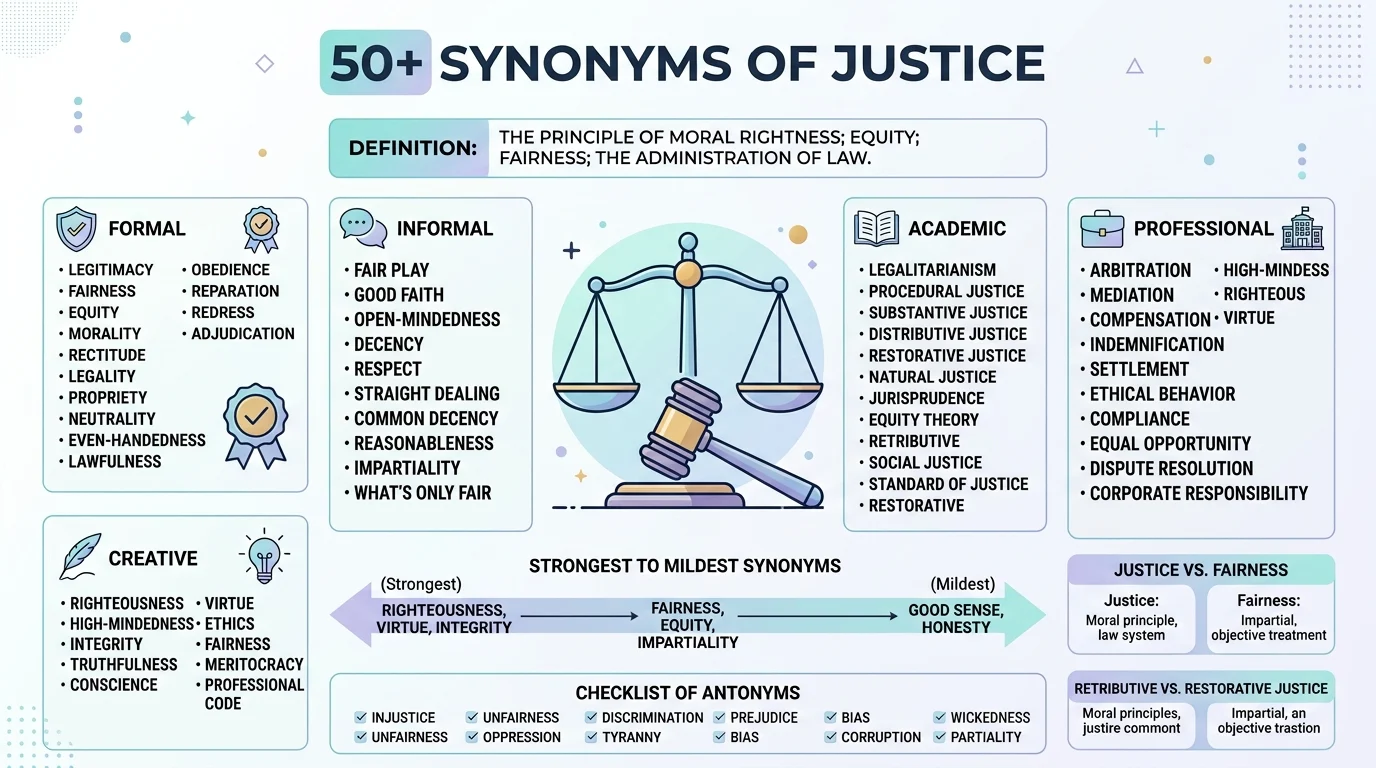
Have you ever needed to describe fairness or legal accountability but felt that the word “justice” did not fully capture the nuance you intended? You want to convey moral rightness, legal authority, or social equality, and the word “justice” comes to mind. But is it the best fit for your audience? Choosing the right synonym for “justice” can transform a simple statement into a precise reflection of ethical, legal, or social principles. This guide explores the best synonyms of justice, explaining exactly which word to use and when.
Quick Ans: “Justice” means the quality of being fair and reasonable, or the administration of law and legal decisions. It is a positive, formal noun. For legal writing, choose judgment or verdict. For casual conversation, use fairness or right. In academic contexts, equity and impartiality are strong choices. For a stronger, more dramatic impact, select retribution or vengeance.
Meaning, Tone, and Context
Understanding the core meaning of “justice” is the first step to using it effectively.
Simple Definition: Fair and reasonable treatment in accordance with law or moral principles. The administration of legal decisions.
Part of Speech: Noun.
Overall Tone: Positive to neutral. It indicates moral correctness and legal order.
Formality Level: Formal. The word is appropriate in legal, academic, and professional settings.
Common Uses: Native English speakers use it in legal contexts, social commentary, and everyday expressions of fairness. For example, “The judge delivered justice,” or “They demanded justice for the victims.”
Word Forms: Related words include the adjective just, the adverb justly, and the noun justification.
When and How to Use “Justice”
“Justice” is the perfect choice when you want to emphasize fairness, legal accountability, or moral rightness. Here are seven realistic examples.
Professional: “The legal team worked tirelessly to ensure justice was served for their client.”
Academic: “The philosopher’s work examines the relationship between justice and equality in society.”
Workplace: “The employee handbook was created to ensure justice and fairness for all staff members.”
Personal: “She felt a deep sense of justice when the truth finally came to light.”
Email: “The committee will review the case to ensure justice is applied equally.”
Resume: “Advocated for social justice through volunteer work and community organizing.”
Social Media: “Justice is not a privilege; it is a fundamental right for all people.”
Best Synonyms of “Justice”
No synonym is identical in every situation. Here is your guide to the best replacement for “justice” based on your writing context.
Professional Writing: Judgment. It suggests a formal legal decision. “The judgment was in favor of the plaintiff.”
Academic Writing: Equity. This is ideal when discussing fairness in systems. “The policy aims to achieve equity in education.”
Business Communication: Fairness. A practical choice that emphasizes equal treatment. “The company values fairness in all its decisions.”
Casual Conversation: Right. It tones down the formality and sounds natural. “We need to do what is right.”
Emotional Writing: Vindication. This word carries weight, suggesting the clearing of blame or suspicion. “His acquittal was complete vindication.”
Creative Writing: Retribution. It implies punishment or repayment for wrongdoing. “The villain faced retribution for his crimes.”
Resume Writing: Advocacy. Use it to describe working for fairness. “Led advocacy efforts for criminal justice reform.”
When Not to Use “Justice”
Using “justice” can sound wrong or awkward in certain situations.
When It Sounds Too Grand: In everyday disagreements, “justice” is overly dramatic.
Better Choice: Fairness or right. “It is only fair that we split the bill.”
When You Mean “Punishment”: “Justice” is broader than punishment.
Better Choice: Punishment or penalty. “The court imposed a harsh penalty.”
When Describing Simple Preferences: “Justice” is too formal for minor decisions.
Better Choice: Proper or appropriate. “Let us choose the proper course of action.”
When It Sounds Too Vague: “Justice” can be abstract. You might need a more specific word.
Better Choice: Accountability or responsibility. “We need accountability in government.”
Words Commonly Confused With “Justice”
Several words are often mixed up with “justice.” Here is how to keep them straight.
Word: Equity
Difference: Means fairness according to need. “Justice” is about applying laws and principles equally.
When to Use: Use it when discussing fair distribution of resources.
Example: “The policy promotes equity in healthcare access.”
Word: Fairness
Difference: Broader and more casual. “Justice” is more formal and legal.
When to Use: Use this for everyday situations.
Example: “The teacher handled the dispute with fairness.”
Word: Judgment
Difference: Means a formal decision. “Justice” is the principle behind the decision.
When to Use: Use this for court decisions and formal evaluations.
Example: “The judge issued her judgment after deliberation.”
Word: Vengeance
Difference: Implies personal revenge. “Justice” is about social order and legality.
When to Use: Use this for personal retaliation, not legal process.
Example: “He sought vengeance for his brother’s death.”
Word: Retribution
Difference: Implies punishment for wrongdoing. “Justice” is broader, including fairness and legality.
When to Use: Use it for deserved punishment.
Example: “The criminal faced retribution for his actions.”
Word: Impartiality
Difference: Means lack of bias. “Justice” is the outcome of impartiality.
When to Use: Use it for neutral decision-making.
Example: “The judge’s impartiality was unquestionable.”
Best Synonyms of “Justice” by Context
| Context | Best Synonym | Why It Works | Example |
|---|---|---|---|
| Formal writing | Judgment | Suggests a formal legal decision. | “The judgment was met with widespread approval.” |
| Academic writing | Equity | Indicates fairness in systems. | “The study examines equity in public education.” |
| Professional communication | Fairness | Emphasizes equal treatment. | “The policy ensures fairness for all employees.” |
| Business emails | Right | Professional yet accessible. | “It is only right that we compensate them.” |
| Resume writing | Advocacy | Highlights working for fairness. | “Spearheaded advocacy for workplace equality.” |
| Workplace communication | Impartiality | Emphasizes neutrality. | “The review requires complete impartiality.” |
| Casual conversation | Fair | Simple, natural, and conversational. | “That does not seem fair to me.” |
| Creative writing | Retribution | Evokes punishment and repayment. | “The story ends with retribution for the villain.” |
| Emotional writing | Vindication | Suggests clearing of blame. | “The verdict was sweet vindication.” |
| Strong emphasis | Righteousness | Implies moral correctness. | “She fought with righteousness and passion.” |
| Mild tone | Decency | Simple and moral. | “The decision was a matter of basic decency.” |
| Social media captions | Fairness | Widely understood and relatable. | “Fairness is not optional; it is required.” |
How to Choose the Best Synonym of “Justice”
Choosing the right word is a simple decision. Answer these questions.
What is my audience? For a professor or judge, equity or judgment is powerful. For a friend, fair or right is more natural.
What is my purpose? Are you trying to describe a legal outcome, a moral principle, or a social goal? Use judgment for legal outcomes, fairness for moral principles, and equity for social goals.
Am I describing a system or an action? For systems, justice, equity, or impartiality work well. For actions, retribution, vindication, or punishment are better.
What is the emotional strength? Vengeance and retribution are stronger. Fairness and decency are mild. Pick the one that matches your message.
Real Life Examples of “Justice”
To truly master the word, it helps to see how it behaves in the wild and how a stronger synonym can elevate the sentence.
School: Basic: “The student wanted justice for the unfair grade.” Improved: “The student sought fairness when she challenged her grade.”
College: Basic: “The class discussed justice in society.” Improved: “The class discussed equity in social systems.”
Workplace: Basic: “The employee demanded justice.” Improved: “The employee demanded impartiality in the investigation.”
Business: Basic: “The contract ensured justice for both parties.” Improved: “The contract ensured fairness and equity for both parties.”
Email: Basic: “We need to ensure justice for all.” Improved: “We need to ensure fairness and accountability for all.”
Conversation: Basic: “That is not justice.” Improved: “That is not fair to anyone involved.”
Storytelling: Basic: “He brought the criminal to justice.” Improved: “He brought the criminal to judgment before the court.”
Top 10 Synonyms of “Justice”
| Synonym | Simple Meaning | Best Used For | Example Sentence |
|---|---|---|---|
| Judgment | A formal legal decision | Legal, professional, and court-related contexts. | “The judgment was delivered after two weeks.” |
| Equity | Fairness according to need | Academic, social, and policy contexts. | “The new policy promotes equity in housing.” |
| Fairness | Equal and reasonable treatment | Everyday, business, and personal contexts. | “She always acts with fairness.” |
| Impartiality | Absence of bias | Legal, workplace, and decision-making contexts. | “The judge’s impartiality was respected by all.” |
| Right | Moral correctness | Casual, personal, and ethical contexts. | “We need to do what is right.” |
| Vindication | Clearing of blame or suspicion | Emotional, personal, and legal contexts. | “His confession was vindication for the accused.” |
| Retribution | Deserved punishment | Creative, literary, and dramatic contexts. | “The story explores retribution for past wrongs.” |
| Righteousness | Moral justice and goodness | Religious, spiritual, and inspirational contexts. | “She fought with righteousness and courage.” |
| Accountability | Responsibility for actions | Business, political, and professional contexts. | “The new rules ensure accountability.” |
| Decency | Basic moral fairness | Personal, conversational, and ethical contexts. | “It is just a matter of basic decency.” |
Synonyms of “Justice” by Usage
Professional vs. Personal Synonyms
In the workplace (professional), choose impartiality, accountability, or judgment to describe legal or ethical standards. These words convey professionalism and precision. “The committee ensured impartiality in the decision” is more precise than “The committee ensured justice.”
With friends (personal), fair, right, or decent keep the tone relaxed and relatable. These alternatives sound natural in everyday conversation.
Formal vs. Conversational Synonyms
For formal writing (reports, essays, professional emails), use judgment, equity, or impartiality. These choices maintain the sophisticated tone expected in professional documents.
For casual conversations and texting, use fair, right, or decency. These options sound more natural and less pretentious.
Academic Synonyms
For research and essays, choose precise, authoritative words. Equity is great for social justice discussions, impartiality for legal processes, and retribution for philosophical debates. These words sound considered and scholarly.
Using precise academic vocabulary demonstrates expertise and careful thinking. Professors and reviewers expect this level of precision.
Professional and Business Synonyms
For maximum impact in business writing, choose accountability for responsibility, impartiality for neutrality, and fairness for equal treatment. These words demonstrate confidence and professional awareness.
Business leaders respond to language that conveys ethical standards and reliability. These synonyms project authority.
Creative and Literary Synonyms
To add emotion and imagery to your writing, choose retribution, vengeance, or vindication. These words create atmosphere and drama.
Literary writers use these alternatives to build conflict, character motivation, and theme. They transform ordinary descriptions into evocative prose.
Slang or Modern Synonyms
There is no direct slang synonym for “justice” in mainstream American English. In modern texting, people use fair, right, or simply just. This straightforward approach works best for casual digital communication.
Strongest to Mildest Synonyms
Mild: fairness, decency, right
Moderate: impartiality, judgment, accountability
Strong: equity, righteousness, vindication
Very Strong: retribution, vengeance, punishment
Emotional vs. Neutral Synonyms
Emotional Synonyms: Vindication, retribution, vengeance. These words often hint at passion, anger, or strong moral conviction. Use them when you want to evoke feeling.
Neutral Synonyms: Judgment, impartiality, accountability. These words simply communicate factual information. Use them when you want to inform without emotional coloring.
Antonyms of “Justice”
Here are 15 genuine opposites of “justice.”
| Antonym | Meaning | Example Sentence |
|---|---|---|
| Injustice | Unfair treatment or violation of rights | “The injustice of the verdict angered the community.” |
| Bias | Unfair preference for one side | “The judge’s bias compromised the trial.” |
| Partiality | Favoritism toward one party | “The manager’s partiality caused resentment.” |
| Unfairness | Lack of fair treatment | “The unfairness of the decision was obvious.” |
| Inequity | Lack of fairness according to need | “The policy created inequity in funding.” |
| Corruption | Dishonest or unethical conduct | “The corruption in the system was exposed.” |
| Prejudice | Preconceived bias against others | “The prejudice of the jury affected the verdict.” |
| Discrimination | Unfair treatment based on group membership | “The new laws aim to end discrimination.” |
| Lawlessness | Disregard for legal rules | “The lawlessness in the region was alarming.” |
| Anarchy | Absence of law and order | “The country descended into anarchy.” |
| Oppression | Cruel and unjust treatment | “The people rose up against oppression.” |
| Tyranny | Cruel and oppressive government | “The citizens fled the tyranny of the regime.” |
| Iniquity | Gross immorality or injustice | “The novel explores the iniquity of the system.” |
| Miscarriage | Failure to achieve a just outcome | “The trial was a miscarriage of justice.” |
| Wrong | An unjust or unfair action | “He sought to right a terrible wrong.” |
Comparison: “Justice” vs Similar Words
Justice vs. Equity
Main Difference: Justice applies laws equally. Equity adjusts for individual needs and circumstances.
Which Is Stronger? They are similar in strength. Equity is more specific to social systems.
Which Is More Formal? Both are formal, but equity is more academic.
When to Use Each: Use justice for legal contexts. Use equity for social and policy discussions.
Examples:
Justice: “The court delivered justice.”
Equity: “The program promotes equity in education.”
Justice vs. Fairness
Main Difference: Justice is more formal and legal. Fairness is broader and more casual.
Which Is Stronger? Justice carries more formal weight.
Which Is More Formal? Justice is more formal. Fairness is neutral.
When to Use Each: Use justice in formal documents. Use fairness in everyday conversation.
Examples:
Justice: “The judge sought justice for the victim.”
Fairness: “The system should ensure fairness for everyone.”
Justice vs. Judgment
Main Difference: Justice is the principle. Judgment is the specific decision.
Which Is Stronger? They are equally strong but different in function.
Which Is More Formal? Both are very formal.
When to Use Each: Use justice for broader principles. Use judgment for specific rulings.
Examples:
Justice: “Justice must be impartial.”
Judgment: “The judgment was announced yesterday.”
Justice vs. Vengeance
Main Difference: Justice is about social order. Vengeance is about personal retaliation.
Which Is Stronger? Vengeance is stronger and more emotional.
Which Is More Formal? Justice is formal. Vengeance is more dramatic and literary.
When to Use Each: Use justice for legal and social contexts. Use vengeance for creative writing.
Examples:
Justice: “The legal system ensures justice.”
Vengeance: “He swore vengeance on his enemies.”
Justice vs. Retribution
Main Difference: Justice includes fairness and legality. Retribution is specifically punishment.
Which Is Stronger? Retribution is stronger and more focused on punishment.
Which Is More Formal? Both are formal, but retribution is more literary.
When to Use Each: Use justice for balanced outcomes. Use retribution for deserved punishment.
Examples:
Justice: “The victim’s family sought justice.”
Retribution: “The criminal faced retribution for his crimes.”
Justice vs. Vindication
Main Difference: Justice is about the system. Vindication is about clearing someone of blame.
Which Is Stronger? They are similar in strength. Vindication is more personal.
Which Is More Formal? Both are formal.
When to Use Each: Use justice for systemic outcomes. Use vindication for personal exoneration.
Examples:
Justice: “The trial resulted in justice.”
Vindication: “The acquittal was personal vindication.”
Common Phrases and Expressions with “Justice”
Phrase: Justice is served
Meaning: A fair outcome has been achieved.
Example Sentence: “The guilty verdict ensured justice was served.”
Phrase: Poetic justice
Meaning: A satisfying outcome where good is rewarded and evil is punished.
Example Sentence: “His downfall was poetic justice for his cruelty.”
Phrase: Criminal justice
Meaning: The system of laws and procedures for dealing with crime.
Example Sentence: “She studied criminal justice at the university.”
Phrase: Obstruction of justice
Meaning: Interfering with the legal process.
Example Sentence: “He was charged with obstruction of justice.”
Phrase: Justice system
Meaning: The courts, laws, and procedures for administering justice.
Example Sentence: “The justice system must be reformed.”
Phrase: Natural justice
Meaning: Basic principles of fairness and fairness.
Example Sentence: “The decision violated principles of natural justice.”
Common Mistakes to Avoid
Mistake 1: Using “justice” when you mean “fairness”.
Incorrect: “The teacher’s decision was a matter of justice.”
Better: “The teacher’s decision was a matter of fairness.”
Why: Justice is formal and legal. Fairness is broader and more casual.
Mistake 2: Using “vengeance” when you mean “justice”.
Incorrect: “The court delivered vengeance.”
Better: “The court delivered justice.”
Why: Vengeance is personal revenge. Justice is legal and impartial.
Mistake 3: Overusing “justice” in casual conversation.
Incorrect: “This parking ticket is a matter of justice.”
Better: “This parking ticket is unfair.”
Why: Justice is too grand for minor everyday issues.
Mistake 4: Using “retribution” for legal processes.
Incorrect: “The judge imposed retribution.”
Better: “The judge imposed a sentence.”
Why: Retribution is emotional and personal. Legal processes use terms like sentence or penalty.
Mistake 5: Using “equity” when you mean “equality”.
Incorrect: “We need equity for everyone to have the same resources.”
Better: “We need equality for everyone to have the same resources.”
Why: Equity means distributing resources according to need. Equality means everyone gets the same.
Frequently Asked Questions
1. What are the best synonyms of “justice”?
The best synonyms depend on your context. For formal writing, choose judgment or impartiality. And for casual conversation, fairness or right are ideal choices. For legal contexts, use judgment or accountability.
2. What are the best formal synonyms of “justice”?
The best formal synonyms are judgment, impartiality, and equity. These words are suitable for academic papers, professional reports, and legal communications.
3. What are common informal synonyms of “justice”?
For informal settings, use fairness, right, or decency. These alternatives sound more natural in everyday conversation.
4. What is another word for “justice” in professional writing?
In professional writing, impartiality is an excellent choice. It conveys neutrality and fairness in decision-making. Accountability is also strong for responsibility.
5. What is the difference between “justice” and “equity”?
While both indicate fairness, justice applies laws equally. Equity adjusts for individual needs and circumstances. Use justice for legal contexts and equity for social policy.
6. What is the opposite of “justice”?
The most direct opposites (antonyms) of justice are injustice, bias, and unfairness. These words describe violations of fairness and legal standards.
Conclusion
“Justice” is a powerful word for describing fairness, legal accountability, and moral rightness. The term is formal and widely accepted in professional and legal contexts, yet it can sound overly dramatic in everyday conversation. The best choice among the synonyms of justice depends entirely on your audience, tone, and purpose.Remember, no single synonym works perfectly in every situation. Your goal is to choose the word that communicates your message with the most clarity and impact. A practical tip for your vocabulary growth is to study how justice is discussed in different contexts and practice using various synonyms to build confidence and precision.
Discover More:
- 50+ Synonyms of Effect: Meanings, Uses, Examples, and Best Alternatives 2026
- 50+ Synonyms of Inherently: Meanings, Uses, Examples, and Best Alternatives

Amelia Brooks is a professional content writer and digital publishing specialist with a passion for creating clear, engaging, and informative content. She has extensive experience writing about technology, business, lifestyle, and online services.