Have you ever needed to describe writing or speech that is brief yet full of meaning but felt that “short” did not capture the value of the content? You want to highlight clarity, efficiency, and the absence of unnecessary words, and the word “concise” comes to mind. But is it the best fit for your audience? Choosing the right synonym for “concise” can transform a simple description of length into a powerful compliment about clarity and precision. This guide explores the best synonyms of concise, explaining exactly which word to use and when.
Quick Ans: “Concise” means giving a lot of information clearly and in a few words; brief but comprehensive. It is a positive, formal-to-neutral adjective. For professional writing, choose succinct or pithy. For academic contexts, use terse or compendious. For casual conversation, brief or short and sweet are ideal choices. For a stronger, more dramatic impact, select laconic or epigrammatic.
Meaning, Tone, and Context
Understanding the core meaning of “concise” is the first step to using it effectively.
Simple Definition: Giving a lot of information clearly and in a few words. Brief but comprehensive.
Part of Speech: Adjective.
Overall Tone: Positive. It indicates clarity, efficiency, and respect for the reader’s time.
Formality Level: Formal to neutral. The word is appropriate in professional, academic, and everyday contexts.
Common Uses: Native English speakers use it to describe writing, speeches, instructions, and explanations. For example, “She gave a concise summary of the report,” or “Please be concise in your response.”
Word Forms: Related words include the noun conciseness (or concision), the adverb concisely, and the verb to concise (rare).
When and How to Use “Concise”
“Concise” is the perfect choice when you want to emphasize clarity and efficiency in communication. Here are seven realistic examples.
Professional: “The CEO delivered a concise presentation that covered all key points in twenty minutes.”
Academic: “The researcher wrote a concise abstract that summarized the entire study.”
Workplace: “Please keep your email concise so that everyone can read it quickly.”
Personal: “I appreciated her concise explanation of the complicated process.”
Email: “A concise response would be helpful for the team’s review.”
Resume: “Wrote concise project descriptions that highlighted measurable outcomes.”
Social Media: “A concise caption often gets more engagement than a long one.”
Best Synonyms of “Concise”
No synonym is identical in every situation. Here is your guide to the best replacement for “concise” based on your writing context.
Professional Writing: Succinct. It suggests brevity combined with clarity and effectiveness. “Her succinct summary saved the meeting from running overtime.”
Academic Writing: Compendious. This is ideal when discussing comprehensive yet brief coverage. “The compendious handbook covered all major theories in one volume.”
Business Communication: Pithy. A practical choice for statements that are both brief and powerful. “His pithy remark clarified the entire issue.”
Casual Conversation: Brief. It tones down the formality and sounds natural. “Can you give me a brief overview?”
Emotional Writing: Laconic. This word carries weight, suggesting a deliberate, almost terse brevity. “His laconic reply revealed his frustration.”
Creative Writing: Epigrammatic. It implies clever, witty, and concise expression. “Her epigrammatic style made her essays memorable.”
Resume Writing: Concise. This is the standard and expected term for resumes. It communicates efficiency and clarity.
When Not to Use “Concise”
Using “concise” can sound wrong or awkward in certain situations.
When It Sounds Too Formal: In casual conversation, “concise” can sound overly formal.
Better Choice: Short or brief. “Can you give me a short answer?”
When You Mean “Incomplete”: “Concise” means complete but brief. It is wrong for something that is missing information.
Better Choice: Incomplete or sketchy. “The report was incomplete.”
When You Mean “Blunt”: “Concise” is positive. If brevity is rude, use a different word.
Better Choice: Abrupt or curt. “His abrupt reply was rude.”
When It Sounds Too Technical: “Concise” can sound academic.
Better Choice: To the point. “Please keep your explanation to the point.”
Words Commonly Confused With “Concise”
Several words are often mixed up with “concise.” Here is how to keep them straight.
Word: Succinct
Difference: Means brief and clearly expressed. “Concise” is similar but focuses more on completeness.
When to Use: Use it for clear, effective brevity.
Example: “Her succinct explanation cleared up all confusion.”
Word: Pithy
Difference: Means brief and full of meaning or substance. “Concise” is about length; “pithy” emphasizes substance.
When to Use: Use this for statements that are brief and powerful.
Example: “His pithy comment made everyone think.”
Word: Terse
Difference: Means brief and often abrupt. “Concise” is positive; “terse” can be negative.
When to Use: Use this for brevity that might be rude.
Example: “He gave a terse reply and walked away.”
Word: Laconic
Difference: Means using very few words, often deliberately. “Concise” is about completeness.
When to Use: Use this for deliberate, minimal speech.
Example: “The laconic cowboy spoke only when necessary.”
Word: Brief
Difference: Means short in duration or length. “Concise” implies completeness.
When to Use: Use this for general shortness.
Example: “We had a brief meeting.”
Word: Compendious
Difference: Means concise but comprehensive. “Concise” is similar, but “compendious” is more academic.
When to Use: Use this for comprehensive summaries.
Example: “The compendious text covered all major theories.”
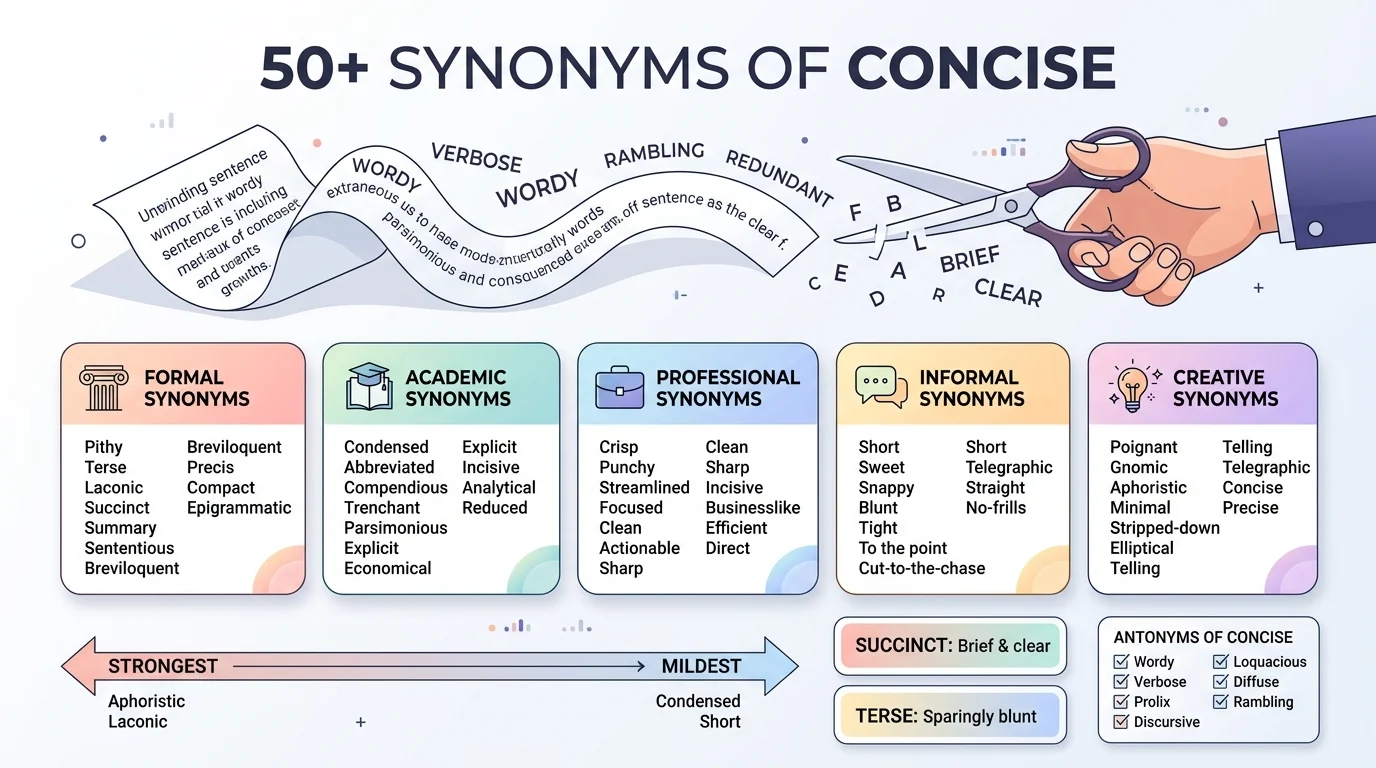
Best Synonyms of “Concise” by Context
| Context | Best Synonym | Why It Works | Example |
|---|---|---|---|
| Formal writing | Succinct | Emphasizes clarity and brevity. | “The succinct report saved time.” |
| Academic writing | Compendious | Suggests comprehensive coverage. | “The compendious guide was invaluable.” |
| Professional communication | Pithy | Emphasizes substance and brevity. | “The pithy statement clarified the issue.” |
| Business emails | Brief | Professional yet accessible. | “Please keep your email brief.” |
| Resume writing | Concise | The standard, expected term. | “Wrote concise project descriptions.” |
| Workplace communication | To the point | Emphasizes directness. | “Her comments were to the point.” |
| Casual conversation | Short | Simple, natural, and conversational. | “Can I get a short answer?” |
| Creative writing | Epigrammatic | Evokes cleverness and wit. | “His epigrammatic style was admired.” |
| Emotional writing | Laconic | Suggests deliberate minimalism. | “His laconic reply revealed his sorrow.” |
| Strong emphasis | Terse | Suggests extreme brevity. | “His terse response left no room for questions.” |
| Mild tone | Brief | Simple and unassuming. | “A brief explanation would help.” |
| Social media captions | Short and sweet | Widely understood and relatable. | “Short and sweet. That is how I like it.” |
How to Choose the Best Synonym of “Concise”
Choosing the right word is a simple decision. Answer these questions.
What is my audience? For a professor or CEO, succinct or compendious is powerful. For a friend, brief or short is more natural.
What is my purpose? Are you trying to praise, instruct, or describe? Use pithy for praise, brief for instruction, and concise for description.
Am I describing writing, speech, or instruction? For writing, concise or succinct work. And for speech, laconic or terse are better. For instructions, clear or to the point are best.
What is the emotional strength? Terse and laconic are stronger. Brief and short are mild. Pick the one that matches your message.
Real Life Examples of “Concise”
To truly master the word, it helps to see how it behaves in the wild and how a stronger synonym can elevate the sentence.
School: Basic: “The student wrote a concise essay.” Improved: “The student wrote a succinct essay that impressed the teacher.”
College: Basic: “The professor gave a concise lecture.” Improved: “The professor gave a compendious lecture that covered all key concepts.”
Workplace: Basic: “Her concise summary helped the team.” Improved: “Her pithy summary helped the team understand the issue.”
Business: Basic: “The report was concise.” Improved: “The report was to the point and saved everyone time.”
Email: Basic: “Please be concise in your reply.” Improved: “Please be brief in your reply.”
Conversation: Basic: “That was a concise answer.” Improved: “That was a short and sweet answer.”
Storytelling: Basic: “The soldier gave a concise report.” Improved: “The soldier gave a laconic report, using only a few words.”
Top 10 Synonyms of “Concise”
| Synonym | Simple Meaning | Best Used For | Example Sentence |
|---|---|---|---|
| Succinct | Brief and clearly expressed | Professional, formal, and effective contexts. | “Her succinct explanation saved time.” |
| Pithy | Brief and full of meaning | Business, powerful statements, and praise contexts. | “His pithy remark was memorable.” |
| Terse | Brief and often abrupt | Strong, dramatic, and negative contexts. | “His terse reply ended the conversation.” |
| Laconic | Using very few words deliberately | Literary, deliberate, and character contexts. | “The laconic cowboy spoke rarely.” |
| Compendious | Concise but comprehensive | Academic, research, and reference contexts. | “The compendious handbook was useful.” |
| Epigrammatic | Clever and concise | Creative, witty, and literary contexts. | “Her epigrammatic style was admired.” |
| Brief | Short in length | Casual, everyday, and general contexts. | “A brief answer would help.” |
| Short | Not long in duration or length | Casual conversation and general contexts. | “Can you give a short explanation?” |
| To the point | Direct and relevant | Workplace, instruction, and clarity contexts. | “Her comments were to the point.” |
| Crisp | Clear and concise | Professional, fresh, and effective contexts. | “The crisp report was easy to read.” |
Synonyms of “Concise” by Usage
Professional vs. Personal Synonyms
In the workplace (professional), choose succinct, pithy, or to the point to describe effective communication. These words convey professionalism and clarity. “Her succinct presentation saved time” is more precise than “Her short presentation saved time.”
With friends (personal), short, brief, or short and sweet keep the tone relaxed and relatable. These alternatives sound natural in everyday conversation.
Formal vs. Conversational Synonyms
For formal writing (reports, essays, professional emails), use succinct, compendious, or terse. These choices maintain the sophisticated tone expected in professional documents.
For casual conversations and texting, use short, brief, or short and sweet. These options sound more natural and less pretentious.
Academic Synonyms
For research and essays, choose precise, authoritative words. Compendious is great for comprehensive coverage, succinct for clear summaries, and terse for concise style. These words sound considered and scholarly.
Using precise academic vocabulary demonstrates expertise and careful thinking. Professors and reviewers expect this level of precision.
Professional and Business Synonyms
For maximum impact in business writing, choose pithy for powerful statements, succinct for summaries, and to the point for direct communication. These words demonstrate confidence and professional awareness.
Business leaders respond to language that conveys clarity and efficiency. These synonyms project authority.
Creative and Literary Synonyms
To add emotion and imagery to your writing, choose laconic, epigrammatic, or terse. These words create atmosphere and demonstrate character.
Literary writers use these alternatives to build voice and style. They transform ordinary descriptions into evocative prose.
Slang or Modern Synonyms
In modern American slang, short and sweet or straight to the point are commonly used alternatives. For example, “Keep it short and sweet,” or “Just get straight to the point.” These are acceptable in casual contexts. Avoid them in professional or academic writing.
Strongest to Mildest Synonyms
Mild: short, brief, short and sweet
Moderate: concise, to the point, crisp
Strong: succinct, pithy, compendious
Very Strong: terse, laconic, epigrammatic
Emotional vs. Neutral Synonyms
Emotional Synonyms: Laconic, terse, epigrammatic. These words often hint at personality, cleverness, or abruptness. Use them when you want to evoke feeling.
Neutral Synonyms: Brief, short, to the point. These words simply communicate factual information. Use them when you want to inform without emotional coloring.
Antonyms of “Concise”
Here are 15 genuine opposites of “concise.”
| Antonym | Meaning | Example Sentence |
|---|---|---|
| Verbose | Using more words than needed | “His verbose speech bored the audience.” |
| Wordy | Containing too many words | “The wordy essay needed editing.” |
| Long-winded | Tediously long in speaking or writing | “The long-winded speaker lost the audience.” |
| Prolix | Using too many words | “Her prolix writing style was tedious.” |
| Lengthy | Very long in duration | “The lengthy report was exhausting.” |
| Expansive | Broad and comprehensive | “The expansive explanation was thorough but long.” |
| Diffuse | Spread out and not concise | “The diffuse writing style was confusing.” |
| Ramble | To speak or write at length | “His ramble was difficult to follow.” |
| Repetitive | Saying the same thing multiple times | “The repetitive speech was boring.” |
| Redundant | Unnecessarily repetitive | “The redundant phrases were cut.” |
| Circumlocutory | Using many words | “His circumlocutory answer avoided the question.” |
| Pompous | Overly elaborate | “The pompous speech was insincere.” |
| Windy | Wordy and long | “His windy explanations were tiring.” |
| Superfluous | More than necessary | “The superfluous details were removed.” |
| Loquacious | Talkative and wordy | “The loquacious guest dominated the conversation.” |
Comparison: “Concise” vs Similar Words
Concise vs. Succinct
Main Difference: Concise emphasizes completeness. Succinct emphasizes clarity and effectiveness.
Which Is Stronger? Succinct is often considered more effective and polished.
Which Is More Formal? Both are formal, but succinct is more professional.
When to Use Each: Use concise for general brevity. Use succinct for clear, effective brevity.
Examples:
Concise: “The concise summary covered all points.”
Succinct: “Her succinct explanation was perfect.”
Concise vs. Pithy
Main Difference: Concise is about length. Pithy is about substance and power.
Which Is Stronger? Pithy is stronger and implies more impact.
Which Is More Formal? Both are formal.
When to Use Each: Use concise for completeness. Use pithy for powerful brevity.
Examples:
Concise: “The concise statement saved time.”
Pithy: “His pithy remark changed opinions.”
Concise vs. Terse
Main Difference: Concise is positive. Terse can be negative and abrupt.
Which Is Stronger? Terse implies extreme brevity.
Which Is More Formal? Both are formal.
When to Use Each: Use concise for positive brevity. Use terse for abrupt brevity.
Examples:
Concise: “The concise report was praised.”
Terse: “His terse reply ended the discussion.”
Concise vs. Laconic
Main Difference: Concise is about completeness. Laconic is about deliberate minimalism.
Which Is Stronger? Laconic implies a personality trait.
Which Is More Formal? Laconic is more literary.
When to Use Each: Use concise for writing. Use laconic for speech.
Examples:
Concise: “The concise essay was well-written.”
Laconic: “The laconic cowboy spoke rarely.”
Concise vs. Brief
Main Difference: Concise implies completeness. Brief simply means short.
Which Is Stronger? Concise is stronger because it includes completeness.
Which Is More Formal? Concise is formal. Brief is neutral.
When to Use Each: Use concise for comprehensive brevity. Use brief for simple shortness.
Examples:
Concise: “The concise speech was informative.”
Brief: “We had a brief chat.”
Concise vs. Compendious
Main Difference: Concise is general. Compendious is specifically for comprehensive coverage.
Which Is Stronger? Compendious is more specific and academic.
Which Is More Formal? Compendious is very formal.
When to Use Each: Use concise for general brevity. Use compendious for academic summaries.
Examples:
Concise: “The concise memo was clear.”
Compendious: “The compendious volume covered all topics.”
Common Phrases and Expressions with “Concise”
Phrase: Concise summary
Meaning: A brief and complete overview.
Example Sentence: “She gave a concise summary of the meeting.”
Phrase: Concise writing
Meaning: Writing that is brief and clear.
Example Sentence: “Concise writing is valued in professional settings.”
Phrase: Concise explanation
Meaning: A brief and clear explanation.
Example Sentence: “He provided a concise explanation of the process.”
Phrase: Concise response
Meaning: A brief and complete answer.
Example Sentence: “A concise response was appreciated.”
Phrase: Concise style
Meaning: A style of writing or speaking that is brief and clear.
Example Sentence: “Her concise style made her writing popular.”
Phrase: Concise language
Meaning: Language that uses few words effectively.
Example Sentence: “The author used concise language.”
Common Mistakes to Avoid
Mistake 1: Using “concise” when you mean “brief”.
Incorrect: “The concise meeting was only five minutes long.”
Better: “The brief meeting was only five minutes long.”
Why: Brief means short duration. Concise implies completeness.
Mistake 2: Using “concise” for incomplete information.
Incorrect: “The concise notes were missing key details.”
Better: “The incomplete notes were missing key details.”
Why: Concise implies completeness.
Mistake 3: Overusing “concise” in casual conversation.
Incorrect: “Can you give me a concise answer?”
Better: “Can you give me a short answer?”
Why: Concise sounds too formal for casual conversation.
Mistake 4: Using “terse” when you mean “concise”.
Incorrect: “She wrote a terse email that was very effective.”
Better: “She wrote a concise email that was very effective.”
Why: Terse implies abruptness and can be negative.
Mistake 5: Using “concise” when you mean “succinct”.
Incorrect: “His concise explanation was very clear.”
Better: “His succinct explanation was very clear.”
Why: Succinct emphasizes clarity and effectiveness more.
Frequently Asked Questions
1. What are the best synonyms of “concise”?
The best synonyms depend on your context. For professional writing, choose succinct or pithy. And for academic contexts, use compendious or terse. For casual conversation, brief or short are ideal choices.
2. What are the best formal synonyms of “concise”?
The best formal synonyms are succinct, compendious, and terse. These words are suitable for academic papers, professional reports, and business communications.
3. What are common informal synonyms of “concise”?
For informal settings, use brief, short, or short and sweet. These alternatives sound more natural in everyday conversation.
4. What is another word for “concise” in professional writing?
In professional writing, succinct is an excellent choice. It conveys clarity and effectiveness. Pithy is also strong for powerful statements.
5. What is the difference between “concise” and “succinct”?
While both indicate briefness, concise emphasizes completeness. Succinct emphasizes clarity and effectiveness. Use succinct for well-crafted brevity.
6. What is the opposite of “concise”?
The most direct opposites (antonyms) of concise are verbose, wordy, and lengthy. These words describe using too many words.
Conclusion
“Concise” is a valuable word for describing clear, efficient, and complete communication. The term is formal and widely accepted in most contexts, yet it can sound too formal for casual conversation or incomplete information. The best choice among the synonyms of concise depends entirely on your audience, tone, and purpose. Remember, no single synonym works perfectly in every situation. Your goal is to choose the word that communicates your message with the most clarity and impact. A practical tip for your vocabulary growth is to edit your writing regularly and practice replacing “concise” with more specific synonyms.
Discover More:
- 50+ Synonyms of Peculiar: Meanings, Uses, Examples, and Best Alternatives 2026
- 50+ Synonyms of Propaganda: Meanings, Uses, Examples, and Best Alternatives 2026

Ella Parker is a professional content writer with a passion for creating clear, engaging, and well-researched articles. She focuses on delivering valuable insights and practical information across business, technology, and lifestyle topics.