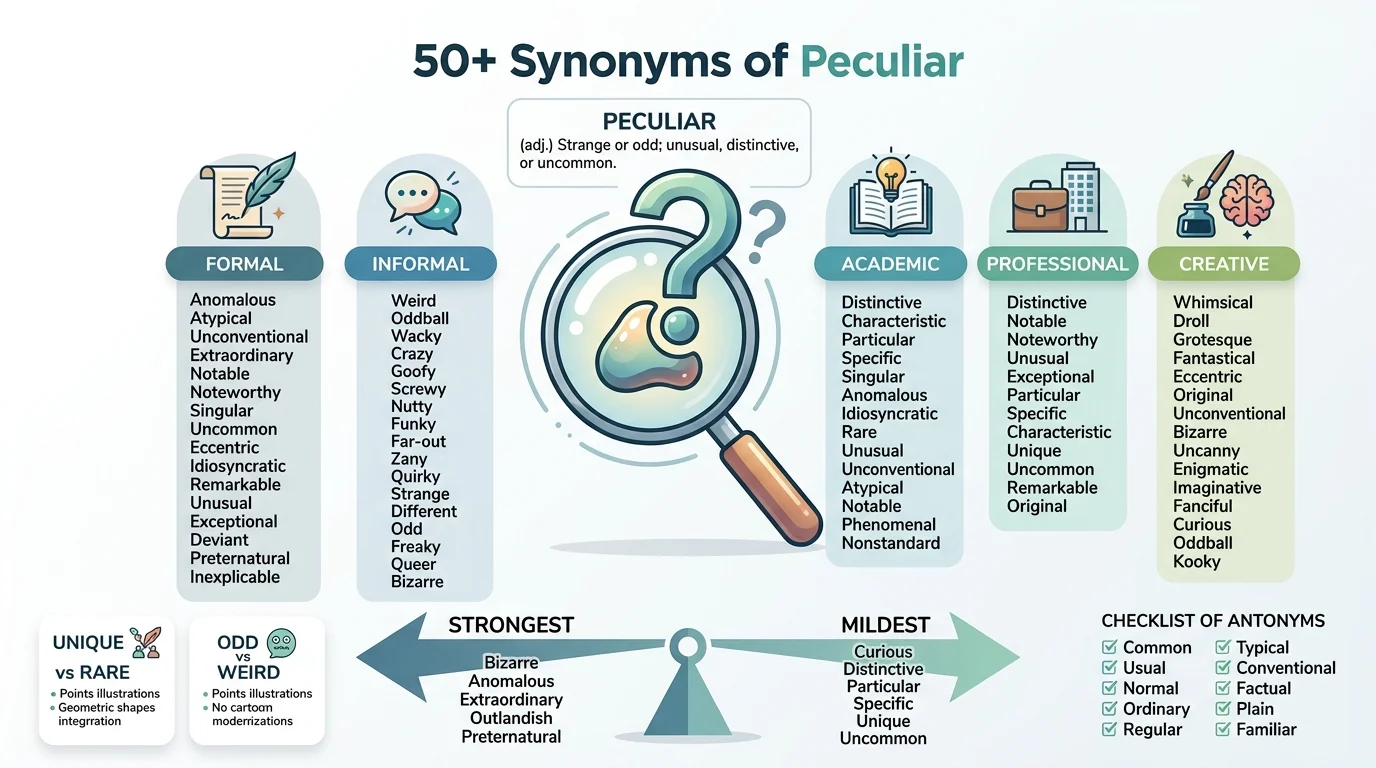
Have you ever needed to describe something that seems unusual or stands out from the ordinary but felt that “weird” or “strange” did not quite capture the nuance? You want to highlight distinctiveness or oddity, and the word “peculiar” comes to mind. But is it the best fit for your audience? Choosing the right synonym for “peculiar” can transform a simple observation into a precise description of uniqueness, strangeness, or distinctiveness. This guide explores the best synonyms of peculiar, explaining exactly which word to use and when.
Quick Ans: “Peculiar” means unusual, strange, or distinctive in a way that sets something apart. It is a neutral-to-positive adjective that can indicate oddity or uniqueness. For formal writing, choose singular or uncommon. For casual conversation, use odd or weird. In academic contexts, anomalous and exceptional are strong choices. For a stronger, more dramatic impact, select eccentric or quaint.
Meaning, Tone, and Context
Understanding the core meaning of “peculiar” is the first step to using it effectively.
Simple Definition: Different from the usual or normal. Strange, odd, or distinctive.
Part of Speech: Adjective.
Overall Tone: Neutral to slightly positive. It can mean “unusual” in a neutral way or “unique” in a complimentary way.
Formality Level: Neutral. The word works in most contexts, from casual to formal.
Common Uses: Native English speakers use it to describe things that are strange, unique, or characteristic. For example, “He has a peculiar sense of humor,” or “The peculiar smell in the kitchen made her curious.”
Word Forms: Related words include the noun peculiarity, the adverb peculiarly, and the noun peculiarness.
When and How to Use “Peculiar”
“Peculiar” is the perfect choice when you want to emphasize strangeness or distinctiveness. Here are seven realistic examples.
Professional: “The company has a peculiar approach to problem-solving that sets it apart.”
Academic: “The study examined peculiar behaviors observed in the isolated population.”
Workplace: “There is a peculiar dynamic between the two managers that everyone notices.”
Personal: “My grandmother always wore a peculiar hat that made her stand out.”
Email: “I noticed a peculiar pattern in the data that I think we should investigate.”
Resume: “Developed a peculiar yet effective method for streamlining workflow.”
Social Media: “The peculiar architecture of this building always catches my eye.”
Best Synonyms of “Peculiar”
No synonym is identical in every situation. Here is your guide to the best replacement for “peculiar” based on your writing context.
Professional Writing: Singular. It suggests something that stands alone as unique. “Her singular perspective on the market made her invaluable.”
Academic Writing: Anomalous. This is ideal when discussing data or behaviors that deviate from the norm. “The anomalous result required further investigation.”
Business Communication: Distinctive. A positive choice for describing what makes a product or brand unique. “The company has a distinctive brand identity.”
Casual Conversation: Odd. It tones down the formality and sounds natural. “That is an odd way to do it.”
Emotional Writing: Eccentric. This word carries a more personal, character-based weight. “Her eccentric personality charmed everyone.”
Creative Writing: Quaint. It suggests old-fashioned charm and distinctiveness. “The quaint little village was frozen in time.”
Resume Writing: Unique. Use it to highlight what makes you stand out. “I bring a unique combination of skills to the role.”
When Not to Use “Peculiar”
Using “peculiar” can sound wrong or awkward in certain situations.
When It Sounds Too Negative: “Peculiar” can sound negative if you mean “strange” in a bad way.
Better Choice: Unusual or odd. “His behavior was unusual, but not harmful.”
When You Mean Characteristic: “Peculiar” can mean “characteristic of” something.
Better Choice: Characteristic or typical. “This is characteristic of his work.”
When Describing Something Very Strange: “Peculiar” is mild. For extreme strangeness, choose a stronger word.
Better Choice: Bizarre or outlandish. “The bizarre event shocked everyone.”
When It Sounds Too Formal: In casual conversation, “peculiar” can sound a bit formal.
Better Choice: Weird or strange. “That is a weird way to do it.”
Words Commonly Confused With “Peculiar”
Several words are often mixed up with “peculiar.” Here is how to keep them straight.
Word: Odd
Difference: Means strange or unusual. “Peculiar” can be more neutral.
When to Use: Use it for things that seem out of place.
Example: “There is something odd about the whole situation.”
Word: Strange
Difference: Means unfamiliar or unusual. “Peculiar” is more about distinctiveness.
When to Use: Use this for things that are unfamiliar.
Example: “I had a strange feeling when I entered the room.”
Word: Weird
Difference: Means uncanny or eerie. “Peculiar” is less dramatic.
When to Use: Use this for things that are uncanny.
Example: “The weird noise kept me awake.”
Word: Unique
Difference: Means one of a kind. “Peculiar” is about strangeness.
When to Use: Use this for something that has no equal.
Example: “Her unique style sets her apart.”
Word: Eccentric
Difference: Means unconventional in behavior. “Peculiar” is broader.
When to Use: Use this for unusual personality traits.
Example: “The eccentric millionaire lived in a castle.”
Word: Quaint
Difference: Means attractively unusual or old-fashioned. “Peculiar” is neutral.
When to Use: Use this for charming old-fashioned things.
Example: “The quaint village attracted many tourists.”
Best Synonyms of “Peculiar” by Context
| Context | Best Synonym | Why It Works | Example |
|---|---|---|---|
| Formal writing | Singular | Suggests unique and exceptional. | “The singular achievement was recognized.” |
| Academic writing | Anomalous | Precise for statistical deviations. | “The anomalous data required further study.” |
| Professional communication | Distinctive | Emphasizes positive uniqueness. | “Our distinctive approach sets us apart.” |
| Business emails | Unusual | Professional yet accessible. | “I noticed an unusual trend in the data.” |
| Resume writing | Unique | The standard term for distinctiveness. | “I offer a unique combination of skills.” |
| Workplace communication | Odd | Neutral and widely understood. | “That is an odd way to solve the problem.” |
| Casual conversation | Weird | Simple, natural, and conversational. | “That is a weird thing to say.” |
| Creative writing | Quaint | Evokes old-fashioned charm. | “The quaint cottage was surrounded by flowers.” |
| Emotional writing | Eccentric | Suggests personal character. | “Her eccentric nature made her unforgettable.” |
| Strong emphasis | Outlandish | Suggests extreme strangeness. | “The outlandish claim was immediately rejected.” |
| Mild tone | Curious | Simple and non-judgmental. | “That is a curious observation.” |
| Social media captions | Strange | Widely understood and relatable. | “Strange but true. This actually happened.” |
How to Choose the Best Synonym of “Peculiar”
Choosing the right word is a simple decision. Answer these questions.
What is my audience? For a professor or CEO, singular or anomalous is powerful. For a friend, odd or weird is more natural.
What is my purpose? Are you trying to praise, inform, or warn? Use distinctive for praise, anomalous for information, and strange for caution.
Am I describing a person or a thing? For people, eccentric is good for character. For things, odd or quaint are better.
What is the emotional strength? Outlandish and bizarre are stronger. Unusual and curious are mild. Pick the one that matches your message.
Real Life Examples of “Peculiar”
To truly master the word, it helps to see how it behaves in the wild and how a stronger synonym can elevate the sentence.
School: Basic: “The student had a peculiar way of writing.” Improved: “The student had a singular way of writing that stood out.”
College: Basic: “The results showed a peculiar pattern.” Improved: “The results showed an anomalous pattern that required further study.”
Workplace: Basic: “His peculiar approach worked.” Improved: “His distinctive approach worked and inspired others.”
Business: Basic: “Their peculiar branding made them memorable.” Improved: “Their unique branding made them memorable.”
Email: Basic: “I noticed a peculiar detail in the report.” Improved: “I noticed a curious detail in the report.”
Conversation: Basic: “That is a peculiar thing to do.” Improved: “That is a weird thing to do.”
Storytelling: Basic: “The old house had a peculiar charm.” Improved: “The old house had a quaint charm that captivated visitors.”
Top 10 Synonyms of “Peculiar”
| Synonym | Simple Meaning | Best Used For | Example Sentence |
|---|---|---|---|
| Singular | Exceptionally unique and remarkable | Formal, academic, and praise contexts. | “Her singular achievement was unprecedented.” |
| Anomalous | Deviating from the normal pattern | Scientific, statistical, and academic contexts. | “The anomalous finding puzzled the team.” |
| Distinctive | Having a special character that stands out | Branding, professional, and positive contexts. | “The product has a distinctive design.” |
| Eccentric | Unconventional in behavior or appearance | Personality, character, and lifestyle contexts. | “The eccentric artist was known worldwide.” |
| Quaint | Attractively unusual or old-fashioned | Travel, architecture, and charming contexts. | “The quaint village was full of history.” |
| Odd | Strange or unusual | Casual conversation and everyday references. | “That is an odd thing to say.” |
| Weird | Unsettling or uncanny | Casual conversation and dramatic contexts. | “The weird sound came from the attic.” |
| Unusual | Not common or frequent | Neutral, factual, and general contexts. | “The unusual weather continued all week.” |
| Curious | Strange in a way that sparks interest | Mild, observation, and academic contexts. | “The curious object caught my attention.” |
| Outlandish | Very strange or unconventional | Strong, dramatic, and emphatic contexts. | “The outlandish idea was met with skepticism.” |
Synonyms of “Peculiar” by Usage
Professional vs. Personal Synonyms
In the workplace (professional), choose distinctive, unique, or singular to describe what sets something apart. These words convey positive uniqueness. “Our distinctive culture makes us stand out” is more professional than “Our weird culture makes us stand out.”
With friends (personal), odd, weird, or strange keep the tone relaxed and relatable. These alternatives sound natural in everyday conversation.
Formal vs. Conversational Synonyms
For formal writing (reports, essays, professional emails), use singular, anomalous, or distinctive. These choices maintain the sophisticated tone expected in professional documents.
For casual conversations and texting, use weird, odd, or strange. These options sound more natural and less pretentious.
Academic Synonyms
For research and essays, choose precise, authoritative words. Anomalous is great for statistical deviations, singular for exceptional cases, and unusual for general observations. These words sound considered and scholarly.
Using precise academic vocabulary demonstrates expertise and careful thinking. Professors and reviewers expect this level of precision.
Professional and Business Synonyms
For maximum impact in professional writing, choose distinctive for branding, unique for skills, and singular for achievements. These words demonstrate confidence and professional awareness.
Business leaders respond to language that conveys clarity and distinctiveness. These synonyms project authority.
Creative and Literary Synonyms
To add emotion and imagery to your writing, choose quaint, eccentric, or outlandish. These words create atmosphere and develop character.
Literary writers use these alternatives to build setting and personality. They transform ordinary descriptions into evocative prose.
Slang or Modern Synonyms
In modern American slang, off, out there, or quirky are sometimes used as informal alternatives. For example, “That is a bit out there,” or “She is a quirky person.” These are acceptable in casual, friendly contexts. Avoid them in professional or academic writing.
Strongest to Mildest Synonyms
Mild: curious, unusual, odd
Moderate: strange, peculiar, distinctive
Strong: eccentric, singular, anomalous
Very Strong: outlandish, bizarre, freakish
Emotional vs. Neutral Synonyms
Emotional Synonyms: Eccentric, outlandish, quaint. These words often hint at charm, admiration, or shock. Use them when you want to evoke feeling.
Neutral Synonyms: Unusual, odd, curious. These words simply communicate factual information. Use them when you want to inform without emotional coloring.
Antonyms of “Peculiar”
Here are 15 genuine opposites of “peculiar.”
| Antonym | Meaning | Example Sentence |
|---|---|---|
| Ordinary | Normal, not special | “The ordinary day passed without incident.” |
| Common | Occurring frequently | “The common problem affected many people.” |
| Normal | Conforming to the standard | “His normal routine was disrupted.” |
| Typical | Representing the usual case | “The typical result was expected.” |
| Average | Middle of the range | “The average performance was acceptable.” |
| Standard | The usual or expected | “The standard procedure was followed.” |
| Usual | What happens most often | “Her usual behavior was predictable.” |
| Commonplace | Ordinary and not unusual | “The commonplace event went unnoticed.” |
| Regular | Happening at set times | “His regular attendance was noted.” |
| Unremarkable | Not notable or special | “The unremarkable building was demolished.” |
| Familiar | Well known and recognized | “The familiar face brought comfort.” |
| Conventional | Following accepted standards | “The conventional approach was safe.” |
| Traditional | Handed down through customs | “The traditional method was effective.” |
| Natural | Expected and understandable | “Her natural response was kind.” |
| Everyday | Common and usual | “The everyday task was completed.” |
Comparison: “Peculiar” vs Similar Words
Peculiar vs. Odd
Main Difference: Peculiar can mean distinctive. Odd always means strange.
Which Is Stronger? Odd is often stronger for strangeness.
Which Is More Formal? Peculiar is more formal. Odd is neutral.
When to Use Each: Use peculiar for distinctiveness. Use odd for strangeness.
Examples:
Peculiar: “She has a peculiar way of speaking.”
Odd: “He had an odd look on his face.”
Peculiar vs. Strange
Main Difference: Strange means unfamiliar. Peculiar can mean distinctive.
Which Is Stronger? Strange is stronger for unfamiliarity.
Which Is More Formal? Both are neutral, but peculiar is slightly more formal.
When to Use Each: Use strange for things that feel alien. Use peculiar for things that are distinctive.
Examples:
Peculiar: “This is a peculiar custom.”
Strange: “I had a strange dream last night.”
Peculiar vs. Weird
Main Difference: Weird implies uncanny or eerie. Peculiar is more neutral.
Which Is Stronger? Weird is stronger and more dramatic.
Which Is More Formal? Peculiar is formal. Weird is casual.
When to Use Each: Use weird in casual conversation. Use peculiar in formal writing.
Examples:
Peculiar: “The peculiar smell came from the kitchen.”
Weird: “The weird noise made me nervous.”
Peculiar vs. Unique
Main Difference: Unique means one of a kind. Peculiar means unusual.
Which Is Stronger? Unique is stronger and more absolute.
Which Is More Formal? Both are formal, but unique has a more positive tone.
When to Use Each: Use unique for things with no equal. Use peculiar for things that are simply unusual.
Examples:
Peculiar: “He has a peculiar habit.”
Unique: “She has a unique perspective.”
Peculiar vs. Eccentric
Main Difference: Eccentric is for people. Peculiar can be for things.
Which Is Stronger? Eccentric is stronger for character descriptions.
Which Is More Formal? Both are formal.
When to Use Each: Use eccentric for unusual people. Use peculiar for unusual things or behaviors.
Examples:
Peculiar: “The peculiar pattern caught my eye.”
Eccentric: “The eccentric professor fascinated his students.”
Peculiar vs. Quaint
Main Difference: Quaint implies charm. Peculiar is neutral.
Which Is Stronger? Quaint has a positive emotional tone.
Which Is More Formal? Both are formal, but quaint is more literary.
When to Use Each: Use quaint for old-fashioned charm. Use peculiar for general strangeness.
Examples:
Peculiar: “The peculiar village was abandoned.”
Quaint: “The quaint village attracted tourists.”
Common Phrases and Expressions with “Peculiar”
Phrase: Peculiar to
Meaning: Characteristic or exclusive to something.
Example Sentence: “This custom is peculiar to the region.”
Phrase: Peculiar way
Meaning: An unusual or distinctive method.
Example Sentence: “He has a peculiar way of telling stories.”
Phrase: Peculiar sense of humor
Meaning: An unusual or specific kind of humor.
Example Sentence: “She has a peculiar sense of humor that not everyone appreciates.”
Phrase: Peculiar circumstances
Meaning: Unusual or specific conditions.
Example Sentence: “Due to peculiar circumstances, we had to cancel.”
Phrase: Peculiar smell
Meaning: An unusual or distinctive odor.
Example Sentence: “A peculiar smell filled the room.”
Common Mistakes to Avoid
Mistake 1: Using “peculiar” when you mean “characteristic”.
Incorrect: “This is peculiar to his work.”
Better: “This is characteristic of his work.”
Why: Peculiar means unusual. Characteristic means typical.
Mistake 2: Using “peculiar” for very strange things.
Incorrect: “The peculiar monster scared everyone.”
Better: “The bizarre monster scared everyone.”
Why: Peculiar is mild. Bizarre is stronger.
Mistake 3: Overusing “peculiar” in casual conversation.
Incorrect: “That is a peculiar thing to do.”
Better: “That is a weird thing to do.”
Why: Weird sounds more natural in casual conversation.
Mistake 4: Using “peculiar” in a negative way.
Incorrect: “His peculiar behavior was offensive.”
Better: “His odd behavior was offensive.”
Why: Odd is more negative. Peculiar is neutral.
Mistake 5: Confusing “singular” with “peculiar”.
Incorrect: “She has a singular way of eating.”
Better: “She has a peculiar way of eating.”
Why: Singular implies exceptional and admirable. Peculiar means unusual.
Frequently Asked Questions
1. What are the best synonyms of “peculiar”?
The best synonyms depend on your context. For formal writing, choose singular or distinctive. And for casual conversation, odd or weird are ideal choices. For character descriptions, use eccentric.
2. What are the best formal synonyms of “peculiar”?
The best formal synonyms are singular, anomalous, and distinctive. These words are suitable for academic papers, professional reports, and business communications.
3. What are common informal synonyms of “peculiar”?
For informal settings, use odd, weird, or strange. These alternatives sound more natural in everyday conversation.
4. What is another word for “peculiar” in professional writing?
In professional writing, distinctive is an excellent choice. It conveys positive uniqueness and sets something apart from competitors.
5. What is the difference between “peculiar” and “eccentric”?
While both indicate unusualness, peculiar can apply to things or people. Eccentric specifically applies to people and their behavior. Use eccentric for character descriptions.
6. What is the opposite of “peculiar”?
The most direct opposites (antonyms) of peculiar are ordinary, common, and normal. These words describe things that are not unusual.
Conclusion
“Peculiar” is a versatile and nuanced word for describing uniqueness and strangeness. The term is neutral and widely accepted in most contexts, yet it can sound too mild for extreme strangeness or too formal for casual conversation. The best choice among the synonyms of peculiar depends entirely on your audience, tone, and purpose. Remember, no single synonym works perfectly in every situation. Your goal is to choose the word that communicates your message with the most clarity and impact. A practical tip for your vocabulary growth is to notice how writers describe unusual things and practice using different synonyms in your writing.
Discover More:
- 50+ Synonyms of Punctual: Meanings, Uses, Examples, and Best Alternatives 2026
- 50+ Synonyms of Ubiquitous: Meanings, Uses, Examples, and Best Alternatives

Amelia Brooks is a professional content writer and digital publishing specialist with a passion for creating clear, engaging, and informative content. She has extensive experience writing about technology, business, lifestyle, and online services.