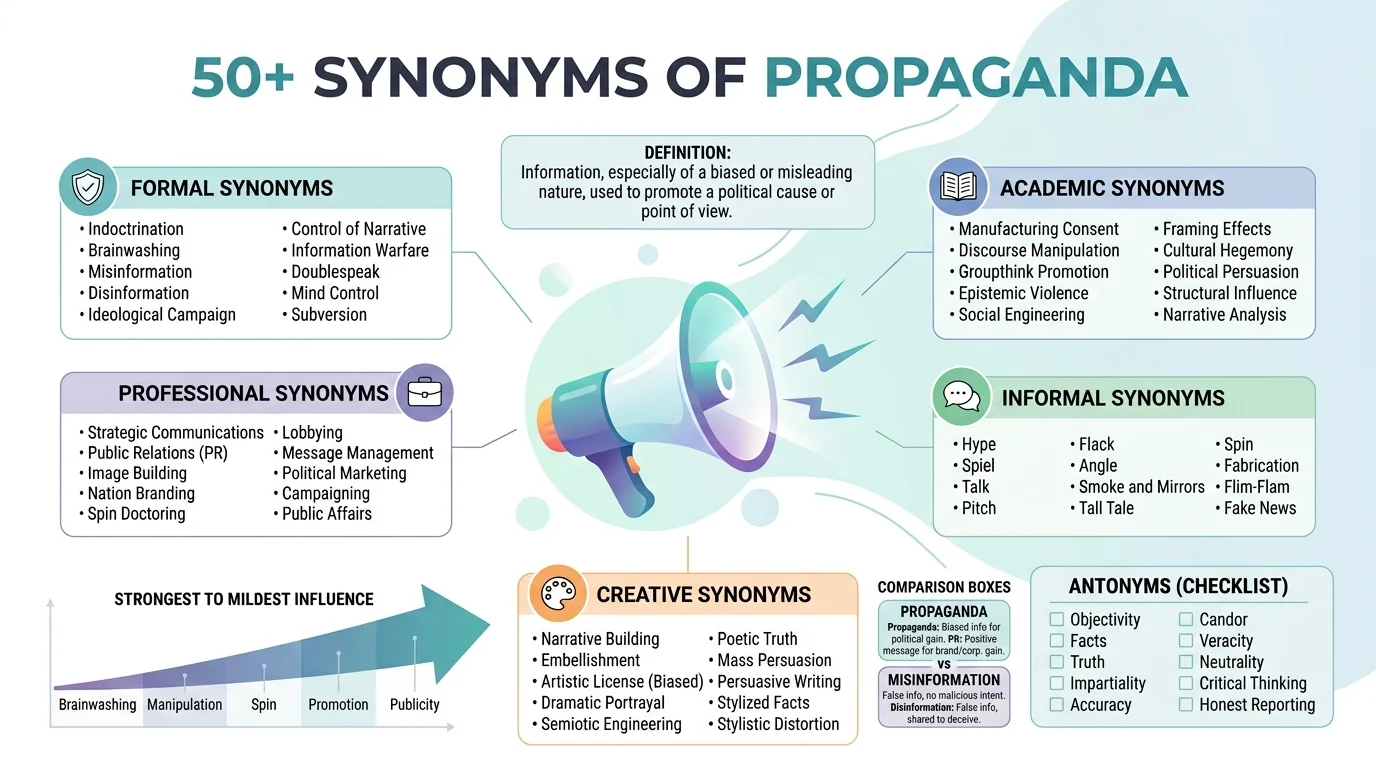
Have you ever needed to describe information that is deliberately spread to influence opinions but felt that “marketing” or “advertising” did not fully capture the manipulative intent? You want to highlight bias, persuasion, or misleading communication, and the word “propaganda” comes to mind. But is it the best fit for your audience? Choosing the right synonym for “propaganda” can transform a simple label into a precise characterization of persuasion, manipulation, or influence. This guide explores the best synonyms of propaganda, explaining exactly which word to use and when.
Quick Ans: “Propaganda” means information, often biased or misleading, that is spread to promote a political cause, point of view, or agenda . It is a negative-to-neutral noun. For formal writing, choose disinformation or brainwashing. For casual conversation, use spin or hype. In academic contexts, indoctrination and agitprop are strong choices. For a stronger, more dramatic impact, select newspeak or big lie.
Meaning, Tone, and Context
Understanding the core meaning of “propaganda” is the first step to using it effectively.
Simple Definition: Information, ideas, or rumors deliberately spread widely to help or harm a person, group, movement, or nation . The information may be true or false but is always carefully selected for political effect .
Part of Speech: Noun.
Overall Tone: Neutral to negative. The word often carries a negative connotation, especially for political manipulation . In some cultures, it can be neutral or even positive .
Formality Level: Formal. The word is appropriate in political, academic, and professional contexts.
Common Uses: Native English speakers use it to describe political campaigns, wartime communication, and institutional persuasion. For example, “The government was accused of spreading propaganda,” or “The propaganda machine was relentless.”
Word Forms: Related words include the noun propagandist, the noun propagandism, the verb propagandize, and the adjective propagandistic .
When and How to Use “Propaganda”
“Propaganda” is the perfect choice when you want to emphasize deliberate influence and persuasion. Here are seven realistic examples.
Political: “The election campaign was filled with propaganda from both sides.”
Historical: “Nazi propaganda was instrumental in promoting their ideology.”
Workplace: “The internal memo was dismissed as corporate propaganda.”
Academic: “The study examined the role of propaganda in shaping public opinion.”
Media: “The news outlet was accused of spreading propaganda disguised as journalism.”
Social: “Social media has become a powerful tool for propaganda dissemination.”
Everyday: “The advertisement was pure propaganda for the new product.”
Best Synonyms of “Propaganda”
No synonym is identical in every situation. Here is your guide to the best replacement for “propaganda” based on your writing context.
Political Writing: Disinformation. It suggests deliberately false information spread to deceive . “The disinformation campaign was exposed by journalists.”
Academic Writing: Indoctrination. This is ideal when discussing the systematic teaching of beliefs. “The regime used indoctrination to control the population” .
Media Criticism: Spin. It suggests biased interpretation of events. “The spin doctor tried to frame the story favorably.”
Casual Conversation: Hype. It tones down the formality for promotions. “The hype around the product was exaggerated” .
Marketing Context: Advertising. A neutral term for promoting products . “The advertising campaign was effective.”
Political Persuasion: Agitprop. A specific term for political propaganda, especially communist . “The agitprop literature was widely distributed.”
Professional Writing: Publicity. A neutral term for gaining public attention . “The publicity generated a lot of interest.”
When Not to Use “Propaganda”
Using “propaganda” can sound wrong or biased in certain situations.
When You Mean Neutral Information: “Propaganda” implies manipulation. “Information” is neutral.
Better Choice: Information or communication. “The information was distributed to all employees.”
When You Mean Education: “Propaganda” implies bias. “Education” implies learning.
Better Choice: Education or teaching. “The education program was designed to inform.”
When It Sounds Too Accusatory: “Propaganda” can be offensive.
Better Choice: Persuasion or promotion. “The persuasion campaign was effective.”
When You Mean Simple Advertising: “Propaganda” is too strong for commercial promotion.
Better Choice: Advertising or marketing. “The advertising campaign boosted sales.”
Words Commonly Confused With “Propaganda”
Several words are often mixed up with “propaganda.” Here is how to keep them straight.
Word: Disinformation
Difference: Means deliberately false information. “Propaganda” can include true information.
When to Use: Use it when you know the information is false.
Example: “The disinformation was spread to confuse voters.”
Word: Misinformation
Difference: Means false information that may not be deliberate. “Propaganda” is deliberate.
When to Use: Use this for accidental falsehoods.
Example: “The misinformation spread quickly on social media.”
Word: Indoctrination
Difference: Means teaching beliefs systematically. “Propaganda” is broader.
When to Use: Use this for educational systems and regimes .
Example: “The school’s indoctrination program was criticized.”
Word: Hype
Difference: Means exaggerated promotion. “Propaganda” is more political.
When to Use: Use this for product launches and entertainment .
Example: “The hype around the movie was intense.”
Word: Spin
Difference: Means biased interpretation. “Propaganda” is broader.
When to Use: Use this for media and political messaging .
Word: Agitprop
Difference: Means political propaganda, especially communist . “Propaganda” is general.
When to Use: Use this for radical political messaging.
Best Synonyms of “Propaganda” by Context
| Context | Best Synonym | Why It Works | Example |
|---|---|---|---|
| Political writing | Disinformation | Suggests deliberate lies. | “The disinformation campaign was exposed.” |
| Academic writing | Indoctrination | Precise for systematic belief teaching. | “The indoctrination was pervasive.” |
| Media criticism | Spin | Emphasizes biased framing. | “The spin distorted the truth” . |
| Casual conversation | Hype | Simple and conversational. | “The hype was overblown” . |
| Marketing context | Advertising | Neutral for commercial promotion . | “The advertising was effective.” |
| Professional writing | Publicity | Neutral for gaining attention . | “The publicity generated interest.” |
| Historical context | Agitprop | Specific for communist propaganda . | “The agitprop was widespread.” |
| Creative writing | Brainwashing | Suggests severe manipulation. | “The brainwashing was relentless.” |
| Strong emphasis | Big Lie | Suggests a major falsehood. | “The big lie was repeated often.” |
How to Choose the Best Synonym of “Propaganda”
Choosing the right word is a simple decision. Answer these questions.
What is my audience? For a professor, indoctrination or disinformation is powerful. For a friend, hype or spin is more natural .
What is my purpose? Are you trying to accuse, inform, or describe? Use disinformation for accusation, information for neutrality, and advertising for description.
Am I describing politics, marketing, or media? For politics, propaganda or agitprop work . And for marketing, advertising or publicity are better . For media, spin or disinformation are best.
What is the emotional strength? Brainwashing and big lie are stronger. Publicity and information are mild. Pick the one that matches your message.
Real Life Examples of “Propaganda”
To truly master the word, it helps to see how it behaves in the wild and how a stronger synonym can elevate the sentence.
School: Basic: “The teacher discussed propaganda.” Improved: “The teacher discussed political indoctrination in the classroom.”
College: Basic: “The regime used propaganda.” Improved: “The regime used disinformation to control public opinion.”
Workplace: Basic: “The memo was propaganda.” Improved: “The memo was corporate spin designed to calm employees.”
Political: Basic: “The campaign used propaganda.” Improved: “The campaign used agitprop to mobilize supporters” .
Media: Basic: “The news was propaganda.” Improved: “The news was disinformation spread to influence voters.”
Conversation: Basic: “That is just propaganda.” Improved: “That is just hype to sell the product” .
Storytelling: Basic: “The propaganda was effective.” Improved: “The brainwashing was so effective that everyone believed the lies.”
Top 10 Synonyms of “Propaganda”
| Synonym | Simple Meaning | Best Used For | Example Sentence |
|---|---|---|---|
| Disinformation | Deliberately false information | Political, media, and critical contexts . | “The disinformation campaign was exposed.” |
| Indoctrination | Systematic teaching of beliefs | Academic, educational, and regime contexts . | “The indoctrination was relentless.” |
| Spin | Biased interpretation of events | Media, political, and public relations contexts . | “The spin was designed to mislead.” |
| Hype | Exaggerated promotion | Casual, marketing, and entertainment contexts . | “The hype was overblown.” |
| Agitprop | Political propaganda, especially communist | Historical, political, and radical contexts . | “The agitprop was widespread.” |
| Brainwashing | Severe psychological manipulation | Creative, dramatic, and extreme contexts. | “The brainwashing was terrifying.” |
| Publicity | Information to gain public attention | Professional, marketing, and neutral contexts . | “The publicity was effective.” |
| Advertising | Commercial promotion | Marketing, business, and neutral contexts . | “The advertising boosted sales.” |
| Promotion | Active support or advancement | Professional, marketing, and neutral contexts . | “The promotion was successful.” |
| Newspeak | Manipulative language used for propaganda | Literary, Orwellian, and critical contexts. | “The newspeak was designed to control thought.” |
Synonyms of “Propaganda” by Usage
Professional vs. Personal Synonyms
In the workplace (professional), choose publicity, promotion, or information to describe communications. These words convey neutrality and professionalism. “The publicity campaign was effective” is more neutral than “The propaganda campaign was effective.”
With friends (personal), hype, spin, or buzz keep the tone relaxed and relatable . These alternatives sound natural in everyday conversation.
Formal vs. Conversational Synonyms
For formal writing (reports, essays, professional documents), use disinformation, indoctrination, or agitprop . These choices maintain the sophisticated tone expected in professional documents.
For casual conversations and texting, use hype, spin, or propaganda. These options sound more natural and less pretentious .
Academic Synonyms
For research and essays, choose precise, authoritative words. Indoctrination is great for systematic belief teaching , disinformation for deliberate falsehoods, and agitprop for historical political messaging . These words sound considered and scholarly.
Using precise academic vocabulary demonstrates expertise and careful thinking. Professors and reviewers expect this level of precision.
Professional and Business Synonyms
For maximum impact in business writing, choose publicity for generating interest, promotion for advancing products, and advertising for commercial messaging. These words demonstrate professionalism and neutrality .
Business leaders respond to language that conveys clarity and precision. These synonyms project authority.
Creative and Literary Synonyms
To add emotion and imagery to your writing, choose brainwashing, newspeak, or big lie. These words create atmosphere and evoke dramatic tension.
Literary writers use these alternatives to build dystopian or political narratives. They transform ordinary descriptions into evocative prose.
Slang or Modern Synonyms
In modern American slang, hype, buzz, or spin are sometimes used for exaggerated promotion or biased information . For example, “The hype was unreal,” or “They put a spin on the story.” These are acceptable in casual, friendly contexts. Avoid them in professional or academic writing.
Strongest to Mildest Synonyms
Mild: information, communication, promotion
Moderate: advertising, publicity, hype
Strong: spin, disinformation, agitprop
Very Strong: brainwashing, indoctrination, big lie
Emotional vs. Neutral Synonyms
Emotional Synonyms: Brainwashing, big lie, agitprop. These words often hint at manipulation, oppression, or outrage. Use them when you want to evoke strong feeling.
Neutral Synonyms: Information, publicity, advertising. These words simply communicate factual information. Use them when you want to inform without emotional coloring .
Antonyms of “Propaganda”
Here are 15 genuine opposites of “propaganda.”
| Antonym | Meaning | Example Sentence |
|---|---|---|
| Truth | The state of being true | “The truth was finally revealed.” |
| Fact | A thing known to be true | “The facts spoke for themselves.” |
| Evidence | Information proving something | “The evidence was compelling.” |
| Information | Knowledge communicated | “The information was accurate.” |
| Education | The process of learning | “The education program was effective.” |
| Objectivity | Lack of bias | “The objectivity of the report was praised.” |
| Honesty | The quality of being truthful | “The honesty of the witness was clear.” |
| Transparency | Openness and clarity | “The transparency of the process was appreciated.” |
| Reality | The state of things as they exist | “The reality was different from the spin.” |
| Accuracy | The quality of being correct | “The accuracy of the data was confirmed.” |
| Impartiality | Lack of favoritism | “The impartiality of the judge was respected.” |
| Authenticity | The quality of being genuine | “The authenticity of the document was verified.” |
| Veracity | Truthfulness | “The veracity of the statement was questioned.” |
| Neutrality | Not taking sides | “The neutrality of the news outlet was questioned.” |
| Unbiased | Not prejudiced | “The unbiased report was trusted.” |
Comparison: “Propaganda” vs Similar Words
Propaganda vs. Disinformation
Main Difference: Propaganda can be true or false. Disinformation is deliberately false .
Which Is Stronger? Disinformation is stronger for accusing deception.
Which Is More Formal? Both are formal.
When to Use Each: Use propaganda for broad persuasion. Use disinformation for deliberate lies.
Examples:
Propaganda: “The propaganda campaign was effective.”
Disinformation: “The disinformation was exposed by journalists” .
Propaganda vs. Indoctrination
Main Difference: Propaganda is broader. Indoctrination is systematic teaching of beliefs .
Which Is Stronger? Indoctrination is stronger for educational manipulation.
Which Is More Formal? Both are formal.
When to Use Each: Use propaganda for general persuasion. Use indoctrination for systematic belief teaching.
Examples:
Propaganda: “The propaganda was spread through media.”
Indoctrination: “The indoctrination began in childhood” .
Propaganda vs. Spin
Main Difference: Propaganda is broad. Spin is specifically biased interpretation .
Which Is Stronger? They are different. Spin is more specific about framing.
Which Is More Formal? Propaganda is more formal. Spin is casual.
When to Use Each: Use propaganda for broad persuasion. Use spin for media framing.
Examples:
Propaganda: “The propaganda machine was relentless.”
Propaganda vs. Hype
Main Difference: Propaganda is political. Hype is commercial .
Which Is Stronger? Propaganda is stronger and more serious.
Which Is More Formal? Propaganda is formal. Hype is casual .
When to Use Each: Use propaganda for political persuasion. Use hype for commercial promotion.
Examples:
Propaganda: “The political propaganda was relentless.”
Hype: “The hype around the product was intense” .
Propaganda vs. Agitprop
Main Difference: Propaganda is general. Agitprop is specifically political, especially communist .
Which Is Stronger? They are similar. Agitprop is more specific.
Which Is More Formal? Both are formal.
When to Use Each: Use propaganda for general persuasion. Use agitprop for radical political messaging.
Examples:
Propaganda: “The propaganda was widespread.”
Agitprop: “The agitprop posters were distributed at the rally” .
Propaganda vs. Advertising
Main Difference: Propaganda is political. Advertising is commercial .
Which Is Stronger? Propaganda is stronger and more manipulative.
Which Is More Formal? Both are formal, but advertising is neutral.
When to Use Each: Use propaganda for political persuasion. Use advertising for commercial promotion.
Examples:
Propaganda: “The propaganda campaign was designed to influence voters.”
Advertising: “The advertising campaign boosted sales” .
Common Phrases and Expressions with “Propaganda”
Phrase: Propaganda machine
Meaning: A system for spreading propaganda.
Example Sentence: “The propaganda machine was relentless.”
Phrase: Propaganda campaign
Meaning: A coordinated effort to spread propaganda.
Example Sentence: “The propaganda campaign got expose’
Phrase: Political propaganda
Meaning: Propaganda related to politics.
Example Sentence: “The political propaganda was divisive.”
Phrase: Propaganda war
Meaning: A conflict waged through propaganda.
Example Sentence: “The propaganda war escalated between the two countries.”
Phrase: Enemy propaganda
Meaning: Propaganda from an adversary.
Example Sentence: “The enemy propaganda was design to demoralize the troops.”
Phrase: Propaganda value
Meaning: The value of information for propaganda.
Example Sentence: “The story had significant propaganda value.”
Common Mistakes to Avoid
Mistake 1: Using “propaganda” when you mean “information”.
Incorrect: “The company sent propaganda to employees.”
Better: “The company sent information to employees.”
Why: Propaganda implies manipulation. Information is neutral.
Mistake 2: Using “propaganda” when you mean “advertising”.
Incorrect: “The propaganda for the product was effective.”
Better: “The advertising for the product was effective” .
Why: Advertising is commercial. Propaganda is political.
Mistake 3: Using “propaganda” when you mean “education”.
Incorrect: “The school’s propaganda program was effective.”
Better: “The school’s education program was effective.”
Why: Education is neutral. Propaganda is manipulative.
Mistake 4: Overusing “propaganda” in casual conversation.
Incorrect: “The commercial was just propaganda.”
Better: “The commercial was just hype” .
Why: Hype sounds more natural in casual conversation.
Mistake 5: Using “propaganda” when you mean “spin”.
Incorrect: “The propaganda got design to frame the story.”
Better: “The spin was designed to frame the story” .
Why: Spin is specifically about framing. Propaganda is broader.
Frequently Asked Questions
1. What are the best synonyms of “propaganda”?
The best synonyms depend on your context. For formal writing, choose disinformation or indoctrination. And for casual conversation, hype or spin are ideal choices . For specific political contexts, use agitprop .
2. What are the best formal synonyms of “propaganda”?
The best formal synonyms are disinformation, indoctrination, and agitprop . These words are suitable for academic papers, professional reports, and political analysis.
3. What are common informal synonyms of “propaganda”?
For informal settings, use hype, spin, or buzz . These alternatives sound more natural in everyday conversation.
4. What is another word for “propaganda” in professional writing?
In professional writing, publicity is an excellent choice. It conveys the act of gaining public attention without the negative connotation of propaganda . Promotion is also strong.
5. What is the difference between “propaganda” and “disinformation”?
While both are used for persuasion, propaganda can be true or false . Disinformation is deliberately false . Use disinformation when you are certain the information is lies.
6. What is the opposite of “propaganda”?
The most direct opposites (antonyms) of propaganda are truth, fact, and information. These words describe unbiased, accurate communication.
Conclusion
“Propaganda” is a powerful and nuanced word for describing deliberate persuasion and manipulation. The term is formal and widely accepted in political, historical, and academic contexts, yet it carries a strong negative connotation that requires careful use. The best choice among the synonyms of propaganda depends entirely on your audience, tone, and purpose. Remember, no single synonym works perfectly in every situation. Your goal is to choose the word that communicates your message with the most clarity and impact. A practical tip for your vocabulary growth is to pay attention to how media critics and historians use these terms and practice using different synonyms in your writing.
Discover More:
- 50+ Synonyms of Algorithm: Meanings, Uses, Examples, and Best Alternatives 2026
- 50+ Synonyms of Check: Meanings, Uses, Examples, and Best Alternatives 2026

Ella Parker is a professional content writer with a passion for creating clear, engaging, and well-researched articles. She focuses on delivering valuable insights and practical information across business, technology, and lifestyle topics.
1 thought on “50+ Synonyms of Propaganda: Meanings, Uses, Examples, and Best Alternatives 2026”