Have you ever found yourself explaining what a synonym is but realized you needed another word for “synonym” itself? You want to talk about words with similar meanings, and the word “synonym” comes to mind. But is it the best fit for every situation? Choosing the right term for “synonym” can transform a basic explanation into a precise discussion of language relationships. This guide explores the best synonyms of synonym, explaining exactly which word to use and when.
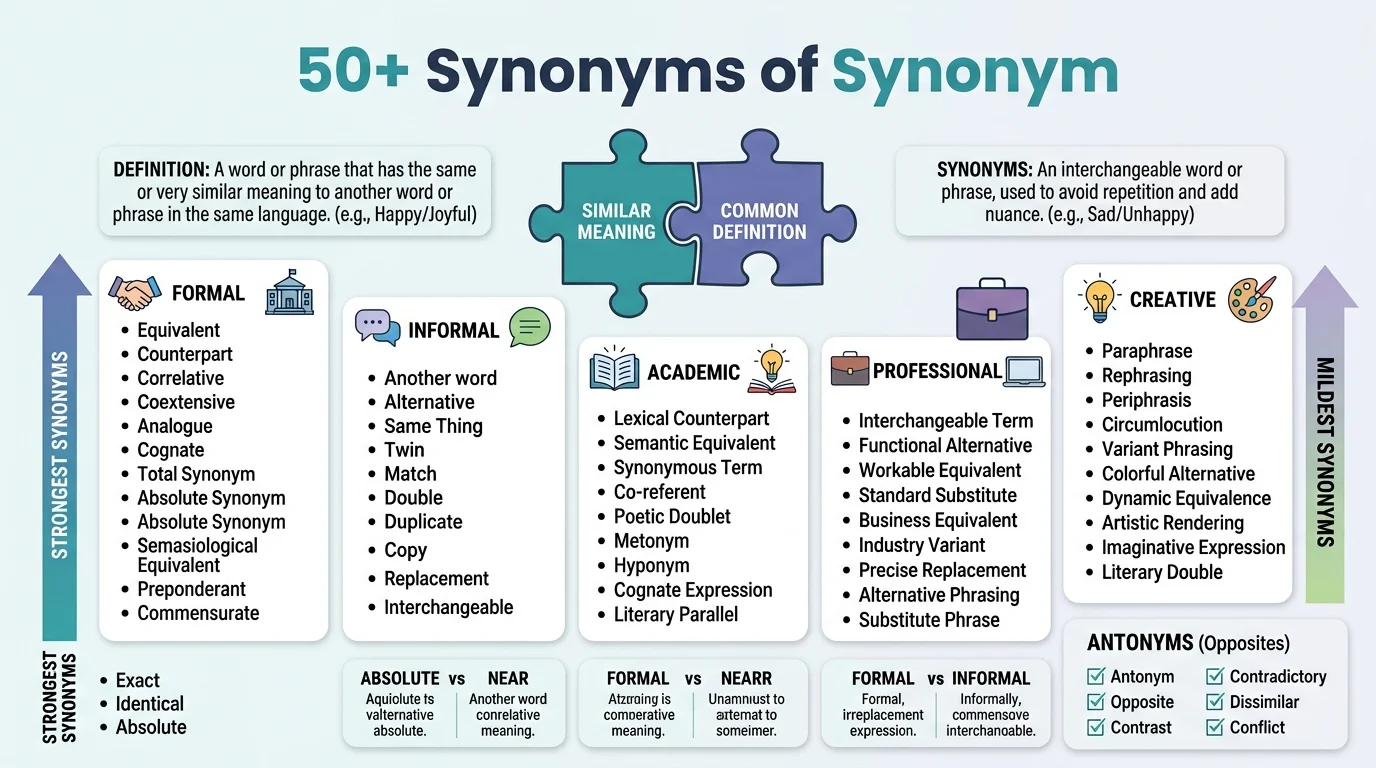
Quick Ans: A “synonym” is a word or phrase that has the same or nearly the same meaning as another word in the same language. It is a neutral, linguistic noun. For formal contexts, choose equivalent or cognate. For casual conversation, use similar word or alternative. In academic writing, analogue and parallel are strong choices. For a more technical term, select metonym.
Meaning, Tone, and Context
Understanding the core meaning of “synonym” is the first step to using it effectively.
Simple Definition: A word or phrase that means the same as another word in the same language.
Part of Speech: Noun.
Overall Tone: Neutral and educational. It is a standard term in linguistics, writing, and vocabulary studies.
Formality Level: Neutral. The word works in most contexts, from casual to formal.
Common Uses: Native English speakers use it constantly in writing, education, and language learning. For example, “Happy” is a synonym of “joyful,” or “Can you find a synonym for this word?”
Word Forms: Related words include the adjective synonymous, the verb synonymize, and the noun synonymy.
When and How to Use “Synonym”
“Synonym” is the perfect choice when you want to discuss words with similar meanings. Here are seven realistic examples.
Educational: “The teacher asked the students to find a synonym for the word ‘big’.”
Academic: “The study examined how synonyms are processed in the human brain.”
Writing: “Using synonyms can improve the richness of your writing and prevent repetition.”
Conversation: “What is a synonym for ‘excellent’? I need a better word.”
Professional: “The document should use precise synonyms to avoid ambiguity in the contract.”
Social Media: “Can anyone suggest a synonym for ‘awesome’? I am tired of using it.”
Resume: “Avoid overused synonyms on your resume to maintain professionalism.”
Best Synonyms of “Synonym”
No synonym of “synonym” is identical in every situation. Here is your guide to the best replacement based on your writing context.
Formal Writing: Equivalent. It suggests equal value or meaning. “The word ‘big’ is the equivalent of ‘large’ in many contexts.”
Academic Writing: Cognate. This is ideal when discussing words with common origins. “In linguistics, ‘mother’ and ‘mater’ are cognates.”
Casual Conversation: Similar word. It tones down the formality. “Can you think of a similar word for ‘good’?”
Professional Writing: Alternative. A practical choice for substitutions. “You can use an alternative word to avoid repetition.”
Creative Writing: Analogue. It suggests a parallel in meaning. “The word ‘anger’ has an analogue in many languages.”
Technical Context: Metonym. Use it when a word is substituted for something related to it. “The crown is a metonym for the monarchy.”
Resume Writing: Alternative. Use it to describe different skill descriptions. “Use alternative phrasing to keep your resume engaging.”
When Not to Use “Synonym”
Using “synonym” can sound out of place in certain situations.
When You Mean “Antonym”: “Synonym” is the opposite of antonym. Use antonym for opposite meanings.
Better Choice: Antonym. “What is the antonym of ‘sad’?”
When Discussing Homophones: “Synonym” is not about sound. Use homophone for similar sounds.
Better Choice: Homophone. “‘Their’ and ‘there’ are homophones.”
When It Is Too Technical: In casual conversation, “synonym” can sound academic.
Better Choice: Similar meaning. “Give me a word with a similar meaning.”
When You Mean “Euphemism”: “Synonym” is not about politeness. Use euphemism for a milder term.
Better Choice: Euphemism. “‘Passed away’ is a euphemism for ‘died’.”
Words Commonly Confused With “Synonym”
Several words are often mixed up with “synonym.” Here is how to keep them straight.
Word: Equivalent
Difference: Means having the same value or function. “Synonym” is specifically about words.
When to Use: Use it when discussing equal value or importance.
Example: “The two plans are equivalent in cost.”
Word: Cognate
Difference: Refers to words with a common origin. “Synonym” is about meaning.
When to Use: Use this for languages and etymology.
Example: “‘Night’ and ‘Nacht’ are cognates.”
Word: Analog
Difference: Means something similar in function or structure. “Synonym” is about meaning.
When to Use: Use this for comparable things.
Example: “The new device is an analog of the old one.”
Word: Alternative
Difference: Means a different option. “Synonym” is specifically a word with the same meaning.
When to Use: Use this for choices and options.
Example: “We have an alternative solution.”
Word: Metonym
Difference: Refers to a word substituted for a related thing. “Synonym” is about meaning.
When to Use: Use this for rhetorical devices.
Example: “The White House is a metonym for the US government.”
Word: Euphemism
Difference: A mild word substituted for a harsh one. “Synonym” is about similarity.
When to Use: Use this for politeness or sensitivity.
Example: “Passed away is a euphemism for died.”
Best Synonyms of “Synonym” by Context
| Context | Best Synonym | Why It Works | Example |
|---|---|---|---|
| Formal writing | Equivalent | Suggests equal value. | “The word is the equivalent of ‘joyful’.” |
| Academic writing | Cognate | Precise for linguistic origins. | “The cognate appears in all Romance languages.” |
| Professional communication | Alternative | Practical and clear. | “You can use an alternative word.” |
| Casual conversation | Similar word | Natural and accessible. | “Give me a similar word for ‘funny’.” |
| Creative writing | Analogue | Suggests a parallel. | “The word has an analogue in poetry.” |
| Technical context | Metonym | Precise for rhetorical devices. | “The crown is a metonym for the monarchy.” |
| Resume writing | Alternative | Emphasizes variety. | “Use alternative phrases for your skills.” |
How to Choose the Best Synonym of “Synonym”
Choosing the right word is a simple decision. Answer these questions.
What is my audience? For a professor or linguist, cognate or equivalent is powerful. For a friend, similar word or alternative is more natural.
What is my purpose? Are you discussing meaning, origin, or substitution? Use cognate for origin, equivalent for meaning, and alternative for substitution.
Am I describing a word relationship or a function? For words, synonym or equivalent works. For functions, analogue or metonym is better.
What is the emotional strength? All synonyms are neutral. Pick the one that fits the technicality of your context.
Real Life Examples of “Synonym”
To truly master the word, it helps to see how it behaves in the wild and how a stronger synonym can elevate the sentence.
School: Basic: “Find a synonym for ‘happy’.” Improved: “Find an equivalent for ‘happy’ in the thesaurus.”
College: Basic: “The synonyms were listed.” Improved: “The cognates were listed in the linguistics textbook.”
Workplace: Basic: “Use a synonym to avoid repetition.” Improved: “Use an alternative term to avoid repetition.”
Business: Basic: “The synonym was clear.” Improved: “The analogue in the industry was clear.”
Email: Basic: “Can you find a synonym?” Improved: “Can you find an alternative word?”
Conversation: Basic: “What is a synonym for ‘big’?” Improved: “What is a similar word for ‘big’?”
Storytelling: Basic: “The synonym helped.” Improved: “The metonym helped create a vivid image.”
Top 10 Synonyms of “Synonym”
| Synonym | Simple Meaning | Best Used For | Example Sentence |
|---|---|---|---|
| Equivalent | Equal in value or meaning | Formal and semantic contexts. | “The word is the equivalent of ‘large’.” |
| Cognate | Words with common origin | Linguistic and academic contexts. | “‘Mother’ and ‘mater’ are cognates.” |
| Analogue | Similar in function or structure | Creative and comparative contexts. | “The new term is an analogue of the old one.” |
| Alternative | A different option | Professional and practical contexts. | “Use an alternative word for variety.” |
| Metonym | Substituted related word | Rhetorical and literary contexts. | “The White House is a metonym for the presidency.” |
| Paronym | Words with similar forms but different meanings | Linguistic and academic contexts. | “‘Affect’ and ‘effect’ are paronyms.” |
| Equivalent word | A word of equal meaning | General and educational contexts. | “Find an equivalent word in the thesaurus.” |
| Correlative | Mutually related words | Linguistic and grammatical contexts. | “‘Either’ and ‘or’ are correlatives.” |
| Similar word | A word with similar meaning | Casual and conversational contexts. | “Can you think of a similar word?” |
| Literal equivalent | Exact translation | Translation and bilingual contexts. | “The literal equivalent in Spanish is different.” |
Synonyms of “Synonym” by Usage
Professional vs. Personal Synonyms
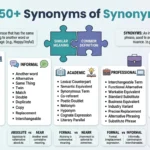
In the workplace (professional), choose alternative or equivalent to discuss word choices. These words convey practicality and precision. “Use an alternative term” is more actionable than “Use a synonym.”
With friends (personal), similar word or the same as keep the tone relaxed and relatable. These alternatives sound natural in everyday conversation.
Formal vs. Conversational Synonyms
For formal writing (reports, essays, professional documents), use cognate, equivalent, or metonym. These choices maintain the sophisticated tone expected in professional documents.
For casual conversations and texting, use similar word, same meaning, or another word. These options sound more natural and less pretentious.
Academic Synonyms
For research and essays, choose precise, authoritative words. Cognate is great for linguistic origins, paronym for similar forms, and equivalent for semantic relationships. These words sound considered and scholarly.
Using precise academic vocabulary demonstrates expertise and careful thinking. Professors and reviewers expect this level of precision.
Professional and Business Synonyms
For maximum impact in professional writing, choose alternative for practical substitutions, equivalent for equal meaning, and analogue for comparable functions. These words demonstrate confidence and professional awareness.
Business leaders respond to language that conveys clarity and precision. These synonyms project authority.
Creative and Literary Synonyms
To add nuance to your writing, choose metonym, analogue, or correlative. These terms create rhetorical devices and literary effects.
Literary writers use these alternatives to build meaning and symbolism.
Strongest to Mildest Synonyms
Mild: similar word, another word, same meaning
Moderate: synonym, alternative, equivalent
Strong: analogue, paronym, correlative
Very Strong: metonym, cognate, literal equivalent
Emotional vs. Neutral Synonyms
Emotional Synonyms: There are no emotional synonyms for “synonym.” All are neutral. Metonym and cognate have intellectual appeal.
Neutral Synonyms: Synonym, equivalent, alternative, analogue. These words simply communicate factual information without emotional coloring.
Antonyms of “Synonym”
Here are 15 genuine opposites of “synonym.”
| Antonym | Meaning | Example Sentence |
|---|---|---|
| Antonym | A word with the opposite meaning | “‘Hot’ is an antonym of ‘cold’.” |
| Opposite | A word with the opposite meaning | “‘Happy’ is the opposite of ‘sad’.” |
| Contradiction | A statement that is opposite | “His words were a contradiction of his actions.” |
| Contrary | Opposite in nature | “The contrary position was unexpected.” |
| Inverse | Opposite in order or effect | “The inverse operation is subtraction.” |
| Reverse | The opposite direction | “The reverse of the argument was presented.” |
| Counterpoint | An opposing argument | “The counterpoint was well-reasoned.” |
| Dissimilar | Not similar | “The two words are dissimilar in meaning.” |
| Divergent | Different and moving apart | “Their opinions were divergent.” |
| Disparate | Fundamentally different | “The disparate elements could not be compared.” |
| Incompatible | Not able to exist together | “The incompatible terms caused confusion.” |
| Contrast | A state of being different | “The contrast between the words was clear.” |
| Opposition | Resistance or dissent | “The opposition to the plan was strong.” |
| Different word | Not the same word | “Use a different word for variety.” |
| Unrelated | Not connected | “The unrelated terms confused the audience.” |
Comparison: “Synonym” vs Similar Words
Synonym vs. Equivalent
Main Difference: Synonym is specifically about words with similar meanings. Equivalent is about equal value or function in a broader sense.
Which Is Stronger? They are equal in strength. Equivalent has a broader application.
Which Is More Formal? Both are formal.
When to Use Each: Use synonym for word relationships. Use equivalent for value or function.
Examples:
Synonym: “Happy is a synonym of joyful.”
Equivalent: “The two plans are equivalent in cost.”
Synonym vs. Cognate
Main Difference: Synonym is about meaning. Cognate is about linguistic origin.
Which Is Stronger? They are different in function. Cognate is more technical.
Which Is More Formal? Cognate is more formal and academic.
When to Use Each: Use synonym for similar meanings. Use cognate for words with a common ancestor.
Examples:
Synonym: “Big is a synonym of large.”
Cognate: “‘Night’ and ‘Nacht’ are cognates.”
Synonym vs. Alternative
Main Difference: Synonym is about meaning. Alternative is about choice or option.
Which Is Stronger? They are different. Alternative emphasizes choice.
Which Is More Formal? Both are neutral.
When to Use Each: Use synonym for linguistic similarity. Use alternative for practical choices.
Examples:
Synonym: “Use a synonym to avoid repetition.”
Alternative: “We have an alternative solution.”
Synonym vs. Metonym
Main Difference: Synonym is about similar meaning. Metonym is about substituting something related.
Which Is Stronger? They are different. Metonym is a rhetorical device.
Which Is More Formal? Both are formal.
When to Use Each: Use synonym for meaning. Use metonym for figurative language.
Examples:
Synonym: “The word ‘big’ is a synonym of ‘large’.”
Metonym: “The White House announced the new policy.”
Synonym vs. Analogue
Main Difference: Synonym is about linguistic meaning. Analogue is about comparable function or structure.
Which Is Stronger? They are different. Analogue emphasizes comparison.
Which Is More Formal? Both are formal.
When to Use Each: Use synonym for words. Use analogue for things or systems.
Examples:
Synonym: “Happy is a synonym of joyful.”
Analogue: “The new device is an analogue of the old one.”
Synonym vs. Paronym
Main Difference: Synonym is about similar meaning. Paronym is about similar form but different meaning.
Which Is Stronger? They are different. Paronym is more technical.
Which Is More Formal? Paronym is more formal and linguistic.
When to Use Each: Use synonym for meaning. Use paronym for form.
Examples:
Synonym: “Start is a synonym of begin.”
Paronym: “‘Affect’ and ‘effect’ are paronyms.”
Common Phrases and Expressions with “Synonym”
Phrase: Synonym for
Meaning: A word or phrase that means the same as another.
Example Sentence: “Can you find a synonym for ‘good’?”
Phrase: Used as a synonym for
Meaning: Employed to mean the same as something else.
Example Sentence: “The term ‘initiative’ is used as a synonym for ‘drive’.”
Phrase: Be synonymous with
Meaning: To be so closely associated that they mean the same.
Example Sentence: “Her name is synonymous with success.”
Phrase: Synonym search
Meaning: Looking for words with similar meanings.
Example Sentence: “The synonym search results were helpful.”
Phrase: Perfect synonym
Meaning: A word with exactly the same meaning.
Example Sentence: “There is no perfect synonym for the word.”
Phrase: Near synonym
Meaning: A word with similar but not identical meaning.
Example Sentence: “Joyful is a near synonym of happy.”
Common Mistakes to Avoid
Mistake 1: Using “synonym” when you mean “antonym”.
Incorrect: “‘Hot’ is a synonym of ‘cold’.”
Better: “‘Hot’ is an antonym of ‘cold’.”
Why: Antonym means opposite.
Mistake 2: Using “synonym” for homophones.
Incorrect: “‘Their’ and ‘there’ are synonyms.”
Better: “‘Their’ and ‘there’ are homophones.”
Why: Homophones sound alike but have different meanings.
Mistake 3: Overusing “synonym” in casual conversation.
Incorrect: “What is a synonym for ‘tired’?”
Better: “What is a similar word for ‘tired’?”
Why: Similar word sounds more natural in casual conversation.
Mistake 4: Confusing “synonym” with “equivalent”.
Incorrect: “The two strategies are synonyms.”
Better: “The two strategies are equivalents.”
Why: Equivalent is for value or function.
Mistake 5: Using “synonym” for translations.
Incorrect: “The Spanish word is a synonym of the English one.”
Better: “The Spanish word is the translation of the English one.”
Why: Translation is for different languages.
Mistake 6: Using “synonym” in a negative context.
Incorrect: “Incompetence is a synonym for laziness.”
Better: “Incompetence is often associated with laziness.”
Why: This usage is too broad and judgmental.
Frequently Asked Questions
1. What are the best synonyms of “synonym”?
The best synonyms depend on your context. For formal writing, choose equivalent or cognate. And for casual conversation, use similar word or alternative. For academic writing, analogue and metonym are strong choices.
2. What are the best formal synonyms of “synonym”?
The best formal synonyms are equivalent, cognate, and analogue. These words are suitable for academic papers, professional reports, and linguistic communications.
3. What are common informal synonyms of “synonym”?
For informal settings, use similar word, same meaning, or another word. These alternatives sound more natural in everyday conversation.
4. What is another word for “synonym” in professional writing?
In professional writing, alternative is an excellent choice. It conveys practical substitution. Equivalent is also strong for semantic equality.
5. What is the difference between “synonym” and “cognate”?
While both indicate a word relationship, synonym is about similar meaning. Cognate is about shared linguistic origin. Use synonym for meaning and cognate for etymology.
6. What is the opposite of “synonym”?
The most direct opposites (antonyms) of synonym are antonym, opposite, and contrary. These words describe words or concepts with opposite meanings.
Conclusion
“Synonym” is a foundational and essential word for describing word relationships and similar meanings. The term is neutral and widely accepted in most contexts, yet it can sound too technical in some situations or too broad in others. The best choice among the synonyms of synonym depends entirely on your audience, tone, and purpose. Remember, no single word works perfectly in every situation. Your goal is to choose the term that communicates your message with the most clarity and impact. A practical tip for your vocabulary growth is to pay attention to how different fields describe word relationships and practice using these terms in your writing.
Discover More:
- 50+ Synonyms of Propaganda: Meanings, Uses, Examples, and Best Alternatives 2026
- 50+ Synonyms of Justify: Meanings, Uses, Examples, and Best Alternatives 2026

Amelia Brooks is a professional content writer and digital publishing specialist with a passion for creating clear, engaging, and informative content. She has extensive experience writing about technology, business, lifestyle, and online services.