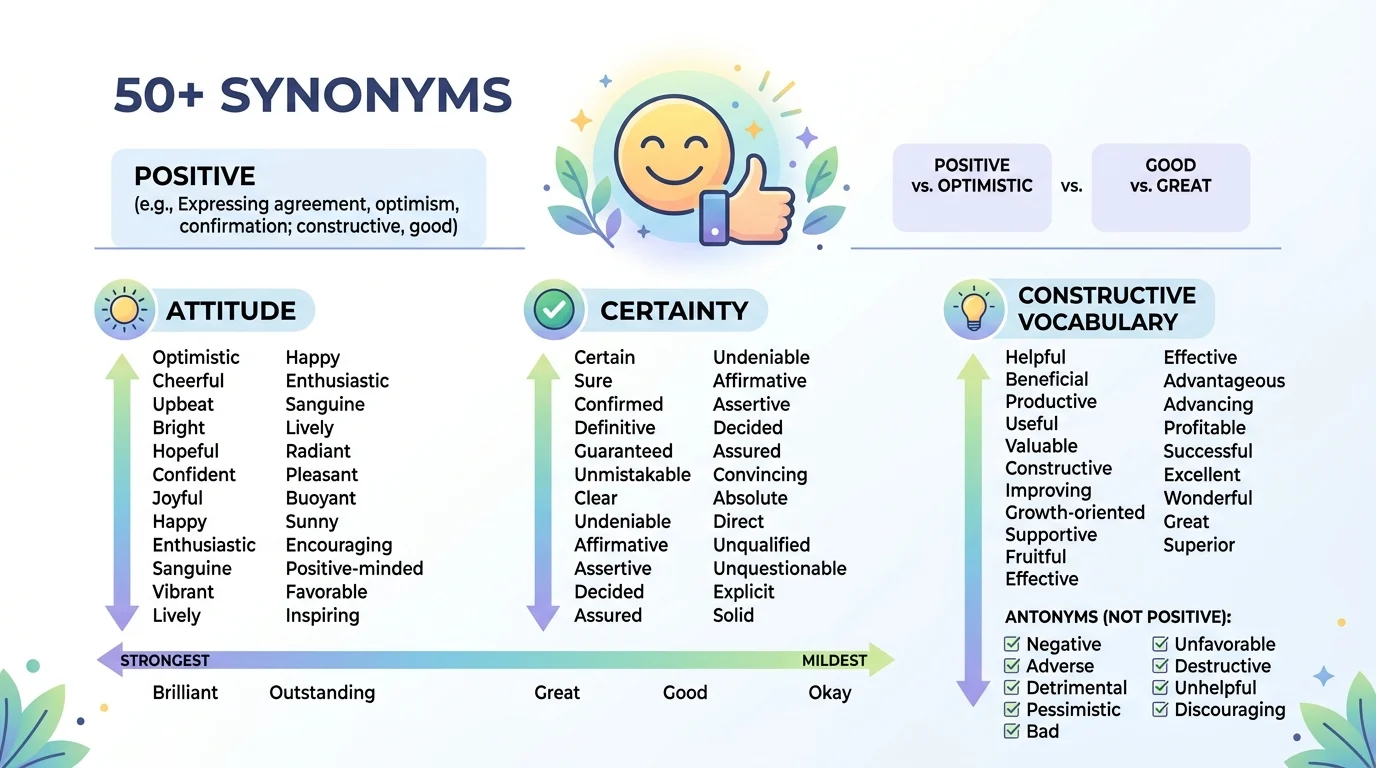
Have you ever needed to describe an optimistic attitude, a confirmed result, or a constructive outcome but felt that “good” or “happy” was too simple? You want to capture certainty, hope, or beneficial qualities, and the word “positive” comes to mind. Choosing the right synonym for “positive” can transform a vague statement into a precise expression of confidence, approval, or helpfulness. This guide explores the best synonyms of positive, explaining exactly which word to use and when.
Quick Ans: “Positive” means optimistic, confident, constructive, or definite. For an optimistic attitude, choose hopeful or upbeat. For a confirmed result, use certain or definite. For a constructive outcome, use beneficial or favorable. In medical contexts, use confirmed. For a confident mindset, use assured.
Meaning, Tone, and Context
Understanding the core meaning of “positive” is the first step to using it effectively.
Simple Definition: Expressing or implying optimism, certainty, or affirmation; constructive or beneficial in nature.
Part of Speech: Adjective.
Overall Tone: Positive and affirming. It indicates confidence, hope, or beneficial qualities.
Formality Level: Neutral to formal. The word is appropriate in most contexts.
Common Uses: Native English speakers use it to describe attitudes (“She has a positive outlook”), test results (“The test was positive”), feedback (“We received positive reviews”), and contributions (“He made a positive impact”).
Word Forms: Related words include the noun positivity, the adverb positively, and the noun positiveness.
When and How to Use “Positive”
“Positive” is the perfect choice when you want to express optimism, certainty, or constructive qualities. Here are seven realistic examples.
Professional: “The team maintained a positive attitude despite the setbacks.”
Academic: “The study yielded positive results that supported the hypothesis.”
Workplace: “We received positive feedback from our clients.”
Personal: “She has a positive outlook on life that inspires others.”
Email: “I wanted to share some positive news about the project.”
Resume: “Made a positive contribution to the company’s growth.”
Social Media: “Surround yourself with positive people who lift you up.”
Best Synonyms of “Positive”
No synonym is identical in every situation. Here is your guide to the best replacement for “positive” based on your writing context.
For Optimism and Attitude
Hopeful: Suggests optimism about the future. “She remained hopeful despite the challenges.”
Upbeat: Casual and energetic. “The team was upbeat after the win.”
Optimistic: Formal and clear. “He has an optimistic view of the economy.”
Cheerful: Emphasizes happiness. “Her cheerful demeanor brightened the room.”
For Certainty and Definiteness
Certain: Strong confidence. “I am certain of the outcome.”
Definite: Clear and unambiguous. “We need a definite answer by Friday.”
Confident: Belief in oneself or the outcome. “She was confident in her abilities.”
Assured: Formal and certain. “His assured manner put everyone at ease.”
For Constructive and Beneficial Qualities
Beneficial: Producing good results. “Exercise is beneficial for health.”
Favorable: Advantageous conditions. “The reviews were favorable.”
Constructive: Helpful and improving. “We value constructive criticism.”
Productive: Achieving results. “It was a productive meeting.”
When Not to Use “Positive”
Using “positive” can sound wrong or awkward in certain situations.
When You Mean “Good”: “Positive” is stronger than “good” but can sound formal.
Better Choice: Good or great. “The results were great.”
When You Mean “Sure”: “Positive” can mean certain. In casual conversation, use “sure.”
Better Choice: Sure or certain. “I am sure about it.”
When It Sounds Too Clinical: In medical contexts, “positive” can mean the presence of disease.
Better Choice: Confirmed. “The test confirmed the diagnosis.”
Words Commonly Confused With “Positive”
Word: Optimistic
Difference: Focuses on hopefulness. “Positive” is broader.
When to Use: Use it for future outlook.
Example: “She is optimistic about the future.”
Word: Confident
Difference: Belief in oneself. “Positive” can mean certain.
When to Use: Use it for self-assurance.
Example: “He is confident in his skills.”
Word: Certain
Difference: Complete surety. “Positive” can imply certainty but is broader.
When to Use: Use it for definite knowledge.
Example: “I am certain of the facts.”
Word: Beneficial
Difference: Producing good effects. “Positive” is broader.
When to Use: Use it for helpful things.
Example: “The changes were beneficial.”
Word: Favorable
Difference: Advantageous or approving. “Positive” is broader.
When to Use: Use it for conditions or opinions.
Example: “The conditions were favorable.”
Best Synonyms of “Positive” by Context
| Context | Best Synonym | Why It Works | Example |
|---|---|---|---|
| Attitude | Optimistic | Emphasizes hope | “She has an optimistic outlook.” |
| Attitude | Upbeat | Casual and energetic | “The team was upbeat.” |
| Certainty | Definite | Clear and unambiguous | “We need a definite answer.” |
| Certainty | Confident | Belief in outcome | “She was confident of success.” |
| Results | Favorable | Advantageous | “The reviews were favorable.” |
| Results | Beneficial | Producing good | “The changes were beneficial.” |
| Feedback | Constructive | Helpful and improving | “We value constructive feedback.” |
| Medical | Confirmed | Clinical and precise | “The test was confirmed positive.” |
How to Choose the Best Synonym of “Positive”
Choosing the right word is a simple decision. Answer these questions.
What type of positivity am I describing? For attitude, use optimistic or upbeat. And For certainty, use certain or definite. For results, use favorable or beneficial.
What is my audience? For a formal report, use favorable or constructive. For a friend, use upbeat or good.
What is my purpose? Are you encouraging, confirming, or describing? The correct synonym depends entirely on this.
What is the emotional strength? Optimistic and hopeful are stronger for attitude. Favorable is neutral. Pick the one that matches your message.
Real Life Examples of “Positive”
School: Basic: “The student has a positive attitude.” Improved: “The student has an optimistic attitude.”
College: Basic: “The results were positive.” Improved: “The results were favorable.”
Workplace: Basic: “We received positive feedback.” Improved: “We received constructive feedback.”
Business: Basic: “The market response was positive.” Improved: “The market response was favorable.”
Email: Basic: “I have positive news.” Improved: “I have encouraging news.”
Conversation: Basic: “She is positive about it.” Improved: “She is optimistic about it.”
Storytelling: Basic: “The ending was positive.” Improved: “The ending was hopeful.”
Top 10 Synonyms of “Positive”
| Synonym | Simple Meaning | Best Used For | Example Sentence |
|---|---|---|---|
| Optimistic | Hopeful about the future | Attitude and outlook | “She is optimistic about the future.” |
| Upbeat | Cheerful and energetic | Casual and personal contexts | “The team was upbeat after the win.” |
| Hopeful | Feeling hope | Emotional and personal contexts | “He remained hopeful despite the odds.” |
| Confident | Belief in oneself | Professional and personal contexts | “She was confident in her abilities.” |
| Certain | Sure and definite | Formal and factual contexts | “I am certain of the outcome.” |
| Definite | Clear and unambiguous | Formal and precise contexts | “We need a definite answer.” |
| Beneficial | Producing good results | Health and business contexts | “Exercise is beneficial for health.” |
| Favorable | Advantageous and approving | Business and general contexts | “The reviews were favorable.” |
| Constructive | Helpful and improving | Feedback and criticism contexts | “We value constructive criticism.” |
| Productive | Achieving results | Work and business contexts | “It was a productive meeting.” |
Synonyms of “Positive” by Usage
Professional vs. Personal Synonyms
In the workplace (professional), choose favorable, constructive, or productive. With friends (personal), use upbeat, good, or hopeful.
Formal vs. Conversational Synonyms
For formal writing, use favorable, beneficial, or constructive. For casual conversation, use upbeat, good, or great.
Academic Synonyms
For research and essays, use favorable, significant, or beneficial.
Professional and Business Synonyms
For business writing, use favorable, productive, or constructive.
Creative and Literary Synonyms
For creative writing, use hopeful, bright, or uplifting.
Strongest to Mildest Synonyms
Mild: good, okay, fine
Moderate: positive, upbeat, hopeful
Strong: optimistic, confident, beneficial
Very Strong: certain, definite, assured
Emotional vs. Neutral Synonyms
Emotional Synonyms: Hopeful, uplifting, inspiring. These words evoke feeling.
Neutral Synonyms: Certain, definite, favorable. These words communicate facts.
Antonyms of “Positive”
| Antonym | Meaning | Example Sentence |
|---|---|---|
| Negative | Expressing denial or opposition | “The feedback was negative.” |
| Pessimistic | Expecting bad outcomes | “He has a pessimistic view.” |
| Doubtful | Uncertain | “The outcome is doubtful.” |
| Uncertain | Not sure | “The results are uncertain.” |
| Harmful | Causing damage | “The substance is harmful.” |
| Unfavorable | Not advantageous | “The conditions were unfavorable.” |
| Destructive | Causing damage | “The behavior was destructive.” |
| Gloomy | Dark and depressing | “The mood was gloomy.” |
| Hopeless | Without hope | “The situation seemed hopeless.” |
| Detrimental | Causing harm | “The policy was detrimental.” |
| Adverse | Unfavorable | “The adverse effects were noted.” |
| Cynical | Distrustful | “He has a cynical attitude.” |
| Defeatist | Expecting defeat | “His defeatist attitude was discouraging.” |
| Unproductive | Not achieving results | “The meeting was unproductive.” |
| Counterproductive | Hindering progress | “The strategy was counterproductive.” |
Comparison: “Positive” vs Similar Words
Positive vs. Optimistic
Main Difference: “Optimistic” specifically means hopeful about the future. “Positive” is broader.
Which Is Stronger? “Optimistic” is more specific.
Which Is More Formal? Both are formal.
When to Use Each: Use “optimistic” for future outlook. Use “positive” for general affirmation.
Examples:
Positive: “The results were positive.”
Optimistic: “She is optimistic about the future.”
Positive vs. Confident
Main Difference: “Confident” means belief in oneself. “Positive” can mean certain.
Which Is Stronger? “Confident” is about self-assurance.
Which Is More Formal? Both are formal.
When to Use Each: Use “confident” for self-belief. Use “positive” for certainty.
Examples:
Positive: “I am positive about the outcome.”
Confident: “She is confident in her abilities.”
Positive vs. Certain
Main Difference: “Certain” means completely sure. “Positive” can imply certainty but is broader.
Which Is Stronger? “Certain” is stronger for surety.
Which Is More Formal? Both are formal.
When to Use Each: Use “certain” for definite knowledge. Use “positive” for general affirmation.
Examples:
Positive: “The test was positive.”
Certain: “I am certain of the facts.”
Positive vs. Beneficial
Main Difference: “Beneficial” means producing good effects. “Positive” is broader.
Which Is Stronger? “Beneficial” is more specific.
Which Is More Formal? Both are formal.
When to Use Each: Use “beneficial” for helpful things. Use “positive” for general affirmation.
Examples:
Positive: “The feedback was positive.”
Beneficial: “Exercise is beneficial.”
Positive vs. Favorable
Main Difference: “Favorable” means advantageous. “Positive” is broader.
Which Is Stronger? “Favorable” is more specific.
Which Is More Formal? Both are formal.
When to Use Each: Use “favorable” for conditions and opinions. Use “positive” for general affirmation.
Examples:
Positive: “The response was positive.”
Favorable: “The conditions were favorable.”
Common Phrases and Expressions with “Positive”
Phrase: Positive attitude
Meaning: An optimistic outlook.
Example Sentence: “A positive attitude can help overcome challenges.”
Phrase: Positive feedback
Meaning: Approving or constructive comments.
Example Sentence: “The teacher gave positive feedback on the essay.”
Phrase: Positive impact
Meaning: A beneficial effect.
Example Sentence: “The program had a positive impact on the community.”
Phrase: Positive result
Meaning: A favorable outcome.
Example Sentence: “The experiment yielded positive results.”
Phrase: Positive reinforcement
Meaning: Encouraging behavior through rewards.
Example Sentence: “Positive reinforcement works better than punishment.”
Common Mistakes to Avoid
Mistake 1: Using “positive” when you mean “good”.
Incorrect: “The food was positive.”
Better: “The food was good.”
Why: “Positive” is not used for food quality.
Mistake 2: Using “positive” in casual conversation.
Incorrect: “I am positive about the party.”
Better: “I am excited about the party.”
Why: “Positive” sounds too formal in casual conversation.
Mistake 3: Using “positive” when you mean “certain”.
Incorrect: “I am positive of the answer.”
Better: “I am certain of the answer.”
Why: “Certain” is more natural for surety.
Mistake 4: Using “positive” in medical contexts without clarification.
Incorrect: “The test was positive.”
Better: “The test confirmed the presence of the virus.”
Why: “Positive” in medical contexts can be alarming. Clarify.
Mistake 5: Overusing “positive” in writing.
Incorrect: “The positive results were positive for the positive team.”
Better: “The favorable results were encouraging for the motivated team.”
Why: Variation in vocabulary demonstrates writing sophistication.
Frequently Asked Questions
1. What are the best synonyms of “positive”?
The best synonyms depend on your context. For attitude, choose optimistic or upbeat. And For certainty, use certain or definite. For results, use favorable or beneficial.
2. What are the best formal synonyms of “positive”?
The best formal synonyms are favorable, beneficial, and constructive. These words are suitable for academic papers and professional reports.
3. What are common informal synonyms of “positive”?
For informal settings, use upbeat, good, or great. These alternatives sound more natural in everyday conversation.
4. What is another word for “positive” in professional writing?
In professional writing, favorable or constructive are excellent choices. Productive is also strong for meetings and results.
5. What is the difference between “positive” and “optimistic”?
“Optimistic” specifically means hopeful about the future. “Positive” is broader and can mean certain, constructive, or affirming.
6. What is the opposite of “positive”?
The most direct opposites (antonyms) of positive are negative, pessimistic, and doubtful.
Conclusion
“Positive” is a versatile and essential word for describing optimism, certainty, and beneficial qualities. The best choice among the synonyms of positive depends entirely on your audience, tone, and purpose. Remember, no single synonym works perfectly in every situation. Your goal is to choose the word that communicates your message with the most clarity and impact. A practical tip for your vocabulary growth is to pay attention to how writers describe optimism and certainty and practice using different synonyms in your writing.









